Tag Archives: Sir Arthur Conan Doyle

6 Famous Authors With Shocking Beliefs | Inverse

Source: 6 Famous Authors With Shocking Beliefs | Inverse

When we fall in love with a novel, we sometimes believe we come to know its author just by reading the book. From reading the Harry Potter novels one can easily conclude that its author — J.K. Rowling — is intolerant of oppression, politically progressive, a strong believer in diversity, and most certainly, British. All of these things about Rowling are overwhelmingly true, though if we found out she hated children, we’d probably be totally scandalized. (She doesn’t, thankfully).

Similarly, if you read Robert A. Heinlein’s Stranger in a Strange Land you might erroneously assume the author was a free-love hippie, when in fact, Heinlein’s libertarian and conservative views couldn’t be further from the tone of that particular novel. With Robert Heinlein and Stranger in a Strange Land, it’s almost as if the novel’s free-love protagonist offers a mirror image to the novelist — it’s Dr. Jekyll to a Mr. Hyde, say — something that is true of other writers on this list. Here are six super-famous writers with beliefs that are either inversions of their literary reputations, or just straight-up fascinating.

Philip K. Dick Thought He Was a Robot and, Also, the Spirit of Elijah

Okay, so this one isn’t too shocking. In addition to believing he was contacted by intelligences from beyond, the prolific and visionary sci-fi writer Philip K. Dick also toyed with the idea that he may, in fact, have been a robot. While the events of many of his novels (notably Do Androids Dream of Electric Sheep?) certainly check with this passing fancy of Dick’s, he also flirted with the idea that he was possessed by the spirit of the biblical prophet Elijah. So, next time you’re at a Seder, ask if you can leave something out for Philip K. Dick and see if anyone gets it.

Sir Arthur Conan Doyle Believed in Fairies

In Conan Doyle’s short story “The Adventure of the Sussex Vampire” the protagonist — the great Sherlock Holmes — says, “This Agency stands flat-footed upon the ground and there it must remain. The world is big enough for us. No ghost need apply.” Throughout the 56 short stories and four novels chronicling the adventures of Sherlock Holmes, never once does the stoic detective flirt with a belief in the supernatural or paranormal. And yet, late in his life, the creator of the uber-rational Sherlock Holmes, Sir Arthur Conan Doyle himself, asserted frequently that he had seen fairies and other supernatural creatures. Perhaps when Conan Doyle attempted to kill off Sherlock Holmes, he was attempting to destroy his rational side to have more fun with fairy thoughts. Either that, or fairies are totally real.

Anne Rice Found God

The author of Interview With the Vampire briefly became extremely pious, and even authored Christian texts (including her novel Christ the Lord: Out of Egypt). While the steamy and grotesque nature of her vampire books seems to be in stark opposition to traditional Christianity, as of 2010, Anne Rice maintains that she is still “committed to Christ.” But to be clear, Rice did officially leave the Catholic Church because she felt that being a “Christian,” was “quarrelsome” and “hostile.” It’s unclear if there are any parallels between her feelings about quarrelsome religious folks and the frequently quarrelsome vampire, Lestat.

James Joyce Thought Radio Controlled the Weather

In Sylvia Beach’s excellent memoir, Shakespeare and Company, the publisher and proprietor of the famous Parisian bookstore recounts her fascinating dealings with the late author of Ulysses, James Joyce. One interesting tidbit was Joyce’s growing impatience with the rise of radios in culture. Specifically, Joyce thought there was obviously some kind of correlation between the surge of radios use and rainstorms in France. Climate change deniers, take that! Or actually, don’t. Let James Joyce have it.

Hemingway Wanted to Work for the KGB?
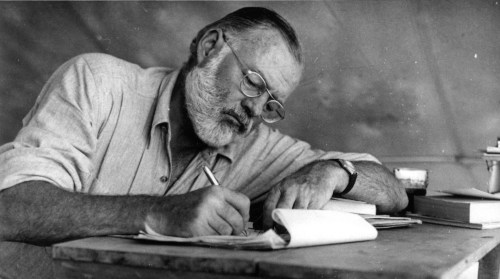
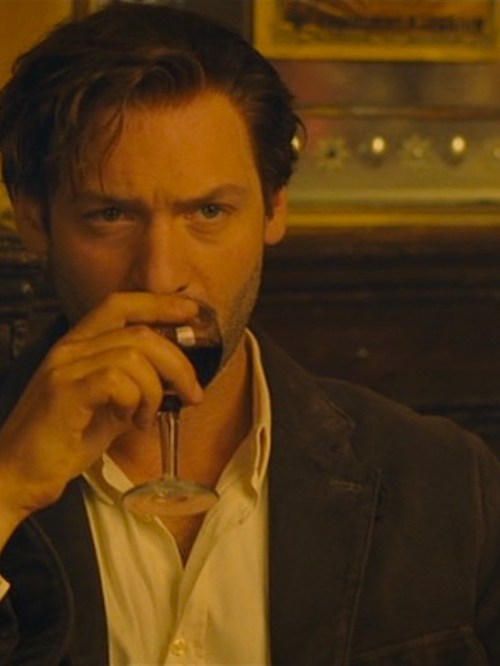
While this one is disputed, there is some indication that Ernest Hemingway was recruited by the KGB in 1941 and that he was a secret agent named “Argo.” The only problem is that apparently Hemingway was really bad at being a double agent — assuming he really wanted to be one — as he never really supplied the KGB with any good intelligence. While we tend to think of Hemingway as an American man of his time (as he’s portrayed in Midnight in Paris), his real-life political leanings were certainly all over the place. While it might be surprising that Hemingway had communist beliefs in the ‘40s, it’s not totally implausible.

Stephen King Hates Adverbs

Stephen King may be the undisputed master of horror, but there’s only one thing truly fears: adverbs. King maintains that adverbs were created with “the timid writer in mind.” He may be an extremely creative guy, but I don’t want to even think about how many grotesque and sickening adverbs I’ve overzealously employed to get my points across throughout the years.

Leave a comment

Filed under 2017, authors

10 Little Known Facts About Sir Arthur Conan Doyle

Source: https://www.goodreads.com/blog/show/520-10-little-known-facts-about-sir-arthur-conan-doyle?fb_ref=Default

1. He compared Sherlock Holmes—arguably his greatest creation—to pâté de foie gras.
…And Doyle really hated pâté de foie gras. He told a friend, “I have had such an overdose of [Holmes] that I feel towards him as I do towards pâté de foie gras, of which I once ate too much, so that the name of it gives me a sickly feeling to this day.”

2. We live in a world with Doyle’s fiction because no one wanted him as their doctor.
If at first you don’t succeed at being a doctor, become a world-famous novelist! After getting his medical degree from the University of Edinburgh Medical School and serving as a ship’s surgeon, Doyle opened his own practice in Southsea. Hardly any patients came, so he began writing fiction in his free time.

3. Doyle and Peter Pan author J.M. Barrie were on the same cricket team.
The team was called the Allah-Akabarries, a combination of Barrie’s name and an Arabic phrase meaning, “May the Lord help us.” The two men met at university and remained lifelong friends.

4. He once bought a car without ever having driven one.
Best way to learn, right? Doyle was one of Britain’s early prominent motorists, and he quickly took to the emerging form of transport, entering an international road competition in 1911.

5. He spent a million dollars trying to convince the world that fairies were real.
Not only did Doyle believe fairies existed, he worked pretty tirelessly to make other people believe too. His million went to promoting the authenticity of the infamous Cottingley Fairy photographs—a hoax, if you’re a skeptic, and not a true believer like Doyle—and he later wrote a book called The Coming of the Fairies.

To read the rest, go to: https://www.goodreads.com/blog/show/520-10-little-known-facts-about-sir-arthur-conan-doyle?fb_ref=Default

Leave a comment

Filed under 2015, writers

Writing tip Wednesday: writerly thinking

How a writer thinks—elementary my dear

by DON WILLIAMS

During a holiday sometime back, the Williams clan, including in-laws, outlaws and assorted friends, gathered to play Trivial Pursuit.

A competitive lot, we turn such games into raucous entertainment. Lots of praise, derision and laughter pertain, not necessarily in that order.

The games were close and the questions difficult, prompting snorts and catcalls, and three of the teams had flamed out by the time my friend the writer’s turn came to answer a question.

My sister Rebecca drew a card and read:

Sherlock Holmes turned into the gate at 221 Baker St, stepped inside the door and climbed ___ steps to his second story flat. How many steps did he climb?

There was a collective groan.

“Bury that one,” a brother-in-law said, even as Rebecca was discarding the question. “He’ll never get that.”

“Hold on!” My friend held up his right hand. “I’ve only read one Arthur Conan Doyle book, and it wasn’t Sherlock Holmes, but I’ll take a shot at that.”

“No way. How are you going to guess that one?”

“Elementary my dear Watson,” my friend replied. “In the time-honored Holmes-ian way. Deductive Reasoning.”

“That’ll be the day,” my brother Tim said.

“Listen up,” said my friend. “It has to be at least 10 steps to Sherlock’s apartment, even if the risers are relatively high, say, 10 inches, because they have to clear that first-floor apartment’s ceiling. And the answer likely won’t be more than, say, 20 steps, even if the risers are short, because that would put the esteemed detective’s pad more than ten or twelve feet above street level. See? Already I’ve reduced the universe of possible answers to 10.”

“Yeah, yeah,” my brother Rodney said.

“So,” my friend continued, “the answer lies somewhere between 10 and 20. Let’s take them one by one.”

“Better hurry,” said my sister Kathleen, eyeing the sandglass.

“OK. Ten is a lazy number that would make the author appear lazy too, so a writer like Doyle would never use it. Not here. Nor can it be 11, because that’s a lucky number, mildly distracting and therefore intrusive. More importantly, Sherlock’s a deductive thinker, so the author wouldn’t suggest, even subliminally, that his detective’s success owes anything to a lucky number. Number 12? Again, distracting. Sir Doyle wouldn’t want his readers to be thinking, even subconsciously, about Twelve Apostles or even 12 months. Unlucky thirteen? Similary distracting.”

“Time’s almost up,” said Kathleen.

Adventures of Sherlock Holmes

Step by step deduction led to the right conclusion.

I could see my friend faintly flush, but he continued in a calm if faster voice. “Fourteen? Now there’s a Plain Jane. No writer worth his salt would dull down a book with such tasteless seasoning, even if it is red.”

“Red?”

“See? That could be a subjective thing. And 15? Again, like 10, it’s too pat and pregnant. Makes the author appear lazy.”

“Sixteen?” a brother-in-law asked, eyeing the fleeting sands.

“Like 14, another Plain Jane, even if it is black,” my friend added.

“Seventeen?”

My friend smiled. You could almost hear bells going off. “Seventeen seems random,” he said, savoring the moment, “but it’s actually quite sexy. That unobtrusive 7, peeking from behind the place-holding 1, is subtly mystical, alluring even, hardly rising even to the level of the subliminal, yet there it is.”

Rebecca rolled her eyes. “So, is that your final answer?” she asked in a bored voice, as she glanced at the card, but we knew her attitude was all bluff.

“Yesssss,” my friend whispered aloud, calmly assured. “Seventeen it is. By far the most interesting number between 10 and 20.”

Her eyes widened. “You’re right. How did you do that?” she asked as she flashed the card, answer-side up, on the table.

“Elementary, my dear. I’m a writer.”

8888
Don Williams is a prize-winning columnist, short story writer, sometime TV commentator and the founding editor and publisher of New Millennium Writings, an annual anthology of stories, essays and poems. His awards include a National Endowment for the Humanities Journalism Fellowship at the University of Michigan, a Golden Presscard Award, the Malcolm Law Journalism Prize and many others. He was recently inducted into the East Tennessee Writers Hall of Fame. He is at work on a novel and a book of journalism..

Need a speaker, panelist, tv commentator or teacher for your group or to lead a writing workshop in your town? E-mail donwilliams7@charter.net, or visit www.NewMillenniumWritings.com. New Millennium Writings is holding a writing contest for fiction, non-fiction, and poetry that you can still enter. Deadline is July 31, 2012.

Leave a comment

Filed under Thinking like a writer, writing tip, Writing Tip Wednesday