Tag Archives: science fiction

John Scalzi, Science Fiction Writer, Signs $3.4 Million Deal for 13 Books

Mr. Scalzi said he hoped books like “Lock In” could draw more readers toward science fiction, since many, he said, are still “gun-shy” about the genre.

By JOHN SCHWARTZ

Source: http://www.nytimes.com/2015/05/25/business/media/science-fiction-writer-signs-a-3-4-million-deal.html?ref=books&_r=2

John Scalzi, a best-selling author of science fiction, has signed a $3.4 million, 10-year deal with the publisher Tor Books that will cover his next 13 books.

Mr. Scalzi’s works include a series known as the “Old Man’s War” and the more recent “Redshirts,” a Hugo-award-winning sendup of the luckless lives of nonfeatured characters on shows like the original “Star Trek.” Three of his works are being developed for television, including “Redshirts” and “Lock In,” a science-inflected medical thriller that evokes Michael Crichton. Mr. Scalzi’s hyper-caffeinated Internet presence through his blog, Whatever, has made him an online celebrity as well.

Mr. Scalzi approached Tor Books, his longtime publisher, with proposals for 10 adult novels and three young adult novels over 10 years. Some of the books will extend the popular “Old Man’s War” series, building on an existing audience, and one will be a sequel to “Lock In.” Mr. Scalzi said he hoped books like “Lock In” could draw more readers toward science fiction, since many, he said, are still “gun-shy” about the genre.

Patrick Nielsen Hayden, the executive editor for Tor, said the decision was an easy one. While Mr. Scalzi has never had a “No. 1 best seller,” he said, “he backlists like crazy.”

“One of the reactions of people reading a John Scalzi novel is that people go out and buy all the other Scalzi novels,” Mr. Nielsen Hayden said.

He said Mr. Scalzi sells “a healthy five-figure number of his books every month,” and that he “hasn’t even begun to reach his full potential audience.”

Science fiction films like “2001: A Space Odyssey” and “Star Wars” have been considered popular classics for decades, “but there’s a lot of work to be done,” Mr. Scalzi said, in bringing readers to the genre. He said the long-term contract would allow him to continue experimenting with different forms of publishing, including online serialization, a technique he has tried with some success.

Mr. Scalzi, who lives in Ohio, said he was still trying to come to grips with the size and scope of the deal. He said his wife, Kristine, had kept his ego from going supernova.

“My celebration, personally, has just been standing around,” exclaiming with profane expressions of delight, he said. “And my wife saying, ‘Yes, now go take out the trash.’ ”
Leave a comment

Filed under 2015, writer

Monday morning writing joke: “Dented erudition”

There once was a man of erudition /

who took to writing science fiction. /

His thoughts were transcendent, /

his paragraphs perfectly indented, /

but still something got lost in transmission.

1 Comment

Filed under 2015, Monday morning writing joke

Photo finish Friday: “Shameless self-promotion, part2”

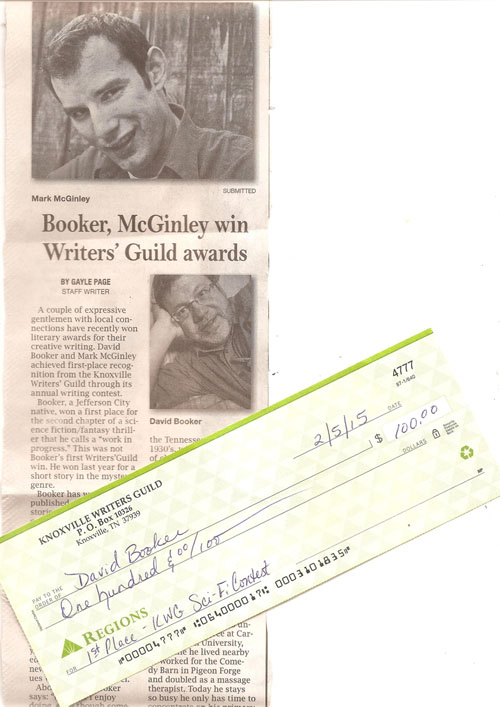
After some delays, the 1st Place Check for the Knoxville Writers' Guild Science Fiction and Fantasy writing contest arrived. The 2015 KWG writing contest is now accepting submissions. Go to http://www.knoxvillewritersguild.org/contest.

After some delays, the 1st Place Check for the Knoxville Writers’ Guild Science Fiction and Fantasy writing contest arrived. The 2015 KWG writing contest is now accepting submissions. Go to http://www.knoxvillewritersguild.org/contest.

1 Comment

Filed under 2015, photo by David E. Booker, Photo Finish Friday

Literary or Genre fiction?

How Genre Fiction Became More Important Than Literary Fiction

The book war is over. The aliens, dragons, and detectives won.

Source: http://www.esquire.com/entertainment/books/a33599/genre-fiction-vs-literary-fiction/?fb_ref=Default

Literature or Genre fiction?

Literature or Genre fiction?

The writers Kazuo Ishiguro and Ursula K. Le Guin are having a highly old-fashioned debate about the distinction between literary and genre fiction. Ishiguro started it, in an interview with The New York Times about his latest novel The Buried Giant, when he asked “Will readers follow me into this? Will they understand what I’m trying to do, or will they be prejudiced against the surface elements? Are they going to say this is fantasy?” Le Guin didn’t like the tone of that last remark and fired back, “Well, yes, they probably will. Why not? It appears the author takes the word for an insult.” Now Ishiguro has defended himself, rather meekly, by saying, “I am on the side of the pixies and the dragons.” The whole spectacle is very odd. It sounds like a debate from another era. What writer today would feel any need whatsoever to separate him or herself from fantasy or indeed any other genre? If anything, the forms of genre—science fiction, fantasy, the hardboiled detective story, the murder mystery, horror, vampire, and werewolf stories—have become the natural homes for the most serious literary questions.

Only idiots or snobs ever really thought less of “genre books” of course. There are stupid books and there are smart books. There are well-written books and badly written books. There are fun books and boring books. All of these distinctions are vastly more important than the distinction between the literary and the non-literary. Time has a tendency to demolish old snobberies. Once upon a time, Conan Doyle was embarrassed by the Sherlock Holmes stories; he wanted to be remembered for his serious historical novels. Jim Thompson’s books—considered straight pulp during his lifetime—are obviously as dense and layered and confounding as great literature. Correction: They are great literature. Who really thinks, today, that Stanislaw Lem isn’t a genius, that he’s “just a science fiction writer”?

Rest of the article: http://www.esquire.com/entertainment/books/a33599/genre-fiction-vs-literary-fiction/?fb_ref=Default

1 Comment

Filed under 2015, genre, literature

Indignation and hope

Physicist, inventor, bestselling author, and futurist David Brin talks about how problems are solved in today’s society, how we should approach things that frustrate us, and why and when we should speak up. How do we combat the cynicism that prevents us from acting to solve our problems? And how do we handle the anger that comes with them?

Published June 20, 2014

1 Comment

Filed under 2015

Some shameless self-promotion

Booker, McGinley win Writers’ Guild awards

Source: http://www.standardbanner.com/news/booker-mcginley-win-writers-guild-awards/article_87118cd4-bd2b-11e4-ba8a-b37639bc4d99.html

By Gayle Page – Staff Writer

David E. Booker -- lost in the cosmos, as always.

David E. Booker — lost in the cosmos, as always.

A couple of expressive gentlemen with local connections have recently won literary awards for their creative writing. David Booker and Mark McGinley achieved first-place recognition from the Knoxville Writers’ Guild through its annual writing contest.

Booker, a Jefferson City native, won a first place for the second chapter of a science fiction/fantasy thriller that he calls a “work in progress.” This was not Booker’s first Writers’ Guild win. He won last year for a short story in the mystery genre.

Booker has written and published several short stories, and he has been a contributor to a few area newspapers, including the Morristown Citizen Tribune.

He earns his living as a writer, currently doing technical writing for Y-12. Earlier, he did technical and promotional consumer writing for Phillips Electronics (formerly Magnavox), and has done some promotional writing for Log Home magazines, as well. For the past three years Booker has served as editor of his neighborhood newsletter, and he continues working on his novel.

About writing Booker says: “It’s what I enjoy doing, even though sometimes I sit frustrated in front of a blank screen.” He is a long-time member of the Knoxville Writers’ Guild, and invites other interested writers to join and enjoy the support of an active, dedicated and diverse writing community.

Mark McGinley, another former resident of Jefferson City who is now Assistant Professor of Theater and Technical Director of Stage Design at Lincoln Memorial University, is also a winner of the Knoxville Writers’ Guild 2014 contest.

McGinley’s writing primarily focuses on his work as a playwright. His winning entry “Still Waters,” is a one-act play set in the Tennessee hills in the 1930’s, with a ragtag cast of characters and a moonshine theme. It hasn’t been performed on stage yet, but whenever that happens, the 32-page script will take actors about 30 minutes to execute.

He has had one play entitled “Sold” performed by a theater workshop group (now disbanded), but McGinley still has plenty of other ideas and plays he hopes to produce. It’s possible that one of his plays will be performed at the Tiger Lily Theater in Knoxville, in April.

McGinley earned his undergraduate degree at Carson-Newman University, and while he lived nearby he worked for the Comedy Barn in Pigeon Forge and doubled as a massage therapist. Today he stays so busy he only has time to concentrate on his primary vocation, which is theater. He received his graduate degree, a masters in theater design and stage combat, from Louisiana Tech.

About writing McGinley says: “It’s hard work until you come up with an idea that burns inside of you until you put it on a page. Then it’s more work, work, work.”

Of course, he would never want to do anything else.
Finishing first earned Booker and McGinley $100 each in prize money. Aspiring writers who might be interested in joining the Knoxville Writers Guild are invited to go online to http://www.knoxvillewritersguild.org and see what they have to offer, or write to them for an informational brochure, at Knoxville Writers’ Guild, P.O. Box 10326, Knoxville TN 37939-032.

Leave a comment

Filed under 2015, Self-promotion

An Interview With Margaret Atwood

The acclaimed author on hope, science, and writing about the future.

By Ed Finn

Source: http://www.slate.com/articles/technology/future_tense/2015/02/margaret_atwood_interview_the_author_speaks_on_hope_science_and_the_future.single.html

Margaret Atwood

Margaret Atwood

Climate fiction, or “cli fi,” can be a dreary genre. Storytellers like to make a grim business of climate change, populating their narratives with a humorless onslaught of death, destruction, drowned monuments, and starving children. Margaret Atwood is the conspicuous exception, somehow managing to tackle the subject, including these familiar elements, with deadpan wit and an irreverent playfulness, making it both more interesting and believable. The flood is coming, her MaddAddam trilogy promises, but there is hope.

Atwood’s intensely literary, human focus on environmental issues and the future of the planet is shaping a more optimistic vision of cli fi, one that sidesteps the blame games and the “will-they, won’t-they” battles over carbon emissions. Her response is clear and compelling: The planet is changing. We need creativity, ambition, and some powerful new stories to understand how we can change with it.

My colleagues and I invited Atwood to Arizona State University in November to help launch a new project about these challenges, the Imagination and Climate Futures Initiative. (Disclosure: ASU is a partner with Slate and New America in Future Tense.) Our conversation was inspired by the idea that an effective response to what Atwood calls the “everything change” will take more than better batteries and lightbulbs (though we’ll need them too). To answer the challenge, we need to think much bigger about what it means to be human in the era when we dominate every corner of this world.

Last fall, you became the first author to submit work to the Future Library project—and no one will be able to read that story until 2114.

The Future Library project is something thought up by a conceptual artist called Katie Paterson. She was approached by the Oslo Library in Norway, which is building a new facility, and it wanted a special thing. What she came up with was Future Library. A forest has been planted in Norway that will grow for 100 years. Each one of those 100 years, one author will be invited to contribute something to the future library in a sealed box. It can be one word. It can be a poem. It can be a story. It can be a novel. It can be nonfiction. There are two stipulations: No. 1, no images. No. 2, you cannot tell anybody what is inside the box.

These boxes will accumulate in a special room—the Future Library room—and people will be able to go into that room and see the titles and the authors and imagine what’s in the boxes. Meanwhile the forest is growing, and at the 100-year moment, the boxes will all be opened and enough trees will be cut from this forest to make the paper to print the Future Library books. The first person to put a box in there—their book will be a hundred years old. The last person to put it in—it will be 1 year old. You will get a continuum through 100 years of what writers have seen fit to communicate to the future.

The selecting committee will renew itself as it will have to do, and the people who will be on that final committee have not been born yet nor have their parents been born. The final authors have not been born yet nor have their parents been born, so it’s completely an unknown. It’s the kind of project you are going to either say yes to immediately because it grabs your imagination, or you’re going to say no to it immediately because you’ll not be able to see the point of writing something that will not be published in your lifetime.

Rest of the interview: http://www.slate.com/articles/technology/future_tense/2015/02/margaret_atwood_interview_the_author_speaks_on_hope_science_and_the_future.single.html

Leave a comment

Filed under 2015, author interview

2014 Nebula Awards Nominees Announced

Source: http://www.sfwa.org/2015/02/2014-nebula-awards-nominees-announced/

Awards to be given in June 2015.

Awards to be given in June 2015.

The Science Fiction and Fantasy Writers of America are pleased to announce the nominees for the 2014 Nebula Awards (presented 2015), nominees for the Ray Bradbury Award for Outstanding Dramatic Presentation, and nominees for the Andre Norton Award for Young Adult Science Fiction and Fantasy.

Awards are given in categories such as novel, novella, novelette, short story, young adult fiction, and film.

Novel

The Goblin Emperor, Katherine Addison (Tor)

Trial by Fire, Charles E. Gannon (Baen)

Ancillary Sword, Ann Leckie (Orbit US; Orbit UK)

The Three-Body Problem, Cixin Liu, translated by Ken Liu (Tor)

Coming Home, Jack McDevitt (Ace)

Annihilation, Jeff VanderMeer (FSG Originals; Fourth Estate; HarperCollins Canada)

Novella

“We Are All Completely Fine,” Daryl Gregory (Tachyon)

“Yesterday’s Kin,” Nancy Kress (Tachyon)

“The Regular,” Ken Liu (Upgraded)

“The Mothers of Voorhisville,” Mary Rickert (Tor.com 4/30/14)

“Calendrical Regression,” Lawrence Schoen (NobleFusion)

“Grand Jeté (The Great Leap),” Rachel Swirsky (Subterranean Summer ’14)

Novelette

“Sleep Walking Now and Then,” Richard Bowes (Tor.com 7/9/14)

“The Magician and Laplace’s Demon,” Tom Crosshill (Clarkesworld 12/14)

“A Guide to the Fruits of Hawai’i,” Alaya Dawn Johnson (F&SF 7-8/14)

“The Husband Stitch,” Carmen Maria Machado (Granta #129)

“We Are the Cloud,” Sam J. Miller (Lightspeed 9/14)

“The Devil in America,” Kai Ashante Wilson (Tor.com 4/2/14)

Short Story

“The Breath of War,” Aliette de Bodard (Beneath Ceaseless Skies 3/6/14)

“When It Ends, He Catches Her,” Eugie Foster (Daily Science Fiction 9/26/14)

“The Meeker and the All-Seeing Eye,” Matthew Kressel (Clarkesworld 5/14)

“The Vaporization Enthalpy of a Peculiar Pakistani Family,” Usman T. Malik (Qualia Nous)

“A Stretch of Highway Two Lanes Wide,” Sarah Pinsker (F&SF 3-4/14)

“Jackalope Wives,” Ursula Vernon (Apex 1/7/14)

“The Fisher Queen,” Alyssa Wong (F&SF 5/14)

Details at: http://www.sfwa.org/2015/02/2014-nebula-awards-nominees-announced/

Leave a comment

Filed under 2015, awards

Looking out as a way of looking in

Creation writing: is sci-fi a 21st-century religion?

Space shuttle during the early years.

Space shuttle during the early years.

Source: http://www.theguardian.com/books/booksblog/2015/jan/16/sci-fi-21st-century-religion-universe-hubble

Ever since mankind began to count, the uncountable stars have been filling us with awe. But the splendour revealed by a cloudless night reveals only a fraction of the universe’s truly awe-inspiring scale. The Hubble space telescope reveals a tiny smudge in the sky such as Andromeda to be a galaxy vaster than our own, teeming with a trillion stars, one of a hundred million other galaxies spread across the heavens.

Science today shows us a very different universe than the clockwork model imagined by Isaac Newton in his description of gravity. Jules Verne could imagine shooting a rocket from the Earth to the moon in 1865, but could not have imagined the vastness even of our solar system’s Kuiper belt. It was only when Edwin Hubble identified the first star beyond the Milky Way, and only when the telescope that bore his name photographed 3,000 galaxies in a single patch of “empty” space, that the human eye could glimpse the near infinite depths of space.

The work of the most ambitious SF authors like Iain M Banks, Vernor Vinge and David Brin manages to capture the true scale of the universe in fiction. And even then SF can detail only the tiniest portion of a cosmos some 93bn light years wide (and expanding ever more quickly), shaped by the unifying force of gravity, where the elements of life are created in supernova explosions and destroyed in black holes. The scientific model of the universe begins to look eerily like that expressed by Hindu astronomers over 3,000 years ago, in which the cycles of the universe are measured in aeons 1.28tn years long, reality is maintained by the force of Vishnu, and all things are created by Brahma and destroyed by Shiva.

Perhaps it’s these mythic resonances that have seen science fiction trend more and more towards religious zeal in recent years. The Singularity, a point in the near future when technology evolves so fast that it allows life to transcend all physical boundaries, is now a common idea in SF, explored by writers from Damien Broderick to Charlie Stross. Its believers style themselves as singulatarians and transhumanists, but their rhetoric of life after death in silicon virtual realities so deeply echoes fundamentalist Christianity that no one is joking when they call it the Rapture of the Nerds.

More at: http://www.theguardian.com/books/booksblog/2015/jan/16/sci-fi-21st-century-religion-universe-hubble

Leave a comment

Filed under science fiction

Saying goodbye to literary history

Bradbury home during demolition.  Photo by John King Tarpinian of file770.com.

Bradbury home during demolition. Photo by John King Tarpinian of file770.com.

What costs $1.76 million to buy and then gets torn down? What unassuming, even “ordinary” place was the 50-year home to a literary light of the 20th century? Somebody who has probably been read by school children for many years?

Answer: the what-is-now-former home of Ray Bradbury. Bradbury, author of novels such as Fahrenheit 451, The Martian Chronicles, and Dandelion Wine to name just a few, died in 2012. His home in Cheviot Hills, Los Angeles, CA, was put on the market and was recently purchased by an architect, who then razed it to make way from the architect’s home.

Details at http://www.latimes.com/la-me-before-after-ray-bradbury-house-20150116-photogallery.html, http://www.latimes.com/books/jacketcopy/la-et-jc-ray-bradbury-house-being-torn-down-20150113-story.html, and http://file770.com/?p=20397?michpun.

The architect, Thom Mayne, explains why he did it. His answers are at: http://www.mhpbooks.com/why-was-ray-bradburys-home-demolished-an-interview-with-architect-thom-mayne/

He says he had been looking for the right property in the Cheviot Hills neighborhood for five years when the Bradbury house came up for sale. At first, he said he and his wife were unaware of Bradbury’s connection to the house. He also said he was surprised by the lack of historical interest in the house.

Still, as a person who lives in a house over 110 years old and as a person who considers himself a writer, I find it surprising and saddening that this would happen. And all for the asking price of $1.76 million. I guess in LA that’s just the price of doing business.

Or as Sam Weller, author of Bradbury’s authorized biography, The Bradbury Chronicles, put it:

“I suspected it might be a teardown. Other houses in Ray’s longtime neighborhood of Cheviot Hills had been demolished. A few years ago, the house next door to the Bradbury residence was knocked down to make-way for a super-sized monstrosity. Much of the neighborhood is under siege by mansionization. Ray and his wife Maggie couldn’t understand why people didn’t respect the historical value of their sweeping old Los Angeles neighborhood. So I suspected this fate could well come to the Bradbury house, but I held out hope that its significance to imaginative literature might save it from the developers.”

More at http://www.mhpbooks.com/there-are-so-many-memories-an-interview-with-sam-weller-bradburys-authorized-biographer-about-the-authors-now-demolished-home/

–Compiled by David E. Booker. Opinions expressed are my own.

Leave a comment

Filed under Ray Bradbury