Tag Archives: science fiction

Ted Chiang’s Soulful Science Fiction – The New Yorker

With just fourteen short stories and a novella, the author behind the recent film “Arrival” has gained a rapturous following within the genre and beyond.

Source: Ted Chiang’s Soulful Science Fiction – The New Yorker

by Joshua Rothman

In the early nineteen-nineties, a few occurrences sparked something in Ted Chiang’s mind. He attended a one-man show in Seattle, where he lives, about a woman’s death from cancer. A little later, a friend had a baby and told Chiang about recognizing her son from his movements in the womb. Chiang thought back to certain physical principles he had learned about in high school, in Port Jefferson, New York, having to do with the nature of time. The idea for a story emerged, about accepting the arrival of the inevitable. A linguist, Chiang thought, might learn such acceptance by deciphering the language of an alien race with a different conception of time. For five years, when he wasn’t working as a technical writer in the software industry, Chiang read books about linguistics. In 1998, he published “Story of Your Life,” in a science-fiction anthology series called Starlight. It was around sixty pages long and won three major science-fiction prizes: the Nebula, the Theodore Sturgeon, and the Seiun, which is bestowed by the Federation of Science Fiction Fan Groups of Japan. Last year, “Arrival” was released, an adaptation of “Story of Your Life,” in which Amy Adams plays a linguist who learns, decades in advance, that her daughter will die, as a young woman, of a terminal illness, but goes ahead with the pregnancy anyway.

Chiang is now forty-nine, with streaks of gray in his ponytail. He started writing science fiction in high school. Since then, he has published fourteen short stories and a novella. By this means, he has become one of the most influential science-fiction writers of his generation. He has won twenty-seven major sci-fi awards; he might have won a twenty-eighth if, a few years ago, he hadn’t declined a nomination because he felt that the nominated story, “Liking What You See: A Documentary,” was unfinished. (It imagines using neuroscience to eliminate “lookism,” or the preference for beautiful faces.) Many of Chiang’s stories take place in the past, not the future. His first published story, “Tower of Babylon,” which appeared in 1990 and won a Nebula Award, follows Hillalum, a Babylonian stonecutter tasked with climbing to the top of the world and carving a doorway into its granite ceiling. It has the structure of a parable and an uncanny and uncompromising material concreteness. At the top of the tower, Hillalum finds that the roof of the world is cold and smooth to the touch. The stonecutters are eager to find out what lies on the other side of the sky, but they are also afraid, and, in a prayer service, Chiang writes, “they gave thanks that they were permitted to see so much, and begged forgiveness for their desire to see more.” Chiang goes to great lengths to show how ancient stonecutting techniques might actually be used to breach the floor of Heaven. He writes the science fiction that would have existed in an earlier era, had science existed then.

Chiang’s stories conjure a celestial feeling of atemporality. “Hell Is the Absence of God” is set in a version of the present in which Old Testament religion is tangible, rather than imaginary: Hell is visible through cracks in the ground, angels appear amid lightning storms, and the souls of the good are plainly visible as they ascend to Heaven. Neil, the protagonist, had a wife who was killed during an angelic visitation—a curtain of flame surrounding the angel Nathanael shattered a café window, showering her with glass. (Other, luckier bystanders were cured of cancer or inspired by God’s love.) Attending a support group for people who have lost loved ones in similar circumstances, he finds that, although they are all angry at God, some still yearn to love him so that they can join their dead spouses and children in Heaven. To write this retelling of the Book of Job, in which one might predict an angel’s movements using a kind of meteorology, Chiang immersed himself in the literature of angels and the problem of innocent suffering; he read C. S. Lewis and the evangelical author Joni Eareckson Tada. Since the story was published, in 2001, readers have argued about the meaning of Chiang’s vision of a world without faith, in which the certain and proven existence of God is troubling, rather than reassuring.

Earlier this winter, I began talking with Chiang about his work, first through Skype, then over the phone and via e-mail. He still works as a technical writer—he creates reference materials for programmers—and lives in Bellevue, near Seattle. “I’m curious about what you might call discredited world views,” he told me, during a phone conversation. “It can be tempting to dismiss people from the past—to say, ‘Weren’t they foolish for thinking things worked that way?’ But they weren’t dummies. They came up with theories as to how the universe worked based on the observations available to them at the time. They thought about the implications of things in the ways that we do now. Sometimes I think, What if further observation had confirmed their initial theories instead of disproving them? What if the universe had really worked that way?”

Chiang has been described as a writer of “humanist” sci-fi; many readers feel that his stories are unusually moving and wonder, given their matter-of-fact tone, where their emotional power comes from. His story “The Great Silence” was included in last year’s edition of “The Best American Short Stories,” and Junot Díaz, who edited that volume, has said that Chiang’s “Stories of Your Life and Others” is “as perfect a collection of stories as I’ve ever read.” Chiang himself seems to find this kind of praise bewildering. When, after about a month of long-distance conversation—he is a slow, careful speaker, and so I had asked to interview him again and again—we met for lunch at a ramen restaurant in Bellevue, I asked Chiang why he thought his stories were beloved. He threw up his hands and laughed with genuine incredulity. He had “no idea” how to account for his own success, he said. He seems almost to regard his stories as research projects pursued for their own sake. When I asked him to speculate—surely all writers have some sense of why they are valued?—he blushed and declined.

Chiang was born on Long Island in 1967. He went to Brown and majored in computer science. In 1989, he attended the Clarion Workshop, a kind of Bread Loaf for sci-fi and fantasy writers. Around that time, he moved to Seattle, where he met Marcia Glover, his long-term partner, during a stint at Microsoft (“I was documenting class libraries or A.P.I.s,” he said); she’s an interface designer turned photographer. He admires the writing of Annie Dillard and enjoyed “The Last Samurai,” by Helen DeWitt.

Beyond this narrow Wikipedian territory, Chiang is reluctant to venture. Although he is amiable and warm, he is also reticent and does not riff. Over several conversations, I learned, in addition, that he owns four cats, goes to the gym three times a week, and regards a small cylindrical seal made of hematite sometime around 1200 B.C. as one of his most treasured possessions—it was a gift from his sister, a reference to “Tower of Babylon.” He told me that, when he was a child, his family celebrated Christmas but wasn’t religious. When I asked Chiang if he had hobbies, he said no, and then, after a long pause, admitted that he plays video games. He refused to say what he eats for breakfast. Eventually, I sent him an e-mail with twenty-four questions that, I hoped, might elicit more personal details:

Do you have a favorite novel?
There isn’t one that I would want to single out as a favorite. I’m wary of the idea of a favorite anything.

You’ve spent many years living near the water. Do you like the sea?
Not particularly. I don’t actually spend much time on the coast; it’s just chance that I happened to move here.

What was the last work of art that made you cry?
Don’t know.

Do you consider yourself a sensitive person?
Yes.

What Chiang really wanted to talk about was science fiction. We spoke about free will (“I believe that the universe is deterministic, but that the most meaningful definition of free will is compatible with determinism”), the literary tradition of naturalism (“a fundamentally science-fictional approach of trying to work out the logical consequences of an idea”), time travel (he thinks of “A Christmas Carol” as the first time-travel story), and the metaphorical and political incoherence of Neill Blomkamp’s aliens-under-apartheid movie “District 9” (he believes that “Alien Nation,” in which the aliens are framed as immigrants, is more rigorously thought through). Chiang reframes questions before answering them, making fine philosophical distinctions. He talks more about concepts than he does about people. “I do want there to be a depth of human feeling in my work, but that’s not my primary goal as a writer,” he said, over lunch. “My primary goal has to do with engaging in philosophical questions and thought experiments, trying to work out the consequences of certain ideas.”

Chiang’s novella, “The Lifecycle of Software Objects,” grew, he said, out of his intellectual skepticism about how artificial intelligence is imagined in science fiction. Often, such computers are super-competent servants born in a lab and preprogrammed by engineers. “But what makes any human being a good, reliable worker?” he asked me. “A hundred thousand hours of good parenting, of unpaid emotional labor. That’s the kind of investment on which the business world places no value; it’s an investment made by people who do it out of love.” “Lifecycle” tells of Ana and Derek, two friends who, almost by accident, become the loving and protective parents of artificially intelligent computer programs. Ana and Derek spend decades raising their virtual children, and, by means of a “slow, difficult, and very fraught process”—playing, teaching, chiding, comforting—succeed in creating artificial beings with fully realized selves. Having done so, they are loath to sell their children, or copies of them, to the Silicon Valley startups that are eager to monetize them. They face, instead, the unexpected challenges of virtual parenthood: What do you do when the operating system on which your child runs becomes obsolete? How can you understand the needs and wants of a child so different from yourself?

In an e-mail, I asked Chiang to tell me about his own parents. (He has no children.) Did they inspire the ones in his novella? “I’m not going to try to describe their personalities,” he wrote, “but here are some basic facts”:

Both of my parents were born in mainland China. Their families fled to Taiwan during the Communist Revolution. They went to college in Taiwan and came to the U.S. for their graduate studies; they met here. They’re divorced. My father still works as a professor in the engineering department at SUNY Stony Brook. My mother is retired, but used to be a librarian. I didn’t have them in mind when writing “Lifecycle.”

Perhaps there’s something contrarian in Chiang’s refusal to acknowledge, or even describe, the role that his life plays in the construction of his fiction. Alternatively, he may be being accurate. Contemplating his e-mail, I found myself thinking, in a Chiangian way, about the nature of ethics. According to one theory, a system of ethics flows from the bottom up, emerging from the network of agreements we make in everyday life. According to another, it flows from the top down, and consists of absolute moral truths that are discoverable through rigorous analysis. The feelings in Chiang’s stories are discovered from the top down. “The Lifecycle of Software Objects” isn’t a story about Chiang’s parents disguised as a thought experiment. It’s a thought experiment so thorough that it tells us something about the feeling of parenthood. That kind of thoroughness is unusual. It is, in itself, a labor of love.

“I don’t get that many ideas for stories,” Chiang said, around a decade ago, in an interview with the sci-fi magazine Interzone. “If I had more ideas, I would write them, but unfortunately they only come at long intervals. I’m probably best described as an occasional writer.” That is still more or less true. Chiang continues to make ends meet through technical writing; it’s unclear whether the success of “Arrival” could change that, or even whether he would desire such a change. A script based on another of his stories, “Understand,” is also in development. “I don’t want to try to force myself to write novels in order to make a living,” Chiang wrote, in an e-mail. “I’m perfectly happy writing short stories at my own pace.”

In the course of our conversations, he and I discussed various theories about his writing—about what, in general, his project might be. At lunch, he proffered one theory—that his stories were an attempt to resist “the identification of materialism with nihilism.” Over the phone, I suggested another, perhaps related theory—that Chiang’s stories are about the costs and uses of knowledge. I pointed out that some of his stories are about the pain of knowing too much, while others are about the long path to knowing, which permits of no shortcuts. In “Story of Your Life,” Chiang’s linguist, Louise, finds that knowing your life story in advance doesn’t make you want to change it; if anything, it makes you more determined to live it out in full. Knowledge alone is flat and lifeless; it becomes meaningful through the accumulation of experience over time.

Chiang, in his precise and affable way, questioned my idea that his stories were “about” knowledge. “Is that really a useful way to characterize my stories, as opposed to other people’s stories?” he asked. He laughed—and then suggested a different subject that, he’d noticed, was a “recurring concern” in his work. “There’s a book by Umberto Eco called ‘The Search for the Perfect Language,’ ” he said. “It’s a history of the idea that there could be a language which is perfectly unambiguous and can perfectly describe everything. At one point, it was believed that this was the language spoken by angels in Heaven, or the language spoken by Adam in Eden. Later on, there were attempts by philosophers to create a perfect language.” There’s no such thing, Chiang said, but the idea appealed to him in an abstract way. In “Understand,” he pointed out, the protagonist learns to reprogram his own mind. He knits together the vocabularies of science and art, memory and prediction, literature and math, physics and emotion. “He’s searching for the perfect language, a cognitive language in which he can think,” Chiang said. “A language that will let him think the kinds of thoughts he wants.”
Leave a comment

Filed under 2017, author profile

17 Science Fiction Books That Forever Changed The Genre | Lifehacker Australia

Source: 17 Science Fiction Books That Forever Changed The Genre | Lifehacker Australia

Speculative fiction is the literature of change and discovery. But every now and then, a book comes along that changes the rules of science fiction for everybody. Certain great books inspire scores of authors to create something new. Here are 21 of the most influential science fiction and fantasy books.

These are books which clearly inspired a generation of authors, and made a huge splash either in publishing success or critical acclaim. Or both. And these are in no particular order.

#1 The Hitchhiker’s Guide to the Galaxy by Douglas Adams (1979)

The first (maybe only) science-fiction-comedy-multimedia phenomenon, Hitchhiker’s was a radio drama before it was a book, and the book sold 250,000 copies in its first three months.The Guardian named it one of the 1000 novels everyone must read, and a BBC poll ranked it fourth, out of 200, in their Big Read poll.

Ted Gioia comments on Adams’ hilarious book about the trials and tribulations of Arthur Dent, the survivor of a destroyed Earth, across the universe:

“No book better epitomizes the post-heroic tone of sci-fi than Douglas Adams’ The Hitchhiker’s Guide to the Galaxy. As the name indicates, a certain louche bohemianism permeates its pages. This is star-hopping on the cheap, pursued by those aiming not to conquer the universe, but merely sample its richeson fewer than thirty Altairian dollars per day. You can trace the lineage of many later science fictions books, with their hip and irreverent tone, back to this influential and much beloved predecessor.”

#2 20,000 Leagues Under the Sea by Jules Verne (1870)

Verne’s whole career is full of works that have inspired generations of authors — but this tale of the underwater adventure of Captain Nemo and the Nautilus has also had a profound effect on science, and inspired real scientific advancement.

In the introduction to William Butcher’s book Verne’s Journey to the Centre of the Self Ray Bradbury wrote that, “We are all, in one way, children of Jules Verne. His name never stops. At aerospace or NASA gatherings, Verne is the verb that moves us to space.”

Verne translator and scholar F.P. Walter added:

“For many, then, this book has been a source of fascination, surely one of the most influential novels ever written, an inspiration for such scientists and discoverers as engineer Simon Lake, oceanographer William Beebe, polar traveller Sir Ernest Shackleton. Likewise Dr. Robert D. Ballard, finder of the sunken Titanic, confesses that this was his favourite book as a teenager, and Cousteau himself, most renowned of marine explorers, called it his shipboard bible.”

#3 Dhalgren by Samuel R. Delaney (1975)

Sam Anderson prefaced his interview with Samuel R. Delany with this praise for Dhalgren’s impact:

“In the 35 years since its publication, Dhalgren has been adored and reviled with roughly equal vigour. It has been cited as the downfall of science fiction (Philip K. Dick once called it “the worst trash I’ve ever read”), turned into a rock opera, dropped by its publisher, and reissued by others. These days, it seems to have settled into the groove of a cult classic. In a foreword in the current edition, William Gibson describes the book as “a literary singularity” and Jonathan Lethem called it “the secret masterpiece, the city-book-labyrinth that has swallowed astonished readers alive.”

Dhalgren has remained popular through the years, being reprinted 7 times since 1975. It was also dropped by Bantam, the original publisher, because of its willingness to tackle LGBT themes despite the fact that the Bantam version sold over a million copies and went through 19 printings.

#4 War of the Worlds by H.G. Wells (1898)

In his book about The War of the Worlds, a seminal look at an invasion of Earth by Martians, author Brian Holmsten states:

“Since 1898 the War of the Worlds has been translated into countless languages, adapted by comic books, radio, film, stage, and even computer games, and has inspired a wide range of alien invasion tales in every medium. Few ideas have captured the imagination of so many people all over the world in the last century so well.

“It is a tribute to H.G. Wells that his story of alien conquest was not only the first of its kind, but remains one of the best.”

The 1927 American reprint, it can be argued, was one of the touching-off points for the Golden Age of science fiction. It inspired John W. Campbell to write and commission invasion stories — which also prompted authors like Arthur C. Clarke, Clifford Simak, Robert A. Heinlein and John Wyndham to do the same.

#5 Foundation by Isaac Asimov (1951)

Foundation is a sweeping tale of pyschohistory and the battle for the intellectual soul of a civilisation. and According to the BBC:

“The Foundation series helped to launch the careers of three notable science fiction authors of the succeeding generation. Janet Asimov sanctioned these novels, which were published in the late 1990s: Foundation’s Fear by Gregory Benford, Foundation and Chaos by Greg Bear, and Foundation’s Triumph by David Brin.” And without a doubt it launched the imaginations of countless other writers.”

It is also worth mentioning that the Foundation series won the 1966 Hugo for best all-time series. An award that has not been given out since.

And this book’s influence goes beyond science fiction: Artificial intelligence pioneer Marvin Minsky classified Asimov “among the finest of modern philosophers,” and Nobel-prize-winning economist Paul Krugman describesFoundation as his version of Atlas Shrugged, “I didn’t grow up wanting to be a square-jawed individualist or join a heroic quest; I grew up wanting to be Hari Seldon, using my understanding of the mathematics of human behaviour to save civilisation.”

#6 Stranger in a Strange Land by Robert Heinlein (1961)

The first science-fiction work to enter the New York Times Book Review’s bestseller list, Stranger sold 100,000 copies in hardcover and over five million in paperback. This book’s influence can’t be overstated. Arthur D. Hlavaty refers to Heinlein as a prototypical science-fiction author, saying:

“One of the ways human beings organise the world is by prototypes. We define a set as a typical example and a bunch of other things that are like it. For instance, when I was growing up, the prototype Writer was Shakespeare, the Artist was Rembrandt, and the Composer was Beethoven. In that way, Robert A. Heinlein has often been taken as the prototype Science Fiction Writer, and as changes and new paradigms shake the field, he still sometimes represents the science fiction of the past.”

Writer Ted Gioia looks at Stranger in a Strange Land’s main character as a prototype for other similar characters in SF, saying: “Smith is more than a character. He is prototype of an alternative personality structure. The question of whether we can remake the human personality from the ground up.”

#7 Dangerous Visions, edited by Harlan Ellison (1967)

This series helped launch the careers of almost every major author of the New Wave. The first volume included Samuel R. Delany, Philip K. Dick, and J.G. Ballard. In his introduction to the 2002 reissue of Ellison’s anthology, contributor Michael Moorcock wrote of Ellison’s collections:

“He changed our world forever. And ironically, it is usually the mark of a world so fundamentally altered — be it by Stokely Carmichael or Martin Luther King Jr. or Lyndon Johnson, or Kate Millet — that nobody remembers what it was like before things got better. That’s the real measure of Ellison’s success.”

“Gonna Roll the Bones” by Fritz Leiber won a Hugo Award and a Nebula Award for Best novelette. “Riders of the Purple Wage” a novella by Philip José Farmer tied for the Hugo Award. Samuel R. Delany got the Nebula for Best Short Story for “Aye, and Gomorrah…” Ellison was given a commendation at the 26th World SF Convention for editing “the most significant and controversial SF book” published in 1967.

#8 Childhood’s End by Arthur C. Clarke (1953)

Arthur C. Clarke himself had reservations about this novel, yet it sold out its first printing, 200,000 copies, in just two months after publication. Author Jo Walton writes about the first book to feature benevolent aliens who try to help the human race evolve:

“Science fiction is a very broad genre, with lots of room for lots of kinds of stories, stories that go all over the place and do all kinds of things. One of the reasons for that is that early on there got to be a lot of wiggle room.

“Childhood’s End was one of those things that expanded the genre early and helped make it more open-ended and open to possibility.

“Clarke was an engineer and he was a solidly scientific writer, but he wasn’t a Campbellian writer. He brought his different experiences to his work, and the field is better for it.”

Childhood’s End was nominated for a retro Hugo award in 2004.

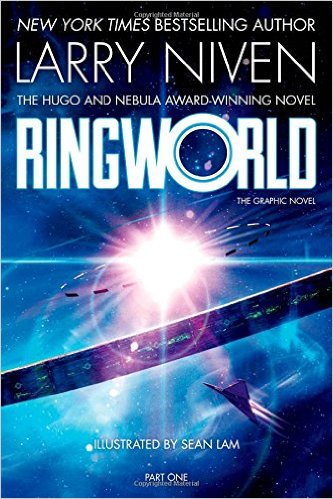
#9 Ringworld by Larry Niven (1970)

Sam Jordison of the Guardian had this to say about Ringworld, the masterpiece that is centered around around a theoretical ring-shaped space-habitat:

“Larry Niven’s 1970 Hugo award winner, Ringworld, is arguably one of the most influential science fiction novels of the past 50 years. As well as having had a huge impact on nearly all subsequent space operas (Iain M Banks’ Culture series and Alastair Reynolds’ House of Suns are just two), the book has helped generate a multi-billion-dollar industry.”

To add to this Jonathan Cowie, who wrote Essetial SF: A Concise Guide, called Ringworld “a landmark novel of planetary engineering (for want of a better term) that ranks alongside the late Bob Shaw’s Orbitsville.”

Niven later added four sequels and four prequels which tie into numerous other books set in Known Space; the fictional setting of about a dozen science fiction novels and several collections of short stories.

The other books are listed and discussed at: http://www.lifehacker.com.au/2016/09/17-science-fiction-books-that-forever-changed-the-genre/

Leave a comment

Filed under 2016, book list

Sci-Fi & Fantasy Library Sweepstakes – Unbound Worlds

Source: Sci-Fi & Fantasy Library Sweepstakes – Unbound Worlds

A chance to build your science fiction and fantasy library.

Leave a comment

Filed under 2016, books

Science Fiction Books For People Who Don’t Read Science Fiction

In case you thought the genre wasn’t for you.

By Tobias Carroll

Source: http://www.readitforward.com/bookshelf/science-fiction-books-people-dont-read-science-fiction/

Science fiction can be an acquired taste. Some readers grew up on it; others never quite saw the appeal of stories involving time travel, alien contact, space exploration, or the ways in which these concepts can be used to explore moral and intellectual debates. But if you’re a reader who’d like to ease their way into the genre, there are a few great places to begin. Some provide a well-written introduction to key science fictional tropes and concepts, while others juxtapose intensely human stories with headier conceptual elements. Here’s a look at fourteen books that introduce big ideas in accessible ways and present readers with a host of directions they can go from there.

Example:

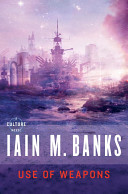
Use of Weapons

IainBanks UseofWeaponsMuch of Iain M. Banks’s science fiction was set in the world of The Culture, a utopian society that encompasses massive amounts of space, and includes artificial intelligence, alien species, simulated afterlives, and more. But for all of that, Banks is also adept at writing memorable characters, and at the center of Use of Weapons, readers will find exactly that, in the person of the memorably-named Cheradenine Zakalwe—along with a structurally innovative method of telling the story.

Other books include:

  • The Water Knife by Paolo Bacigalupi
  • The Book of Strange New Things by Michel Faber
  • Bloodchild and Other Stories by Octavia E. Butler
  • Embassytown by China Miéville
  • Elvissey by Jack Womack
  • Definitely Maybe by Arkady Strugatsky & Strugatsky Boris
  • Midnight Robber by Nalo Hopkinson
  • Oryx and Crake by Margaret Atwood
  • The Einstein Intersection by Samuel R. Delany.

Details: http://www.readitforward.com/bookshelf/science-fiction-books-people-dont-read-science-fiction/

Leave a comment

Filed under 2016, books

Writing tip Wednesday: “Breaking ‘rules'”

10 Writing “Rules” We Wish More Science Fiction and Fantasy Authors Would Break

by Charlie Jane Anders

Source: http://io9.gizmodo.com/5879434/10-writing-rules-we-wish-more-science-fiction-and-fantasy-authors-would-break

Science fiction and fantasy are genres where almost anything can happen — as long as the author can make it seem plausible, and as long as it’s part of a good story. But that doesn’t mean there are no rules. If anything, the fact that these genres are so wide open mean that there are tons of rules out there, some unspoken and some written in black and white.

And sometimes, breaking the rules is the only way to tell a really fascinating story. Here are 10 rules of SF and fantasy that more authors should consider breaking from time to time.

Note: We’re not saying you must break any of the rules below. You can craft a brilliant work of fiction while still following all of the rules below. And most of these rules exist for a reason — because if you break them without knowing what you’re doing, you can screw up horrendously. Some of the rules below represent things that may have been done to death in the past, so it’s best to make sure you have a fresh spin. But at the same time, too many rules can be a creativity-killer, and sometimes it’s good to bust out some illegal moves.

Getting to the heart of the matter.

Getting to the heart of the matter.

Third-person omniscient used to be the default mode for a lot of novelists — a lot of the classics of literary fiction as well as science fiction are written in third person omniscient. This means, in a nutshell, that the narrator can see what’s going through any character’s head, and can flit around as the story requires. But in recent years, fiction writers have opted for first person or limited third — in which only one person at a time gets to be a viewpoint character. The thing is, though, when you have tight third person with multiple viewpoint characters, it often feels like an omniscient narrator who’s choosing to play games.

1) No third-person omniscient

An actual third-person omniscient can be fantastic — you need look no further than Douglas Adams’ Hitchhiker’s Guide to the Galaxy, which freely lets you know what Arthur Dent, Ford Prefect and assorted other characters are thinking at any given moment. Or countless classic SF writers, for that matter. But I also want to put in a plea: anyone who’s serious about writing genre fiction should read Henry Fielding, who makes third-person omniscient into an art form. In novels like Joseph Andrews and Tom Jones, Fielding draws these brilliant tableaux where he pauses to show what everyone’s thinking, and how much at cross-purposes everyone is. It helps him be a keen observer of people, and also creates these beautifully funny set pieces.

2) No prologues

This is one I’ve been hearing for years — some agents and editors say they stop reading immediately if they see that a book has a prologue. But prologues have their uses, especially if you want to set a mood or establish some crucial backstory before you start introducing your main characters. Like most of the other things on this list, prologues can be done well, or they can be done horrendously. Luckily, we don’t have to reach far to think of an example of prologues done well — George R.R. Martin starts every one of the Song of Ice and Fire books with one, and it’s clear why these prologues are there. They help set up the conflicts of each book, via the experiences of a throw-away character. (Literally, in fact.)

3) Avoid infodumps

Like its cousin, “show don’t tell,” this injunction can be a great idea but can also get you into trouble. Sometimes an infodump can be a horrendous load of backstory or technical schematics, rammed down your poor reader’s throat. But at other times, authors can go to huge, insane lengths to avoid having to come out and explain something. Like having contrived conversations, or weird “teachable moments” to convey a basic bit of worldbuilding to the reader, with the effect that the story grinds to a halt. We posted a collection of 20 well-done infodumps a while back, just to prove it can be done well. Perdido Street Station art by Les Daniels.

And you may have noticed that whenever literary writers tackle science fiction or fantasy, they include tons of infodumps? Maybe this is one of those instances where they’re not as familiar with the genre conventions, and thus fall into habits that many “real” SF and fantasy authors would avoid — but in this instance, they may just be right. Sometimes you just have to explain something, as painlessly as you can.

4) Fantasy novels have to be series instead of standalones

We love a good epic trilogy (or decalogy) as much as the next fantasy addict. But sometimes a nice done-in-one story is also exceedingly welcome. And this is one area where science fiction seems to have a slight advantage over fantasy — both genres have tons of sprawling series, but science fiction at least sometimes spawns one-off novels. And there’s something to be said for getting a satisfying story in one volume, without a cliffhanger or any loose ends afterwards. And sometimes, characters can actually be developed more fully if the author doesn’t have to hold anything back for future books. A character who gets a full arc in one book can be a richer character.

5) No portal fantasy

The “portal fantasy” is a mainstay in both science fiction and fantasy, even though it’s mostly used in the latter. (You could argue that Hitchhiker’s Guide is a “portal fantasy.”) In this type of book, someone from our world discovers a pathway to another world, where he or she is our relatable everyhuman explorer, and we discover this new world through his or her eyes. It’s a tried and true notion, and Lev Grossman gets a lot of mileage out of it in The Magicians — both Brakebills and Fillory, in different ways, are strange worlds that Quentin visits from the “real” world, and there’s a lot of portaling. But we’ve heard many people say that “portal fantasy” is over, and so is the neophyte who learns about the magical world over the course of a book. Now, everybody wants stories where the main character is already steeped in the magical (or science-fictional) world as the story begins.

But as we argued a while back, there’s still a lot of awesomeness lurking in the concept of an ordinary person traveling to a strange world. There are so many ways to tell that story, and so many metaphors buried in the notion of someone being thrust into a weird new world. Isn’t that what we all do when we start exploring genre fiction? I think to some extent, this is something that die-hard genre fans have seen too much of, but these sorts of stories could still have a lot of appeal to mainstream and newbie readers.

6) No FTL

Yes, our current understanding of physics tends to frown upon faster-than-light space travel — no matter what a few weird neutrinos may or may not have done. And there’s definitely a place for totally rigid, scientifically plausible fiction in which the very real difficulties of exploring our own solar system are explored. But then again, there’s something undeniably awesome about being able to jump to hyperspace, or warp speed, or whatever. And maybe a little bit less realism is needed sometimes, to amp up the excitement of space travel. Most of us grew up on big, bold space operas in which interstellar travel was unrealistically, thrillingly fast — and that’s still the portrayal of space that resonates with many people. Plus, FTL makes all sorts of other stuff possible, including space warfare and lots more first contact.

Additional rules are:

7) Women can’t write “hard” science fiction.

8) Magic has to be just a minor part of a fantasy world

9) No present tense

10) No “unsympathetic” characters

Details at: http://io9.gizmodo.com/5879434/10-writing-rules-we-wish-more-science-fiction-and-fantasy-authors-would-break

***

Charlie Jane Anders is the author of All The Birds in the Sky, coming in January from Tor Books.

Leave a comment

Filed under 2016, writing tip, Writing Tip Wednesday

Writing tip Wednesday: “Star Trek Strange New Worlds story contest”

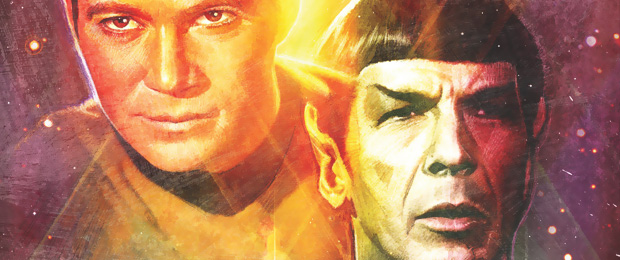
Kirk (left) and Spock (right).

Kirk (left) and Spock (right).

The deadline for entry is 11:59 PM EST January 15, 2016.

In celebration of Star Trek’s 50th anniversary in 2016, publisher Simon & Schuster is bringing back the popular fan fiction writing contest, Strange New Worlds! Here is your unique opportunity to present to this world and beyond that special Star Trek story that has never been told.

Ten winning selections will be published as part of an all-new official anthology, coming from Simon & Schuster in 2016. Plus, two first prize winners will receive a free, self-publishing package from Archway Publishing!

Editorial Guidelines

Stories must focus on past and present Star Trek main characters or familiar guest characters from the live-action TV series or the first ten feature films released prior to 2009.

  • Stories must be between 7,500 and 10,000 words.
  • Stories must contain no explicit sexual activity or graphic depictions of violence or sadism.
  • Stories may not contain the previously unestablished death of a Star Trek character or make significant changes in the life of a major character.
  • No illustrated or graphic submissions will be accepted.
  • The Submission must be an original story based on the established Star Trek universe and or characters from the following Television series or Motion Pictures:

    Television
    The Original Series, Seasons 1-3
    The Next Generation, Seasons 1-7
    Deep Space Nine, Seasons 1-7
    Voyager, Seasons 1-7
    Enterprise, Seasons 1-4

    Motion Pictures
    The Motion Picture (1979)
    The Wrath of Khan (1982)
    The Search for Spock (1984)
    The Voyage Home (1986)
    The Final Frontier (1989)
    The Undiscovered Country (1991)
    Generations (1994)
    First Contact (1996)
    Insurrection (1998)
    Nemesis (2002)

  • See complete list of story qualifications/disqualifications in the Rules at http://www.startrekbooks.com/contest_rules.

1 Comment

Filed under 2015, contest, writing tip, Writing Tip Wednesday

 Samuel R. Delany Speaks

 The award-winning novelist discusses the intersection of race, sexual identity, and science fiction.

by Cecilia D’Anastasio

Source: http://www.thenation.com/article/samuel-r-delany-speaks/

When he was 11, Samuel R. Delany stayed overnight at a Harlem hospital for observation. It was 1953, and nearly a decade before Delany would publish his first science-fiction novel. He had already realized he was gay. With trepidation, he asked the doctor, a white man, how many gays existed in America. The doctor laughed. “[He] told me it was an extremely rare disease,” Delany says. “No more than one out of 5,000 men carried it.” Rest assured, the doctor added, no medical records existed confirming the existence of black homosexuals. “Simply because I was black,” Delany says, “I didn’t need to worry!”

Samuel R. Delany

Samuel R. Delany

In his 2007 novel Dark Reflections, Delany’s experience at the hospital resurfaces. The protagonist, a gay black poet named Arnold, is having his tonsils removed when the doctor notes the improbability of his identity. Such recollections, particular to Delany’s upbringing and voice, surface throughout the body of his work and have taken his science fiction to heights unexplored by authors ignorant of marginality. In July, on the occasion of the publication of A, B, C: Three Short Novels (Vintage; paper $16.95), The Nation spoke with Delany, a four-time Nebula awardee, about intersectionality, growing up black in New York City, and placing his legacy as a gay sci-fi writer of color in perspective. — Cecilia D’Anastasio

CD: You have said, “For better or for worse, I am often spoken of as the first African-American science-fiction writer.” What did you mean by that?

SD: What did I mean by “for better or for worse?” It’s a placeholder. It holds a place for ghosts—the ghosts around any such discussion as this, ghosts sometimes useful to evoke in discussions of any practice of narrative writing, science fiction or other.

In my 1998 essay “Racism and Science Fiction” that you quote, I mention some of those ghosts in the paragraphs following my sentence: M.P. Shiel, Martin Delany (no relation), Sutton E. Griggs, Edward A. Johnson, W.E.B. Du Bois (certainly the best known), and George Schuyler—black Americans (or, in Shiel’s case, Caribbean), who wrote books or stories that we can read as science fiction. Full disclosure: Before I started writing science fiction, I’d looked through a copy of Shiel’s The Purple Cloud but had not known he was black by the current laws that made me so.

Today, I want to amend the sentence, in that I am the first broadly known African-American science-fiction writer to come up through the commercial genre that coalesced before and after the term “science fiction” began to appear more and more frequently in Hugo Gernsback’s magazine Amazing Stories between 1929 and 1932. Octavia E. Butler was the second. She was briefly my student in the summer of 1970 and my friend until her death in Washington State in 2006. We read together at the Schomburg library in New York City or shared panels at the Franklin Institute in Philadelphia, at a book fair in Florida, twice in Atlanta; and once we presented together for the Smithsonian on a rainy DC night.

 But another set of ghosts are needed to make our own discussion here make sense—ghosts who come from the genre (and I used the word advisedly) we call “the literary.” For an idea of how much literature has changed since I first entered the field as a writer in 1962, or perhaps when, in 1966, I attended my first science-fiction convention in Cleveland, consider first what the academy that gives us our sense of what literature is teaches today—and then consider how that differed from what it taught in 1967. In that year, there were no virtually black studies classes (much less programs or departments); there were no women’s studies classes or programs, and no gay studies or queer studies classes or programs.

 CD: It may be fair to say, then, that few writers were using the genre of what Darko Suvin has called “cognitive estrangement” to address personal experiences of marginalization before you.

SD: Here’s one I’ve written about in a narrative contained in my book of stories Atlantis: Three Tales—the second story in the book. Though the story does not narrate the first time; nor does it tell the last.

The first person to call me a nigger was not some hostile white man or woman. (Though, before I’d gone to my first science-fiction convention, some had.) Like many, many, many blacks all through this country, certainly in those years, and even today, it was my dad—whenever he got really frustrated with me. He was a black man—and a black from the American South, born before World War I. We were not poor. But we were nobody’s rich, either. And when my dad got really riled, I was a “stubborn, thickheaded nigger.” I didn’t think much of it. It was one of the most common words on the streets on which I lived, and I knew perfectly well I wasn’t supposed to say it at all. So I didn’t. But it prepared me for the first time a white person did—which we’ll talk about later.

To say that literature—one of the several cultural products that supported this system—was a very different thing (as science fiction, hemmed around by it, was a different thing) is another way of saying the world itself was simply different. To me, it seems neither fair nor accurate [to say that no one was using science fiction to address personal experiences of anti-black racism before me]. The problem here is that I’m not sure how the personal experiences of marginalization and the personal experiences of blackness have to be related. Do both the experiences and the blackness have to be mine to be personal? Could they be observed by someone else? If they were, would they be less personal? Is personal there the same as subjective, and in what way? Or are they not?

Around us, here, I see all those literary ghosts, who I picture as pressing closer to see the outcome as to how we will handle those questions, the ghost of Dickens’s Oliver Twist, David Copperfield; Balzac’s Cousin Bette, le père Goriot; Becky Sharp, Jane Eyre, Heathcliff, Hawkeye, Chingachgook, Ishmael, Queequeg, Jean Valjean, and Raskolnikov, Huck Finn, Jim, the nameless hero of Hamsun’s Hunger, Steinbeck’s Tom Joad, and Fitzgerald’s James Gatz. These ghosts are pushed forward by the black characters behind them. In their own tales, all these ghosts, black and white, are marginalized characters, some clearly so, some only suggestively, in the societies their writers portray, for better or worse (still a placeholder for more emendations, more ghosts that can’t demand them but can explain why they are needed); poor boys who grow up to be poor men or got their money dishonorably or died; socially impoverished poor relations trapped in families who resented having them at all. All of them required their writers to create fictive strategies to present that marginalization.

 The ghosts above have alerted their readers to the fundamental ways in which poverty, economics, the social blindness, and hypocrisy of others as well as small-mindedness and the way small-town propriety chastens and destroys.

CD: What other writers were doing this kind of work in ways that resonated with you?

SD: The first white writer who wrote a black character I personally found believable—and I read lots and lots, both inside and outside science fiction—was Thomas M. Disch, in his 1968 New Wave novel Camp Concentration, first serialized in the British science-fiction magazine New Worlds, whose first installment appeared in its first tabloid-style issue. The presentation of Mordecai is one reason I think it’s such an important book in science fiction’s history. Yes, that book passed my own Turing test in a way that, for me, Faulkner’s black characters did not—as, indeed, many of his white characters failed to do for me as well, though I always found his language exacting, when it wasn’t exhausting. Tom told me later that he’d modeled Mordecai on a black classmate of his in the Midwest. But, boy, did I recognize him from my memories of myself and my black friends on the Harlem streets.

Till that point, all of the white attempts to do this, in my experience, had failed. But that’s narration. That’s science fiction. That’s literature—or perhaps that’s a place where, sometimes, instead of trying to strangle one another, the three become congruent. But it also suggests that the way to succeed is a matter of a writer’s being observant, intelligent, and creative, with a sense that the more cliché the characters are, the more likely (but not certainly) they are to be unbelievable, while at the same time they can’t be so idiosyncratic as to be irrelevant, and that is more important than the race of the writer.

The novel [Camp Concentration] takes place only an indeterminate 10 or 15 years after it was written—in short, it has undergone the transition all science fiction is doomed to follow, from historical speculation to historical fantasy. The United States is fighting a war—which may be an extension of the war in Vietnam or another, in Malaysia. It’s purposely unclear. Our protagonist is a conscientious objector and a poet—and the book is his journal. In 1967, when I first read Camp Concentration in its New Worlds serialization, after it had failed to find a US publisher, I can think of two things that were then inconceivable: The first is that 50 years later, we would have a black president. But by 2005, it was very thinkable. Morgan Freeman had played the current president of the United States in Deep Impact, with at least two other black actors representing the POTUS on various running series—so that, if anything, when Obama got in in ’08, today hindsight makes it look more inevitable than surprising.

And in the early ’70s [in “Angouleme,” from 334, published in 1972], Disch was the first science-fiction writer to conceive of gay marriage as lying in a foreseeable future. I wasn’t. I’d already worked through all my interest in marrying anyone and was pretty sure it was not an institution for me. I still am.

CD: Could you tell me about another experience of yours, growing up in mid-century Harlem, that found its way into your fiction?

novaSD: All the experiences that were used in my own stories and books were black experiences—why? Because they were mine. In my books, sometimes the central characters were white—as in Trouble on Triton. Sometimes, as in The Fall of the Towers, Babel-17 (where the main character is Asian), or The Einstein Intersection, Dhalgren (where the main character has a white father and a Native American mother), or the Return to Nevèrÿon series, many or sometimes all were non-Caucasian.

 Here is something that I think as an almost purely black experience (it is only that racial experiences are never pure that keeps such purity a metaphor), one that I’ve told many of my black friends, fewer of my white friends, and written about fairly indirectly in my Return to Nevèrÿon fantasy sequence.

All my life, one of the things people—white people in particular—had been telling me was that I looked white. I didn’t particularly believe them—though sometimes I wondered. My parents had told me that I was black and I should be proud of it, as both of them were, but one day in late September or among the first days of Indian summer (I was still in elementary school, so I was probably 10 or 11), I was sitting on a bench in Central Park, with my school notebook open, doing my math homework, when, with unkempt blond hair and steel-blue eyes, a kid about 20—today, from the state of his jeans and sneakers and T-shirt you would know immediately he was homeless, and, though “homeless” was not part of our vocabulary then, I realized it—walked up in front of me, his grin showing not very good teeth. “Hey,” he said with the thickest Southern accent I’d heard in a while, “you a nigga ain’ ya, there, huh?” I looked up, surprised. “Yeah, you a nigga. I can tell. Tha’s cause I’m from Alabama. See I can always tell. You ain’ gonna get nothin’ by me. I can see it, right in yo’ face there. The mouth, the nose. All that—naw, I can see it. You ain’t gonna fool somebody like me, get away with nothin’.” Then, still grinning, he turned and walked off, through the sunny park.

And that was the first time I was called a nigger by a white guy—a homeless Alabama drifter coming up to an urban black kid on a bench doing his math homework.

Frankly, I got less upset over that one than I did over my father’s. Because at least it taught me something. I mean, he was right. There’s nothing unpleasant for a black person to be recognized, especially when, I assume, they feel they are telling you something that for some reason they think you want to hear.

And sometimes it happened with black folk. Yet more stories. At this point, I don’t remember whether it was the fifth or sixth time [that happened], but after one of the men or women left, frowning after them, I said to myself: You thickheaded nigger, you better stop believing all these white assholes who keep telling you how white you are, because obviously there are a whole lot of white people in this city—in the country (by then, it had happened a couple of times outside New York)—who have nothing else to do but go around on the lookout for any black person they think might be racially passing, and remind them that they can’t. But this is one very small way in which a race gets constituted socially.

Rest of the article: http://www.thenation.com/article/samuel-r-delany-speaks/

1 Comment

Filed under 2015, author interview, authors

Science fiction and Pluto

Sci-fi becomes reality: 10 books about our future with Pluto

Pluto photographed during New Horizons flyby.

Pluto photographed during New Horizons flyby.

“If you can imagine it, you can achieve it. If you can dream it, you can become it.”

–William Arthur Ward

by Andrea Sefler

Source: http://www.popmythology.com/10-sci-fi-books-about-pluto/

Stargazers are having a momentous week with the Pluto flyby of New Horizons. With this success we have now made close inspection of most of the largest objects throughout much of our solar system, from the sun and all the planets, even the tiny one 4.67 billion miles out. And I refuse to engage in any “size matters” arguments here; I grew up learning nine planets, and nine planets there be.

While scientists will spend many years analyzing data from the mission making new discoveries, there is already a great deal of impressive accomplishments from the mission. Let’s just take the spacecraft itself. Are you one of those people impressed with and lusting after a high-tech Tesla? Well the New Horizons probe engineers managed to pack everything needed for the 9.5 year journey and the data collection upon arrival at Pluto into a craft smaller and lighter than many automobiles. Not to mention the fact that this baby was ripping along at more than 50,000 mph. Okay, maybe we can’t get the benefits of a gravitational assist from Jupiter on our highways, but this still makes a battery life of ~265 miles on an electric car seem weak.

Many will disparage this mission’s $720 million price tag and the space program in general as a waste of taxpayer money for esoteric and useless knowledge about places far too distance to be of concern. But the data collected at the destination is almost hardly more than icing on the cake. The real value lies in the journey and what needed to happen in order to make it a possibility. Most of our public companies, even those considered to be our most innovative, such as Apple, are concerned with small, incremental product changes, e.g. a few more pixels in the camera, a little bit larger screen. With NASA and the space program, the absolute necessity for small, robust, energy efficient components compel designers to push things to the limits. And then we all get to benefit from the successes as the designs find their way into our everyday devices.

Whether this gets done through solely at government agencies or through public/private consortiums, the point is to have these big, shared dreams and goals. My earliest datable memory is of the Apollo 11 moon launch. I am still staggered ever time I visit the Kennedy Space Center by the Saturn V rocket and all the incredible infrastructure developed to build, transport, and launch this behemoth, including the Vehicle Assembly Building, which is so large it sometimes rains inside.

The dream of sending a person to the moon united people to a common mission and, as such, everyone had a part in the success. Even better are the missions involving international collaborations, such as Apollo-Soyuz where we can begin to imagine ourselves as citizens of planet Earth and not Greeks or Germans or Americans or Russians.

But these missions all begin with dreams: dreams that came straight out of the pages of science fiction novels, leapt into the minds of curious, adventurous men and women, and wound up at the far end of our solar system. Many a great scientific discovery throughout history has been preceded by a fictitious imagining of it. Jules Verne published From the Earth to the Moon in 1865, and then in 1969 we did go from the earth to the moon via Apollo 11. H.G. Wells imagined tanks in The Land Ironclads (1903), and tanks were invented in 1915. There are many more examples, and whether these works of sci-fi were merely prophetic visions or actually served as inspiration in some direct or indirect way, the point is that the ability to imagine something comes before the actual doing. And in this respect sci-fi often has stronger ties to the real world than some people give it credit for.

One of several novels about Pluto

One of several novels about Pluto

Today’s far fetched concepts may be tomorrow’s reality. And today’s flyby may be tomorrow’s manned expedition to Pluto. In celebration and acknowledgement of this idea, here are some sci-fi works over the years that have involved Pluto in some way. Some of these are forgotten works, but may they be rediscovered and inspire future generations to imagine new discoveries.

Details about the books at: http://www.popmythology.com/10-sci-fi-books-about-pluto/

Leave a comment

August 8, 2015 · 11:04 pm

The best recent science fiction – review roundup

Eric Brown on Chris Beckett’s Mother of Eden; Becky Chambers’s The Long Way to a Small, Angry Planet; Stephen Palmer’s Beautiful Intelligence; Ian Sales’s All That Outer Space Allows; SL Grey’s Under Ground; Alex Lamb’s Roboteer

by Eric Brown

Source: http://www.theguardian.com/books/2015/jul/31/science-fiction-roundup?CMP=twt_books*gdnbooks

Chris Beckett won the 2013 Arthur C Clarke award for his novel Dark Eden, about the survival and adaptation of human colonists on a world without light. The sequel, Mother of Eden (Corvus, £17.99), begins generations later, charting the growth and political divisions between the colonists. It follows the rise of Starlight Brooking, a humble fishergirl, and her quest to bring equality and revolution to Edenheart, a settlement ruled by a conservative patriarchy. Beckett doesn’t do traditional heroes and villains: Starlight Brooking is contradictory and flawed, at once brave and vulnerable, and likewise his villains are portrayed with sympathy and understanding. He also eschews easy answers and formulaic plotting; where a hundred other writers would have Starlight triumph over her enemies, her victories are on a more profound and personal level, and not without tragedy. Mother of Eden is a masterpiece.

When the captain of the Wayfarer starship is offered a job travelling to a faraway planet that could make him and his crew financially secure, he agrees despite the dangers involved.Such a precis might suggest that Becky Chambers’s first novel, The Long Way to a Small, Angry Planet (Hodder & Stoughton, £18.99), originally self‑published and shortlisted for the Kitschies awards, is an action-adventure space opera. But this is a slow, discursive novel of character as the motivations of the diverse and likable crew, comprising humans and aliens, are laid bare for the reader’s delight. It is a quietly profound, humane tour de force that tackles politics and gender issues with refreshing optimism.

Stephen Palmer’s marvellous ninth novel, Beautiful Intelligence (Infinity Plus, £8.99), posits a beleaguered 22nd century in which oil has run out, water is scarce, and in a neat inversion of the contemporary world order, Europe is an economic ruin and Africa the promised land. Two techno wizards abscond from a Japanese laboratory, each attempting to develop artificial intelligence according to their own philosophies – one based on the social intelligence theory of consciousness, the other on a linguistic approach – but billionaire tech-mogul Aritomo Ichikawa will stop at nothing to get them back. What follows is a thrilling chase across a ravaged Europe, a burgeoning North Africa and balkanised US, interleaving excellent action set-pieces with fascinating philosophising on the nature of consciousness. A gripping read to the poignant last line.

More at: http://www.theguardian.com/books/2015/jul/31/science-fiction-roundup?CMP=twt_books*gdnbooks

Leave a comment

Filed under 2015, book review, books

Stephen Baxter interview: why science fiction is like therapy

The bestselling SF writer talks about the rush to finish the Long Earth series, being the order to Terry Pratchett’s chaos and how maths helps him write

by Alison Flood

Source: http://www.theguardian.com/books/2015/jul/25/stephen-baxter-interview-why-science-fiction-is-like-therapy

In the summer of 2013, Stephen Baxter and Terry Pratchett published The Long War, the second volume of their Long Earth science-fiction series, about parallel worlds that can be “stepped” into. By the end of that year, the two authors – both prolific by any standards – had completed drafts of the remaining three novels in the series. It was an astonishing rate of work, but there was a deadline that needed to be met: Pratchett had announced his diagnosis with a rare form of early onset Alzheimer’s in 2007. By the summer of 2014, he would pull out of a Discworld convention, citing “The Embuggerance”, which was “finally catching up with me”. He died in March this year.

Stephen Baxter

Stephen Baxter

“I think Terry was aware he was running out of time, and he wanted to do other things as well,” Baxter says. “So we rushed through it a little bit. Terry’s basic vision was the first step, but he also wanted to have a huge cosmic climax at the end, which would be book five … We had no idea how to get there but we knew where we were going.”

The Long Utopia, the fourth in the series, sees settlers on an Earth more than “a million steps” west of ours stumble across a disturbing, insectile form of alien life. Like its predecessors, the novel is compelling not only for its central storyline of exploration and danger and humans doing foolishly human things – and in this case a particularly cataclysmic finale – but also for its slow, unhurried laying out of the minute differences between these empty-of-humanity Earths.

The concept of a chain of parallel worlds, each a little different from its neighbour, was one Pratchett originally had, and set aside, in the 1980s. He told Baxter, a long-time friend and one of the UK’s most respected science-fiction authors, about it over dinner one night, and they decided to collaborate.

“It was a great idea but Terry’s strength did not lie in landscapes and things,” Baxter says. “He’d get a story by having a basic idea, get two people in a room talking and see where it went from there.”

This is not how Baxter works. His fiction, whether about the colonising mission sent to a planet orbiting a nearby red dwarf star, in Proxima, or the exploration of different evolutions of humanity in the Destiny’s Children series, is meticulously planned and pinned down, rooted in the scientific background from which he comes. He has a degree in maths from Cambridge and a PhD in aeronautical engineering; he is a fellow of the British Interplanetary Society and applied for a guest spot on the Mir space station in 1989, making it through a number of stages on his quest to be a cosmonaut but eventually missing out because of his lack of foreign languages.

Whether Baxter decides to submerge the world (Flood), or make humanity live in the centre of a neutron star (Flux), or keep the sea off Doggerland in an alternative prehistory (Stone Spring), there’s always a hook into something real. “I try to get it right. If you can get the maths right, I figure you’re most of the way there,” he says.

Baxter is fiercely intelligent, in a generous way, sharing his enthusiasms and knowledge on everything from recently discovered exoplanets to the Mars project (he’s not hopeful, because he doesn’t think enough has been done on long-term life support systems). At the British Interplanetary Society, he’s been part of study projects on everything from designing star ships to extraterrestrial liberty, an issue explored in Ark, his follow-up to Flood, in which the scraps of humanity flee their devastated planet in “generation ships” for an uncertain future outside the solar system.

“It’s all very well to plan a five-generation mission to Alpha Centauri, but if you’re one of the middle generations, you live out your life with very little room for manoeuvre,” he says. “So what right do you have to submit your children and grandchildren to a life of slavery like that? You get some interesting ethical issues – do you have rights over people who don’t yet exist, do they have rights?”

Rest of the article: http://www.theguardian.com/books/2015/jul/25/stephen-baxter-interview-why-science-fiction-is-like-therapy

Leave a comment

Filed under 2015, author interview