Tag Archives: Saturday

Brother, can you spare a change?

Anthony Horowitz to copy editor: “I’M NOT CHANGING THIS.”

The full article at: http://www.mhpbooks.com/anthony-horowitz-to-copyeditor-im-not-changing-this/

by Kirsten Reach

Nobody wants his conversation with a copy editor made public, but there’s a galley floating around from Harper at the moment that contains some accidental gems. Anthony Horowitz, author of a new Sherlock Holmes novel and the next James Bond novel, had a conversation in the margins of Moriarty that mistakenly made it into the advanced reader’s copies.

Sarah Lyall‘s report in The New York Times gives you a sense of her own reading experience as well as the dialogue between author and copy editor. What’s so brilliant about her telling is the way she manages to rationalize the notes at first, as some sort of meta-commentary:

“Moriarty’s” narrator, an American detective named Frederick Chase, is laying out the background to the story – how Holmes and Moriarty came to be at Reichenbach Falls and what is believed to have happened next. All of a sudden he switches to capitals. “NO NEED TO COMPLICATE THINGS HERE, I THINK,” the text announces. “WHAT I’VE WRITTEN IS BROADLY TRUE.”

Can the narrator be offering some meta-commentary on his own text? At first it seems so. But then it happens again. In a spot where Chase and a Scotland Yard inspector have found an important clue that seems to be an excerpt from a previous Holmes story written by Dr. Watson, things suddenly veer off-piste again. “IT MAKES NO SENSE FOR FREDERICK CHASE TO HAVE READ THE SIGN OF FOUR,” the text declares.

Of the six annotations, the highlight is one firm line from Horowitz: “I’M NOT CHANGING THIS.”

So what happened?

The rest of the story at: http://www.mhpbooks.com/anthony-horowitz-to-copyeditor-im-not-changing-this/

[Editor’s note: Thank you Ashlie for the link to this article.]

1 Comment

Filed under publishing, publishing news

What Classic Novel Describes Your Life?

Which one indeed

Which one indeed

What Classic Novel Describes Your Life?.

Leave a comment

Filed under what novel are you?

New words to live by: “Loopid”

It is the first weekend of the month and time again for a new word to live by. This is a word or phrase not currently in use in the U.S. English lexicon, but might need to be considered. Other words, such as obsurd, crumpify, subsus, flib, congressed, and others, can be found by clicking on the tags below. Today’s New Word is a merging of two words: Loop and Stupid. Without further chattering, Loopid is the new word for this month:

Loop, n. an object, such as a string, rope, or wire folded or turned back on itself, sometimes so that what goes out will come back on itself. Example, a feedback loop when the original signal keeps repeating itself.

Stupid, adj. dull, foolish, senseless, either a person or idea.

Loopid, adj. When you are so stupid, you don’t know how stupid you are and because of that, you continue to remain stupid, but may nonetheless think you are smart. Also known as a Loop Stupid.

n. One who is Loop Stupid.

To further explain the concept here is a short video.

Leave a comment

Filed under new word, New words to live by

The Devil’s Dictionary: “Abscond”

In our continuing quest to revisit a classic, or even a curiosity from the past and see how relevant it is, we continue with The Devil’s Dictionary by Ambrose Bierce. Originally published in newspaper installments from 1881 until 1906. You might be surprised how current many of the entries are.

A young Ambrose Bierce

A young Ambrose Bierce

For example, here is a definition for the words Corporation and Congress. The Old definitions are Bierce’s. The New definition is mine. From time to time, just as it was originally published, we will come back to The Devil’s Dictionary, for a look at it then and how it applies today. Click on Devil’s Dictionary in the tags below to bring up the other entries.

OLD DEFINITION

Abscond, v.i. To “move in a mysterious way,” commonly with the property of another.

Spring beckons! All things to the call respond;
The trees are leaving and cashiers abscond.

–Phela Orm

NEW DEFINITION

Abscond, v.i. To “move in a mysterious way,” commonly with the property of another, usually a lobbyist in order to the bidding of “the people” as conveyed by the lobbyist to the politician. The people in this case being the person, persons, or corporation that hired the lobbyist(s).

Elections beckon! All candidates to the lobbyists respond;
The people are leaving and the politicians abscond.
–d.e.b.

Leave a comment

Filed under Devil's Dictionary

Bill Murray Gives a Delightful Dramatic Reading of Twain’s Huckleberry Finn (1996) | Open Culture

Bill Murray Gives a Delightful Dramatic Reading of Twain’s Huckleberry Finn (1996) | Open Culture.

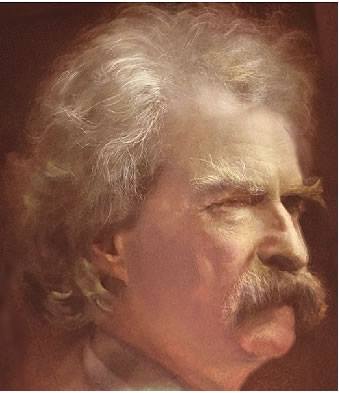
Mark Twain

Mark Twain

George Barnard Shaw once called Mark Twain “the American Voltaire,” and like the inspired French satirist, Twain seems to have something to say to every age, from his own to ours. But if Twain is Voltaire, to whom do we compare Bill Murray? Only posterity can properly assess Murray’s considerable impact on our culture, but his current role as everyone’s favorite pleasant surprise will surely figure largely in his historical portrait. Of Murray’s many random acts of kindness—which include “popping in on random karaoke nights, or doing dishes at other people’s house parties, or crashing wedding photo shoots”—he has also taken to surprising us with readings from American literary greats: from Cole Porter, to Wallace Stevens, to Emily Dickinson.

Just above see Murray read an excerpt from American great Mark Twain’s The Adventures of Huckleberry Finn. Murray’s appearance at the 1996 Barnes & Noble event apparently came as a surprise to the audience—and to himself. The excerpt he reads might also surprise many readers of Twain’s classic, who probably won’t find it in their copies of the novel. These passages were originally published in Life on the Mississippi but reinserted—“correctly, I guess,” Murray shrugs—into Huck Finn in Random House’s 1996 republication of the novel, marketed as “the only comprehensive edition.” (Read a publication history and summary of the changes in this brief, unsympathetic review of the re-edited text.)

1996 was an interesting year for Twain’s novel. Long at the center of debates over racial sensitivity in public education, and banned many times over, the book figured prominently that year in a tense but fruitful meeting between parents and teachers in Cherry Hill, New Jersey. These discussions produced a new curricular approach that PBS outlines in its teaching guide “Huck Finn in Context,” which offers a variety of responses to the thorny pedagogy of “the ‘n’ word,” racial stereotyping, and reading satire. Beyond the issue of derogatory language, there also arose that year a pugnacious challenge to the book’s place in the American literary canon from novelist Jane Smiley. Smiley’s polemic prompted a lengthy rebuttal in The New York Times from Twain scholar Justin Kaplan.

More at: http://www.openculture.com/2014/09/bill-murray-gives-a-delightful-dramatic-reading-of-twains-huck-finn.html

[Editor’s note: the over hour-long video contains much more than Murray’s reading and is worth watching for its own merits and authors on the panel.]

1 Comment

Filed under Huckleberry Finn, Mark Twain

Writing Quotes from Hemingway

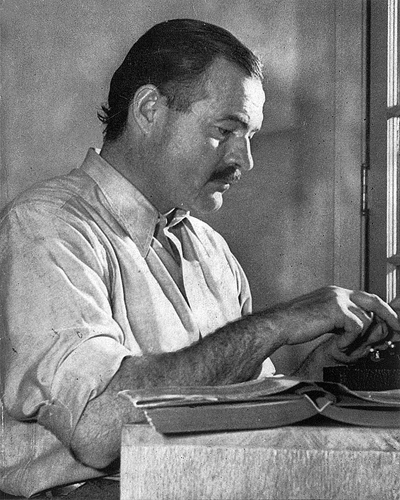
Ernest Hemingway at typewriter

Ernest Hemingway at typewriter

  1. If a writer knows enough about what he is writing about, he may omit things that he knows. The dignity of movement of an iceberg is due to only one ninth of it being above water.
  2. That is what we are supposed to do when we are at our best – make it all up – but make it up so truly that later it will happen that way.
  3. When writing a novel a writer should create living people; people not characters. A character is a caricature.
  4. All you have to do is write one true sentence. Write the truest sentence that you know.
  5. To F. Scott Fitzgerald: “Write the best story that you can and write it as straight as you can.”
  6. To an aspiring writer: “You shouldn’t write if you can’t write.”

Leave a comment

Filed under writing quotes, writing tip, writing tips

Limerick: “$catology”

There once was a woman in scatology /

who proceeded to take a class in tautology./

“$h!t, $h!t, $h!t,” she said./

She said shaking her head./

She passed the final test without apology.

1 Comment

Filed under poetry by author

Meet Karl Ove Knausgaard, the literary world’s latest hero – ES Magazine – Life & Style – London Evening Standard

Meet Karl Ove Knausgaard, the literary world's latest hero – ES Magazine – Life & Style – London Evening Standard.

Three reasons why you should read this man’s book: It’s the literary sensation of the year, reinventing the autobiographical novel; half his family no longer speaks to him because of it; one reader hated it so much he started a fire in a bookshop in protest. Hermione Eyre travels to Sweden to meet Karl Ove Knausgaard, the reclusive author behind this summer’s must-read.

Ystad, on the south coast of Sweden. Seagulls call; wheatfields stretch inland. Whizzing past on the train, I am on my way to interview the latest Scandinavian sensation, the cult literary hero and international bestseller Karl Ove Knausgaard. My Struggle, his compulsive, self-eviscerating six-volume autobiographical novel, which Zadie Smith famously needs ‘like crack’, was a publishing phenomenon in Norway, unfolding ‘live’, almost in real-time; the English-speaking world is just catching up with the translation of volume three, Boyhood Island. It’s essential summer reading, worth starting with volume one, A Death in the Family, a car-crash confessional told with Proustian poise.

Rest of the article: http://www.standard.co.uk/lifestyle/esmagazine/meet-karl-ove-knausgaard-the-literary-worlds-latest-hero-9626561.html

Leave a comment

Filed under author write up

Are you a book hoarder? There’s a word for that. – LA Times

Are you a book hoarder? There's a word for that. – LA Times.

How many books is too many books? What makes you a book hoarder? What do you do when you have too many?

In Japanese, there’s a word for it: tsundoku. It’s a noun that describes a person who buys books and doesn’t read them, and then lets them pile up on the floor, on shelves, and assorted pieces of furniture.

Read the rest of the article at: http://www.latimes.com/books/jacketcopy/la-et-jc-book-hoarding-tsundoku-20140724-story.html

1 Comment

Filed under books

Stacey-I-am

Tennessee state Senator Stacey Campfield

Tennessee state Senator Stacey Campfield

I am Stacey.
Stacey I am.

That Stacey-I-am!
That Stacey-I-am!
Do you not like
That Stacey-I-am?

Do you not like
My flavor of ham?

I do not like you
Stacey-I-am
I do not like
Your favor of ham.

Would you like it
Here or there?

I would not like it
Here or there.
I would not like it
Anywhere.
I do not like
Your flavor of ham.
I do not like it,
Stacey-I-am.

Would you like it
In a senate or a house?
Would you like it
With a correct spouse?

I would not like it
In a senate or a house
I would not like it
And neither does my spouse.
I do not like it
Here or there.
I do not like it anywhere.
I do not like your flavor of ham.
I do not like you, Stacey-I-am.

Would you like it
In a box?
Would you like it
On Faux News Fox?

Not in a box.
Not on Faux News Fox.
Not in a senate or a house.
Not with my spouse.
I do not like it here or there.
I do not like it anywhere.
I do not like your flavor of ham.
I do not like you, Stacey-I-am.

Would you? Could you?
In a stadium?
I could wear a mask
And create some mayhem.

I would not, could not
In a stadium.

You may like it.
You will see.
You may like it
On TV!

I would not, could not on TV.
Not in a stadium! You let me be.
I do not like it in a box.
I do not like it on Faux News Fox.
I do not like it in a senate or a house.
I do not like it with a correct spouse.
I do not like it here or there.
I do not like it anywhere.
I do not like your flavor of ham.
I do not like you, Stacey-I-am.

A plane! A plane!
Could you, would you
On a plane?
The monkey can fly while I explain.

Not on a plane! Not in a stadium!
Not in a mask! Stacey, stop the mayhem!
I would not, could not, in a box.
I could not, would not, on Faux News Fox.
I will not and neither will my spouse.
I will not like you in a senate or a house.
I will not like you here or there.
I will not like you anywhere.
I do not like you, Stacey-I-am.

Say!
In the dark?
Here in the dark!
Would you, could you, in the dark?

I would not, could not,
in the dark.
Though from the dark
Is where you hark.

Would you, could you,
on voting day?
We can starve children
And “Don’t Say Gay.”

I would not, could not, on voting day.
Not in the dark. Not in any way,
Not in a stadium, Not on TV.
I do not like you, Stacey, you see.
Not in a house. Not in a box.
Not with my spouse or Faux News Fox.
Not in a plane. Not in a mask.
I do not like you, so don’t ask.
I do not like you here or there.
I do not like you anywhere!

I do not like
Your type of ham.
I do not like you
Stacey-I-am.

So when it comes
Election day
I’ll pull the lever
And send you away.

Stacey Campfield on TV.

Stacey Campfield on TV.

–with apologies to Dr. Seuss. Parody by David E. Booker

Leave a comment

Filed under poetry by author, political humor