Tag Archives: Saturday

The (Still) Mysterious Death of Edgar Allan Poe

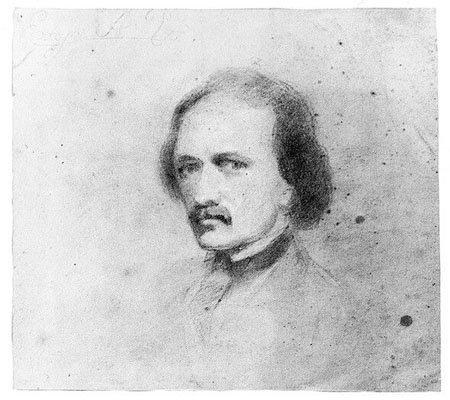
Edgar Allan Poe -- self-portrait

Edgar Allan Poe — self-portrait

Was the famous author killed from a beating? From carbon monoxide poisoning? From alcohol withdrawal? Here are the top nine theories

By Natasha Geiling

Source: http://www.smithsonianmag.com/history/still-mysterious-death-edgar-allan-poe-180952936/#vV6aWAfTgq8vGGWu.99
Give the gift of Smithsonian magazine for only $12! http://bit.ly/1cGUiGv
Follow us: @SmithsonianMag on Twitter

t was raining in Baltimore on October 3, 1849, but that didn’t stop Joseph W. Walker, a compositor for the Baltimore Sun, from heading out to Gunner’s Hall, a public house bustling with activity. It was Election Day, and Gunner’s Hall served as a pop-up polling location for the 4th Ward polls. When Walker arrived at Gunner’s Hall, he found a man, delirious and dressed in shabby second-hand clothes, lying in the gutter. The man was semi-conscious, and unable to move, but as Walker approached the him, he discovered something unexpected: the man was Edgar Allan Poe. Worried about the health of the addled poet, Walker stopped and asked Poe if he had any acquaintances in Baltimore that might be able to help him. Poe gave Walker the name of Joseph E. Snodgrass, a magazine editor with some medical training. Immediately, Walker penned Snodgrass a letter asking for help.

Baltimore City, Oct. 3, 1849
Dear Sir,

There is a gentleman, rather the worse for wear, at Ryan’s 4th ward polls, who goes under the cognomen of Edgar A. Poe, and who appears in great distress, & he says he is acquainted with you, he is in need of immediate assistance.

Yours, in haste,
JOS. W. WALKER
To Dr. J.E. Snodgrass.

On September 27—almost a week earlier—Poe had left Richmond, Virginia bound for Philadelphia to edit a collection of poems for Mrs. St. Leon Loud, a minor figure in American poetry at the time. When Walker found Poe in delirious disarray outside of the polling place, it was the first anyone had heard or seen of the poet since his departure from Richmond. Poe never made it to Philadelphia to attend to his editing business. Nor did he ever make it back to New York, where he had been living, to escort his aunt back to Richmond for his impending wedding. Poe was never to leave Baltimore, where he launched his career in the early 19th- century, again—and in the four days between Walker finding Poe outside the public house and Poe’s death on October 7, he never regained enough consciousness to explain how he had come to be found, in soiled clothes not his own, incoherent on the streets. Instead, Poe spent his final days wavering between fits of delirium, gripped by visual hallucinations. The night before his death, according to his attending physician Dr. John J. Moran, Poe repeatedly called out for “Reynolds”—a figure who, to this day, remains a mystery.

Poe’s death—shrouded in mystery—seems ripped directly from the pages of one of his own works. He had spent years crafting a careful image of a man inspired by adventure and fascinated with enigmas—a poet, a detective, an author, a world traveler who fought in the Greek War of Independence and was held prisoner in Russia. But though his death certificate listed the cause of death as phrenitis, or swelling of the brain, the mysterious circumstances surrounding his death have led many to speculate about the true cause of Poe’s demise. “Maybe it’s fitting that since he invented the detective story,” says Chris Semtner, curator of the Poe Museum in Richmond, Virginia, “he left us with a real-life mystery.”

Read more: http://www.smithsonianmag.com/history/still-mysterious-death-edgar-allan-poe-180952936/#vV6aWAfTgq8vGGWu.99

The nine theories include: beating, cooping (voter fraud), alcohol (related to cooping), poisoning (carbon monoxide or heavy metal), murder, and flu.

1 Comment

Filed under poet, writer

Saying goodbye to literary history

Bradbury home during demolition.  Photo by John King Tarpinian of file770.com.

Bradbury home during demolition. Photo by John King Tarpinian of file770.com.

What costs $1.76 million to buy and then gets torn down? What unassuming, even “ordinary” place was the 50-year home to a literary light of the 20th century? Somebody who has probably been read by school children for many years?

Answer: the what-is-now-former home of Ray Bradbury. Bradbury, author of novels such as Fahrenheit 451, The Martian Chronicles, and Dandelion Wine to name just a few, died in 2012. His home in Cheviot Hills, Los Angeles, CA, was put on the market and was recently purchased by an architect, who then razed it to make way from the architect’s home.

Details at http://www.latimes.com/la-me-before-after-ray-bradbury-house-20150116-photogallery.html, http://www.latimes.com/books/jacketcopy/la-et-jc-ray-bradbury-house-being-torn-down-20150113-story.html, and http://file770.com/?p=20397?michpun.

The architect, Thom Mayne, explains why he did it. His answers are at: http://www.mhpbooks.com/why-was-ray-bradburys-home-demolished-an-interview-with-architect-thom-mayne/

He says he had been looking for the right property in the Cheviot Hills neighborhood for five years when the Bradbury house came up for sale. At first, he said he and his wife were unaware of Bradbury’s connection to the house. He also said he was surprised by the lack of historical interest in the house.

Still, as a person who lives in a house over 110 years old and as a person who considers himself a writer, I find it surprising and saddening that this would happen. And all for the asking price of $1.76 million. I guess in LA that’s just the price of doing business.

Or as Sam Weller, author of Bradbury’s authorized biography, The Bradbury Chronicles, put it:

“I suspected it might be a teardown. Other houses in Ray’s longtime neighborhood of Cheviot Hills had been demolished. A few years ago, the house next door to the Bradbury residence was knocked down to make-way for a super-sized monstrosity. Much of the neighborhood is under siege by mansionization. Ray and his wife Maggie couldn’t understand why people didn’t respect the historical value of their sweeping old Los Angeles neighborhood. So I suspected this fate could well come to the Bradbury house, but I held out hope that its significance to imaginative literature might save it from the developers.”

More at http://www.mhpbooks.com/there-are-so-many-memories-an-interview-with-sam-weller-bradburys-authorized-biographer-about-the-authors-now-demolished-home/

–Compiled by David E. Booker. Opinions expressed are my own.

Leave a comment

Filed under Ray Bradbury

Death of a young author: “The mystery of Marsha Mehran”

The mystery of Marsha Mehran:
The best-selling young novelist who died a recluse in a rubbish-strewn cottage on Ireland’s west coast

by Cahal Milmo

Source: http://www.independent.co.uk/arts-entertainment/books/features/the-mystery-of-marsha-mehran–the-bestselling-young-novelist-who-died-a-recluse-in-a-rubbishstrewn-cottage-on-irelands-windswept-west-coast-9953073.html

From the moment of her arrival in Lecanvey, Marsha Mehran cut a solitary figure.

The few times she was seen were when she would sit, in the depths of winter, on a bench in the shadow of Ireland’s holiest mountain and open her laptop to catch the Wi-Fi from the village pub opposite.

The Dawson family, who run Staunton’s Pub in a crook of the meandering road that tracks the stark beauty of County Mayo’s Atlantic coast, repeatedly invited the striking young woman into the warmth.

Once or twice in four months, she accepted. But most of the time the 36-year-old politely declined, explaining that she needed to get back home. Visitors to her nearby rented house overlooking a rocky beach were greeted with a sign: “Do not disturb. I’m working.”

As Therese Dawson, the landlady of the homely boozer in the shadow of the 2,500ft Croagh Patrick, put it: “I suppose she needed our Wi-Fi and she’d be out there in all weathers. Of course we invited her in. We told her she didn’t have to worry about buying anything. But I sensed from her that she preferred to be alone.”

Just how alone only became clear shortly before 1pm on 30 April last year.

After days of messages and door knocks had gone unanswered, Teresa Walsh, the letting agent for the boxy, unlovely bungalow on nearby Pier Road, rented by Marsha since late January, used her spare keys to get inside.

Some 18 days earlier, Marsha had sent a text saying she could not deal with a question about her tenancy because she had been “vomiting blood for the last few weeks”. The estate agent’s response – asking if she had seen a doctor and offering help – met with no answer.
Marsha Mehran: obituary

Mrs Walsh found her Iranian-born tenant lying face down on the bedroom floor, wearing only a woollen cardigan. She had been dead for about a week and around her lay the detritus of her increasingly marginal existence in the previous weeks and months: dozens of empty mineral water bottles and the wrappers of the large chocolate bars that had become her chief source of sustenance.

Amid the squalor, her sole tangible financial assets were a single euro coin and a $5 note.

It was a grim, lonely passing that might otherwise have gone unremarked beyond Lecanvey and its windswept beaches, but for one thing: Marsha Mehran was an internationally best-selling author, read in dozens of countries, pursued by film directors, garlanded with rave reviews and, according to those who knew her, a free spirit with a rare zest for life and many more books to write.

Rest of the article at: http://www.independent.co.uk/arts-entertainment/books/features/the-mystery-of-marsha-mehran–the-bestselling-young-novelist-who-died-a-recluse-in-a-rubbishstrewn-cottage-on-irelands-windswept-west-coast-9953073.html

Leave a comment

Filed under author obituary, author write up

New words to live by: “Shonkey”

It is the first or second weekend of the month and time, once again, for a new word to live by. This is a word or phrase not currently in use in the U.S. English lexicon, but might need to be considered. Other words, such as obsurd, crumpify, subsus, flib, congressed, and others, can be found by clicking on the tags below. Today’s New Word is a compounding of two words sheep and donkey. Without further chattering, shonkey is the new word / phrase for this month:

Sheep, n. a ruminant mammal related to goats, of the genius Ovis and the family Bovidae, often domesticated for is hair and sometimes for meat.

Donkey, n. domesticated ass. Also a ruminant, though nor related to the sheep.

How about Shonkey?

Shonkey, n. An animal in a manger scene or other situation that you are not quite sure what it is. Is that a sheep? No, it’s a donkey. You sure? Could be any animal of the manger scene, or any animal in any other situation. For example, hunting: Bill, what was that animal? It was a shonkey, Ed.

Shonkey is the animal equivalent of doohickey, which is an informal word for a part, a tool, a gadget, a dingus, or a thingumbob.

Leave a comment

Filed under New words to live by

Flannery O’Connor: Friends Don’t Let Friends Read Ayn Rand (1960) | Open Culture

Flannery O'Connor: Friends Don't Let Friends Read Ayn Rand (1960) | Open Culture.

In a letter dated May 31, 1960, Flannery O’Connor, the author best known for her classic story, “A Good Man is Hard to Find” (listen to her read the story here) penned a letter to her friend, the playwright Maryat Lee. It begins rather abruptly, likely because it’s responding to something Maryat said in a previous letter:

I hope you don’t have friends who recommend Ayn Rand to you. The fiction of Ayn Rand is as low as you can get re fiction. I hope you picked it up off the floor of the subway and threw it in the nearest garbage pail. She makes Mickey Spillane look like Dostoevsky.

The letter, which you can read online or find in the book The Habit of Being, then turns to other matters.

Details at: http://www.openculture.com/2014/06/flannery-oconnor-friends-dont-let-friends-read-ayn-rand-1960.html

1 Comment

Filed under writers on writers, Writers on writing

New words to live by: “Indiplation or Contemgestion”?

It is the first or second weekend of the month and time again for a new word to live by. This is a word or phrase not currently in use in the U.S. English lexicon, but might need to be considered. Other words, such as obsurd, crumpify, subsus, flib, congressed, and others, can be found by clicking on the tags below. Today’s New Word is a compounding of two words in two possible way: Indigestion and Contemplation. Without further chattering, Indiplation or Contemgestion is the new word / phrase for this month:

Indigestion, n. Difficulty in or inability to digest food. Also known as dyspepsia.

Contemplation, n. deep or full reflection or consideration.

How about Indiplation or Contemgestion?

Indiplation, n. In the midst of pain from indigestion, trying to remember where you put the medicine. Example: Heart burn, again? Where did I leave those chalky round pills? You know, the ones with the sigh-something in them? Oh, where did I leave them? Damn it, damn it, damn it.

Contemgestion, n. Thinking or contemplating your way through difficulty in digesting either an idea or food. Example: This fire of impurity raging in my alimentary canal can only be quenched with the round lozenge of hope. You know. The one that I must chew in a symbolic, transubstantiated breaking of the body of deep regret, as I regret now that re-fried turkey enchilada for dinner this evening. It is a feeling most foul in my intestinal world. A placebo effect administered by the mind.

1 Comment

Filed under New words to live by

Saturday update: “‘Breakneck speed'”

[Editor’s note: below is a follow up article to the one posted in this blog on Thursday: https://talltalestogo.wordpress.com/2014/12/04/haiku-to-you-thursday-brain-drain/.]

UT: Missing brains were destroyed

By Benjamin Wermund | December 3, 2014

Source: http://www.chron.com/local/education/campus-chronicles/article/UT-scrambling-to-find-missing-brains-5932435.php

The bizarre mystery of the University of Texas at Austin’s missing brains came to a swift end Wednesday, as officials revealed that the preserved organs had been destroyed more than a decade ago. But some questions remain.

One hundred brains, kept in formaldehyde-filled jars, were reported missing this week from the state’s premier research university. About 200 brains dating from the 1950s, which originally belonged to patients at the Austin State Hospital, were given to UT for research in the 1980s.

About half of them briefly went unaccounted for and officials spent Tuesday and Wednesday scrambling to find them. A preliminary university investigation found that UT environmental health and safety officials disposed of multiple brain specimens in 2002 in accordance with protocols concerning biological waste.

But questions remain — including why the brains were destroyed — and the university said it would appoint an investigative committee to get answers.

“As researchers and teachers, we understand the potential scientific value of all of our holdings and take our roles as stewards of them very seriously,” UT officials said in a statement. “The university will also investigate how the decision was made to dispose of some of these specimens and how all brain specimens have been handled since the university received its collection from the Austin State Hospital in the 1980s.”

The brains were in poor condition when the university received them in the 1980s and were not suitable for research or teaching, the university said in a statement. Workers disposed of between 40 and 60 jars, some of which contained multiple human brains, the statement said.

Despite reports that the missing brains included that of Charles Whitman, the sniper who went on a shooting spree from the UT Tower in 1966, UT officials said they had no evidence that Whitman’s brain had been destroyed with the others. Other reports Wednesday that the brains had been given to UT campuses in San Antonio also appeared to be false, UT said. The university will continue to investigate both claims, however.

“We’re moving at breakneck [Editor’s note: An interesting word choice considering speed to figure this all out,” UT spokesman Gary Susswein said Wednesday. “We obviously take this very seriously.”

Author Alex Hannaford discovered the brains had gone missing while reporting for his book, “Malformed: Forgotten Brains of the Texas State Mental Hospital.” Hannaford detailed the mystery in an article for the Atlantic, published Tuesday.

Timothy Schallert, a neuroscientist at UT and curator of the university’s collection of preserved brains, told Hannaford that by the mid-1990s, about 200 of the organs, sealed in jars, were taking up much-needed space at UT’s Animal Resources Center. Jerry Fineg, the center’s then-director, asked Schallert if he would move half of the jars elsewhere.

Eventually, Schallert discovered about half of the brains had gone missing. “I never found out exactly what happened—whether they were just given away, sold or whatever—but they just disappeared,” he told Hannaford.

Hannaford said Wednesday that UT still has a lot of questions to answer. He questioned whether 100 brains could possibly fit into the 40 to 60 jars UT says it destroyed.

“It leaves the question, are there some that are unaccounted for?” he said, adding that it was “pretty obvious that Whitman’s brain was part of the collection.”

Coleman de Chenar, a pathologist at the Austin State Hospital in the 1960s, conducted the autopsy on Whitman, who had left a note for police, urging physicians to examine his brain for signs of mental illness. Whitman’s brain reportedly ended up in the collection of specimens then housed at the hospital that was later given to UT, Hannaford said.

“As far as I’m concerned, it leaves some sort of open ended questions,” Hannaford said.

1 Comment

Filed under advice

The Ferguson Public Library

In the midst of what is happening in Ferguson, MO, the library has remained open to all.

A Nationwide Outpouring Of Support For Tiny Ferguson Library

Source: http://www.npr.org/blogs/thetwo-way/2014/11/27/366811650/a-nationwide-outpouring-of-support-for-tiny-ferguson-library

The Ferguson Public Library is just a block away from the center of demonstrations at the Ferguson Police Department. As we’ve reported, when violent protests this week led to the burning of more than a dozen businesses and the uncertainty caused schools to close, the library stayed open.

It has become a quiet refuge for adults and children alike in this St. Louis suburb. And the nation has taken notice. The outpouring of support for the library has reached “orders of magnitude” more than any previous amount, says library Director Scott Bonner.

He’s the only full-time librarian there — and he started his job in July, just weeks before the town became an internationally known name. Bonner says the donations may allow him to hire another person to help.

Source: http://www.npr.org/blogs/thetwo-way/2014/11/27/366811650/a-nationwide-outpouring-of-support-for-tiny-ferguson-library

The Ferguson Public Library could use our support

Source: http://www.reddit.com/r/books/comments/2nfocf/the_ferguson_public_library_could_use_our_support/

Hey, all! I’m the director of the Ferguson Municipal Public Library. Thank you, everyone, for the praise and encouragement for us and for libraries in general!

One advantage of a small, independent library like ours is that we have the luxury of being able to be all about the local community. So, when Ferguson needs us, we do our best to be there. And, yup, Ferguson needs us. One thing that doesn’t get out much in the media is that this community will come together when they have a common cause. We saw it at the library. When the kids needed help, everyone from every side came running to do all they could, and built an ad-hoc school in our building. That, right there, gives me hope that Ferguson can – and will – come together in the end.

For those asking how best to donate: 1) Go to your local public library and help them. 2) Use the paypal and bitcoin links in the original post if you want to help us. Thanks, AdamBertocci! 3) If you want to send us books, the Powell’s list is the place to start. http://www.powells.com/cgi-bin/wishlist?email=booksforferguson@gmail.com&list=Books%20for%20Ferguson%20III Thanks, Wonderland01, for the Powell’s link. That book list was put together by Angie Manfredi, a New Mexico librarian who knows her stuff.

We appreciate the hell out of anything you want to do to help us. At least one person was worried about the money going to bad guys. If that was paranoia talking, well, I can’t help that. But I will say that librarians are famous for making the most of every dollar. We’re frugal to a fault, and I am worse than most. I can guarantee that every penny will be spent to help the library help Ferguson. While you’re at it, take a look at Operation Food Search, some of the local churches, and the local public schools for groups that are saving the day, every day.

If you’ve got 8 minutes to waste, here’s a tour of our library (watch on computer so the annotations work – they’re the best part): https://www.youtube.com/watch?v=XtrUgdJZMQQ

Question: would there be interest in me doing an AMA, as a librarian/library director, and someone who works in Ferguson? Or are the questions basically pre-answered, as it were?

Source: http://www.reddit.com/r/books/comments/2nfocf/the_ferguson_public_library_could_use_our_support/

Leave a comment

Filed under library

Saturday: “Halloween Round-up”

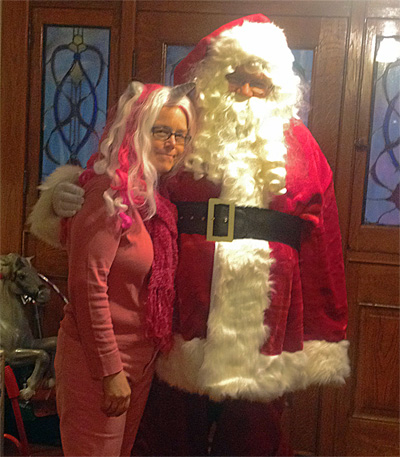
Santa and a "demented" little Red Riding Hood.

Santa and a “demented” little Red Riding Hood.

This post is not writing related. For the small number of loyal reader who stop by, I hope you will indulge me. Halloween in my historic neighborhood in Knoxville, TN, has evolved into an event where literally hundreds of children (and would-be children) show up for trick or treat on Halloween in night. For example, in 2013, between 6:15 and 8:15 PM, 283 tricksters showed up. This year, 2014, between approximately 5:45 PM and 8:45 PM, 300 tricksters (young and not-so-young). Roughly the same, though this year there was some rain, gusty wind at times, and a stronger dip in temperatures than last year, all of which may have discouraged some.

As a side note, a fellow in an adjoining historic neighborhood complained that as the weather turned colder and rain and wind picked up, he had parents come to collect for their kids who stayed in the cars. I saw one or two examples of that, but mostly I saw kids and adults with umbrellas making the best of it.

Regardless, as you can see, that is quite a few tricksters who came to Old North Knoxville. I dressed as Santa Claus and handed out candy, while my wife and daughter went trick-or-treating with some friends. I surprised a few young tricksters when I would open the sidelight window next to our front door and stick my head out. Some were rendered speechless. A few asked if I was real, to which I replied, “I’m as real as you.” Two or three wanted to touch my white-gloved hand or my beard. A few older, more “seasoned” kids started into their Christmas wish list, including one young lady who wanted both an iPad and an iPhone among the items on her list. I just don’t know if she has been good enough to receive both or even one. She looked a little naughty to me. Then, again, I guess Halloween was the night for a little naughtiness.

Santa Claus and the Pink Unicorn Lady. Nothing says Halloween quite like a woman in pink with a horn on her head.

Santa Claus and the Pink Unicorn Lady. Nothing says Halloween quite like a woman in pink with a horn on her head.

Leave a comment

Filed under holiday

The Bookstore Strikes Back

The Bookstore Strikes Back – Ann Patchett – The Atlantic.

Parnassus Books

by Ann Patchett

Author opens an independent bookstore to fill a need.

Address: 3900 Hillsboro Pike, Nashville, TN 37215
Phone:(615) 953-2243

Two years ago, when Nashville lost its only in-town bookstores, the novelist Ann Patchett decided to step into the breach. Parnassus Books, which Patchett and two veteran booksellers envisioned, designed, financed, and manage, is now open for business and enjoying the ride.

In late February I am in my basement, which is really a very nice part of my house that is not done justice by the word basement. For the purposes of this story, let’s call it the Parnassus Fulfillment Center. I have hauled 533 boxed-up hardback copies of my latest novel, State of Wonder, from Parnassus, the bookstore I co-own in Nashville, into my car; driven them across town (three trips there and three trips back); and then lugged them down here to the Parnassus Fulfillment Center. Along with the hardbacks, I have brought in countless paperback copies of my backlist books as well. I sign all these books and stack them up on one enormous and extremely sturdy table. Then I call for backup: Patrik and Niki from the store, my friend Judy, my mother. Together we form an assembly line, taking orders off the bookstore’s Web site, addressing mailing labels, writing tiny thank-you notes to tuck inside the signed copies, then bubble-wrapping, taping, and packing them up to mail. We get a rhythm going, we have a system, and it’s pretty smooth, except for removing the orders from the Web site. What I don’t understand is why, no matter how many orders I delete from the list, the list does not get shorter. We are all work and no progress, and I’m sure something serious must be going wrong. After all, we’ve had this Web site for only a week, and who’s to say we know what we’re doing? “We know what we’re doing,” Niki says, and Patrik, who set up the Web site in the first place, confirms this. They explain to me that the reason the list isn’t getting any shorter is that orders are still coming in.

You may have heard the news that the independent bookstore is dead, that books are dead, that maybe even reading is dead—to which I say: Pull up a chair, friend. I have a story to tell.

The reason I was signing and wrapping books in my basement is that more orders were coming in than the store could handle, and the reason so many orders were coming in is that, a few days before, I had been a guest on The Colbert Report. After a healthy round of jousting about bookstores versus Amazon, Stephen Colbert held a copy of my novel in front of the cameras and exhorted America to buy it from Amazon—to which I, without a moment’s thought (because without a moment’s thought is how I fly these days), shouted, “No! No! Not Amazon. Order it off ParnassusBooks.net, and I’ll sign it for you.” And America took me up on my offer, confirming once and for all that the “Colbert bump” is real. That explains how I got stuck in the basement, but fails to answer the larger question of what a writer of literary fiction whose “new” book was already nine months old was doing on The Colbert Report in the first place. Hang on, because this is where things get weird: I was on the show not because I am a writer but because I am a famous independent bookseller.

Let’s go back to the beginning of the story.

Two years ago, the city of Nashville had two bookstores. One was Davis-Kidd, which had been our much-beloved locally owned and operated independent before selling out to the Ohio-based Joseph-Beth Booksellers chain 15 years earlier. Joseph-Beth moved Davis-Kidd into a mall, provided it with 30,000 square feet of retail space, and put wind chimes and coffee mugs and scented candles in front of the book displays. We continued to call it our “local independent,” even though we knew that wasn’t really true anymore. Nashville also had a Borders, which was about the same size as Davis-Kidd and sat on the edge of Vanderbilt’s campus. (In candor, I should say that Nashville has some truly wonderful used-book stores that range from iconic to overwhelming. But while they play an important role in the cultural fabric of the city, it is a separate role—or maybe that’s just the perspective of someone who writes books for a living.) We have a Barnes & Noble that is a 20-minute drive out of town without traffic, a Books-A-Million on the western edge of the city, near a Costco, and also a Target. Do those count? Not to me, no, they don’t, and they don’t count to any other book-buying Nashvillians with whom I am acquainted.

In December 2010, Davis-Kidd closed. It was profitable, declared the owners from Ohio, who were dismantling the chain, but not profitable enough. Then, in May 2011, our Borders store—also profitable—went the way of all Borders stores. Nashvillians woke up one morning and found that we no longer had a bookstore.

The rest of the story at: http://www.theatlantic.com/magazine/archive/2012/12/the-bookstore-strikes-back/309164/?single_page=true

1 Comment

Filed under bookstore