Tag Archives: Saturday

Book banning … quietly. Shhh

Florida principal tries to quietly ban book to appease Christians — sets off sh*tstorm instead

by David Ferguson

Source: http://www.rawstory.com/2015/08/florida-principal-tries-to-quietly-ban-book-to-appease-christians-sets-off-shtstorm-instead/

A high school principal in Tallahassee, Florida is in hot water over his unilateral decision to drop a controversial book from a summer reading list for students.

Book banning

Book banning

According to the Tallahassee Democrat, Lincoln High School Principal Allen Burch pulled The Curious Incident of the Dog in the Nighttime by Mark Haddon after a handful of Christian parents complained that the novel did not show proper reverence for God and the Christian faith.

Curious Incident is the story of a 15-year-old British math genius who is on the autism/Asperger’s Syndrome spectrum. The teenager relays everything that happens around him in the same matter-of-fact, almost emotionless tone, including some adults’ struggles with faith and a belief in God.

Burch’s decision to pull the book has caught the attention of the National Coalition Against Censorship (NCAC) and other major freedom of information, anti-censorship organizations.

“This case is very startling. A handful of parents are making choices for every other parent in that school,” said Sarah Hoffman of the NCAC to the Democrat. “There is a reason policies are in place — to protect educators and the decisions they make.”

“This seems like a knee-jerk decision,” she continued.

But Sue Gee, one of the parents who complained about the book, feels that Curious Case is an affront to her faith and that its casual use of swear words would be harmful to students.

“I am not interested in having books banned,” said Gee, a former primary school teacher. “But to have that language and to take the name of Christ in vain — I don’t go for that. As a Christian, and as a female, I was offended. Kids don’t have to be reading that type of thing and that’s why I was asking for an alternative assignment.”

“I know it’s not realistic to pretend bad words don’t exist, but it is my responsibility as a parent to make sure that my daughter knows what is right or wrong,” she said.

But parents like Valerie Mindlin said they don’t want religious parents or any other kinds of ideologues dictating to teachers what they can and can’t teach.

“I was stunned,” said Mindlin. “I feel like it is second-guessing teachers. I never thought that the school would participate in an act of censorship. “At what point do you let parents decide the curriculum for an entire school?”

Lincoln County School Board member Alva Striplin told the Democrat that the agency is just trying to act in the best interests of students.

Striplin believes that Curious Incident should be replaced by something more innocuous.

“We are simply listening to parents’ concerns,” Striplin said. “We’ve got a million books to choose from and this one should not be on the district approval list.”

1 Comment

Filed under 2015

Science fiction and Pluto

Sci-fi becomes reality: 10 books about our future with Pluto

Pluto photographed during New Horizons flyby.

Pluto photographed during New Horizons flyby.

“If you can imagine it, you can achieve it. If you can dream it, you can become it.”

–William Arthur Ward

by Andrea Sefler

Source: http://www.popmythology.com/10-sci-fi-books-about-pluto/

Stargazers are having a momentous week with the Pluto flyby of New Horizons. With this success we have now made close inspection of most of the largest objects throughout much of our solar system, from the sun and all the planets, even the tiny one 4.67 billion miles out. And I refuse to engage in any “size matters” arguments here; I grew up learning nine planets, and nine planets there be.

While scientists will spend many years analyzing data from the mission making new discoveries, there is already a great deal of impressive accomplishments from the mission. Let’s just take the spacecraft itself. Are you one of those people impressed with and lusting after a high-tech Tesla? Well the New Horizons probe engineers managed to pack everything needed for the 9.5 year journey and the data collection upon arrival at Pluto into a craft smaller and lighter than many automobiles. Not to mention the fact that this baby was ripping along at more than 50,000 mph. Okay, maybe we can’t get the benefits of a gravitational assist from Jupiter on our highways, but this still makes a battery life of ~265 miles on an electric car seem weak.

Many will disparage this mission’s $720 million price tag and the space program in general as a waste of taxpayer money for esoteric and useless knowledge about places far too distance to be of concern. But the data collected at the destination is almost hardly more than icing on the cake. The real value lies in the journey and what needed to happen in order to make it a possibility. Most of our public companies, even those considered to be our most innovative, such as Apple, are concerned with small, incremental product changes, e.g. a few more pixels in the camera, a little bit larger screen. With NASA and the space program, the absolute necessity for small, robust, energy efficient components compel designers to push things to the limits. And then we all get to benefit from the successes as the designs find their way into our everyday devices.

Whether this gets done through solely at government agencies or through public/private consortiums, the point is to have these big, shared dreams and goals. My earliest datable memory is of the Apollo 11 moon launch. I am still staggered ever time I visit the Kennedy Space Center by the Saturn V rocket and all the incredible infrastructure developed to build, transport, and launch this behemoth, including the Vehicle Assembly Building, which is so large it sometimes rains inside.

The dream of sending a person to the moon united people to a common mission and, as such, everyone had a part in the success. Even better are the missions involving international collaborations, such as Apollo-Soyuz where we can begin to imagine ourselves as citizens of planet Earth and not Greeks or Germans or Americans or Russians.

But these missions all begin with dreams: dreams that came straight out of the pages of science fiction novels, leapt into the minds of curious, adventurous men and women, and wound up at the far end of our solar system. Many a great scientific discovery throughout history has been preceded by a fictitious imagining of it. Jules Verne published From the Earth to the Moon in 1865, and then in 1969 we did go from the earth to the moon via Apollo 11. H.G. Wells imagined tanks in The Land Ironclads (1903), and tanks were invented in 1915. There are many more examples, and whether these works of sci-fi were merely prophetic visions or actually served as inspiration in some direct or indirect way, the point is that the ability to imagine something comes before the actual doing. And in this respect sci-fi often has stronger ties to the real world than some people give it credit for.

One of several novels about Pluto

One of several novels about Pluto

Today’s far fetched concepts may be tomorrow’s reality. And today’s flyby may be tomorrow’s manned expedition to Pluto. In celebration and acknowledgement of this idea, here are some sci-fi works over the years that have involved Pluto in some way. Some of these are forgotten works, but may they be rediscovered and inspire future generations to imagine new discoveries.

Details about the books at: http://www.popmythology.com/10-sci-fi-books-about-pluto/

Leave a comment

August 8, 2015 · 11:04 pm

Stephen Baxter interview: why science fiction is like therapy

The bestselling SF writer talks about the rush to finish the Long Earth series, being the order to Terry Pratchett’s chaos and how maths helps him write

by Alison Flood

Source: http://www.theguardian.com/books/2015/jul/25/stephen-baxter-interview-why-science-fiction-is-like-therapy

In the summer of 2013, Stephen Baxter and Terry Pratchett published The Long War, the second volume of their Long Earth science-fiction series, about parallel worlds that can be “stepped” into. By the end of that year, the two authors – both prolific by any standards – had completed drafts of the remaining three novels in the series. It was an astonishing rate of work, but there was a deadline that needed to be met: Pratchett had announced his diagnosis with a rare form of early onset Alzheimer’s in 2007. By the summer of 2014, he would pull out of a Discworld convention, citing “The Embuggerance”, which was “finally catching up with me”. He died in March this year.

Stephen Baxter

Stephen Baxter

“I think Terry was aware he was running out of time, and he wanted to do other things as well,” Baxter says. “So we rushed through it a little bit. Terry’s basic vision was the first step, but he also wanted to have a huge cosmic climax at the end, which would be book five … We had no idea how to get there but we knew where we were going.”

The Long Utopia, the fourth in the series, sees settlers on an Earth more than “a million steps” west of ours stumble across a disturbing, insectile form of alien life. Like its predecessors, the novel is compelling not only for its central storyline of exploration and danger and humans doing foolishly human things – and in this case a particularly cataclysmic finale – but also for its slow, unhurried laying out of the minute differences between these empty-of-humanity Earths.

The concept of a chain of parallel worlds, each a little different from its neighbour, was one Pratchett originally had, and set aside, in the 1980s. He told Baxter, a long-time friend and one of the UK’s most respected science-fiction authors, about it over dinner one night, and they decided to collaborate.

“It was a great idea but Terry’s strength did not lie in landscapes and things,” Baxter says. “He’d get a story by having a basic idea, get two people in a room talking and see where it went from there.”

This is not how Baxter works. His fiction, whether about the colonising mission sent to a planet orbiting a nearby red dwarf star, in Proxima, or the exploration of different evolutions of humanity in the Destiny’s Children series, is meticulously planned and pinned down, rooted in the scientific background from which he comes. He has a degree in maths from Cambridge and a PhD in aeronautical engineering; he is a fellow of the British Interplanetary Society and applied for a guest spot on the Mir space station in 1989, making it through a number of stages on his quest to be a cosmonaut but eventually missing out because of his lack of foreign languages.

Whether Baxter decides to submerge the world (Flood), or make humanity live in the centre of a neutron star (Flux), or keep the sea off Doggerland in an alternative prehistory (Stone Spring), there’s always a hook into something real. “I try to get it right. If you can get the maths right, I figure you’re most of the way there,” he says.

Baxter is fiercely intelligent, in a generous way, sharing his enthusiasms and knowledge on everything from recently discovered exoplanets to the Mars project (he’s not hopeful, because he doesn’t think enough has been done on long-term life support systems). At the British Interplanetary Society, he’s been part of study projects on everything from designing star ships to extraterrestrial liberty, an issue explored in Ark, his follow-up to Flood, in which the scraps of humanity flee their devastated planet in “generation ships” for an uncertain future outside the solar system.

“It’s all very well to plan a five-generation mission to Alpha Centauri, but if you’re one of the middle generations, you live out your life with very little room for manoeuvre,” he says. “So what right do you have to submit your children and grandchildren to a life of slavery like that? You get some interesting ethical issues – do you have rights over people who don’t yet exist, do they have rights?”

Rest of the article: http://www.theguardian.com/books/2015/jul/25/stephen-baxter-interview-why-science-fiction-is-like-therapy

Leave a comment

Filed under 2015, author interview

Twilight Zone script: “Walking Distance”

From the Famous Writers Course. Part of the Famous Writers School in Westport, CT. I don’t believe the school or the course is in existence today.

Front cover of the facsimile script.

Front cover of the facsimile script.

Inside, first page.

Inside, first page.

“There is a fifth dimension beyond that which is known to man. It is a dimension as vast as space, and as timeless as infinity. It is the middle ground between land and shadow — between science and superstition. And it lies between the pit of man’s fears and the summit of his knowledge. It is an area which we call The Twilight Zone.

1 Comment

Filed under 2015, The Twilight Zone

What Not to Say to Bookstore Employees

Source: http://bookriot.com/2015/07/03/what-not-to-say-to-bookstore-employees-2/

Avoid bookstore faux pas like the following while speaking to the overworked bookstore employees with their smocks and helpful head nods:

  1. How much does this cost on Amazon?
  2. How can you work here when Amazon Prime exists? Are you on Amazon Prime?
  3. I’m a writer and I don’t want to waste my time, so which of these should I actually read?
  4. I only read signed copies. Where is the signed section?
  5. I don’t need help. I just come by the bookstore to hit on the smart people buying Ulysses for light, fun reading.
  6. I don’t need help. I just want to write down all of Giada’s recipes.
  7. I don’t need help. I’m just figuring out where my book will be shelved once I finish it, get an agent, sell it, and get it stocked here, in this location.
  8. I don’t need help. I’m just writing notes on page fifteen of every book. I’m creating a treasure hunt for the bookish.
  9. Which of these is going to be a movie? I want to judge the future movie by the past cover.
  10. How many teens die in this one? I only respond to mass numbers of teen deaths.
  11. If I just spilled my coffee on the hardcover book of swimming dogs, should I tell you about it?

Rest of the list at: http://bookriot.com/2015/07/03/what-not-to-say-to-bookstore-employees-2/

Leave a comment

Filed under 2015, books, bookstore

Court ruling against Apple over e-book pricing upheld

Apple’s mistake was hooking up with the book-publishing cartel

Source: http://fortune.com/2015/06/30/apple-court-books/

An appeal court’s decision finding Apple guilty of collusion with publishers reinforces just how cozy a cartel the industry was.

Apple may be trying to keep the spotlight on its latest foray into the streaming-music business, but it is also still trying to clean up the mess caused by its ham-handed entry into an earlier market: book publishing. A federal court on Tuesday rejected the company’s appeal of an earlier ruling that found it guilty of orchestrating a conspiracy with the major book publishers, in what the court said was a successful attempt to artificially inflate the price of e-books.

As Fortune‘s Jeff Roberts reports, the court found Apple AAPL -0.16% engaged in collusion with what amounted to an oligopoly—namely, Harper Collins, Penguin, Simon & Schuster, Hachette and Macmillan—and that its actions were a clear breach of antitrust law. Apple argued that the deal it cut with the publishers was necessary to blunt Amazon’s dominance in the e-book market, but the appeals court didn’t buy that argument. Judge Debra Ann Livingston wrote:

“Competition is not served by permitting a market entrant to eliminate price competition as a condition of entry, and it is cold comfort to consumers that they gained a new ebook retailer at the expense of passing control over all ebook prices to a cartel of book publishers.”

One reason the court failed to buy this argument is that the major publishers clearly had zero interest in actually competing on price—in fact, they wanted to do exactly the opposite. Their interest in doing a deal with Apple stemmed from a desire to maintain the existing favorable price structure for books, which allowed them to milk the market for high-priced hardcover versions of new novels before eventually releasing cheaper versions. Amazon’s AMZN 0.07% low-priced e-books were a threat.

Rest of the article: http://fortune.com/2015/06/30/apple-court-books/

***
One lawyer’s comments on the judgment:

The Passive Voice

Source: http://www.thepassivevoice.com/07/2015/apples-mistake-was-hooking-up-with-the-book-publishing-cartel/

After strong-arming Amazon into accepting the new “agency pricing” model—in which the publishers got to set the price for their books, rather than allowing the retailer to do so—the book industry got exactly what it wanted. According to research by the Justice Department, the price of newly released books rose by an average of 24% and bestsellers climbed by 40%.

It says a lot about the book-publishing business that doing this actually caused book sales to drop fairly dramatically across the board: research done by another expert using data from Random House showed that publishers who switched to the agency model sold close to 15% fewer books than they would have otherwise. So the industry was effectively willing to trade a short-term decline in sales for the increase in power that they got over pricing as a result of the deal with Apple.

Full blog entry at: http://www.thepassivevoice.com/07/2015/apples-mistake-was-hooking-up-with-the-book-publishing-cartel/

Leave a comment

Filed under 2015, book publishing

Books about women less likely to win prizes, study finds

Study of six major awards in the last 15 years shows male subjects the predominant focus of winning novels.

by ALISON FLOOD

Source: http://www.theguardian.com/books/2015/jun/01/books-about-women-less-likely-to-win-prizes-study-finds

Analysis of the last 15 years of winners of six major literary awards by the critically acclaimed author Nicola Griffith has found that a novel is more likely to land a prize if the focus of the narrative is male.

Griffith looked at the winners of the Pulitzer, Man Booker, National Book award, National Book Critics’ Circle award, Hugo and Newbery medal winners over the last 15 years. She collated the gender of the winners, and that of their protagonists, finding that for the Pulitzer, for example, “women wrote zero out of 15 prize-winning books wholly from the point of view of a woman or girl”.

The Man Booker, between 2000 and 2014, was won by nine books by men about men or boys, three books by women about men or boys, two books by women about women or girls, and one book by a woman writer about both. The US National Book award over the same period, found Griffith, was won by eight novels by men about men, two books by women about men, one book by a man about both, three books by a woman about both, and two books by women about women.

“It’s hard to escape the conclusion that, when it comes to literary prizes, the more prestigious, influential and financially remunerative the award, the less likely the winner is to write about grown women. Either this means that women writers are self-censoring, or those who judge literary worthiness find women frightening, distasteful, or boring. Certainly the results argue for women’s perspectives being considered uninteresting or unworthy. Women seem to have literary cooties,” wrote Griffith in a piece laying out her analysis in a series of pie charts.

“The literary establishment doesn’t like books about women. Why?” she asked. “The answer matters. Women’s voices are not being heard. Women are more than half our culture. If half the adults in our culture have no voice, half the world’s experience is not being attended to, learnt from or built upon. Humanity is only half what we could be.”

Her analysis came as the summer issue of Mslexia, the magazine for women writers, explores the the “silent takeover by men of the top jobs” in British publishing. Industry expert Danuta Kean laid out how, since 2008, the “women at the top of the three biggest corporate publishing houses have stepped aside – in each case to be replaced by men”.

Penguin managing director Helen Fraser retired in 2009, pointed out Kean, Random House chair and chief executive Gail Rebuck stepped down from the day-to-day running of the company in July 2013, and Victoria Barnsley has been replaced at HarperCollins by Charlie Redmayne. Little, Brown chief executive Ursula Mackenzie has also recently announced she would be stepping down from her position in July, replaced by David Shelley.

Rest of the article: http://www.theguardian.com/books/2015/jun/01/books-about-women-less-likely-to-win-prizes-study-finds

Leave a comment

Filed under 2015, literary awards, study

10 Little Known Facts About Sir Arthur Conan Doyle

Source: https://www.goodreads.com/blog/show/520-10-little-known-facts-about-sir-arthur-conan-doyle?fb_ref=Default

1. He compared Sherlock Holmes—arguably his greatest creation—to pâté de foie gras.
…And Doyle really hated pâté de foie gras. He told a friend, “I have had such an overdose of [Holmes] that I feel towards him as I do towards pâté de foie gras, of which I once ate too much, so that the name of it gives me a sickly feeling to this day.”

2. We live in a world with Doyle’s fiction because no one wanted him as their doctor.
If at first you don’t succeed at being a doctor, become a world-famous novelist! After getting his medical degree from the University of Edinburgh Medical School and serving as a ship’s surgeon, Doyle opened his own practice in Southsea. Hardly any patients came, so he began writing fiction in his free time.

3. Doyle and Peter Pan author J.M. Barrie were on the same cricket team.
The team was called the Allah-Akabarries, a combination of Barrie’s name and an Arabic phrase meaning, “May the Lord help us.” The two men met at university and remained lifelong friends.

4. He once bought a car without ever having driven one.
Best way to learn, right? Doyle was one of Britain’s early prominent motorists, and he quickly took to the emerging form of transport, entering an international road competition in 1911.

5. He spent a million dollars trying to convince the world that fairies were real.
Not only did Doyle believe fairies existed, he worked pretty tirelessly to make other people believe too. His million went to promoting the authenticity of the infamous Cottingley Fairy photographs—a hoax, if you’re a skeptic, and not a true believer like Doyle—and he later wrote a book called The Coming of the Fairies.

To read the rest, go to: https://www.goodreads.com/blog/show/520-10-little-known-facts-about-sir-arthur-conan-doyle?fb_ref=Default

Leave a comment

Filed under 2015, writers

MythBuster Adam Savage builds “Star Trek” captain’s chair

Watch the co-host of the “Mythbusters” science show make a functional “Star Trek” chair worthy of Captain Kirk, with help from his friend Jeremy Williams.

Source: http://www.cnet.com/news/mythbuster-adam-savage-builds-star-trek-captains-chair/

Adam Savage, co-host of the Discovery channel’s “MythBusters” science show, never shies away from a challenge. When he acquired a disappointing replica of a “Star Trek” captain’s chair, instead of being content with it, the longtime prop maker decided to make a brand-new and better chair.

n the latest video from Tested.com, Savage shows off his impressive captain’s chair, and then with help from his friend Jeremy Williams does some electronics magic to wire the chair’s lighting system and implement sound effects. After some troubleshooting, the duo add various LED lights, light strips, power sources, speakers and of course, many wires.

“As I was building it, I’d like it to have a feature that no other chair has,” Savage said in the video. “So I ended up adding a couple of features like a viewer, which is in ‘The Cage,’ which is the unaired pilot of ‘Star Trek.’ [And] I added one other feature so I made a drawer (in the base) for the props.”

The handcrafted chair has five interface panels, which include the switch bank of rocker switches, the lights display, five push buttons and the intercom.

The result is the ultimate, one-of-a-kind “Star Trek” captain’s chair with details that would impress even Scotty. Check out this photo gallery to see behind-the-scenes shots of the build process.

Leave a comment

Filed under 2015, Star Trek

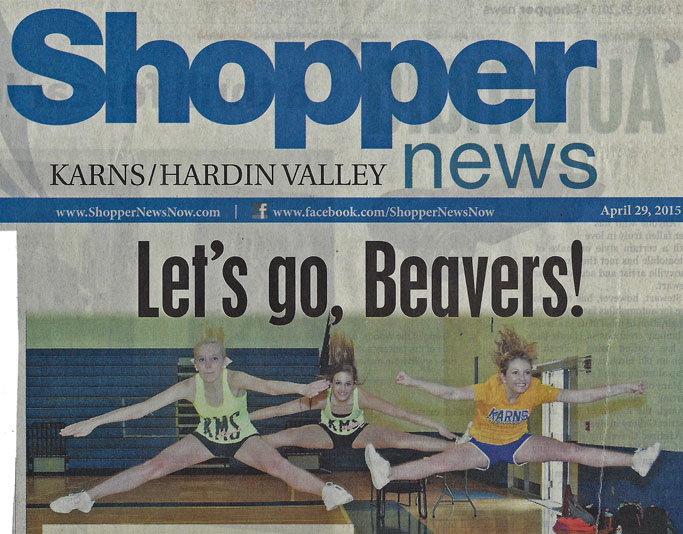
An unfortunate juxtaposition

The headline meaning is clear, or is it?

The headline meaning is clear, or is it?

An unfortunate juxtaposition

It was an unfortunate juxtaposition
An editorially poor rendition
And a layout contradiction
Of the work being done that day.

The ladies were up in the air
Arms and legs wide without a care
And the photographer “froze” them there:
A fine photo some might say.

But a headline was then put in place
Above their wide-open pose embrace
Each with a smile upon her face
And things came out another way.

The headline read: “Let’s go, Beavers”
And for those who are “mis-perceivers”
The headline was an overachiever
Of the double entendre sort of sway.

Some members of the fourth estate
To this day cannot contemplate
How such a printing came to state
Something that put such a pun in play.

So let this be today’s object lesson
About laying out a front-page section
And how others can have a perception
Where you place things a certain way.

–poem by David E. Booker

Leave a comment

Filed under 2015, poetry by author