Tag Archives: Saturday

Libraries: the hauntingly beautiful and the beautifully haunted

The World’s Most Beautiful Library Is In Prague, Czech Republic

Source: http://www.boredpanda.com/beautiful-library-prague-czech-clementinum/

The Klementinum library

The Klementinum library

The Klementinum library, a beautiful example of Baroque architecture, was first opened in 1722 as part of the Jesuit university, and houses over 20,000 books. It was voted as one of the most beautiful and majestic libraries in the world by our readers!

The ceiling frescoes were painted by Jan Hiebl. In 1781, director Karel Rafael Ungar established Biblioteca Nationalis, a collection of Czech language literature. Some of the rare historical books from this collection have been sent to Google for scanning and will eventually be available on Google Books.

Just as the library is a rare and little-known treasure, so is it associated with several little-known facts: the Klementinum used to be the third largest Jesuit college in the world; recording of local weather began there in 1775 and has continued ever since; it is featured in a novel by famous Spanish-language writer Jorge Luis Borges.

Photos of the library can be seen here: http://www.boredpanda.com/beautiful-library-prague-czech-clementinum/

***

Phantoms among the Folios: A Guide to Haunted Libraries

Source: http://americanlibrariesmagazine.org/2015/10/28/phantoms-among-folios-guide-to-haunted-libraries/

In the fall, a journalist’s fancy lightly turns to thoughts of ghosts. Newspapers and magazines that haughtily refrain from printing news of the paranormal for 11 months of the year eagerly jump on the Halloween coach in October to regale their audiences with dubious tales of the preternatural.

American Libraries is no exception. However, unlike less reputable media, we go to original sources whenever possible to ascertain whether or not our spooks are spurious. And in so doing we have uncovered a hauntful of genuinely eerie events hiding amid the folktales.

Libraries are haunted?

Bleak mansions and somber castles usually spring to mind when we think of haunted places. But ghostly phenomena—whatever the cause—can manifest in well-lit, modern offices as well as crumbling Carnegies. Of course, it helps if you inadvertently build your library on top of a graveyard.

Haunted libraries fall into two types. First, there is the “building with a reputation,” where a convenient murder, curse, or other tragedy has occurred. Library staff can then blame the odd noise, the occasional book falling off the shelf, or glitches in the air conditioning on the resident “scapeghost.” No one reports anything too spooky, and the children’s librarians have a good time with it at story hour.

Second, there are libraries where credible, responsible people observe enigmatic human shapes, hear disembodied voices, and witness other classic parapsychological events. Glib explanations about how the building must be settling ring about as hollow as those mysterious footsteps late at night on the upper floorboards. The library staff learns to live with its wraith, usually by accepting the paranormal as a normal working condition.

Both categories of haunted libraries are described here. Like a good journalist I will begin with Type One, forcing you to read through to the end to get the good stuff. Just make sure you don’t finish this article alone in bed, late at night, during a violent thunderstorm.

’Tis the curse of service

As if library directors didn’t have enough to worry about, a curse would be sufficient to send stress levels over the line. Fortunately, the curse on Peoria (Ill.) Public Library directors seem to have lifted long ago. Uttered in 1847 by the lawyer-plagued woman who owned the land where the library now stands, the curse is said to have been responsible for the untimely deaths of three directors: The first was killed in a streetcar accident in 1915, the second died from a heart attack suffered after a heated debate at a library board meeting in 1921, and the third committed suicide in 1924 by swallowing arsenic. Since then, Peoria directors have lived long, fruitful lives.

Trisha Noack, ‎manager of Public Relations at Peoria Public Library, said their Main Library was remodeled and reopened in December 2010.

“Most of these reports came from the stacks area, now known as LL1 and the home of our Art Gallery and Local History and Genealogy Room,” Noack said. “Since the stacks were eliminated (and) the entire library building (was) stripped down to the bare walls, there has been no further activity.”

Ruth did it

On October 11, 1947, Ruth Cochran, assistant librarian at the Umatilla County Public Library in Pendleton and president of the Eastern Oregon Library Association, suffered a cerebral hemorrhage as she was closing the building. She went to the basement to rest, but soon became too weak to move or summon help. The next day the custodian’s wife found her, still conscious, and she was taken to the hospital where she died, according to the Pendleton East Oregonian. Ever since, spooky events in the library have been blamed on Ruth’s ghost.

Harvey Thompson, a library patron who took an interest in Ruth, said there is “something in the building that makes people nervous.” Once a custodian was alone in the building painting the children’s room when the intercom system buzzed repeatedly. “The folklore was that Ruth was suffering in the basement trying to summon someone,” Thompson said.

The library, now called the Pendleton Public Library, moved to into a vacant remodeled junior high school building in November 1996, according to library director Mary Finney. Ruth’s old building has been converted into the Pendleton Center for the Arts. Former executive director Tom Hilliard said that he never saw or heard anything he couldn’t explain: “It was an old building [a Carnegie built in 1916]. Noises turned out to be pipes expanding or a bird in the attic.”

Rockin’ wraith

The Cairo (Ill.) Public Library boasts of a ghost that one young library patron has dubbed Toby. Director Monica Smith noted that Toby usually hangs out in the special collections room on the second floor of this 1884 building. “I’m here a lot of times by myself at night, and I do hear many different sounds like someone walking around upstairs,” Smith said. “Many times I come back and find the lights on that we turned off in that room. I definitely think there is a presence here.”

Former librarian Louise Ogg once saw a ghostly light rise up from behind a desk, pass slowly by her office, and disappear into the book stacks. Another staff member was with her and saw the same thing. There used to be a rocking chair in the library that made creaking noises by itself, as if someone were rocking in it. “You kind of get used to it,” Smith said.

More available at: http://americanlibrariesmagazine.org/2015/10/28/phantoms-among-folios-guide-to-haunted-libraries/
Leave a comment

Filed under 2015, library

The blathering idiot and Saturdays

The blathering idiot and Lydia, his campaign manager for the Pro-Accordion Party, were driving down the road from one stump speech stop to another in his quest for the highest office in the land. It was hard to keep up with the other candidates. He had crossed paths with one of them recently and happened to catch part of what he was saying. What surprised the blathering idiot even more than the other candidates way of speech delivery was the sign on the front of his lectern. Apparently the silent majority stood with this candidate. From the way the candidate was speaking, attacking everyone and everything that wasn’t American and white, he could understand why the “majority” was silent: It couldn’t get in a word edgewise.

The blathering idiot had always wanted to adopt Saturdays.

The blathering idiot had always wanted to adopt Saturdays.

But what intrigued the blathering idiot was a sign he saw outside a business. One time when he passed, it read: “Adopt Nov. 21.” Another time, it read “Adopt Saturday.” He wondered how you could adopt a day in November or even a day of the week. If so, there was a day he wanted to adopt. So, on the way driving through town because there was not enough money in the campaign war chest to fly to the different places or even travel too far, he pulled into the parking lot, then stepped inside the store. He walked up to the counter and asked, “How do I adopt a day?”

The older woman behind the counter looked up and said, “Is this a joke?”

“I’ve always wanted to adopt Saturdays. All of them, if I could. Ever since I was a kid, it was my favorite day of the week. Wake up late, eat two bowls of my favorite cereal, watch cartoons until my eyes were about to pop, then eat popcorn for lunch, and ride bikes with my friends, pedaling so hard we wanted to throw up. I want to adopt Saturdays.”

“Who don’t adopt Saturdays here,” the woman said.

“But your sign says—”

“That sign is for dogs.”

“You mean dogs can adopt Saturdays, but I can’t?” If so, it really was a dog’s life.

“No. The sign is about adopting dogs.”

“You mean if I adopt a dog, the dog can adopt Saturdays?”

“Get out. Now!”

The blathering idiot hustled out the door and back to the campaign car and climbed inside.

“Are you okay?” Lydia asked.

The blathering idiot sighed. “I wish I was eleven and it was Saturday. Saturdays when you are eleven are the best Saturdays there are.”

He wondered if the silent majority felt that way, too.

1 Comment

Filed under 2015, blathering idiot, political humor

Halloween: “Say what?!”

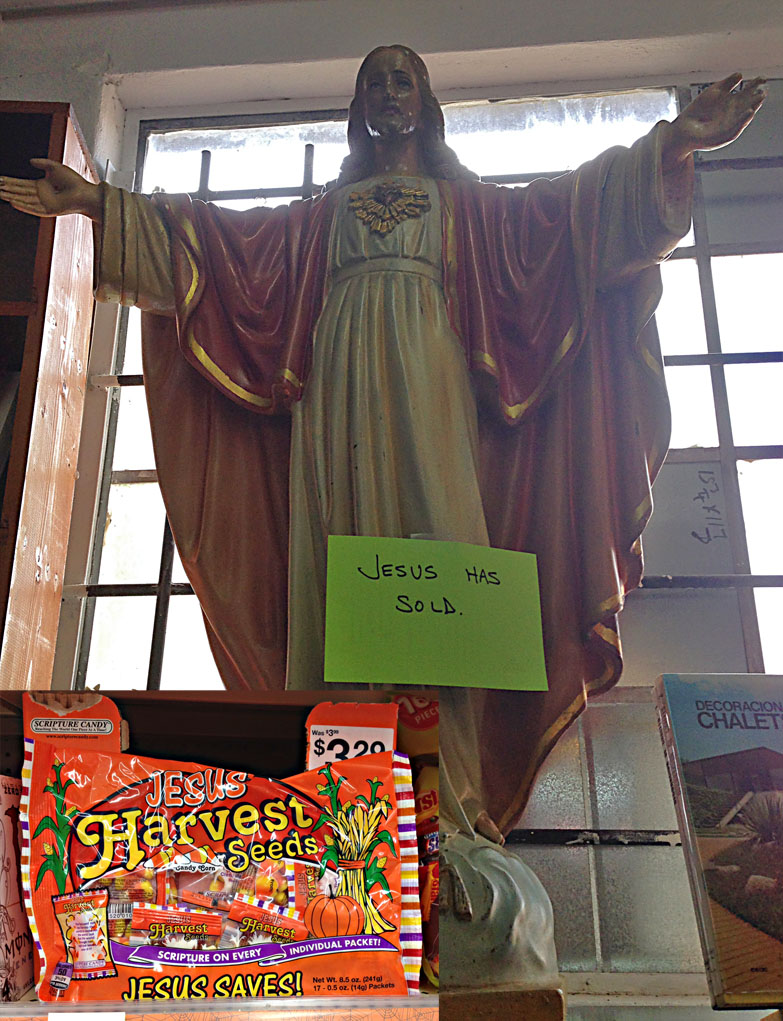
Jesus Harvest Seeds

Jesus Harvest Seeds

Holiday madness is upon us.

Somebody must have thought this was a good idea. I don’t think so. Candy corn is now Jesus Harvest Seeds, at least if you buy them in this package. “Scripture on every individual packet!” I wonder if one of them is “Jesus wept.”

Maybe the second shortest verse in the modern Bible should be “Jesus has sold.” Or, “Jesus has been sold.”

Jesus and "Harvest Seeds."

Jesus and “Harvest Seeds.”

1 Comment

Filed under 2015, holiday, Say what?!

“Holly’s Corner,” part 5

[Writer’s note: What began as a writing prompt — photo and first paragraph — has become at least the start of a story. I will endeavor to add short sections to it, at lest as long as there is some interest. It might be a little rough in parts, but that’s because it is coming “hot off the press,” which could be part of the fun of it. In the meantime, you are free to jump off from any part of this story thus far and write your own version. Click Holly’s Corner below to get Parts 1 – 4.]

by David E. Booker

I felt a little heat come into my ears.

“How cute,” Tricia said, her eyesight back to normal.

“Glad I could entertain.”

I turned and walked up to bar to order a sandwich. Diving into the mud and straddling a 2×6 had left me wet and hungry. The wet part would have to resolve itself with time. The hunger part I could do something about.

“I’ll have a Ricky Ricardo,” I said. “Don’t tell Lucy.”

The young woman behind the counter had a rainbow of colors in her hair, and if perplexed could be a color, she had that one on her face.

I made my glass of tea and found where Tricia was sitting. It was in a booth that looked out one of the front windows. On the window was painted a pig carrying a rolling pin and words underneath about bacon being a salvation. Beyond the pig was the outside world, the sidewalk where I had taken my dive, and the rain that continued its drumming on the world. My client had had a front row seat to my brush with a rolling pin.

It was a cool, rainy day down at Holly's Corner.

It was a cool, rainy day down at Holly’s Corner.

Tricia already had a sandwich, something vegetarian and most of it eaten or at least nibbled into.

“That was my sister that threatened you.”

I didn’t bother correcting the second that. “She doesn’t look anything like you.”

“Well … technically she’s my step-sister. My dad remarried after my mom died.”

“I’m sorry.”

Tricia shrugged. I was two when mom died. Don’t remember much about her. My step-mom was the only mom I really knew, and she was okay … when she wasn’t drinking. And I’m afraid my sister has inherited her predilection.”

I raised an eyebrow slightly. I was impressed that Tricia knew what predilection meant and wasn’t afraid to use it.

My sandwich arrived. I had snagged a bottle of hot sauce from the small round table nearby. The sandwich was cut into two pieces. I lifted the top off one half and added some of the sauce. Tricia winced.

“Don’t like hot sauce?”

“You’re ruining the chef’s work.”

“The chef doesn’t put enough heat on my Ricky.”

Tricia slumped back in her booth seat. There was a slight frown on her face, which only served to make her look even more attractive. She was almost too pretty: blond hair, thin, big teeth, large blue eyes. The wrinkles made her look more human, more accessible, at least to a shlub like me.

“You’re right,” she said. She reached forward and fiddled with her paper napkin.

“Tell you what. I’ll eat the other half as is. As it was made by the chef.”

(To be continued.)

Leave a comment

Filed under 2015, photo by David E. Booker, Story by author

The Devil’s Dictionary: “Werewolf”

In our continuing quest to revisit a classic, or even a curiosity from the past and see how relevant it is, we continue with The Devil’s Dictionary by Ambrose Bierce. Originally published in newspaper installments from 1881 until 1906. You might be surprised how current many of the entries are.

A young Ambrose Bierce

A young Ambrose Bierce

For example, here is a definition for the word Werewolf. The Old definition is Bierce’s. The New definitions is, in many cases, an update. Sometimes little change is needed. Sometimes more. From time to time, just as it was originally published, we will come back to The Devil’s Dictionary, for a look at it then and how it applies today. Click on Devil’s Dictionary in the tags below to bring up the other entries.

OLD DEFINITION
Werewolf, n. A wolf that was once, or is sometimes, a man. All werewolves are of evil disposition, having assumed a bestial form to gratify a bestial appetite, but some, transformed by sorcery, are as humane and is consistent with an acquired taste for human flesh. Some Bavarian peasants having caught a wolf one evening, tied it to a post by the tail and went to bed. The next morning nothing was there! Greatly perplexed, they consulted the local priest, who told them that their captive was undoubtedly a werewolf and had resumed its human for during the night. “The next time that you take a wolf,” the good man said, “see that you chain it by the leg, and in the morning you will find a Lutheran.”.

NEW DEFINITION
Werewolf, n. A politician that was once, or is sometimes, a man (or woman). All werewolves are of evil disposition, having assumed a bestial form to gratify a bestial appetite, but some, transformed by sorcery, are as humane (or high-functioning sociopath) and is consistent with an acquired taste for human flesh. Some neighbors having caught a wolf one evening, tied it to a post by the tail and went to bed. The next morning nothing was there! Greatly perplexed, they consulted the local priest, who told them that their captive was undoubtedly a werewolf and had resumed its human for during the night. “The next time that you take a wolf,” the good man said, “see that you chain it by the leg, and in the morning you will find a ‘Christian’ politician.”

1 Comment

Filed under 2015, definitions, Devil's Dictionary

 Samuel R. Delany Speaks

 The award-winning novelist discusses the intersection of race, sexual identity, and science fiction.

by Cecilia D’Anastasio

Source: http://www.thenation.com/article/samuel-r-delany-speaks/

When he was 11, Samuel R. Delany stayed overnight at a Harlem hospital for observation. It was 1953, and nearly a decade before Delany would publish his first science-fiction novel. He had already realized he was gay. With trepidation, he asked the doctor, a white man, how many gays existed in America. The doctor laughed. “[He] told me it was an extremely rare disease,” Delany says. “No more than one out of 5,000 men carried it.” Rest assured, the doctor added, no medical records existed confirming the existence of black homosexuals. “Simply because I was black,” Delany says, “I didn’t need to worry!”

Samuel R. Delany

Samuel R. Delany

In his 2007 novel Dark Reflections, Delany’s experience at the hospital resurfaces. The protagonist, a gay black poet named Arnold, is having his tonsils removed when the doctor notes the improbability of his identity. Such recollections, particular to Delany’s upbringing and voice, surface throughout the body of his work and have taken his science fiction to heights unexplored by authors ignorant of marginality. In July, on the occasion of the publication of A, B, C: Three Short Novels (Vintage; paper $16.95), The Nation spoke with Delany, a four-time Nebula awardee, about intersectionality, growing up black in New York City, and placing his legacy as a gay sci-fi writer of color in perspective. — Cecilia D’Anastasio

CD: You have said, “For better or for worse, I am often spoken of as the first African-American science-fiction writer.” What did you mean by that?

SD: What did I mean by “for better or for worse?” It’s a placeholder. It holds a place for ghosts—the ghosts around any such discussion as this, ghosts sometimes useful to evoke in discussions of any practice of narrative writing, science fiction or other.

In my 1998 essay “Racism and Science Fiction” that you quote, I mention some of those ghosts in the paragraphs following my sentence: M.P. Shiel, Martin Delany (no relation), Sutton E. Griggs, Edward A. Johnson, W.E.B. Du Bois (certainly the best known), and George Schuyler—black Americans (or, in Shiel’s case, Caribbean), who wrote books or stories that we can read as science fiction. Full disclosure: Before I started writing science fiction, I’d looked through a copy of Shiel’s The Purple Cloud but had not known he was black by the current laws that made me so.

Today, I want to amend the sentence, in that I am the first broadly known African-American science-fiction writer to come up through the commercial genre that coalesced before and after the term “science fiction” began to appear more and more frequently in Hugo Gernsback’s magazine Amazing Stories between 1929 and 1932. Octavia E. Butler was the second. She was briefly my student in the summer of 1970 and my friend until her death in Washington State in 2006. We read together at the Schomburg library in New York City or shared panels at the Franklin Institute in Philadelphia, at a book fair in Florida, twice in Atlanta; and once we presented together for the Smithsonian on a rainy DC night.

 But another set of ghosts are needed to make our own discussion here make sense—ghosts who come from the genre (and I used the word advisedly) we call “the literary.” For an idea of how much literature has changed since I first entered the field as a writer in 1962, or perhaps when, in 1966, I attended my first science-fiction convention in Cleveland, consider first what the academy that gives us our sense of what literature is teaches today—and then consider how that differed from what it taught in 1967. In that year, there were no virtually black studies classes (much less programs or departments); there were no women’s studies classes or programs, and no gay studies or queer studies classes or programs.

 CD: It may be fair to say, then, that few writers were using the genre of what Darko Suvin has called “cognitive estrangement” to address personal experiences of marginalization before you.

SD: Here’s one I’ve written about in a narrative contained in my book of stories Atlantis: Three Tales—the second story in the book. Though the story does not narrate the first time; nor does it tell the last.

The first person to call me a nigger was not some hostile white man or woman. (Though, before I’d gone to my first science-fiction convention, some had.) Like many, many, many blacks all through this country, certainly in those years, and even today, it was my dad—whenever he got really frustrated with me. He was a black man—and a black from the American South, born before World War I. We were not poor. But we were nobody’s rich, either. And when my dad got really riled, I was a “stubborn, thickheaded nigger.” I didn’t think much of it. It was one of the most common words on the streets on which I lived, and I knew perfectly well I wasn’t supposed to say it at all. So I didn’t. But it prepared me for the first time a white person did—which we’ll talk about later.

To say that literature—one of the several cultural products that supported this system—was a very different thing (as science fiction, hemmed around by it, was a different thing) is another way of saying the world itself was simply different. To me, it seems neither fair nor accurate [to say that no one was using science fiction to address personal experiences of anti-black racism before me]. The problem here is that I’m not sure how the personal experiences of marginalization and the personal experiences of blackness have to be related. Do both the experiences and the blackness have to be mine to be personal? Could they be observed by someone else? If they were, would they be less personal? Is personal there the same as subjective, and in what way? Or are they not?

Around us, here, I see all those literary ghosts, who I picture as pressing closer to see the outcome as to how we will handle those questions, the ghost of Dickens’s Oliver Twist, David Copperfield; Balzac’s Cousin Bette, le père Goriot; Becky Sharp, Jane Eyre, Heathcliff, Hawkeye, Chingachgook, Ishmael, Queequeg, Jean Valjean, and Raskolnikov, Huck Finn, Jim, the nameless hero of Hamsun’s Hunger, Steinbeck’s Tom Joad, and Fitzgerald’s James Gatz. These ghosts are pushed forward by the black characters behind them. In their own tales, all these ghosts, black and white, are marginalized characters, some clearly so, some only suggestively, in the societies their writers portray, for better or worse (still a placeholder for more emendations, more ghosts that can’t demand them but can explain why they are needed); poor boys who grow up to be poor men or got their money dishonorably or died; socially impoverished poor relations trapped in families who resented having them at all. All of them required their writers to create fictive strategies to present that marginalization.

 The ghosts above have alerted their readers to the fundamental ways in which poverty, economics, the social blindness, and hypocrisy of others as well as small-mindedness and the way small-town propriety chastens and destroys.

CD: What other writers were doing this kind of work in ways that resonated with you?

SD: The first white writer who wrote a black character I personally found believable—and I read lots and lots, both inside and outside science fiction—was Thomas M. Disch, in his 1968 New Wave novel Camp Concentration, first serialized in the British science-fiction magazine New Worlds, whose first installment appeared in its first tabloid-style issue. The presentation of Mordecai is one reason I think it’s such an important book in science fiction’s history. Yes, that book passed my own Turing test in a way that, for me, Faulkner’s black characters did not—as, indeed, many of his white characters failed to do for me as well, though I always found his language exacting, when it wasn’t exhausting. Tom told me later that he’d modeled Mordecai on a black classmate of his in the Midwest. But, boy, did I recognize him from my memories of myself and my black friends on the Harlem streets.

Till that point, all of the white attempts to do this, in my experience, had failed. But that’s narration. That’s science fiction. That’s literature—or perhaps that’s a place where, sometimes, instead of trying to strangle one another, the three become congruent. But it also suggests that the way to succeed is a matter of a writer’s being observant, intelligent, and creative, with a sense that the more cliché the characters are, the more likely (but not certainly) they are to be unbelievable, while at the same time they can’t be so idiosyncratic as to be irrelevant, and that is more important than the race of the writer.

The novel [Camp Concentration] takes place only an indeterminate 10 or 15 years after it was written—in short, it has undergone the transition all science fiction is doomed to follow, from historical speculation to historical fantasy. The United States is fighting a war—which may be an extension of the war in Vietnam or another, in Malaysia. It’s purposely unclear. Our protagonist is a conscientious objector and a poet—and the book is his journal. In 1967, when I first read Camp Concentration in its New Worlds serialization, after it had failed to find a US publisher, I can think of two things that were then inconceivable: The first is that 50 years later, we would have a black president. But by 2005, it was very thinkable. Morgan Freeman had played the current president of the United States in Deep Impact, with at least two other black actors representing the POTUS on various running series—so that, if anything, when Obama got in in ’08, today hindsight makes it look more inevitable than surprising.

And in the early ’70s [in “Angouleme,” from 334, published in 1972], Disch was the first science-fiction writer to conceive of gay marriage as lying in a foreseeable future. I wasn’t. I’d already worked through all my interest in marrying anyone and was pretty sure it was not an institution for me. I still am.

CD: Could you tell me about another experience of yours, growing up in mid-century Harlem, that found its way into your fiction?

novaSD: All the experiences that were used in my own stories and books were black experiences—why? Because they were mine. In my books, sometimes the central characters were white—as in Trouble on Triton. Sometimes, as in The Fall of the Towers, Babel-17 (where the main character is Asian), or The Einstein Intersection, Dhalgren (where the main character has a white father and a Native American mother), or the Return to Nevèrÿon series, many or sometimes all were non-Caucasian.

 Here is something that I think as an almost purely black experience (it is only that racial experiences are never pure that keeps such purity a metaphor), one that I’ve told many of my black friends, fewer of my white friends, and written about fairly indirectly in my Return to Nevèrÿon fantasy sequence.

All my life, one of the things people—white people in particular—had been telling me was that I looked white. I didn’t particularly believe them—though sometimes I wondered. My parents had told me that I was black and I should be proud of it, as both of them were, but one day in late September or among the first days of Indian summer (I was still in elementary school, so I was probably 10 or 11), I was sitting on a bench in Central Park, with my school notebook open, doing my math homework, when, with unkempt blond hair and steel-blue eyes, a kid about 20—today, from the state of his jeans and sneakers and T-shirt you would know immediately he was homeless, and, though “homeless” was not part of our vocabulary then, I realized it—walked up in front of me, his grin showing not very good teeth. “Hey,” he said with the thickest Southern accent I’d heard in a while, “you a nigga ain’ ya, there, huh?” I looked up, surprised. “Yeah, you a nigga. I can tell. Tha’s cause I’m from Alabama. See I can always tell. You ain’ gonna get nothin’ by me. I can see it, right in yo’ face there. The mouth, the nose. All that—naw, I can see it. You ain’t gonna fool somebody like me, get away with nothin’.” Then, still grinning, he turned and walked off, through the sunny park.

And that was the first time I was called a nigger by a white guy—a homeless Alabama drifter coming up to an urban black kid on a bench doing his math homework.

Frankly, I got less upset over that one than I did over my father’s. Because at least it taught me something. I mean, he was right. There’s nothing unpleasant for a black person to be recognized, especially when, I assume, they feel they are telling you something that for some reason they think you want to hear.

And sometimes it happened with black folk. Yet more stories. At this point, I don’t remember whether it was the fifth or sixth time [that happened], but after one of the men or women left, frowning after them, I said to myself: You thickheaded nigger, you better stop believing all these white assholes who keep telling you how white you are, because obviously there are a whole lot of white people in this city—in the country (by then, it had happened a couple of times outside New York)—who have nothing else to do but go around on the lookout for any black person they think might be racially passing, and remind them that they can’t. But this is one very small way in which a race gets constituted socially.

Rest of the article: http://www.thenation.com/article/samuel-r-delany-speaks/

1 Comment

Filed under 2015, author interview, authors

The byte may destroy the book but the novel isn’t over yet

Technology has always had an effect on the form of the novel, but the story remains.

by Camilla Nelson

Source: http://theconversation.com/the-byte-may-destroy-the-book-but-the-novel-isnt-over-yet-42556?utm_medium=email&utm_campaign=Latest+from+The+Conversation+for+3+June+2015+-+2901&utm_content=Latest+from+The+Conversation+for+3+June+2015+-+2901+CID_d9aa7eed4583444a6198564d2fce1b93&utm_source=campaign_monitor&utm_term=The

In This Will Destroy That, also known as Book V, Chapter 2 of Notre Dame de Paris, Victor Hugo presents his famous argument that it was the invention of the printing press that destroyed the edifice of the gothic cathedral. Stories, hopes and dreams had once been inscribed in stone and statutory, wrote Hugo. But with the arrival of new printing technologies, literature replaced architecture.

Today, “this” may well be destroying “that” again, as the Galaxy of the Internet replaces the Gutenberg Universe. If a book is becoming something that can be downloaded from the app store, texted to your mobile phone, read in 140-character installments on Twitter, or, indeed, watched on YouTube, what will that do to literature – and particularly Hugo’s favourite literary form, the novel?

At one time, the typewriter was the cutting edge technology for novel writing.

At one time, the typewriter was the cutting edge technology for novel writing.

Debates about the future of the book are invariably informed by conversations about the death of the novel. But as far as the digital novel is concerned, it often seems we’re in – dare I say it – the analogue phase. The publishing industry mostly focuses on digital technologies as a means for content delivery – that is, on wifi as a replacement for print, ink, and trucks. In terms of fictional works specifically created for a digital environment, publishers are mostly interested in digital shorts or eBook singles.

At 10,000 words, these are longer than a short story and shorter than a printed novel, which, in every other respect, they continue to resemble.

Digital editions of classic novels are also common. Some, such as the Random House edition of Anthony Burgess’s A Clockwork Orange (1962), available from the App store, are innovatively designed, bringing the novel into dialogue with an encyclopedic array of archival materials, including Burgess’ annotated manuscript, old book covers, videos and photographs.

Also in this category is Faber’s digital edition of John Buchan’s 39 Steps (2013), in which the text unfolds within a digital landscape that you can actually explore, albeit to a limited degree, by opening a newspaper, or reading a letter.

But there is a strong sense in which novels of this sort, transplanted into what are essentially gaming-style environments for which the novel form was not designed, can be experienced as deeply frustrating. This is because the novel, and novel reading, is supported by a particular kind of consciousness that Marshall McLuhan memorably called the “Gutenberg mind”.

Novels are linear and sequential, and post-print culture is interactive and multidimensional. Novels draw the mind into deeply imagined worlds, digital culture draws the mind outward, assembling its stories in the interstices of a globally networked culture.

For the novel to become digital, writers and publishers need to think about digital media as something more than just an alternative publishing vehicle for the same old thing. The fact of being digital must eventually change the shape of the novel, and transform the language.

Far from destroying literature, or the novel genre, digital experimentation can be understood as perfectly in keeping with the history of the novel form. There have been novels in letters, novels in pictures, novels in poetry, and novels which, like Robinson Crusoe (1719), so successfully claimed to be factual accounts of actual events that they were reported in the contemporary papers as a news story. It is in the nature of the novel to constantly outrun the attempt to pin it down.

So too, technology has always transformed the novel. Take Dickens, for example, whose books were shaped by the logic of the industrial printing press and the monthly and weekly serial – comprising a long series of episodes strung together with a cliffhanger to mark the end of each installment.

So what does digital media do differently? Most obviously, digital technology is multimodal. It combines text, pictures, movement and sound. But this does not pose much of a conceptual challenge for writers, thanks, perhaps, to the extensive groundwork already laid by graphic novel.

Rather, the biggest challenge that digital technology poses to the novel is the fact that digital media isn’t linear – digital technology is multidimensional, allowing stories to expand, often wildly and unpredictably, in nonlinear patterns.

Rest of the article at: http://theconversation.com/the-byte-may-destroy-the-book-but-the-novel-isnt-over-yet-42556?utm_medium=email&utm_campaign=Latest+from+The+Conversation+for+3+June+2015+-+2901&utm_content=Latest+from+The+Conversation+for+3+June+2015+-+2901+CID_d9aa7eed4583444a6198564d2fce1b93&utm_source=campaign_monitor&utm_term=The

Leave a comment

Filed under 2015, novel

Rising to the Challenge: How The Book Internet Delivered Books to Teens

by Kelly Jensen

Source: http://bookriot.com/2015/09/04/rising-challenge-book-internet-delivered-books-teens/

Earlier this summer, we talked about a book challenge that took place at West Ashley High School in Charleston, South Carolina. Though it wasn’t the first nor will it be the last book challenge we talk about here, this one hit me in a way that others I’ve read about or experienced hadn’t: Some Girls Are by Courtney Summers is a book about bullying, about girl-on-girl violence, and about sexual violence. It’s the kind of book that teens — especially teen girls — would benefit from picking up, reading, and more, talking about during their first classes in their first year in high school. The book was not an assigned title, but rather, it was one of the choices the teens could pick to read. No one forced them to read it. Leila’s post above, as well as this piece from the National Coalition Against Censorship, break down the pieces of how one upset parent forced the hand of the school to ignore their own challenge policy and remove the title from the list.

I’m a former teen librarian, and over the course of my career, I had two parents bring issues to me with materials available in the library. In one instance, a parent was upset that her 12-year-old was listening to a book where the main character’s father was a playboy father and called it completely and utterly inappropriate for her child. In response, I wrote that parent a letter and agreed with her: perhaps it was inappropriate for her child. But my responsibility as a teen librarian is to serve the diverse array of readers using the public collection, not to parent her child. I would be doing nothing about the book.

In the second instance, an award-winning and well-revered graphic novel was returned with a letter from a parent to my library director. This parent felt that the book’s manner of referencing a character’s erection was completely inappropriate for a fourth grader. Because this letter left me speechless, I kept a copy of it. Here it is:

I recently was alerted to a book by my 10-year-old daughter that is extremely inappropriate for the target age it was published for.

The first 1/4 or so of the book makes continual reference to the young superhero’s public humiliation via an erection that showed through his tights, as a result of his attraction to a girl.

It’s not just a mention — it’s a glorification of it over and over.

I can’t imagine that this has a place in the children’s section, or that young adults would be interested as the cover seems juvenile.

Please consider discarding this book permanently — I’m all for honesty and kids have info about sexuality — but in a responsible manner. This is not it! Thanks so much for your attention.

Copies of the banned book.

Copies of the banned book.

The juvenile cover of the book was because it’s a juvenile book. The publisher’s recommended age range for the book is 8 and older, thus it was shelved in the juvenile section. Please note the language of the letter: the parent requested the book be discarded permanently because her 10 year old was introduced to what happens when someone’s body does something it naturally does in an age appropriate manner.

My boss, rather than having my back on this, suggested I listen to the letter and pull the book from shelves all together. I told her she was wrong, and I put the book back into the juvenile section.

It is not, nor will it ever be, one parent’s duty to parent for the entirety of a group of children. Their job is to watch their child and their child alone. In the instance of Some Girls Are, one parent managed to get a book pulled as an option from a list because she felt it was “smut.” Where it would make sense to tell her child to instead read a different book, she could find no peace in that. She wanted this book removed as an option for all readers.

I’ve been out of libraries now for over a year, but I remain as dedicated as ever to teenagers and their rights. They are already subject to so much contempt culturally, and in all of my experiences, the bulk of teenagers are amazing human beings. They’re wild, awkward, funny, and even when it doesn’t seem to be the case, they really are interested in earning your adult approval. Teens face enough barriers every day, and to have a book that so carefully explores these barriers and so thoughtfully says I see you and I recognize how hard it is to be you, pulled from their hands — I fumbled mentally for what I could do to make some kind of difference for these kids. I’m privileged to have a platform here on Book Riot, as well as on my personal blog and Twitter, and because I’ve been outspoken and passionate about teens, libraries, and intellectual freedom, I had an idea. I could send down a box of 15 or 20 copies of the book for some of the kids who wanted to get the book to pick up a copy for free to keep.

As my gears began turning, I thought about the public library and wondered if I knew someone down there. Andria Amaral’s name stood out in my head after what she and her library said and did following the tragic loss of their coworker Cynthia Graham Hurd in the Charleston shooting.

I picked up the phone, called her, and asked if she’d be up for trying something out. Without hesitation, Andria was in.

On July 30, I put out a call to my readers at STACKED, asking if they’d be willing to donate a copy or two of the book. The book was available for $1 at Book Outlet, and I said I’d be happy to send any amount of books down there on my own dollar. Andria would receive them all, then she’d distribute to the teens.

The response was phenomenal:

Books began rolling into my house by the box. I took daily trips to the post office, where they tossed my mail into a laundry-style cart and rolled it out to the loading deck for me to pop into my car.

Over 830 copies of Some Girls Are (which is also part of a bind-up called What Goes Around, thus explaining the two different titles here) piled up in my guest bedroom. I suddenly realized that my ability to pay shipping for the books may be out of reach.

So I put out another call, asking if anyone would be interested in helping with shipping costs. I could box them, tape them up, address them, and cover a chunk of mailing costs.

Over $600 poured into my Paypal account from those who donated anything they could to help the cause.

The rest of the article: http://bookriot.com/2015/09/04/rising-challenge-book-internet-delivered-books-teens/

1 Comment

Filed under 2015, books

Random acts of poetry: “Mad thing”

My heart is a mad thing
A wild, racing mad thing
Touched by suns, a hundred abandoned suns,
Roiling, a caldron from hell,
Fueled by a heat no man can hold.

My heart is a mad thing
A thousand horses mad thing.
Queen Anne’s Lace trampled in its wake.
Flaring nostrils, wild eyes, driven by an Image
Of the passion that lies within.

My heart is a mad thing
A million scented mad thing.
Honey and cinnamon, skin and nectar.
Overwhelmed and overjoyed,
Drowning in a riot of aromas.

My heart is a mad thing
An eternity filled with mad things
Forgotten and unknown
Hidden there, just beneath the bone
This is how it was, how it all began.
How it should end, how I want it all to end.
My hand in yours, my lips on your skin.
And my heart on your soul
A mad thing, a wild racing mad thing.

–by David E. Booker

Leave a comment

Filed under 2015, poetry by author, Random acts of poetry

Random Act of Poetry: “White Wing Road”

White Wing Road

The road sometimes traveled.

The road sometimes traveled.

O’ White Wing Road
I’ve been told
is a hard, hard road
to travel.

Take route 95,
it’s right before your eyes,
if you strive
and don’t prattle.

If you miss your turn —
cross the river of concern —
you might just learn
how to paddle.

When things go wrong,
ask for Wing O. Wang,
who will help you along
your channel.

O’ White Wing Road
I’ve been told
is a hard, hard road
to travel.

Take route 95,
it’s right before your eyes,
if you strive
and skedaddle.

–by David E. Booker

[Editor’s note: there is a road near where I live that is called White Wing Road. It is also known as route 95. It is a curvy road and it does cross a body of water.]

Leave a comment

Filed under 2015, photo by David E. Booker, poetry by author, Random acts of poetry