Tag Archives: Saturday

Amazon ebook sales

May 2015 Author Earnings Report

Source: http://authorearnings.com/report/may-2015-author-earnings-report/

Welcome to the May 2015 Author Earnings Report. This is our sixth quarterly look at Amazon’s ebook sales, with data taken on over 200,000 bestselling ebooks. With each report over the past year and a half, we have come to see great consistency in our results, but there is always something new that surprises us. Often, it’s something we weren’t expecting, like the massive shadow industry of ISBN-less ebooks being sold, or the effect Kindle Unlimited has on title visibility. This time, we went into our report curious about one thing in particular. But we were still not prepared for what we found.

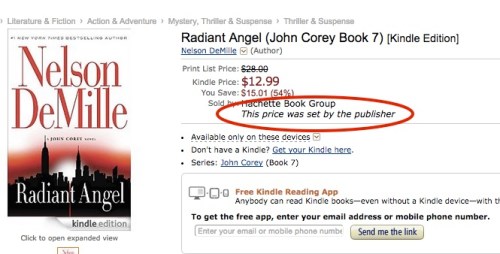
If you’ve been shopping for ebooks on Amazon lately, you may have seen this new addition to many ebook product pages:

Nelson-Book

This announcement can be found on ebooks from several of the largest publishers, and it appears to serve as both an apology from Amazon and also a shifting of the blame for high ebook prices. Amazon has stated in the past that they believe ebooks should not cost more than $9.99. Self-published authors are no doubt familiar with this price constraint, as their royalties are cut in half if they price higher than this amount. But after a contentious and drawn-out negotiation with Hachette Book Group last year, Amazon relinquished the ability to discount ebooks with several publishers. Prices with these publishers are now set firmly by them.

Soon after these agreements went into place, industry observers noted an upward move in average ebook prices. Freed from Amazon’s discounting, and with complete control over pricing, the publishers made a decision to push the price of many of their books above $9.99.

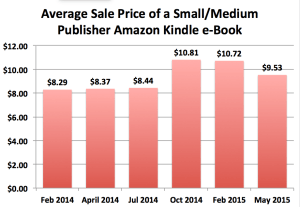
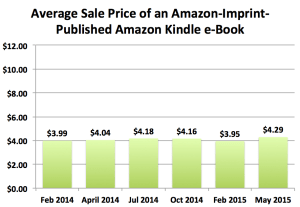
With six quarterly snapshots, each snapshot consisting of 50,000+ of the top-selling ebook titles, we plotted the average price by publisher type to see just how much prices have gone up. The blue bars show the price of self-published ebooks for each of our reports. The purple bars show the average price of Big 5 published ebooks.

Screen-Shot-2015-05-03-at-3.49.53-PM-300x208

Screen-Shot-2015-05-03-at-3.50.03-PM-300x207

Screen-Shot-2015-05-03-at-3.50.17-PM-300x207

Screen-Shot-2015-05-03-at-3.50.28-PM-300x206

Since we started pulling this data, the average price of an ebook from a Big 5 publisher has gone up 17%. Compare this to a difference of 5% for self-published titles, or the increase of 7.5% across Amazon imprints. The prices for Big 5 published ebooks have risen quite steadily, rather than a sudden surge since the return to agency.

What will the effect of these pricing decisions have on unit sales, revenues, and author earnings? We were eager to find out.

The May 2015 Author Earnings Report

We start with a simple counting of the number of titles on Amazon’s ebook bestseller lists. No math involved, just a detailed look at whose works are showing up as top-selling titles. For comparison, we included the same graph from our January 2015 report.

Number of Titles in Amazon’s Ebook Best Seller Lists

may-2015-combined-titlecount-1024x637

In the last three months, the Big 5 publishers have seen a 26% reduction in the number of titles on Amazon’s Best Seller lists. This means fewer titles are selling well enough to make these lists, and it also means fewer titles are receiving that added visibility.

Ebook Unit Sales

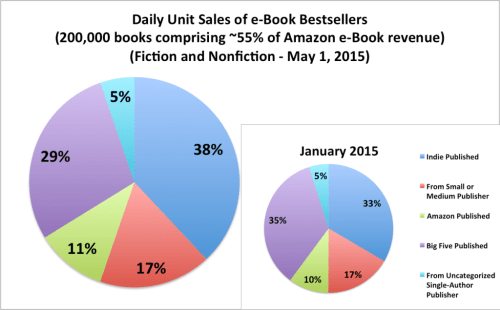
may-2015-combined-unitsales-1024x635

Over the same period, daily unit sales from the Big 5 have fallen 17%. This is a measure of the average rank of each ebook. Just as publishers study the New York Times bestseller lists to gauge the strength of their competition, we are looking at the same thing. But with a sample size of 200,000, rather than 20.

Rest of the article: http://authorearnings.com/report/may-2015-author-earnings-report/

May 2015 Author Earnings Report

Leave a comment

Filed under 2016, ebook publishing

Netflix for books

The woman who is trying to create a Netflix for books

By Neelam Raaj

http://timesofindia.indiatimes.com/tech/tech-news/The-woman-who-is-trying-to-create-a-Netflix-for-books/articleshow/51959813.cms

Chiki Sarkar hates being called a disruptor but that’s exactly what she’s doing to the opaque, incestuous world of Indian publishing. Along with Durga Raghunath, who brings the digital smarts, Sarkar has co-founded Juggernaut, a digital publishing house. She spoke to Neelam Raaj on why she wants to use tech to give dead-tree books a new lease of life.

You’re pitching Juggernaut as India’s first phone publisher. Did you have to rethink the book for the small screen?

When the idea of Juggernaut first came to me in December 2014, I thought about what the phone can do that the book can’t, and I thought Sunny Leone – delicious stories on the screen. But we’re also turning her stories into a physical book. The idea is – Can the physical and digital talk to each other? Can I take the knowledge of who is going to buy our books on the phone and sell them other books?

Sunny will be appointment reading – one story on your mobile at 10pm every night for a week. But there’s a range of reading on the app, including short works of non-fiction, long serialized forms, and a set of short stories that you can buy one of. The cost will be around half of a physical book’s.

What will be your physical vs digital mix?

If we bring 100 books to digital, about 30 or 40 of those will have physical copies too. It will depend mostly on the book and the writer. When we publish authors Arundhati Roy, Prashant Kishore, Twinkle Khanna, Svetlana Alexievich, we’ll publish both physical and digital. But young authors will be tried and tested on digital first. On the phone, we think, people will come for areas around love, sex and romance – stuff you want privacy for. Crime and fantasy tend to naturally move to electronic so it will be a big part of our list. And there’s always going to be a big component of celebrities. Also, I think the only way to get great books in India is to make them up – I did that in Penguin (she was editor-in-chief) too. For instance, I knew I wanted a book on Aarushi so I went in search of a writer.

Do you see yourself as a disruptor in publishing?

I hate this word. Like any other publisher, I think of only one thing – how can I sell more books? Physical books will never die but can I add another way of thinking about publishing books, and can I use it to get more people to read more of my physical list? I’d be very happy if my physical sales go up because of digital.

But I’ll admit I have become increasingly impatient with the status quo. I’m 38, and not 60. I don’t want to be a copout. India is full of people who have good ideas and are following them. Thirty years down the line, I would kick myself silly if I didn’t do this.

Why would an author publish with Juggernaut and not self-publish with Amazon?

The question you should be asking is: why is an author coming to me and not, say a Penguin, Harper or a Picador? We’re not competing with Amazon; we’re a traditional publisher who is asking interesting questions about digital.

How did you get Sunny Leone to write erotica?

We wanted her to write on sex. She told us, ‘Look I don’t want to go all the way erotic. I’ll be sexy, but not pornographic.’ So we kept Fifty Shades of Grey as a marker but we wanted the stories to be empowering for women.

Her stories have a wife asking her husband for sex and being turned down; an overweight girl who fancies a guy who ignores her but things change when she loses weight, and then she changes her mind too.

What is more exciting now – Indian fiction or non-fiction?

Non-fiction, and it’s been that way for the last 6-7 years. We’re in that stage in the life of the country that we want to tell stories about ourselves. The more interesting fiction is coming from Indian languages, Gujarati, Marathi and Tamil.

Leave a comment

Filed under 2016, books, e-book, ebook publishing

The return of the printed book

Books are back. Only the technodazzled thought they would go away

The hysterical cheerleaders of the e-book failed to account for human experience, and publishers blindly followed suit. But the novelty has worn off

by Simon Jenkins

Source: http://www.theguardian.com/commentisfree/2016/may/13/books-ebook-publishers-paper?CMP=fb_gu

At last. Peak digital is at hand. The ultimate disruptor of the new information age is … wait for it … the book.

Chair in the last bookshop

Books are back

Shrewd observers noted the early signs. Kindle sales initially outstripped hardbacks but have slid fast since 2011. Sony killed off its e-readers. Waterstones last year stopped selling Kindles and e-books outside the UK, switched shelf space to books and saw a 5% rise in sales.

Amazon has opened its first bookshop.

Now the official Publishers’ Association confirms the trend. Last year digital content sales fell last year from £563m to £554m. After years on a plateau, physical book sales turned up, from £2.74bn to £2.76bn.

They have been boosted by the marketing of colouring and lifestyle titles, but there is always a reason. The truth is that digital readers were never remotely in the same ballpark. The PA regards the evidence as unmistakable, “Readers take a pleasure in a physical book that does not translate well on to digital.” Virtual books, like virtual holidays or virtual relationships, are not real. People want a break from another damned screen.

What went wrong? Clearly publishing, like other industries before (and since), suffered a bad attack of technodazzle: It failed to distinguish between newness and value. It could read digital’s hysterical cheerleaders, but not predict how a market of human beings would respond to a product once the novelty had passed. It ignored human nature. Reading the meaning of words is not consuming a manufacture: it is experience.

As so often, the market leader was the music business. Already, by the turn of the 21st century, its revenues were shifting dramatically from reproduction to live. This was partly because recording and distributing music became so cheap there was no profit margin, but it was largely because the market had changed. Buyers, young and old, wanted to witness music played in the company of like minds, and were prepared to pay for the experience – often to pay lots. Soon the same was true for live sport, live theatre, even live talks. The festival has become king. The money is back at the gate.

Books must be the ultimate test. Admittedly some festivals now give away books for free and charge instead to hear the writers speak.

But just buying, handling, giving and talking about a book seems to have caught the magic dust of “experience”. A book is beauty. A book is a shelf, a wall, a home.

The book was declared dead with the coming of radio. The hardback was dead with the coming of paperbacks. Print-on-paper was buried fathoms deep by the great god, digital. It was rubbish, all rubbish. Like other aids to reading, such as rotary presses, Linotyping and computer-setting, digital had brought innovation to the dissemination of knowledge and delight. But it was a means, not an end.

Since the days of Caxton and Gutenberg, print-on-paper has shown astonishing longevity. The old bruisers have seen off another challenge.

Leave a comment

Filed under 2016, book publishing, books

Meanwhile, in a dank corner of the dictionary

We Know You Hate ‘Moist.’ What Other Words Repel You?

By JONAH BROMWICH

http://www.nytimes.com/2016/05/07/science/moist-word-aversion.html?rref=collection%2Fsectioncollection%2Fscience&action=click&contentCollection=science&region=rank&module=package&version=highlights&contentPlacement=5&pgtype=sectionfront

Super Moist cake mix

Moist. Luggage. Crevice. Stroke. Slacks. Phlegm.

How did those words make you feel?

Certain everyday words drive some people crazy, a phenomenon experts call “word aversion.” But one word appears to rise above all others: “moist.” For that reason, a recent paper in the journal PLOS One used the word as a stand-in to explore why people find some terms repellent.

“It doesn’t really fit into a lot of existing categories for how people think about the psychology of language,” the study’s author, Paul Thibodeau, a professor of psychology at Oberlin College, said of moist. “It’s not a taboo word, it’s not profanity, but it elicits this very visceral disgust reaction.”

A little less than a quarter of the approximately 2,500 unique subjects tested in Mr. Thibodeau’s five experiments over four years had trouble dealing with any appearance of the word.

When asked to react to moist in a free-association task, about one-third of those people responded with “an expression of disgust,” Mr. Thibodeau said. Almost two-thirds of those who later reported an aversion were so bothered by “moist” that they could recall its inclusion among a set of 63 other words — an unusually high rate.

The peer-reviewed study attempted to explain why moist had become the linguistic equivalent of nails on a chalkboard for some people.

Words that sound similar — including hoist, foist and rejoiced — did not put off participants in the same way, suggesting that aversion to the word was not based on the way it sounds. But people who were bothered by moist also found that words for bodily fluids — vomit, puke and phlegm — largely struck a nerve. That led Mr. Thibodeau to conclude that for those people moist had taken on the connotations of a bodily function.

It has long been acknowledged that many people are cursed with moist phobia. In 2007, a linguistics professor from the University of Pennsylvania, Mark Liberman, wrote about moist in exploring the concept of word aversion. In 2012, the word came up again, after The New Yorker asked readers which ones they would eliminate from the English language. Mr. Thibodeau’s study cites People magazine’s 2013 attempt to have some of its “sexiest men” make “the worst word sound hot!”

But Jason Riggle, a linguistics professor at the University of Chicago, said the excessive focus on moist might have made a broader understanding of word aversion more difficult.

“Moist has become such a flagship word for this, and the fact that so many people talk about it now makes it harder to get a handle on” word aversion more generally, he said.

That may help explain why other recent studies on word aversion, unlike Mr. Thibodeau’s, found a close link between a word’s phonological properties — its combination of sounds — and people’s reactions.

David Eagleman, a neuroscientist at the Baylor College of Medicine whose lab has conducted its own experiments into word aversion over the past year, found that an unusual combination of sounds in a group of made-up words was more likely to put people off than several other factors. A study at Colby College last year also suggested that a word’s phonological properties could repel people.

Dr. Eagleman suspects that word aversion is similar to synesthesia, the blending of senses in which an aural phenomenon, such as a musical note, can trigger a visual or even an emotional response. He suggested that the process through which a specific combination of sounds evokes disgust might be similar.

“There appears to be this relationship between phonological probability and aversion,” he said. “In other words, something that is improbable, something that doesn’t sound like it should belong in your language, has this emotional reaction that goes along with it.”

Dr. Eagleman said that his lab’s experiments were a prelude to neuroimaging that could investigate how the brain responds when faced with aversive words. But in the meantime, it might help to compile a broader list of words that certain people cannot stand.

So here’s a question for you: Forgetting all things moist for a second, what other words (without explicit sexual, scatological, racial or taboo connotations) do you find repulsive? And we don’t mean the merely annoying (like “literally”) or obnoxious (like “synergy”), but words that are viscerally repellent.

Name them, and tell us why they disgust you in the comments section. Feel free to recommend words already listed by others.

[Editor’s note: I find nothing wrong with the word moist. A serviceable word. On cake batter boxes, mixes are promoted as moist and even “Super Moist.” I think people are confusing moist with dank and need a dictionary or dictionary application.]

Leave a comment

Filed under 2016, words

Will fan fiction be the next target?

‘Star Trek’ Copyright Battle Pits Paramount and CBS Against ‘Professional’ Fan Film

Enterprising producer raised over $1.2 million, and promised a ‘feature-quality’ movie

by Mark Perton

Source: http://www.newsweek.com/star-trek-fan-fiction-451320

Star Trek, the venerable sci-fi franchise that turns 50 this year, has long been known for the dedication of its fans. In the late 1960s, when the original TV series was threatened with cancellation after two seasons, a letter-writing campaign brought the show back for a third year. After the show was canceled the following year, fan conventions kept the Trek dream alive, screening rare clips and “blooper reels” which, in that pre-VCR, pre-YouTube era, allowed them to explore the frontiers of their favorite show.

Fans at those conventions also shared fan fiction: mostly mimeographed stories that created new adventures for the characters that left TV two years shy of completing their “five year mission.” Over time, fan fiction evolved and became a multimedia genre, and even as Star Trek was revived and developed as a major media property encompassing a dozen motion pictures and hundreds of TV episodes, fan-produced films became a mainstay of YouTube and other video sites.

Kirk (left) and Spock (right) of Star Trek.

Kirk (left) and Spock (right) of Star Trek.

Today’s fan films, like written fan fiction, occupy a legal gray zone. While some can potentially be considered satire or commentary, and therefore, legally permitted works, many can easily be classified as unauthorized exploitation of copyrighted material—and could be shut down by the copyright’s owners.

For the most part, Paramount Pictures and CBS, which jointly own the copyrights associated with Star Trek, have turned a blind eye to non-commercial fan productions, and have even seemed to encourage them. James Cawley, a fan producer who built detailed reproductions of original Star Trek sets in his upstate New York studio, had a cameo in J.J. Abrams’ 2009 Star Trek film. Paramount also borrowed props from Cawley’s studio for use in the series Star Trek: Enterprise, and named a ship in one episode the Ticonderoga, a reference to the fan producer’s hometown.

Fan efforts have also been embraced by many in the “official” Star Trek creative community; fan films have featured dozens of cast members from Paramount’s productions, including original series stars Walter Koenig, Nichelle Nichols and George Takei, and actors from many other Trek outings, ranging from Star Trek: Voyager’s Tim Russ to Alan Ruck, who played hapless starship captain John Harriman in Star Trek: Generations (but is, of course, best known for playing hapless teenager Cameron Frye in Ferris Bueller’s Day Off). One fan series includes Chris Doohan, the son of the actor who played Scotty in the original series, taking over his father’s role. Even Majel Barrett Roddenberry, wife of Star Trek creator Gene Roddenberry, reprised her role as the voice of the U.S.S. Enterprise’s computer in a fan production. Writers like original series legends D.C. Fontana and David Gerrold (best known for the classic episode “The Trouble With Tribbles”) have contributed scripts to fan films.

For years, fan producers formed a close community, trading tips and cast members, sharing props and studios, and engaging in friendly competition over things like the accuracy of their sets, their interpretations of classic characters and the quality of their productions. And their productions became increasingly more polished as digital technology allowed them to create CGI space battles and elaborate green screen sets, and do sophisticated editing and post-production work on affordable computers. To produce these ever-more sophisticated films, fans turned to crowdfunding, in some cases raising hundreds of thousands of dollars through platforms like Kickstarter and Indiegogo.

As the fan films began working with budgets that rivaled those of some independent movies, and successfully recruited cast and crew members who had worked on commercial Trek properties, one nagging question kept coming up: When will someone go too far and draw the ire of Paramount and CBS? As Hollywood news site The Wrap put it last August, after the fan film Star Trek: Axanar—which its producer said would be as good as something “coming out of the studio”—raised over $1 million through its crowdfunding campaigns, “the seven-figure bankroll raises questions about just how ‘fan’ the project is and at what point it poses a threat to the authorized franchise.”

Axanar’s budget and boasts may have been too much for Paramount and CBS, and in December, the two companies sued Axanar Productions, claiming that its work “infringe[s] Plaintiffs’ works by using innumerable copyrighted elements of Star Trek, including its settings, characters, species, and themes.” The suit named the production company, studio head Alec Peters, and “Does 1-20,” an unnamed group that could expand to include personnel such as director Robert Meyer Burnett, an industry professional who had previously produced featurettes for CBS’ Star Trek Blu-ray releases.

In its lawsuit, Paramount and CBS cited the fact that the Axanar team referred to their project as a “fully professional, independent Star Trek film” that raised over $1 million, adding that the producers “enjoy a direct financial benefit from the preparation, duplication and distribution of the infringing Axanar Works.”

Indeed, Axanar Productions boasted of plans to use its studio to produce other films and actively defended its broader ambitions. Unlike other fan producers, who largely volunteer their time, Axanar’s Peters paid himself a salary of $38,000 in 2015. Axanar also built a merchandising business, offering everything from scale models of ships featured in its films to Axanar-branded coffee on a “donor” website.

Rather than fold up his tent, Peters fought back, and brought on pro bono lawyers to defend his right to produce the film, saying that it’s a non-commercial production, is covered under fair use doctrines, and that the suit is too vague and broad, claiming ownership of things like the fictitious Klingon language. In the meantime, production on Axanar was halted, leaving a 20-minute teaser, Prelude to Axanar (which is also a subject of the lawsuit), as the nascent studio’s only product.

Paramount and CBS may be particularly sensitive at the moment to unauthorized works designed, as the Axanar team put it, to “look and feel like a true Star Trek movie.” The studios are gearing up for the July release of the latest film in the series, Star Trek: Beyond, along with a major merchandising blitz in conjunction with the film and the franchise’s 50th anniversary. Based on the combination of ticket sales and licensing, Star Trek properties could bring in close to $1 billion this year. And in 2017, CBS will launch the sixth live-action Star Trek TV series, with a risky online-only model designed to anchor the network’s CBS All Access streaming service; if successful, the new series could add over $400 million to CBS’s bottom line next year.

As the suit has progressed, it has has split the once tight-knit fan film community. Some fans believe that Peters is going too far.

“There is no question in my mind that CBS owns Star Trek,” fan film producer James Cawley recently commented in a popular Star Trek forum. “They have been very gracious to allow us to play in their sandbox for many years,” he wrote, adding that “if CBS says, stop making fan films, we would abide by their wishes and say thank you.” In a seeming comparison between Axanar’s ambitions and more traditional fan fiction, he commented: “I don’t rent my sets, I don’t charge for anything, and I certainly have never gotten any salary for playing Trek with my friends” and, “I did it for nothing but the love of the game, if and when it ends at least I can say I played by the rules I was given when I cross the finish line.”

Meanwhile, Peters has taken on his erstwhile compatriots, pointing out to the Trek news site 1701News that he’s built a professional team: “They’re not fans who are voice actors, or Elvis impersonators who have a hobby and have always wanted to play Capt. Kirk.” (Cawley, who played Kirk in several of his own productions, is also an Elvis impersonator, while another fan producer and Kirk actor, Vic Mignogna, is a voice actor.)

The suit has also highlighted rifts among those affiliated with the official Star Trek productions. Star Trek: Beyond director Justin Lin took to Twitter to defend Axanar, writing: “This is getting ridiculous! I support the fans. Star Trek belongs to all of us.” However, Rod Roddenberry, son of Trek creator Gene Roddenberry, and an executive producer on CBS’ forthcoming Star Trek series, commented to an interviewer that, while he’s “a fan of fans keeping Star Trek alive,” fan producers have to “follow the rules and do it right,” or “there’s going to be prices and penalties to pay.”

Fallout from the case has already hurt other fan productions. Mignogna’s latest installment of his Star Trek Continues series is far behind in its crowdfunding goals, and the producer told fan site The Bronze Review, “there are a lot of scared folks out there, afraid to donate to a fan production due to the climate now.” In late April, another fan project, Star Trek: Federation Rising, was canceled, after its producer said he was contacted by CBS executives, who “advised me that their legal team strongly suggested that we do not move forward.” In a Facebook posting, producer Tommy Kraft thanked CBS “for reaching out to me, rather than including us in their ongoing lawsuit against Axanar.

Kraft also announced plans to produce an original science fiction film, completely devoid of any Star Trek intellectual property. If there’s a silver lining to the current situation, it may well be based on plans like Kraft’s. One only need look at the history of fan-fiction author Erika Mitchell. After writing a set of stories featuring characters from the popular Twilight books, Mitchell, under the pen-name E.L. James, reworked her tales and removed all references to Twilight. The resulting work, the Fifty Shades of Grey series, has since sold more than 125 million copies worldwide, has been adapted as a major motion picture and has earned Mitchell over $100 million.

Perhaps freedom from Paramount and CBS’s properties, could, in the end, allow former Trek projects to boldly go where no fan film has gone before.

Source: http://www.newsweek.com/star-trek-fan-fiction-451320

Leave a comment

Filed under 2016, Star Trek

“Holly’s Corner,” part 11

[Writer’s note: What began as a writing prompt — photo and first paragraph — has become at least the start of a story. I will endeavor to add short sections to it, at lest as long as there is some interest. It might be a little rough in parts, but that’s because it is coming “hot off the press,” which could be part of the fun of it. In the meantime, you are free to jump off from any part of this story thus far and write your own version. Click Holly’s Corner below to get Parts 1 – 10.]

by David E. Booker

“And you carry around a rolling pin because it is the latest in fashion accessories?”

She lowered the pin. “I don’t believe in guns.”

“The same can’t be said for threats.”

“Do you always speak your mind?”

It was a cool, rainy day down at Holly's Corner.

It was a cool, rainy day down at Holly’s Corner.

“I try to. Saves me having to remember things.”

She smirked again. She was a plump-but-not-fat redhead who stood probably five-seven or so. I did my best to guess with her sitting in my one overstuffed client’s chair. She wasn’t wearing any heels, little or no makeup, and the end of her nose and her nostrils flared like the loops of a three-leaf clover. She was a strawberry blond with freckles that almost worked to make her look younger than she was.

She caught me staring. “Get an eye full.”

“Enough to describe you to the police should you point your pin at me again.”

She smiled, then laughed. The small crows’ feet at the corners of her eyes. They made her face more pleasant.

“Ooohh, my head….” Rachel leaned forward and brought her hands up to the sides of her head. The rolling pin clattered to the scuffed and marred hardwood floor. Another mark wasn’t going to be noticed.

Father Brown stepped in carrying a glass of water and what looked like a couple of aspirin. When Rachel looked up, he urged her to take them. She hesitated, and then accepted. He turned and left the room.

She looked at me. “Do you always provide your clients such service?”

“Father Brown has a knack and since you are not my client, he does it for non-clients, too.”

“’Father’?”

“Retired priest.”

She had started swallowing the aspirin, then stopped.

“He … naht … chilf … masqaaaaaaaaaaaaaaaaaaaaauhhh.”

I nodded. “Yeah, that one.”

She started choking.

“I suggest-—”

Too late. She jerked forward and threw up on my rug. It was a yard sale special, so it wasn’t my favorite color or pattern, but I couldn’t afford a new one.

Father Brown rushed back into the room, bucket in hand, but Rachel had wretched her last bit of food out and onto the rug. She had a few bits of spit for the blue plastic container.

She looked up, saw him, and recoiled back in the chair, her feet swiping through the vomit.

(To be continued.)

Leave a comment

Filed under 2016, photo by David E. Booker, Story by author

Tripped up: “The perils of proofreading”

From a recent letter sent home from school involving a class trip coming up in later part of April:

“Hello 7th grade Families and students,

“The time has come to provide some details for the 7th grade trip to Atlanta! The trip dovetails with our … curriculum, and we are excited about what lies ahead for our students.”

Several paragraphs later:

“Although there is no real need for devices, students may bring cellphones or one electronic device on the trip (sic). We want students to fully engage with activities each day, but we realize that there will be many fabulous photo opportunities in our nation’s capital.”

***

Now, I want to know what curriculum are they teaching?

Did they fight the Civil War again, and I missed it?

Leave a comment

Filed under 2016, proofreading

Book sequel

The 5 best sequels to classic novels

Author Chet Williamson has written an authorised sequel to Robert Bloch’s Psycho. Here, he looks at other sequels that honour the original works while bringing new life to them

Source: http://www.independent.co.uk/arts-entertainment/films/features/my-five-favourite-sequels-to-classic-novels-from-the-further-adventures-of-huckleberry-finn-to-the-a6970976.html

Having just written an authorised sequel to Psycho, Robert Bloch’s original tale of Norman Bates, I was asked by The Independent to come up with what I considered the five best sequels to other classic novels. I’m not so sure about the “best”, but these are certainly my favourites, ones that honour and respect the original works while bringing different perspectives and new life to them:

The Further Adventures of Huckleberry Finn by Greg Matthews (1988)

The author of the western epics, Power in the Blood and Heart of the Country, takes up Sam Clemens’ pen and picks up the story as though channelling Mark Twain. A perfect sequel to a book that’s as close as anyone’s come to the Great American Novel.

Pym by Mat Johnson (2010)

It seems that Edgar Allan Poe’s Arthur Gordon Pym, a story of weird adventure in the Antarctic, is based on fact, and it’s up to a professor of American literature to confirm it with a trip to the South Pole. Johnson deals with race, history, and literature trenchantly and often humorously, while retaining the cosmic mystery of Poe’s original.

Grendel by John Gardner (1971)

Grendel John_GardnerNot so much a sequel as a retelling of the ancient epic, Beowulf, seen from the monster’s point of view. Gardner was an extraordinary writer, and his depiction of Grendel is tender, haunting, empathetic, and terrible.

A Feast Unknown by Philip Jose Farmer (1969)

First published by an “erotica” house, this novel is the great-grandfather of literary mash-ups, and still far superior to most of them. Farmer creates his own versions of Tarzan (Lord Grandith) and pulp hero Doc Savage (Doc Caliban), makes them half-brothers (their father was Jack the Ripper), and sets them against each other in a violent and homoerotic grudge match. A masterpiece of absurdity.

The Hours by Michael Cunningham (1998)

From the ridiculous to the sublime. Cunningham’s tripartite exploration of Virginia Woolf’s Mrs Dalloway is too complex in plot and character to begin to discuss here, but this bold and experimental novel sets the bar for what can be accomplished by treading in the footsteps of an earlier work of literary brilliance.

Psycho: Sanitarium is published on 12th April by Canelo, price £3.99 in eBook

Leave a comment

Filed under 2016, books, novel

Let’s get “fiscal, fiscal”

Lawmaker snaps, files bill demanding fellow lawmakers quit using ‘physical’ when they mean ‘fiscal’

Source: http://www.dailykos.com/story/2016/3/31/1508629/-Lawmaker-snaps-files-bill-demanding-fellow-lawmakers-quit-using-physical-when-they-mean-fiscal

Thank you to the Riverfront Times for bringing us this tidbit from the Missouri legislature:

A state rep from St. Louis, unable to take it any longer, has filed a resolution asking her colleagues in the House of Representatives to please, please stop using the word “physical” when talking about Missouri’s fiscal needs.

“Whereas, on occasion, members of the Missouri House of Representatives have used the word ‘physical’ instead of ‘fiscal’ when referring to fiscal matters including, but not limited to, fiscal review and fiscal notes…” begins House Resolution 1220, offered by Rep. Tracy McCreery.

McCreery tells the Riverfront Times that “fiscal” becomes “physical” almost every single day in the Missouri legislature and she just can’t take it anymore:

The sound of lawmakers screwing up even basic terms as they debate critical financial decisions has become like “nails on a chalkboard” to McCreery and a few of her grammatically sound colleagues.

“There are a lot of reasons to be depressed about the Missouri Legislature, and this just kind of piles on,” she says.

Leave a comment

Filed under 2016, English, right word

The things Spring brings

In the Neighborhood

Spring brings many things:
Alarm sales and fresh-meat men peddling,
Spores flowing as if there will be no more,
Ice cream from a truck whose music rings
As if the end of days will wend
Up and down the streets
Maniacal notes vibrating from the new leaves and petals
As the sun runs undone —
A child on a bike just pedaling to have fun.

–David E. Booker

Leave a comment

Filed under 2016, poetry by author