Tag Archives: Saturday

Relate

Bloviate, expectorate
sniffle, drivel
prevaricate.

Chronic hate, cheat on mate
snivel, quibble,
not so great.

Reprobate, a tyrant’s slate
uncivil, drivel
expropriate.

Disassociate, oh too late
swivel, shrivel
unsubstantiate.

Violate, grope a date
piddle, riddle
desecrate.

Obviate, end of state
cripple middle
subjugate.

–by David E. Booker

Leave a comment

Filed under 2016, poetry by author

New words to live by: “Cackle pants”

It is time, once again, for New words to live by. This is a word or phrase not currently in use in the U.S. English lexicon, but might need to be considered. Other words, such as obsurd, crumpify, subsus, flib, congressed, and others, can be found by clicking on the tags below. Today’s New Word is created by combing a sound and a noun. Without further waiting, Cackle pants.

OLD WORDS
Cackle, v. 1. To chatter noisily; prattle. 2. Laugh in a broken, shrill manner. 3. To utter a broken, shrill sound or cry, like a hen.

Pants, n. A loose- (or sometime tight-) fitting garment for the lower part of the body with leg portions that usually reach the ankle.

NEW WORD
Cackle pants, n. 1. The sound of slightly stiff new pants, particularly wool, worn for the first time. Sometimes accompanied by static electricity sparks. 2. Somebody who has noisy flatulence. Don’t mind, Uncle Bob, he’s a bit ripe, but that’s because he’s a cackle pants. 3. A politician or person seeking public office who speaks in platitudes, generalities, banalities, conspiracies, circular or empty rhetoric. Sometimes demeaning and often predicting dire consequences if not elected.

Leave a comment

Filed under 2016, new word, New words to live by

Short stories on the train

French train stations now have vending machines that dispense short stories to entertain you while you wait

http://metro.co.uk/2016/10/03/french-train-stations-now-have-vending-machines-that-dispense-short-stories-to-entertain-you-while-you-wait-6167708/

By Lisa Bowman for Metro.co.uk

There’s nothing worse than having to wait for your train when you’ve forgotten your book, all the free papers have gone, or you just don’t feel like falling down the rabbit hole of the Internet via your smartphone.

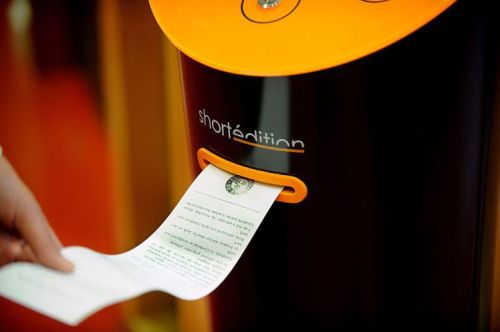
A woman chooses a short story at a short-story distribution terminal in the Mistral district of Grenoble, on October 12, 2015. The city of Grenoble is testing the invention of a local start-up and recently installed the terminal, which delivers free reading material to people waiting in public spaces.  AFP PHOTO / JEAN-PERRE CLATOT        (Photo credit should read JEAN-PIERRE CLATOT/AFP/Getty Images)

A woman chooses a short story at a short-story distribution terminal in the Mistral district of Grenoble, on October 12, 2015. The city of Grenoble is testing the invention of a local start-up and recently installed the terminal, which delivers free reading material to people waiting in public spaces. AFP PHOTO / JEAN-PERRE CLATOT (Photo credit should read JEAN-PIERRE CLATOT/AFP/Getty Images)

Which is why France’s idea to install free short story vending machines is genius.
The idea was trialled a year ago in the country’s Grenoble train station, where it went down so well that they decided to roll it out across more stations.

You simply choose your wait-time – one, three or five minutes – and the machine will dispense a story accordingly. All for free.

The stories are all printed on paper, and topics range from children’s stories to lyrical poetry.

The authors of the stories are all anonymous, and over 5,000 have submitted stories.
The machines have been installed at 24 train stations all over France, with plans to introduce them at a further 11 by the end of the year.

The idea was dreamt up by publishing house Short Edition, which specialises in short stories.

‘Our ambition is to see distributors pop up everywhere to encourage reading – and writing – and to promote our artists,’ Short Edition director Christophe Sibieude told Télérama. ‘The paper medium is a breath of fresh air, it’s more unexpected that a smartphone screen.’

Considering that we’re coming into ‘leaves on the line’ season, it might be a good idea to start installing these at commuter hubs in the UK…

Leave a comment

Filed under 2016, short story

And that’s punctuation. Period.

September 24th was National Punctuation Day. If interested, you can read more about it here: http://www.nationalpunctuationday.com/.

Punctuation is important to writing, whether it be a novel or a set of instructions on how to operate a new gadget. For example, does the panda eat, shoots, and leaves or does the panda eat shoots and leaves? There are even books devoted to punctuation: how to use it, when to use it, and even some about why to use it.

Though belated (Is there a punctuation mark for that?), below is a chart of some little known and rarely — if ever — used punctuation marks.

little-known-punctuation-marks

Leave a comment

Filed under 2016, punctuation

Hey, brother, can you spare a slang word?

Endangered American Slang Needs Your Help

Won’t you consider adopting a word or two?

https://electricliterature.com/endangered-american-slang-needs-your-help-2551a782012a#.s1nrvqukl

by Dani Spencer

If you’re from Delaware, Maryland, or Virginia and think having shat fall from your pinetrees is abnormal, then we have news for you: you are among the many Americans losing touch with your historical regional dialect. And let’s be frank: can our language, our literature really afford to lose fleech, fogo or goose drownder?

Okay, poop jokes aside, the Dictionary of American Regional English views the potential extinction of 50 American words and phrases as no laughing matter. DARE and the global podcasting platform Acast have joined forces and are starting a campaign to bring these colloquialisms back to “their former glory.” The game plan is for hosts of various programs on Acast’s network to start using these at risk words, in hopes that their millions of listeners will adopt them into their vocabulary.

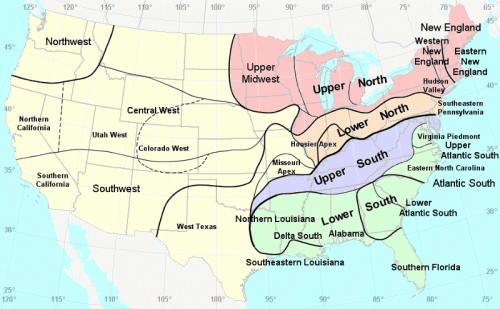
dialect-mapThis is not a bad strategy considering the growing popularity of podcasts in the U.S. The president of Acast, Karl Rosander, believes “learning through audio is a hugely effective educational method,” and “vummed” that there will be a vernacular revival.

And what about the written word? Well, readers, study up, make a point of using a few of these expressions in your own writing. Let’s all of us do Faulkner proud.

Here’s the full DARE list of endangered words and phrases:
Barn burner: a wooden match that can be struck on any surface. Chiefly Pennsylvania, southern New Jersey and Maryland.
Bat hide: a dollar bill. Chiefly south-west.
Be on one’s beanwater: to be in high spirits, feel frisky. Chiefly New England.
Bonnyclabber: thick, sour milk. Chiefly north Atlantic.
Counterpin: a bedspread. Chiefly south and south midland.
Croker sack: a burlap bag. Chiefly Gulf states, south Atlantic.
Cuddy: a small room, closet, or cupboard.
Cup towel: a dish towel. Chiefly Texas, inland south region.
Daddock: rotten wood, a rotten log. Chiefly New England.
Dish wiper: a dish towel. Chiefly New England.
Dozy: of wood, decaying. Chiefly north-east, especially Maine.
Dropped egg: a poached egg. Chiefly New England.
Ear screw: an earring. Chiefly Gulf States, lower Mississippi Valley.
Emptins: homemade yeast used as starter in bread. Chiefly New England, upstate New York.
Farmer match: a wooden match than can be struck on any surface. Chiefly upper midwest, Great Lakes region, New York, West Virginia.
Fleech: to coax, wheedle, flatter. South Atlantic.
Fogo: An offensive smell. Chiefly New England.
Frog strangler: a heavy rain. Chiefly south, south midland.
Goose drownder: a heavy rain. Chiefly midland.
I vum: I swear, I declare. Chiefly New England.
Larbo: a type of candy made of maple syrup on snow. New Hampshire.
Last button on Gabe’s coat: the last bit of food. Chiefly south, south midland.
Leader: a downspout or roof gutter. Chiefly New York, New Jersey.
Nasty-neat: overly tidy. Scattered usage, but especially north-east.
Parrot-toed: pigeon-toed. Chiefly mid-Atlantic, south Atlantic.
Pin-toed: pigeon-toed. Especially Delaware, Maryland, Virginia.
Popskull: cheap or illegal whiskey. Chiefly southern Appalachians.
Pot cheese: cottage cheese. Chiefly New York, New Jersey, northern Pennsylvania, Connecticut.
Racket store: a variety store. Particularly Texas.
Sewing needle: a dragonfly. Especially Michigan, Wisconsin, Minnesota, Massachusetts.
Shat: a pine needle. Chiefly Delaware, Maryland, Virginia.
Shivering owl: a screech owl. Chiefly south Atlantic, Gulf states.
Skillpot: a turtle. Chiefly District of Columbia, Maryland, Virginia, West Virginia.
Sonsy: cute, charming, lively. Scattered.
Spill: a pine needle. Chiefly Maine.
Spin street yarn: to gossip. Especially New England.
Spouty: of ground: soggy, spongy. Scattered.
Suppawn: corn meal mush. Chiefly New York.
Supple-sawney: a homemade jointed doll that can be made to “dance”. Scattered.
Tacker: a child, especially a little boy. Delaware, Maryland, New Jersey, eastern Pennsylvania.
Tag: a pine needle. Chiefly Virginia.
To bag school: to play hooky. Chiefly Pennsylvania, New Jersey.
Tow sack: a burlap bag. Chiefly south, south midland, Texas, Oklahoma.
Trash mover: a heavy rain. Chiefly mid-Atlantic, south Atlantic, lower Mississippi Valley.
Tumbleset: a somersault. Chiefly south-east, Gulf states; also north-east.
Wamus: a men’s work jacket. Chiefly north-central, Pennsylvania.
Whistle pig: a groundhog, also known as woodchuck. Chiefly Appalachians.
Winkle-hawk: a three-cornered tear in cloth. Chiefly Hudson Valley, New York.
Work brittle: eager to work. Chiefly midland, especially Indiana.
Zephyr: a light scarf. Scattered.

[Editor’s note: Similar article at: http://www.huffingtonpost.com/entry/these-50-american-slang-words-are-in-danger-of-disappearing_us_57d2ba4ae4b06a74c9f423dd ]

Leave a comment

Filed under 2016, Writing Week in Review

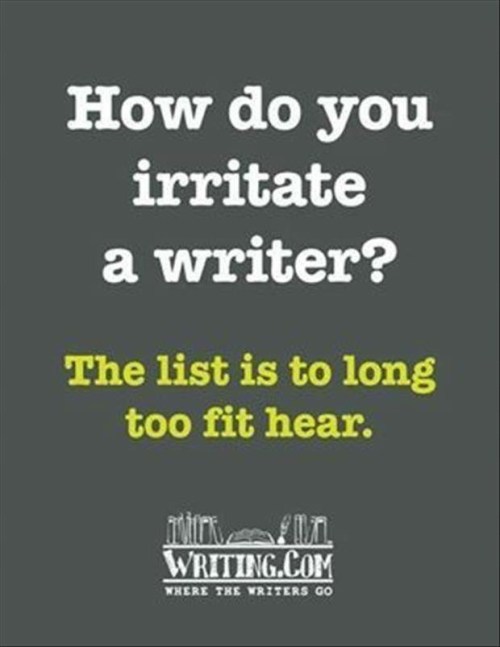
A bridge two far

writer_irritate

Leave a comment

September 17, 2016 · 11:51 pm

Not Just a Southern Writer: Ron Rash

Ron Rash talks about his latest novel and his attachment to the natural world.

by Kelly Crisp

Source: http://www.publishersweekly.com/pw/by-topic/authors/profiles/article/71271-not-just-a-southern-writer-ron-rash.html

Ron Rash has become established as a representative of Southern Literature, although after more than two decades writing poetry, stories, and novels, he transcends the notion of a southern writer. Rash’s works have embraced a universal humanism and naturalism: his characters are both sustained by and compromised by the unpredictable natural world.
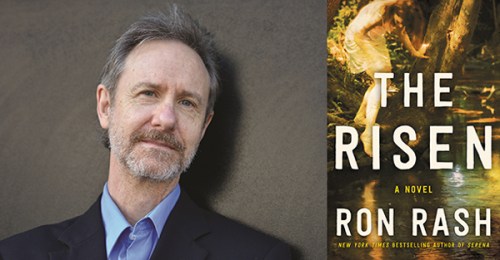
The Risen by Ron RashIn his latest novel, The Risen (Ecco, Sept.), the narrator, Eugene, while fishing with his brother during the summer of 1969, sees a naked teenaged girl with flowing red hair in the creek, the vision of her so fleeting that he wonders if he’s seen a mermaid. Visiting from Florida, Ligeia is no mermaid, but she is an exotic and free-spirited creature who introduces the boys to the excitement of the 60s, experiences they keep secret from their small town, and the watchful eyes of their controlling grandfather.

Ligeia vanishes, as does the close relationship between the brothers as they move into adulthood. When her body surfaces 46 years later, so do the memories of that summer.

The mystery is central to this plot, and like many of Rash’s novels, the story is driven by suspense. But just under the surface, there are difficult questions involving poverty, child neglect sanctioned by religion, and abuse authorized by a self-righteous class system. These are challenging themes, and yet, there is nothing forced in Rash. His prose is clean and without affectation.

Describing fishing: “When a rod tip trembled, one of us got out to reel in what tugged the line. Often it was a knottyhead or catfish, but if a trout we gilled it onto our metal stringer.” And when Eugene’s brother would lift the string of fish from the cooling waters: “Through a gap in the canopy, the declining sun brightened the stringer’s silver sheen, flared the red slashes on the trout’s flanks.”

During our conversation on the eve of Rash’s trip to France for an Eco-Literature convention, where the theme was “Enchantment,” he tells me that “One thing that’s important for me in my work is to remind people that there is a natural world. It’s very easy to think we are not connected to it anymore, but we are, whether we want to be or not.”

His easy reverence is in direct opposition to the rendering of the natural world in TV and film as a creepy, possibly demonic, adversary—or at the very least a place to be wary if you wander too far without an iPhone. “It’s amazing,” Rash says. “When anyone goes out in the woods in a movie, you know something horrible is going to happen.”

While there is danger to irresponsible humans, and the body count can be intense in some of Rash’s more tragic works, often the most profoundly felt loss is that of a formerly protected, or undisturbed natural resource.
Family folklore, passed down from his older relatives, gave Rash the idea that the world is fundamentally enigmatic. “I want the world to be mysterious, I don’t want to know everything,” he says. “One of my great delights is when an animal, that is allegedly extinct, fools people. Jaguars have recently come back into the United States; I love those moments when the natural world surprises us, and reminds us maybe we don’t know as much as we think we do.”

To hear him describe childhood summers on his grandmother’s farm near the Blue Ridge Parkway in N.C., it’s clear why he’s a celebrated voice among the eco-engaged. “I was like Huck Finn,” he says. “My grandmother would let me go, let me wander. It was a gift. I was not afraid. I just reveled in it. The connections I made with the natural world stayed with me.”

Rash is aware that writing about the south brings the possibility, as he has said, of being softly dismissed as “just” a southern writer. Southern writing, he says, “is like any writing. It’s either good or it isn’t. It either transcends the region, or it doesn’t. The best writers from the south transcend the south. Ultimately Faulkner’s goal is not to show how exotic the south is. He has deeper concerns, and certainly Flannery O’Connor did too.”

That doesn’t mean the south is not Rash’s territory. His collection of poems entitled Eureka Mill, based on the mill where his grandparents and parents worked, draws attention to the suffering and loss of humanity that rural southerners felt (and feel) when they leave the farm for the mill. Narratives of southern exploitation are seamlessly woven into the poems, as in “The Stretch-Out,” when a girl of seventeen is exhausted from a brutal day at the mill, and miscarries a child during the night. She explains, “I cried but cried quietly/ and let the bed sheets clot and stain, so that my man and me might save/ what strength a full night’s sleep might give/ I closed my eyes and slept again.”

Constructions like “my man and me,” exhibit Rash’s ear for speech patterns. His stories are known for capturing the voice of a region, but, rendering that voice universally, so that it rings true to any ear, takes a great deal of care and modulation. To Rash, Richard Price is one of the best at translating regional voices onto the page. “In many ways I feel a much deeper connection to him than other writers in the United States,” Rash says. “He’s trying to capture the patois of New York cops and young people in the city, and at the same time, he is working toward the universal. People wouldn’t think that, because of what I write, I would connect with Richard Price, but I feel a real kinship with him.”

As exhibited in Eureka Mill and other collections, his finely honed craftsmanship is most salient in his poetry, which has a casual, addictive appeal. Often compared to Seamus Heaney, the association is especially apt considering the Celtic musical, oral, and folkways ties running deeply through the Appalachians. Palimpsest and layered possession are intrinsic realities for rural North Carolinians. Plowing a field in “The Vanquished” from this year’s Poems: New and Selected turns up “pottery and arrowheads/ bone-shards that spilled across rows/ like kindling, a once-presence/ keen as the light of dead stars.”

By situating himself as the faithful observer of the natural world, Rash makes land, and landscape, available to readers. His dramatizations aren’t driven by sentimentality, but rather complex dilemmas usually centered on a question of land exploitation, or the exploitation of former land-workers, like those stuck in North Carolina’s Eureka Mill, fleeced of their land and sense of purpose. With his latest novel, Rash again creates an irresistible conceit that transcends the South. But, of course, the importance of the South is undeniable.

Source: http://www.publishersweekly.com/pw/by-topic/authors/profiles/article/71271-not-just-a-southern-writer-ron-rash.html

Leave a comment

Filed under 2016, author

A bit of dialogue: “Encounter in Fine Print”

The other day, an acquaintance on Facebook wrote about an “encounter” with a couple of mice that had invaded her second story writing office. She “inflated” the encounter here and there to give it a little fun.

Below is my response to her posting. The encounter told from the point of view of the mice.

Told all in dialogue. You can be the judge if it works.

I call it, Encounter in Fine Print.

“Brian. Hey, Brian, you think it’s workin’? Think we’re scaring her?”

“Yeah, Pink, I think if we stare at her long enough through this magnifying thing we found she’ll think we are four times our size with fangs and claws six inches long. Just keep staring at her.”

“But Brian….”

“Yes, Pink?”

“How do we eat and stare at the same time?”

“We don’t, Pink.”

“Why do you call me Pink? My name’s Gerald.”

“Gerald won’t get us anywhere.”

“Are we goin’ somewhere? I thought we came here for snacks. You know, cheese bits and stuff.”

“Never say ‘and stuff.’ Just say cheese bits.”

“Why?”

“Because I said so.”

“So, I have to be Pink because you said so, and I can’t say ‘and stuff’ because you said so.”

“That’s right.”

“I don’t think I like this game.”

“It’s not a game, Gerald. It’s … it’s … ah … okay, it is a game, but it is a game to make us famous.”

“I want snacks.”

“When we become famous, you will have all the snacks you can handle. I’ll even give you one of mine, Pink.”

“Really!” Pink said.

“Really.”

“Really?”

“Really,” Brian said.

“But when do we get snacks?”

“After we scare this woman. She’s a writer. We scare her, she will put us in one of her stories, her fantastical tales.”

“My tail is nice, but I wouldn’t call it fantastic.”

“It’s not about your tail.”

“If it’s not about snacks and it’s not about my tail. What is it about?”

“Gerald….”

“I thought it was Pink.”

“Pink, I will say it one last time. It’s about being famous. This lady writer writes a story about us in which we are monsters out to take over the world. We’re fifty foot—No, 100 foot rats with fangs like Mammoth tusks and we eat everything in sight. Men, women, children.”

“And they’re our snacks?”

“Yes, Pink, they are our snacks.”

“But I don’t want to eat children.”

“You don’t have to.”

“When do we eat? I’m starving.”

“Not yet, because we have to have to take the story to a Hollywood director, who will want to turn it into a screenplay with lots of special effects that he will use to splash the story across the big screen.”

“And we’ll be movie stars and get snacks?”

“Yes.”

“The Hundred Foot Rat starring Pink and Brian.”

“Brian and Pink”

“Pink and Brian.”

“I think you need a new name.”

“Brian’s a good name.”

“So’s Gerald. But you won’t let it be Gerald and Brian.”

“Okay. Maybe we can use an anagram.”

“Aunt Gram? I think your name would be silly. Aunt Gram.”

“Anagram. Anagram. You rearrange the letters to spell something else.”

“Oh, is that how you got Pink out of Gerald?”

“Ah … exactly.”

“Then what would your Aunt Gram be?”

“Brian … Brian … An rib? No. Hummm. Brian … Brian. Brain. That’s it – Brain.”

“So, we’ll be Pink and Brain.”

“Oh, okay. Your nom de guerre can be first.”

“Now it’s going to be Name the gear and Brain?”

“Pink for short.”

“So Pink for short and Brian?”

“Close enough.”

“Hey, where did the lady writer go? The one who was going to make us monsters?”

“Well, Pink for short, I think she went to get help.”

“You mean another writer to help her write our story, Brain? Our story with snacks in it?”

“Not exactly. I don’t think those footsteps sound friendly.”

“You mean no snacks, Brain.”

“I mean no snacks, Pink.”

“And I bet there ain’t no story, either.”

Leave a comment

Filed under 2016, Random Access Thoughts, Silly Saturday, Story by author

Random Acts of Poetry: “White feathers”

White feathers and flat tires: /
Lost dreams to which we aspire /
Ride the wild wind and rocky road /
As we struggle through life’s occluded code. /
We plug in experience and face neglect. /
We bet on love with a gambler’s regret. /
We dare to be bold, but run a timid race, /
Girding our loins, defending our space. /
The night is young, but the day is old. /
The young seek mercy; the old only scold. /
Wisdom is a feather forgotten by the roadside. /
We leave nothing to chance, not even the rock slide. /
We bury our tomorrows in things we bought /
And deal with the past as if it were a bill best forgot.

by David E. Booker

Leave a comment

Filed under 2016, poetry by author, Random acts of poetry

PhD to Hollywood sleaze

PhD thriller writer who loves true crime and sleazy Hollywood books

by Amy Sutherland

Source: https://www.bostonglobe.com/arts/books/2016/08/18/phd-thriller-writer-who-loves-true-crime-and-sleazy-hollywood-books/gZH59ZltjppHaJohnXtUDL/story.html

Megan Abbott

Megan Abbott

Megan Abbott’s new thriller “You Will Know Me,” gives an alternate, and far darker, view of the world of gymnastics than what you could catch on TV during the Summer Olympics. This is Abbott’s eighth novel. She lives in New York City.

BOOKS: What are you reading currently?

ABBOTT: I just finished Jeffrey Toobin’s Patty Hearst book, “American Heiress,” which was really compelling. I had read her memoir years ago, which I loved. Joan Didion also has a famous essay on her, which I read in college, when I read everything Didion wrote.

BOOKS: Any other famous people you are drawn to in your reading?

ABBOTT: Anything with outlaws. There was a great biography of Bonnie and Clyde by Jeff Guinn, “Go Down Together.” He did one on Charles Manson recently, which was terrifying but really good. I also read a lot of entertainment biographies. I just read the third volume in Simon Callow’s biography of Orson Welles, which covered the ’50s and ’60s.

BOOKS: What other kinds of books do you read?

ABBOTT: I read a lot of crime fiction except when I’m in the latter stages of writing a book. Then I’ll read general fiction or literary fiction. I also read history, but it has to be character driven. I won’t read a Civil War book, but I maybe would read one about Ulysses S. Grant. I also like sleazy books about Hollywood. I love Kenneth Anger’s “Hollywood Babylon.” I don’t care whether it’s true or not.

BOOKS: What were you reading while you were writing your new book?

ABBOTT: I think I was reading Kate Atkinson’s “A God in Ruins.” She’s a big inspiration to me. I was also reading novels about prodigies and remember reading Lionel Shriver’s “We Need to Talk About Kevin.”

BOOKS: What is your favorite kind of true crime?

ABBOTT: In recent years there has been really great reported crime, such as “Lost Girls” by Robert Kolker. I read it twice, which I almost never do with true crime. “People Who Eat Darkness” by Richard Lloyd Parry is a very scary book. Those books also speak to larger issues in society. But I also like ripped-from-the-headlines true crime.

BOOKS: When did you start reading crime fiction?

ABBOTT: I wrote my dissertation on it. Before that I read some mysteries and James Ellroy. During graduate school I read the usual 20th-century authors, but when it came to my dissertation I wanted something that wasn’t a common subject. I started to read 1930s and 1940s crime fiction, Raymond Chandler and Dashiell Hammett. Now there’s no escaping.

BOOKS: Do you have pet peeves about crime writing?

‘Lately, I’ve been very intrigued by more gothic crime. We are having a resurgence of that.’

ABBOTT: I don’t like it when there are too many twists in the end. I also don’t generally like it when people from literary fiction write a crime novel and clearly have never read one. Martin Amis has a great one, “Night Train.” You could tell he loves the genre.

BOOKS: How would you characterize the crime fiction you like best?

ABBOTT: Lately, I’ve been very intrigued by more gothic crime. We are having a resurgence of that with Gillian Flynn’s “Gone Girl” and Paula Hawkins’s “The Girl on the Train,’’ these books about violence in the home, in the family. I also love procedurals because I can’t do them, like Ace Atkins’s books.

BOOKS: What film adaptations of crime novels do you think have worked?

ABBOTT: I really liked “Gone Girl.” A lot of the Patricia Highsmith adaptations have been excellent, and the Elmore Leonard ones are wonderful. A bad example, though I love the book and the director, would be Brian De Palma’s film of “The Black Dahlia,” which has the wrong mix of energy.

BOOKS: What was the hardest book for you in grad school?

ABBOTT: I didn’t enjoy reading “Middlemarch,” which everyone says is the greatest book. I didn’t finish it, which was shameful. I did read Eliot’s shorter one, “The Mill on the Floss,’’ which I liked. I also finished “Moby-Dick” but I had a crush on the professor. That definitely helped.

Leave a comment

Filed under 2016, author