Tag Archives: Saturday

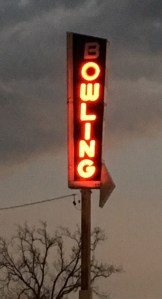
“My Bowling Green”

owling-100dpi_6x11_4c_0615-copyIt’s hard being Bowling Green, /
To see the things I have seen, /
Bodies piled high as friends lean /
Upon the bars in my Bowling Green. /

The reckless came to town one day, /
Said we had all gone away, /
Gone away, no more to say /
In this place now unseen, called my Bowling Green. /

Jihadist from a foreign land /
Had come and massacred us so grand, /
Wiped us all out where we stand. /
O’ the tragedy was so mean deep in my Bowling Green. /

They say none of us were spared, /
That these terrorist did not care. /
We were lost to great despair /
That day in memory serpentine in my Bowling Green. /

The media did not take note. /
Little was said and less was wrote. /
We were left with but just a sad note, /
A sad note it would seem about my Bowling Green. /

Fredrick Douglass had nothing to say. /
Nor Oliver Wendell Douglas about that day /
When Green Acres were turned red with dismay /
O’ that sad, mean, vile scene in my Bowling Green. /

We cannot remember what we do not know, /
Though alternative facts tell us so, /
That lies and lives come and go. /
There is little we can now glean from my Bowling Green. /

They erected a sign to the non-event /
And many a word has long been spent /
In song and poem and prose unbent /
To say what can’t be seen of the wrongs in my Bowling Green. /

It’s hard being Bowling Green, /
To see the things I have seen, /
Bodies piled high as friends lean /
Upon the bars in my Bowling Green.

–photo and poem by David E. Booker

Leave a comment

Filed under 2017, photo by David E. Booker, poetry by author, political humor

6 Famous Authors With Shocking Beliefs | Inverse

Source: 6 Famous Authors With Shocking Beliefs | Inverse

When we fall in love with a novel, we sometimes believe we come to know its author just by reading the book. From reading the Harry Potter novels one can easily conclude that its author — J.K. Rowling — is intolerant of oppression, politically progressive, a strong believer in diversity, and most certainly, British. All of these things about Rowling are overwhelmingly true, though if we found out she hated children, we’d probably be totally scandalized. (She doesn’t, thankfully).

Similarly, if you read Robert A. Heinlein’s Stranger in a Strange Land you might erroneously assume the author was a free-love hippie, when in fact, Heinlein’s libertarian and conservative views couldn’t be further from the tone of that particular novel. With Robert Heinlein and Stranger in a Strange Land, it’s almost as if the novel’s free-love protagonist offers a mirror image to the novelist — it’s Dr. Jekyll to a Mr. Hyde, say — something that is true of other writers on this list. Here are six super-famous writers with beliefs that are either inversions of their literary reputations, or just straight-up fascinating.

Philip K. Dick Thought He Was a Robot and, Also, the Spirit of Elijah

Okay, so this one isn’t too shocking. In addition to believing he was contacted by intelligences from beyond, the prolific and visionary sci-fi writer Philip K. Dick also toyed with the idea that he may, in fact, have been a robot. While the events of many of his novels (notably Do Androids Dream of Electric Sheep?) certainly check with this passing fancy of Dick’s, he also flirted with the idea that he was possessed by the spirit of the biblical prophet Elijah. So, next time you’re at a Seder, ask if you can leave something out for Philip K. Dick and see if anyone gets it.

Sir Arthur Conan Doyle Believed in Fairies

In Conan Doyle’s short story “The Adventure of the Sussex Vampire” the protagonist — the great Sherlock Holmes — says, “This Agency stands flat-footed upon the ground and there it must remain. The world is big enough for us. No ghost need apply.” Throughout the 56 short stories and four novels chronicling the adventures of Sherlock Holmes, never once does the stoic detective flirt with a belief in the supernatural or paranormal. And yet, late in his life, the creator of the uber-rational Sherlock Holmes, Sir Arthur Conan Doyle himself, asserted frequently that he had seen fairies and other supernatural creatures. Perhaps when Conan Doyle attempted to kill off Sherlock Holmes, he was attempting to destroy his rational side to have more fun with fairy thoughts. Either that, or fairies are totally real.

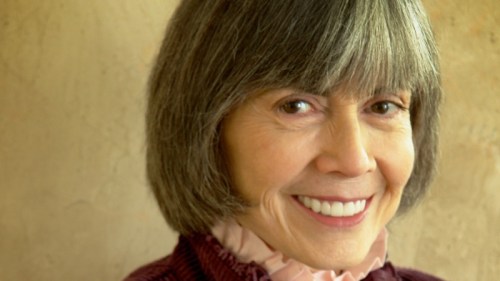
Anne Rice Found God

The author of Interview With the Vampire briefly became extremely pious, and even authored Christian texts (including her novel Christ the Lord: Out of Egypt). While the steamy and grotesque nature of her vampire books seems to be in stark opposition to traditional Christianity, as of 2010, Anne Rice maintains that she is still “committed to Christ.” But to be clear, Rice did officially leave the Catholic Church because she felt that being a “Christian,” was “quarrelsome” and “hostile.” It’s unclear if there are any parallels between her feelings about quarrelsome religious folks and the frequently quarrelsome vampire, Lestat.

James Joyce Thought Radio Controlled the Weather

In Sylvia Beach’s excellent memoir, Shakespeare and Company, the publisher and proprietor of the famous Parisian bookstore recounts her fascinating dealings with the late author of Ulysses, James Joyce. One interesting tidbit was Joyce’s growing impatience with the rise of radios in culture. Specifically, Joyce thought there was obviously some kind of correlation between the surge of radios use and rainstorms in France. Climate change deniers, take that! Or actually, don’t. Let James Joyce have it.

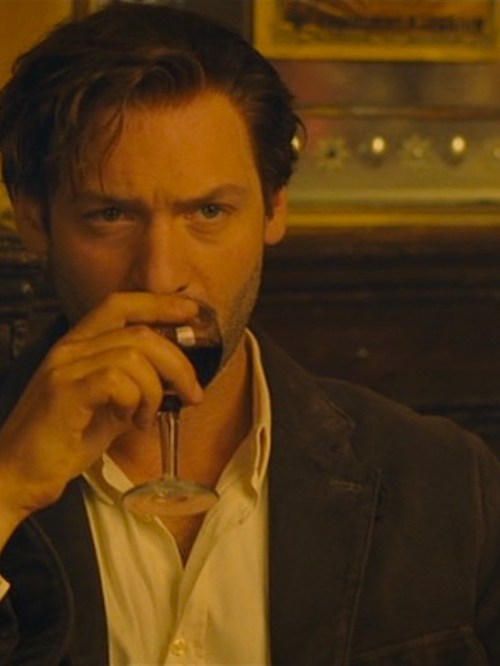
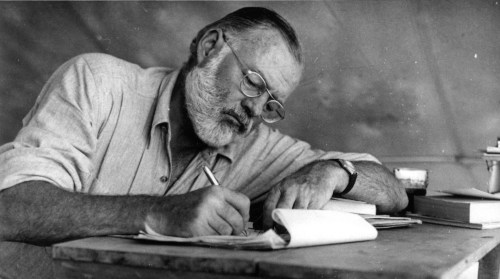
Hemingway Wanted to Work for the KGB?

While this one is disputed, there is some indication that Ernest Hemingway was recruited by the KGB in 1941 and that he was a secret agent named “Argo.” The only problem is that apparently Hemingway was really bad at being a double agent — assuming he really wanted to be one — as he never really supplied the KGB with any good intelligence. While we tend to think of Hemingway as an American man of his time (as he’s portrayed in Midnight in Paris), his real-life political leanings were certainly all over the place. While it might be surprising that Hemingway had communist beliefs in the ‘40s, it’s not totally implausible.

Stephen King Hates Adverbs

Stephen King may be the undisputed master of horror, but there’s only one thing truly fears: adverbs. King maintains that adverbs were created with “the timid writer in mind.” He may be an extremely creative guy, but I don’t want to even think about how many grotesque and sickening adverbs I’ve overzealously employed to get my points across throughout the years.

Leave a comment

Filed under 2017, authors

New words to live by: “Falsetto light”

Time, once again, for New words to live by. This is a word or phrase not currently in use in the U.S. English lexicon, but might need to be considered. Other words, such as obsurd, crumpify, subsus, flib, congressed, and others, can be found by clicking on the tags below. Today’s New Word is created by combing sound and light. Without further waiting, Falsetto light.

OLD WORDS
Falsetto, n. 1) an unnaturally or artificially high-pitched voice or register, especially in a man. 2) a person, especially a man, who sings with such a voice.

Light, n. 1) something that makes things visible or affords illumination: all colors depend on light.
2) Physics.
1. electromagnetic radiation to which the organs of sight react, ranging in wavelength from about 400 to 700 nm and propagated at a speed of 186,282 mi./sec (299,972 km/sec), considered variously as a wave, corpuscular, or quantum phenomenon.
2. a similar form of radiant energy that does not affect the retina, as ultraviolet or infrared rays.

NEW WORD
Falsetto light, n. 1) an unnaturally or artificially high-pitched light or focus shining obsessively on something trivial, unimportant, or misdirected at the expense of losing focus on more important. For example, focusing on missing car keys while the car is being stolen. 2) To loudly trumpet or lay claim to an accomplishment you had little to do with and have little right to claim.

In a sentence: By using falsetto light, the candidate was able to make the press the issue instead of the questions the press was asking that the candidate was not answering.

Leave a comment

Filed under 2017, new word, New words to live by

Storytelling

John Berger (RIP) and Susan Sontag Take Us Inside the Art of Storytelling (1983)

Source: http://www.openculture.com/2017/01/john-berger-rip-and-susan-sontag-take-us-inside-the-art-of-storytelling-1983.html

“Somebody dies,” says John Berger. “It’s not just a question of tact that one then says, well, perhaps it is possible to tell that story,” but “it’s because, after that death, one can read that life. The life becomes readable.” His interlocutor, a certain Susan Sontag, interjects: “A person who dies at 37 is not the same as a person who dies at 77.” True, he replies, “but it can be somebody who dies at 90. The life becomes readable to the storyteller, to the writer. Then she or he can begin to write.” Berger, the consummate storyteller as well as thinker about stories, left behind these and millions of other memorable words, spoken and written, when he yesterday passed away at age 90 himself.

This conversation aired 35 years ago as “To Tell a Story,” an hourlong episode of Channel 4’s Voices, “a forum of debate about the key issues in the world of the arts and the life of the mind.” Though Berger and Sontag surely agreed in life on more than they disagreed (“not since [D.H.] Lawrence has there been a writer who offers such attentiveness to the sensual world with responsiveness to the imperatives of conscience,” the latter once said of the former), they here enter into a kind of debate about storytelling itself: why we do it, how we do it, when we can do it. Berger, for his part, characterizes all fiction as “a fight against the absurd,” against “that endless, terrifying space in which we live.”

Sontag, in the words of Lily Dessau at Berger’s publisher Verso, “considers the storyteller as inventor, in control of the material, out of which the ‘people come.’ Berger conversely takes the form of the story as the result of the language coming out of the people — but he does characterize their differing views as arriving at the same place — the scene of the text.” While both of them wrote fiction as well as essays, “Berger considers the story and essay in one breath, both as a form of struggle to model the unsayable,” while “for Sontag the two are entirely separate, although the struggle persists in both.”

Or, as Berger puts it in highlighting another aspect of the difference in their perspectives, “You say you want to be carried away by the story. I want the story to stop things being carried away into oblivion, into indifference.” The many tributes already paid to him, especially by influential creators formed in part by the influence of his work, indicate that Berger’s legacy hardly finds itself now on the brink of an indifferent oblivion. Now that his long life has reached the end of its final chapter, well, perhaps we can begin to read, and to tell, his story.

Leave a comment

Filed under 2017, storytelling

The 27 Best Books on Writing

Writing is hard, and defining yourself as a writer can be even harder. Here’s our exhaustive list of the best books on writing when the blank page beckons.

Source: The 27 Best Books on Writing

Writing is, as a general rule, hard. Defining yourself as a writer can be even harder. Sure, there are other difficult practices like law and medicine out there, but a person becomes a lawyer or a doctor when he or she passes a series of exams and graduates from a certain school. Writing doesn’t always work that way. There aren’t tests to study for and facts to memorize. Where are we supposed to learn how to write?

From grammar rules to publishing advice to personal narratives, these books on writing reveal in intimate detail the ins and outs of what it means to call yourself a writer. Sometimes harsh, sometimes funny, but always honest, they can be thought of as a kind of syllabus for writing. Whether you’re an aspiring artist working on your first drafts or a seasoned veteran in the publishing world, these are some of the best books on writing with insight and wisdom that can support you at all stages of your writing process.

Books listed include:

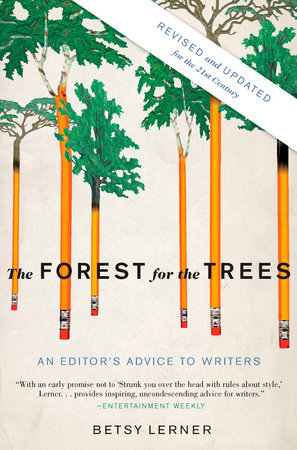
The Forest for the Trees (Revised and Updated)
An Editor’s Advice to Writers

by Betsy Lerner

For both established and prospective authors alike, the publishing house can seem like a jungle. Luckily, Betsy Lerner is here to lead a safari, citing her vast collection of experiences as an editor as her field guide. The Forest for the Trees motivates writers by helping them get over their fear of the unknown. It’s less about taming the wilderness and more about facing the demons of self-doubt and sloth that live in every person’s own mind.

***

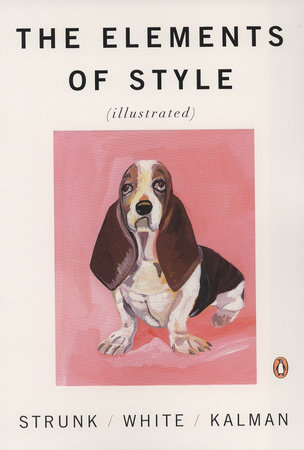
The Elements of Style Illustrated

by Strunk, White, Kalman

William Strunk and E.B. White’s The Elements of Style is so widely known that we’re sure you already have a copy, but of course we had to mention it. The only style guide to ever appear on a bestseller list, this book should be your go-to if your writing is in need of an infusion of clarity. Plus, this particular edition is illustrated by Maira Kalman, adding a visual element of style to the classic.

***

Story Engineering

by Larry Brooks

Larry Books turns a technical eye to the writing process in Story Engineering. If you don’t properly plan out your story prior to setting pen to paper, he argues, your storytelling won’t be as effective as you’d like it to be. To remedy this, he takes readers through six core elements of storytelling: concept, character, theme, story structure, scene construction, and voice.

***

Naked, Drunk, and Writing
Shed Your Inhibitions and Craft a Compelling Memoir or Personal Essay

by Adair Lara

Adair Lara’s Naked, Drunk, and Writing is a must-read for any memoirist or personal essayist. With experience as a teacher, editor, and, of course, writer, Lara’s know-how will help readers through problems like how to face your family after they’ve read your work and how to find an agent who will fight for you. The perfect mix of tough love, comic relief, and passion, Lara’s book is invaluable for anyone who needs a little help telling their story.

***

How to Write a Damn Good Novel

by James N. Frey

James N. Frey’s overarching guide will be of use to both the novice and the seasoned, published writer. He provides advice for how to overcome writer’s block and fear of the blank page, how to turn a critical eye to your own writing, and more. Frey’s book is one to keep within arm’s reach while writing, to grab during those moments when you need to take a step back from your work and get back to basics.

***

On Moral Fiction

by John Gardner

Morality and art have a complicated relationship, but John Gardner faces it fearlessly in this book-length essay. By Gardner’s way of thinking, all real art is moral, but morality doesn’t necessarily have to do with codes of conduct and submission to a Higher Power; it is the ability of art to point to some human value. The harsh lines he draws to distinguish “art” from “not art,” may frustrate some, but even in that case, this book’s ideas stick in the reader’s head.

***

On Writing

by Stephen King

If you’ve ever read a book by renowned American horror novelist Stephen King, you’ve probably wondered just how he comes up with his ideas. For the answer, look no further than On Writing, King’s memoir where he describes his writing process, including anecdotes about how he started some of his most iconic stories. In addition to recounting his personal experiences, he dedicates a whole chapter to grammar and offers his advice on form. It’s a great read for anyone in need of inspiration, and how better to make you pay attention than Mr. King?

***

The Writer’s Journey

by Christopher Vogler

Movie lovers will appreciate this book from Christopher Vogler. He exemplifies his writing tips with movies, a practice that makes this instructional especially helpful for screenwriters. Having received praise from writers and directors such as Darren Aronofsky (Black Swan) and Bruce Joel Rubin (Ghost), The Writer’s Journey can boast its status as an essential to anyone looking to write the next Oscar nominated film. It’s also an excellent field guide for a novelist stuck in a plot maze and desperate to get out.

***

A Poetry Handbook

by Mary Oliver

Imagine if you could get help with the very basics of writing poetry from a Pulitzer Prize-winning poet? Fact is, you can via Mary Oliver’s book A Poetry Handbook. The handbook is written in a way that makes it a perfect resource for both teens and adults as they start on their poetry journey – and is a useful refresher for veteran poets as well.

***

For the full list, with brief descriptions and links to buy them, go to http://www.signature-reads.com/2016/10/the-27-best-books-on-writing/?ref=PRH6E5971A08F&aid=randohouseinc31159-20&linkid=PRH6E5971A08F

Leave a comment

Filed under 2016, advice

Most annoying word?

Poughkeepsie, NY, A poll by Marist College found that the most annoying word or phrase used in casual conversation in America is “whatever.” The poll indicates the word irritates 38 percent of Americans.

The pollsters offered up five options for most annoying word of phrase: “whatever,” “no offense, but,” “you know, right,” I can’t even,” and “huge.”

In second place? “No offense, but” with 20 percent. Third place went to two phrases that tied: “you know, right,” and “I can’t even.” In each case, 14 percent of Americans found the phrase irksome. In last place, with 8 percent, was the word “huge.”

Last year “whatever” took first place with 43 percent. Also, age maters. Americans under 30 years old found “I can’t even” to be the most annoying word or phrase for whatever reason.

Leave a comment

Filed under 2016, words

New words to live by: “Spam fat”

Time, once again, for New words to live by. This is a word or phrase not currently in use in the U.S. English lexicon, but might need to be considered. Other words, such as obsurd, crumpify, subsus, flib, congressed, and others, can be found by clicking on the tags below. Today’s New Word is created by combing a sound and a noun. Without further waiting, Spam fat.

OLD WORDS
Spam, v. Original a noun meant to name a food product consisting mostly of pork and formed into a block, in the digital/computer age it became a verb meaning to inundate people with unwanted e-mails, text messages, possibly even kitten photos.

Fat, n. That adipose material that shows up on your body when and where you least want, often, but not exclusively, around the fall and winter holidays.

NEW WORD
Spam fat, n. 1. That adipose material that shows up too often and too quickly because you are being inundated with too many goodies in too short a space of time. 2. Too many e-mails in too short of time offering you last-minute gifts to buy, parties to attend, and photos of parties to which you didn’t attend or weren’t invited. This also includes post-holiday spam fat offering you ways to lose those “extra holiday pounds.”

Leave a comment

Filed under 2016, new word, New words to live by

Ann Patchett’s Guide for Bookstore Lovers – The New York Times

The pilgrims have been coming to Nashville for as long as the Grand Ole Opry has been on the radio. They come for Fan Fair and Taylor Swift concerts or just to walk down Lower Broad in cowboy boots. Parents visit their children in college. Conventioneers deplane by the thousands. Nashville is a hip city now, with a food scene, an art scene and two poorly performing professional sports teams.

With all the reasons to travel to Nashville, one might be surprised to learn that some people come just to see a small independent bookstore. It’s true. The Book Faithful journey to Music City because they still like their novels printed on paper. They come because they’ve heard about the shop dogs, or because someone told them years ago that bookstores were moving onto the endangered species list and they wanted to see one that was thriving in its natural habitat: in a strip mall, behind Fox’s Donut Den, beside Sherwin-Williams Paint Store. Some come in hopes of seeing a favorite author read, or catching a glimpse of the author who co-owns the store.

That would be me.

Karen Hayes and I opened Parnassus Books in November 2011. This summer, when Pickles and Ice Cream Maternity went out of business, we took down the adjoining wall and doubled our space. Business is good, which, by bookstore standards, means we spring for employee health insurance and pay the rent.

Karen and I are vocal supporters of the Shop Local movement, while at the same time benefiting from the Destination Bookstore travelers. It seems as if every time I’m in the back room signing special orders or meeting with staffers to pick a book for our First Editions Club, Bill, the tall Englishman who works the front, comes to tell me a book club has just arrived from Omaha or Bangor or Sweden. I go out and pose for group pictures, recommend books, give an impromptu tour. I always ask the same question, “What made you think I’d be here?” because seriously, I’m gone a lot. They always give me the same answer: I’m not why they came. They came to see the store.

With its high wooden shelves and rolling ladders and dangling stars, Parnassus is — if I may say so myself — worth a visit, a reminder that a strip mall need not be judged by its parking lot. But there are many bookstores that could stand as the centerpiece of a vacation. Here are some categories to consider when searching for one.

Children’s Books

Before we opened Parnassus, I made a fact-finding tour of American bookstores. The best advice I got was this: If you want customers, you have to raise them yourself. That means a strong children’s section. If e-books have taken a bite out of the adult market, they’ve done very little damage to children’s books, maybe because even the most tech-savvy parents understand that reading “Goodnight Moon” off your phone doesn’t create the same occasion for bonding.

There are some knockout stores that sell nothing but children’s books, including the Curious George Store in Cambridge, Mass., Wild Rumpus in Minneapolis, Books of Wonder in New York, and Tree House Books in Ashland, Ore., as well as loads of general interest stores that do a particularly great job with their children’s section, like Women & Children First in Chicago and Greenlight Bookstore in Brooklyn.

For many of us, children’s books are the foundation of bookselling, the cornerstone, the rock on which this church is built.

Before going, be sure to check the bookstores’ events calendars for visiting authors. If I may make a sweeping generalization, children’s book authors — from those who write board books suitable for teething to those who write young adult fiction full of vampires and angst — are the nicest people on the planet. Not only will they talk to your child or young adult, they will relate to them, they will draw pictures for them, they will create an indelible link between reading and joy.

The Destination Stores

I’m not sure why you’d be going to Greenwood, Miss., except for a mad desire to see TurnRow Book Company. It’s one of the most beautiful bookstores I know, and the sheer unlikelihood of its presence makes a traveler feel she’s stumbled into an oasis in the Mississippi Delta. Thanks to the Viking Range plant, the town also has a few top-notch restaurants and a very pretty inn, but the bookstore is the reason to go.

And since you’re in Greenwood, you’ve got to go to Oxford, a town defined by its writers. You can visit Faulkner’s home as well as the bookstore, or make that bookstores. Richard Howorth, the former mayor of Oxford, has three locations on the downtown square: the original Square Books; Square Books, Jr., the children’s store; and Off Square, which sells discount books and provides space for author events. Despite the enormity of Ole Miss, these three stores are the backbone of Oxford.

When was the last time you strolled around downtown Los Angeles near Skid Row? Never? I’m from Los Angeles and it took the Last Bookstore to get me there. The store’s tagline, “What are you waiting for? We won’t be here forever,” has a suitably apocalyptic ring to it, but the place is so monumental that it’s hard to imagine it going anywhere: 22,000 square feet on three floors with new and used books, vinyl records and gallery space. The whole thing appears to have been made out of books, books that are folded and fanned and stacked into towering sculptures. The clientele is as eclectic and fascinating as the reading selection. It did my heart good to see so many tattooed kids with black nail polish and nose rings sprawled out in chairs reading books.

As long as you’re going to places you never thought you’d go, head to Plainville, Mass., to see An Unlikely Story Bookstore & Café, which I hope will soon replace Disney World as the place all parents feel duty-bound to take their children. Jeff Kinney took part of the proceeds from his juggernaut series “Diary of a Wimpy Kid” and built his hometown a four-story bookstore — the ultimate fulfillment of literary civic duty. The building contains a dazzling bookshop, event space and cafe, and the top floor will soon be a Wimpy Kid museum, complete with movie props and the model for the Wimpy Kid Macy’s Thanksgiving Day parade balloon. (How do you know that your character is reaching the heights of Snoopy? You get your own parade balloon.)

The Tiny Stores

I’m a sucker for a little bookstore. In the right hands, the limited space can set off an explosion of personality and innovation. It’s like going to a French bistro with five tables and five things on the menu: You discover they’re exactly the right five things. New York City, land of skyrocketing rents and ubiquitous nail salons, has some of the best tiny bookstores in the world, including the Corner Bookstore, 192 Books and my favorite, Three Lives & Company. Sometimes what’s lost in square footage is made up for by a brilliant staff, or maybe it’s just that the people who work in tiny stores really do know exactly where every book is located. And they’ve read them. Little bookstores give off that same warm, snug feeling one gets from reading a novel in a comfy chair. Go look at the light in Newtonville Books outside Boston, or drive down the cape to Provincetown Bookshop, that essential last stop before hitting the beach. The novelist Louise Erdrich owns the tiny Birchbark Books in Minneapolis, a store that uses a chunk of its limited space to display an elaborately carved confessional box. You’ll wish every bookstore had one.

The Venerables

In Washington you see the Vietnam Memorial, the new National Museum of African American History & Culture and Politics & Prose Bookstore. It’s where the Obamas shop, and it’s where the movers and shakers of our nation’s capital come to see what’s really going on. It also happens to be where I eat lunch, as they have the best bookstore cafe I know.

Doesn’t everyone who visits Harvard go across the street to the Harvard Book Store, a shop as esteemed as the university? When you’re finished there (it will take all day), walk down Plympton Street to Grolier Poetry Book Shop. In Cambridge a store that sells nothing but poetry seems indispensable.

But if you’re interested in Grolier’s aesthetic opposite, go to the fabulous Books & Books. It’s everything I love about Miami without any of the things I don’t love about Miami, a store where books are elevated to new heights of gorgeousness. Just walking in the door of either the Coral Gables or South Beach location makes me feel like an automatic hipster, a book hipster. I always leave with armloads of art books and travel books, things I never knew I needed but I do need desperately.

And then, of course, there’s Powell’s: an entire block, a dizzying, self-proclaimed City of Books. The fact that Portland, Ore., celebrates being defined by its independent bookstore is really all you need to know about Portland.
The Personals

I went on my first book tour in 1992 when I was 28, and I have been going on book tours ever since. I have made it a point to go to bookstores in every town I’ve ever driven through. I go both as a writer and a reader, for business and for pleasure, and I have been in love with too many to make a comprehensive list here. Still, I have to call out some of my favorites, like Boswell Book Company in Milwaukee, lit by the internal fire of one Daniel Goldin, a stupendously great bookseller. And since you’re in Milwaukee, you won’t be that far from McLean & Eakin Booksellers in Petoskey, Mich., a personal favorite that proves Northern Michigan has a lot more to offer than cherries and apples. Malaprop’s was the heart and soul of Asheville, N.C., when Asheville was a sleepy little hippie town, and it’s still its heart and soul now that the city is cool and overcrowded, a position Malaprop’s maintained by being unabashedly true to itself.

No bookstore ever made a strip mall look better than Book Passage in Corte Madera, Calif. Every author you could hope to see comes to read at Book Passage.

And then there’s Explore Booksellers in Aspen, Colo., a town that’s gotten so expensive that the bookstore would have to sell Chanel bags alongside Michael Chabon novels in order to make the rent, so a group of people got together and bought it so that the town could have a bookstore

All these bookstores will welcome you, as will those I failed to mention. They’re delicate little ecosystems based on a passion for books and a belief in community. They’re here for you, but they need your attention and support to thrive.

Of course we’d love to see you at Parnassus. The shop dogs are lazy. They pile up in the office and sleep beneath the desks, but if you ask, we’ll wake them up and send them out on the floor. When you’ve gotten your recommendations from our brilliant staff, and listened to story time in the children’s section, and seen a couple of authors (and country music stars) shopping themselves, we’ll give you advice on where to go to dinner and hear music. Or maybe you just want to sit in a quiet chair and read your new book. Go ahead, that’s what we’re here for.

Ann Patchett’s most recent novel is “Commonwealth.”

Leave a comment

Filed under 2016, bookstore

17 Science Fiction Books That Forever Changed The Genre | Lifehacker Australia

Source: 17 Science Fiction Books That Forever Changed The Genre | Lifehacker Australia

Speculative fiction is the literature of change and discovery. But every now and then, a book comes along that changes the rules of science fiction for everybody. Certain great books inspire scores of authors to create something new. Here are 21 of the most influential science fiction and fantasy books.

These are books which clearly inspired a generation of authors, and made a huge splash either in publishing success or critical acclaim. Or both. And these are in no particular order.

#1 The Hitchhiker’s Guide to the Galaxy by Douglas Adams (1979)

The first (maybe only) science-fiction-comedy-multimedia phenomenon, Hitchhiker’s was a radio drama before it was a book, and the book sold 250,000 copies in its first three months.The Guardian named it one of the 1000 novels everyone must read, and a BBC poll ranked it fourth, out of 200, in their Big Read poll.

Ted Gioia comments on Adams’ hilarious book about the trials and tribulations of Arthur Dent, the survivor of a destroyed Earth, across the universe:

“No book better epitomizes the post-heroic tone of sci-fi than Douglas Adams’ The Hitchhiker’s Guide to the Galaxy. As the name indicates, a certain louche bohemianism permeates its pages. This is star-hopping on the cheap, pursued by those aiming not to conquer the universe, but merely sample its richeson fewer than thirty Altairian dollars per day. You can trace the lineage of many later science fictions books, with their hip and irreverent tone, back to this influential and much beloved predecessor.”

#2 20,000 Leagues Under the Sea by Jules Verne (1870)

Verne’s whole career is full of works that have inspired generations of authors — but this tale of the underwater adventure of Captain Nemo and the Nautilus has also had a profound effect on science, and inspired real scientific advancement.

In the introduction to William Butcher’s book Verne’s Journey to the Centre of the Self Ray Bradbury wrote that, “We are all, in one way, children of Jules Verne. His name never stops. At aerospace or NASA gatherings, Verne is the verb that moves us to space.”

Verne translator and scholar F.P. Walter added:

“For many, then, this book has been a source of fascination, surely one of the most influential novels ever written, an inspiration for such scientists and discoverers as engineer Simon Lake, oceanographer William Beebe, polar traveller Sir Ernest Shackleton. Likewise Dr. Robert D. Ballard, finder of the sunken Titanic, confesses that this was his favourite book as a teenager, and Cousteau himself, most renowned of marine explorers, called it his shipboard bible.”

#3 Dhalgren by Samuel R. Delaney (1975)

Sam Anderson prefaced his interview with Samuel R. Delany with this praise for Dhalgren’s impact:

“In the 35 years since its publication, Dhalgren has been adored and reviled with roughly equal vigour. It has been cited as the downfall of science fiction (Philip K. Dick once called it “the worst trash I’ve ever read”), turned into a rock opera, dropped by its publisher, and reissued by others. These days, it seems to have settled into the groove of a cult classic. In a foreword in the current edition, William Gibson describes the book as “a literary singularity” and Jonathan Lethem called it “the secret masterpiece, the city-book-labyrinth that has swallowed astonished readers alive.”

Dhalgren has remained popular through the years, being reprinted 7 times since 1975. It was also dropped by Bantam, the original publisher, because of its willingness to tackle LGBT themes despite the fact that the Bantam version sold over a million copies and went through 19 printings.

#4 War of the Worlds by H.G. Wells (1898)

In his book about The War of the Worlds, a seminal look at an invasion of Earth by Martians, author Brian Holmsten states:

“Since 1898 the War of the Worlds has been translated into countless languages, adapted by comic books, radio, film, stage, and even computer games, and has inspired a wide range of alien invasion tales in every medium. Few ideas have captured the imagination of so many people all over the world in the last century so well.

“It is a tribute to H.G. Wells that his story of alien conquest was not only the first of its kind, but remains one of the best.”

The 1927 American reprint, it can be argued, was one of the touching-off points for the Golden Age of science fiction. It inspired John W. Campbell to write and commission invasion stories — which also prompted authors like Arthur C. Clarke, Clifford Simak, Robert A. Heinlein and John Wyndham to do the same.

#5 Foundation by Isaac Asimov (1951)

Foundation is a sweeping tale of pyschohistory and the battle for the intellectual soul of a civilisation. and According to the BBC:

“The Foundation series helped to launch the careers of three notable science fiction authors of the succeeding generation. Janet Asimov sanctioned these novels, which were published in the late 1990s: Foundation’s Fear by Gregory Benford, Foundation and Chaos by Greg Bear, and Foundation’s Triumph by David Brin.” And without a doubt it launched the imaginations of countless other writers.”

It is also worth mentioning that the Foundation series won the 1966 Hugo for best all-time series. An award that has not been given out since.

And this book’s influence goes beyond science fiction: Artificial intelligence pioneer Marvin Minsky classified Asimov “among the finest of modern philosophers,” and Nobel-prize-winning economist Paul Krugman describesFoundation as his version of Atlas Shrugged, “I didn’t grow up wanting to be a square-jawed individualist or join a heroic quest; I grew up wanting to be Hari Seldon, using my understanding of the mathematics of human behaviour to save civilisation.”

#6 Stranger in a Strange Land by Robert Heinlein (1961)

The first science-fiction work to enter the New York Times Book Review’s bestseller list, Stranger sold 100,000 copies in hardcover and over five million in paperback. This book’s influence can’t be overstated. Arthur D. Hlavaty refers to Heinlein as a prototypical science-fiction author, saying:

“One of the ways human beings organise the world is by prototypes. We define a set as a typical example and a bunch of other things that are like it. For instance, when I was growing up, the prototype Writer was Shakespeare, the Artist was Rembrandt, and the Composer was Beethoven. In that way, Robert A. Heinlein has often been taken as the prototype Science Fiction Writer, and as changes and new paradigms shake the field, he still sometimes represents the science fiction of the past.”

Writer Ted Gioia looks at Stranger in a Strange Land’s main character as a prototype for other similar characters in SF, saying: “Smith is more than a character. He is prototype of an alternative personality structure. The question of whether we can remake the human personality from the ground up.”

#7 Dangerous Visions, edited by Harlan Ellison (1967)

This series helped launch the careers of almost every major author of the New Wave. The first volume included Samuel R. Delany, Philip K. Dick, and J.G. Ballard. In his introduction to the 2002 reissue of Ellison’s anthology, contributor Michael Moorcock wrote of Ellison’s collections:

“He changed our world forever. And ironically, it is usually the mark of a world so fundamentally altered — be it by Stokely Carmichael or Martin Luther King Jr. or Lyndon Johnson, or Kate Millet — that nobody remembers what it was like before things got better. That’s the real measure of Ellison’s success.”

“Gonna Roll the Bones” by Fritz Leiber won a Hugo Award and a Nebula Award for Best novelette. “Riders of the Purple Wage” a novella by Philip José Farmer tied for the Hugo Award. Samuel R. Delany got the Nebula for Best Short Story for “Aye, and Gomorrah…” Ellison was given a commendation at the 26th World SF Convention for editing “the most significant and controversial SF book” published in 1967.

#8 Childhood’s End by Arthur C. Clarke (1953)

Arthur C. Clarke himself had reservations about this novel, yet it sold out its first printing, 200,000 copies, in just two months after publication. Author Jo Walton writes about the first book to feature benevolent aliens who try to help the human race evolve:

“Science fiction is a very broad genre, with lots of room for lots of kinds of stories, stories that go all over the place and do all kinds of things. One of the reasons for that is that early on there got to be a lot of wiggle room.

“Childhood’s End was one of those things that expanded the genre early and helped make it more open-ended and open to possibility.

“Clarke was an engineer and he was a solidly scientific writer, but he wasn’t a Campbellian writer. He brought his different experiences to his work, and the field is better for it.”

Childhood’s End was nominated for a retro Hugo award in 2004.

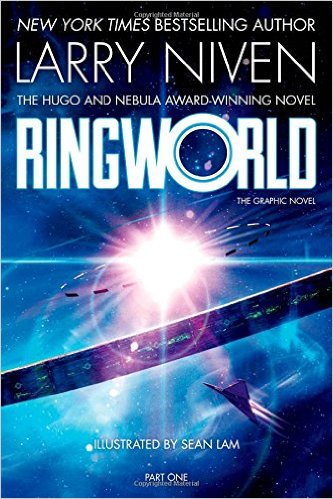
#9 Ringworld by Larry Niven (1970)

Sam Jordison of the Guardian had this to say about Ringworld, the masterpiece that is centered around around a theoretical ring-shaped space-habitat:

“Larry Niven’s 1970 Hugo award winner, Ringworld, is arguably one of the most influential science fiction novels of the past 50 years. As well as having had a huge impact on nearly all subsequent space operas (Iain M Banks’ Culture series and Alastair Reynolds’ House of Suns are just two), the book has helped generate a multi-billion-dollar industry.”

To add to this Jonathan Cowie, who wrote Essetial SF: A Concise Guide, called Ringworld “a landmark novel of planetary engineering (for want of a better term) that ranks alongside the late Bob Shaw’s Orbitsville.”

Niven later added four sequels and four prequels which tie into numerous other books set in Known Space; the fictional setting of about a dozen science fiction novels and several collections of short stories.

The other books are listed and discussed at: http://www.lifehacker.com.au/2016/09/17-science-fiction-books-that-forever-changed-the-genre/

Leave a comment

Filed under 2016, book list

Should Novels Aim for the Heart or the Head? – The New York Times

Is it a good thing for a novel to stimulate our emotions? Montaigne, Brecht and others thought not.

Source: Should Novels Aim for the Heart or the Head? – The New York Times

The devil is in the detail. Talking about moments when excruciating gallstone pains made him believe he was soon to die, Montaigne remarks: “When I looked upon death as the end of my life, universally, then I looked upon it with indifference. Wholesale, I could master it: Retail, it savaged me; the tears of a manservant, the distributing of my wardrobe, the known touch of a hand, a routine word of comfort discomforted me and made me weep.”

It is the details that attach us to life and arouse our emotions. “A hound, a horse, a book, a wineglass and whatnot,” Montaigne observes, all “had their role in my loss.” Reasoning and accumulated wisdom, he goes on, may give us some insight into human grief, but it is the small things, picked up by ears and eyes — “organs which can be stirred by inessentials only” — that will really have an impact. So we might be aware of, but not greatly moved by, the plight of Syrian refugees until the photograph of a dead child face down in the sand triggers our emotions and has us bursting into tears.

Having made these observations, Montaigne embarks on what might best be described as a creative writing lesson in reverse. Literature, he points out, is adept at exploiting this aspect of our psychology; it focuses on evocative inessentials to stimulate our emotional response. Generally unmoved by the human condition, we nevertheless “disturb our souls with fictional laments.” It hardly even matters that they are invented: “The plaints of Dido and Ariadne in Virgil and Catullus arouse the feelings of the very people who do not believe in them.”

And he asks a question that no one asks these days: “Is it right for the arts to serve our natural weakness and to let them profit from our inborn animal-stupidity?” Aside from its astute selection of moving detail, art is constantly in the business of manipulating our emotions, as if this were an end in itself. This, after all, was Plato’s objection to the arts and every kind of artistic effect — that it was manipulative and potentially mendacious. Or simply a waste: “How often,” Montaigne asks, “do we encumber our spirits with yellow bile or sadness by means of such shadows?”

If we apply these ideas to narrative fiction as it is today, what do we find? First, the idea that a book, or film for that matter, stimulates extreme emotions is constantly deployed as a promotional tool. Terrifying, hair-raising, profoundly upsetting, painfully tender, heartbreaking, devastating, shocking, are all standard fare in dust-jacket blurbs and newspaper reviews; it is as if the reader were an ectoplasm in need of powerful injections of adrenaline. Anything that disturbs us, arouses us, unsettles us, is unconditionally positive. “You will be on the edge of your seat.” “Your heart will be thumping.” “Your pulse will be racing.” Aristotle’s response to Plato, that arousing emotion could be positive so long as the emotion was clarified, cathartically contained and understood, is rarely invoked. At best there is the implication that arousing emotions fosters sympathy, perhaps even empathy, with fictional characters and that such sympathy then breaks down our prejudices and hence is socially useful. So readers will frequently be invited to contemplate the sufferings of threatened minorities or discriminated-against ethnic groups, or the predicament of those who are young, helpless and preferably attractive. But this is an alibi and we all know it; what matters is stimulating emotion to sell books.

Similarly, creative writing courses, as far as I am able to judge, are obsessed with technique — how to arrive at that powerful detail, how to give it prominence, how to grab the reader, not why we want to grab the reader or to what end. Traditional literature courses used to reflect on the way detail was used inside a novel’s overall vision. The present zeitgeist invites us only to contemplate how the trigger can be pulled, not where the bullet is going, because the purpose of creative writing courses — especially when the fees are high — is to teach the would-be writer how to produce a publishable narrative, not a “good,” let alone a “responsible” narrative.

Montaigne is hardly alone in criticizing an overeasy excitement of the sentiments. In recent times, Bertolt Brecht objected to the stimulation of emotional identification with fictional characters, and Muriel Spark argued strongly against arousing compassion in novels; it allowed readers, she complained, to “feel that their moral responsibilities are sufficiently fulfilled by the emotions they have been induced to feel.” She advocated satire and ridicule instead as more effective tools of social criticism.

Samuel Beckett entirely rejected the idea of narrative as a vehicle for arousing emotion. Again and again he blocks any sympathy for his characters, drawing attention to their fictional status, making their suffering grotesque and comic rather than endearing. Yet even he understands how naturally narrative moves in this direction, admitting that in the final analysis even the struggle to avoid arousing emotions will confer a kind of pathos on the author.

But does it actually matter? Why not let novels stimulate emotions all they will and readers buy into them as intensely as they wish? The hell with it. What on earth could be wrong with that?

Montaigne’s comments on the evocative power of detail are not isolated. He lived in an age of division and dogmatism; the religious wars between Catholics and Huguenots lasted almost 40 years and caused countless deaths. In 1572 the St. Bartholomew’s Day Massacre alone saw thousands of Huguenots killed by their Catholic enemies. Montaigne’s position was always that we must be extremely careful about our emotions, in particular our tendency to get emotional about ideas. He didn’t advise neutrality, but simply that “we should not nail ourselves so strongly to our humors and complexions.” To foster emotions deliberately and habitually was dangerous, because once a strong emotion had kicked in it was very difficult to find a way back. Certainly, had he been alive today, he would have seen a continuity not just between violent fiction and real violence, war films and war, but also more generally between a culture that has turned the stimulation of emotion into a major industry and a society torn apart by heated conflicts of all kinds.

No civilization has ever produced as much narrative as our own, and with so little collective control. Thousands upon thousands of stories and novels are published worldwide every month. Not to mention TV series and films. There is intense competition: competition to get published, competition to win prizes, competition to reach a national audience, competition to reach an international audience. Of course there are various cards to play in that competition: wit, creativity, ideology, comedy, savviness; but the factor most frequently stressed, the one no one can do without, is emotional impact. When was the last time you heard a novel praised because it invited the reader to a higher level of intellectual engagement with complex issues? Or because it retreated from spicy detail to offer a balanced view of life overall? Or because its characters managed to handle potentially dangerous conflicts without arriving at a destructive showdown? Often as we read it seems that all the energy and creativity of the writer has been channeled into conjuring up those piquant, lurid or simply shocking details that will unleash the reader’s emotions.

How can we suppose that this state of affairs, this constant rush for the most disturbing, the most poignant, the most emphatic, the most terrifying, has no effect on the way we respond to the dramas of our lives? As I write this morning, three months after Brexit, two months after the Republican Convention nominated Donald Trump, following a summer that has seen scores of deaths from terrorism and with Aleppo still under relentless bombing, all I hear around me is violent, overheated, highly emotional rhetoric, ferocious discrediting of all adversaries, poignant details of the lives of unlucky victims, horror for the future and, beneath it all, a complacent excitement about our own capacity for feeling life intensely.

***
Tim Parks’s most recent book is “The Novel: A Survival Skill.”

Leave a comment

Filed under 2016, novel