Tag Archives: Saturday

How To Wake Up And Not Feel Like Going Right Back To Bed

Fitness gurus share their morning routines.

NYLON |

  • Molly Hurford

https://getpocket.com/explore/item/how-to-wake-up-and-not-feel-like-going-right-back-to-bed?utm_source=pocket-newtab

How do some people manage to look so darn perky as they sip coffee and smoothies in their Instagram stories in the morning? It all comes down to establishing a winning routine, one that’s easy for you to do every day and leaves you feeling awake, alert, and inspired. You don’t have to steal an entire routine from these fitness and wellness experts, but they have some pretty great suggestions of places to start.

Once you begin to develop a routine of your own, optimize it to your specific needs. Meditation for 20 minutes might not work for you, but maybe you can handle five minutes. Yoga might not be your jam, but what about a few basic stretches instead? And journaling can feel a little cliche, but what about a Google Doc where you list one thing daily that you’re grateful for? We don’t all need to be fitness and wellness junkies, but we can all get a little bit better at managing our mornings and crushing the rest of our day. 

Stay Offline

“I’d say my number one tip is to get ready for your day, whether that be breakfast, journaling, meditation, or working out before looking at your phone,” Sophie Gray of WayofGray.com says. “I recommend being off of your phone for at least 30 to 60 minutes in the morning! I like to do this because I can check in with myself first, before checking in with others.”  

Productivity gurus and the authors of Peak Performance, Brad Stulberg and Steve Magness, also back this one up. The more time you can stay off your phone and not be distracted, the better. Getting your primary workout for the day done before the flood of emails, Instagrams, and text is going to make the day feel a lot smoother. 

“This year has officially been the year of slowing down and learning to give myself what I need in order to thrive throughout the day with sustained energy and inspiration,” adds The Balance Blonde blogger Jordan Younger. “You could say I am a notorious overcommitter and a workaholic-slash-iPhone-aholic—who isn’t?—so I decided to get serious with my morning routine, to start to cultivate more peace and serenity in my daily life. I start each day with a digital detox where I do not look at my phone until I feel ready to be on and communicate with the world!”

Get Some Sun

“Working from home can sometimes mean there’s no need for you to leave the house, but, for me, getting outdoors every day for fresh air, a sense of vitality, and vitamin D is so important,” says Melissa Hemsley of the Hemsley Sisters. “Daylight helps to reset your internal body clock, also known as the circadian rhythm, leading to better sleep and allowing your body to tune into what it needs. I’ve got a staffy called Nelly who I take for runs around my local park, so it’s a non-negotiable for me!”

Studies bear this out: We need vitamin D to stay happy and energized. One such study even linked vitamin D deficiency in young women with depression. You don’t need to start supplementing to get it. Just getting sunlight should do the trick. And if, like Melissa, you work at home, a walk outside can give you the divide between “you time” and working hours.

Add a Yoga Flow

It’s no shock that Strala Yoga creator Tara Stiles starts every morning with a yoga flow, though as a new mom, her routine varies daily depending on what she needs and how she feels. And that’s a good thing! Even if you’re not nursing a newborn, switching up your yoga flow makes the morning a bit more exciting. Strala Yoga has a ton of quick and simple morning flows that Stiles created, and most of them run between seven and 12 minutes. Check out this one and this one if you prefer to have a video to flow with, or just do a few sun salutations and poses that make you feel particularly good. 

A regular yoga practice—10 minutes a day is over an hour a week!—can increase strength, balance, and flexibility, calm the mind, and reduce stress, according to the American College of Sports Medicine. It can even help battle things like lower back pain, according to a recent study

Scrape Your Tongue (or Whatever)

“Tongue scraping with a copper or stainless steel tongue scraper removes the toxins that brushing and flossing your teeth doesn’t,” says the other Hemsley sister, Jasmine. “Quite frankly, I’d rather forget to brush my teeth!” If tongue scraping isn’t for you, that’s fine, too, but having a morning beauty/cleansing routine can go a long way toward making you feel more awake and alert if you’re having a tough time crawling out of bed and perking up. 

Meditate

“I wake up, make a matcha tea or coffee in my kitchen, stretch on my yoga mat, and do a mindfulness meditation practice,” says Younger. “I have also gotten very into crystals, sage, essential oils, and palo santo. The morning is my ‘me time’ to play around with all of my yogi, kundalini grounding practices and also get some reading or journaling in. Then I head off to teach yoga down the street and feel like a new human! Also breathing. It sounds simple, but it’s been a game changer to really focus on my breath.” 

Meditation also makes you more creative, according to one study. And another championed morning meditation because that’s when we’re at our most spiritually aware.

It’s not just the yogis who are doing morning meditation, fitness junkies are into it, too. “Everyday is different for me, but no matter where I am, I make sure to spend a few moments alone setting my intention and purpose for the day through meditation,” says Karena Dawn of ToneItUp.com. It really helps me stay centered and focused.  After that, I head out for my workout. If I don’t workout in the morning, it usually won’t happen.” 

Get in a Quick Workout

Dawn also digs a morning workout to get the blood pumping. If you’re an early riser and can sneak in a quick run or strength workout, it’s a great way to kick off the day. And bonus, if you do a low-key workout before you eat breakfast; you’ll reap the benefits of fasted state training and gain extra strength and aerobic capacity in the process. Bonus: You can burn almost 20 percent more fat if you exercise pre-breakfast, according to one study. Plus, let’s be honest, breakfast will taste a whole lot better when you’ve really worked for it. 

Leave a comment

Filed under 2020, writing tip

‘Sleep Should Be Prescribed’: What Those Late Nights Out Could Be Costing You

A leading neuroscientist on why sleep deprivation is increasing our risk of cancer, heart attack, and Alzheimer’s – and what you can do about it.

Matthew Walker has learned to dread the question “What do you do?” At parties, it signals the end of his evening; thereafter, his new acquaintance will inevitably cling to him like ivy. On an aeroplane, it usually means that while everyone else watches movies or reads a thriller, he will find himself running an hours-long salon for the benefit of passengers and crew alike. “I’ve begun to lie,” he says. “Seriously. I just tell people I’m a dolphin trainer. It’s better for everyone.”

Walker is a sleep scientist. To be specific, he is the director of the Center for Human Sleep Science at the University of California, Berkeley, a research institute whose goal – possibly unachievable – is to understand everything about sleep’s impact on us, from birth to death, in sickness and health. No wonder, then, that people long for his counsel. As the line between work and leisure grows ever more blurred, rare is the person who doesn’t worry about their sleep. But even as we contemplate the shadows beneath our eyes, most of us don’t know the half of it – and perhaps this is the real reason he has stopped telling strangers how he makes his living. When Walker talks about sleep he can’t, in all conscience, limit himself to whispering comforting nothings about camomile tea and warm baths. It’s his conviction that we are in the midst of a “catastrophic sleep-loss epidemic”, the consequences of which are far graver than any of us could imagine. This situation, he believes, is only likely to change if government gets involved.

Walker has spent the last four and a half years writing Why We Sleep, a complex but urgent book that examines the effects of this epidemic close up, the idea being that once people know of the powerful links between sleep loss and, among other things, Alzheimer’s disease, cancer, diabetes, obesity and poor mental health, they will try harder to get the recommended eight hours a night (sleep deprivation, amazing as this may sound to Donald Trump types, constitutes anything less than seven hours). But, in the end, the individual can achieve only so much. Walker wants major institutions and law-makers to take up his ideas, too. “No aspect of our biology is left unscathed by sleep deprivation,” he says. “It sinks down into every possible nook and cranny. And yet no one is doing anything about it. Things have to change: in the workplace and our communities, our homes and families. But when did you ever see an NHS poster urging sleep on people? When did a doctor prescribe, not sleeping pills, but sleep itself? It needs to be prioritised, even incentivised. Sleep loss costs the UK economy over £30bn a year in lost revenue, or 2% of GDP. I could double the NHS budget if only they would institute policies to mandate or powerfully encourage sleep.”

Why, exactly, are we so sleep-deprived? What has happened over the course of the last 75 years? In 1942, less than 8% of the population was trying to survive on six hours or less sleep a night; in 2017, almost one in two people is. The reasons are seemingly obvious. “First, we electrified the night,” Walker says. “Light is a profound degrader of our sleep. Second, there is the issue of work: not only the porous borders between when you start and finish, but longer commuter times, too. No one wants to give up time with their family or entertainment, so they give up sleep instead. And anxiety plays a part. We’re a lonelier, more depressed society. Alcohol and caffeine are more widely available. All these are the enemies of sleep.”

But Walker believes, too, that in the developed world sleep is strongly associated with weakness, even shame. “We have stigmatised sleep with the label of laziness. We want to seem busy, and one way we express that is by proclaiming how little sleep we’re getting. It’s a badge of honour. When I give lectures, people will wait behind until there is no one around and then tell me quietly: ‘I seem to be one of those people who need eight or nine hours’ sleep.’ It’s embarrassing to say it in public. They would rather wait 45 minutes for the confessional. They’re convinced that they’re abnormal, and why wouldn’t they be? We chastise people for sleeping what are, after all, only sufficient amounts. We think of them as slothful. No one would look at an infant baby asleep, and say ‘What a lazy baby!’ We know sleeping is non-negotiable for a baby. But that notion is quickly abandoned [as we grow up]. Humans are the only species that deliberately deprive themselves of sleep for no apparent reason.” In case you’re wondering, the number of people who can survive on five hours of sleep or less without any impairment, expressed as a percent of the population and rounded to a whole number, is zero.

The world of sleep science is still relatively small. But it is growing exponentially, thanks both to demand (the multifarious and growing pressures caused by the epidemic) and to new technology (such as electrical and magnetic brain stimulators), which enables researchers to have what Walker describes as “VIP access” to the sleeping brain. Walker, who is 44 and was born in Liverpool, has been in the field for more than 20 years, having published his first research paper at the age of just 21. “I would love to tell you that I was fascinated by conscious states from childhood,” he says. “But in truth, it was accidental.” He started out studying for a medical degree in Nottingham. But having discovered that doctoring wasn’t for him – he was more enthralled by questions than by answers – he switched to neuroscience, and after graduation, began a PhD in neurophysiology supported by the Medical Research Council. It was while working on this that he stumbled into the realm of sleep.

“I was looking at the brainwave patterns of people with different forms of dementia, but I was failing miserably at finding any difference between them,” he recalls now. One night, however, he read a scientific paper that changed everything. It described which parts of the brain were being attacked by these different types of dementia: “Some were attacking parts of the brain that had to do with controlled sleep, while other types left those sleep centres unaffected. I realised my mistake. I had been measuring the brainwave activity of my patients while they were awake, when I should have been doing so while they were asleep.” Over the next six months, Walker taught himself how to set up a sleep laboratory and, sure enough, the recordings he made in it subsequently spoke loudly of a clear difference between patients. Sleep, it seemed, could be a new early diagnostic litmus test for different subtypes of dementia.

After this, sleep became his obsession. “Only then did I ask: what is this thing called sleep, and what does it do? I was always curious, annoyingly so, but when I started to read about sleep, I would look up and hours would have gone by. No one could answer the simple question: why do we sleep? That seemed to me to be the greatest scientific mystery. I was going to attack it, and I was going to do that in two years. But I was naive. I didn’t realise that some of the greatest scientific minds had been trying to do the same thing for their entire careers. That was two decades ago, and I’m still cracking away.” After gaining his doctorate, he moved to the US. Formerly a professor of psychiatry at Harvard Medical School, he is now professor of neuroscience and psychology at the University of California.

Does his obsession extend to the bedroom? Does he take his own advice when it comes to sleep? “Yes. I give myself a non-negotiable eight-hour sleep opportunity every night, and I keep very regular hours: if there is one thing I tell people, it’s to go to bed and to wake up at the same time every day, no matter what. I take my sleep incredibly seriously because I have seen the evidence. Once you know that after just one night of only four or five hours’ sleep, your natural killer cells – the ones that attack the cancer cells that appear in your body every day – drop by 70%, or that a lack of sleep is linked to cancer of the bowel, prostate and breast, or even just that the World Health Organisation has classed any form of night-time shift work as a probable carcinogen, how could you do anything else?”

There is, however, a sting in the tale. Should his eyelids fail to close, Walker admits that he can be a touch “Woody Allen-neurotic”. When, for instance, he came to London over the summer, he found himself jet-lagged and wide awake in his hotel room at two o’clock in the morning. His problem then, as always in these situations, was that he knew too much. His brain began to race. “I thought: my orexin isn’t being turned off, the sensory gate of my thalamus is wedged open, my dorsolateral prefrontal cortex won’t shut down, and my melatonin surge won’t happen for another seven hours.” What did he do? In the end, it seems, even world experts in sleep act just like the rest of us when struck by the curse of insomnia. He turned on a light and read for a while.

Will Why We Sleep have the impact its author hopes? I’m not sure: the science bits, it must be said, require some concentration. But what I can tell you is that it had a powerful effect on me. After reading it, I was absolutely determined to go to bed earlier – a regime to which I am sticking determinedly. In a way, I was prepared for this. I first encountered Walker some months ago, when he spoke at an event at Somerset House in London, and he struck me then as both passionate and convincing (our later interview takes place via Skype from the basement of his “sleep centre”, a spot which, with its bedrooms off a long corridor, apparently resembles the ward of a private hospital). But in another way, it was unexpected. I am mostly immune to health advice. Inside my head, there is always a voice that says “just enjoy life while it lasts”.

The evidence Walker presents, however, is enough to send anyone early to bed. It’s no kind of choice at all. Without sleep, there is low energy and disease. With sleep, there is vitality and health. More than 20 large scale epidemiological studies all report the same clear relationship: the shorter your sleep, the shorter your life. To take just one example, adults aged 45 years or older who sleep less than six hours a night are 200% more likely to have a heart attack or stroke in their lifetime, as compared with those sleeping seven or eight hours a night (part of the reason for this has to do with blood pressure: even just one night of modest sleep reduction will speed the rate of a person’s heart, hour upon hour, and significantly increase their blood pressure).

A lack of sleep also appears to hijack the body’s effective control of blood sugar, the cells of the sleep-deprived appearing, in experiments, to become less responsive to insulin, and thus to cause a prediabetic state of hyperglycaemia. When your sleep becomes short, moreover, you are susceptible to weight gain. Among the reasons for this are the fact that inadequate sleep decreases levels of the satiety-signalling hormone, leptin, and increases levels of the hunger-signalling hormone, ghrelin. “I’m not going to say that the obesity crisis is caused by the sleep-loss epidemic alone,” says Walker. “It’s not. However, processed food and sedentary lifestyles do not adequately explain its rise. Something is missing. It’s now clear that sleep is that third ingredient.” Tiredness, of course, also affects motivation.

Sleep has a powerful effect on the immune system, which is why, when we have flu, our first instinct is to go to bed: our body is trying to sleep itself well. Reduce sleep even for a single night, and your resilience is drastically reduced. If you are tired, you are more likely to catch a cold. The well-rested also respond better to the flu vaccine. As Walker has already said, more gravely, studies show that short sleep can affect our cancer-fighting immune cells. A number of epidemiological studies have reported that night-time shift work and the disruption to circadian sleep and rhythms that it causes increase the odds of developing cancers including breast, prostate, endometrium and colon.

Getting too little sleep across the adult lifespan will significantly raise your risk of developing Alzheimer’s disease. The reasons for this are difficult to summarise, but in essence it has to do with the amyloid deposits (a toxin protein) that accumulate in the brains of those suffering from the disease, killing the surrounding cells. During deep sleep, such deposits are effectively cleaned from the brain. What occurs in an Alzheimer’s patient is a kind of vicious circle. Without sufficient sleep, these plaques build up, especially in the brain’s deep-sleep-generating regions, attacking and degrading them. The loss of deep sleep caused by this assault therefore lessens our ability to remove them from the brain at night. More amyloid, less deep sleep; less deep sleep, more amyloid, and so on. (In his book, Walker notes “unscientifically” that he has always found it curious that Margaret Thatcher and Ronald Reagan, both of whom were vocal about how little sleep they needed, both went on to develop the disease; it is, moreover, a myth that older adults need less sleep.) Away from dementia, sleep aids our ability to make new memories, and restores our capacity for learning.

And then there is sleep’s effect on mental health. When your mother told you that everything would look better in the morning, she was wise. Walker’s book includes a long section on dreams (which, says Walker, contrary to Dr Freud, cannot be analysed). Here he details the various ways in which the dream state connects to creativity. He also suggests that dreaming is a soothing balm. If we sleep to remember (see above), then we also sleep to forget. Deep sleep – the part when we begin to dream – is a therapeutic state during which we cast off the emotional charge of our experiences, making them easier to bear. Sleep, or a lack of it, also affects our mood more generally. Brain scans carried out by Walker revealed a 60% amplification in the reactivity of the amygdala – a key spot for triggering anger and rage – in those who were sleep-deprived. In children, sleeplessness has been linked to aggression and bullying; in adolescents, to suicidal thoughts. Insufficient sleep is also associated with relapse in addiction disorders. A prevailing view in psychiatry is that mental disorders cause sleep disruption. But Walker believes it is, in fact, a two-way street. Regulated sleep can improve the health of, for instance, those with bipolar disorder.

I’ve mentioned deep sleep in this (too brief) summary several times. What is it, exactly? We sleep in 90-minute cycles, and it’s only towards the end of each one of these that we go into deep sleep. Each cycle comprises two kinds of sleep. First, there is NREM sleep (non-rapid eye movement sleep); this is then followed by REM (rapid eye movement) sleep. When Walker talks about these cycles, which still have their mysteries, his voice changes. He sounds bewitched, almost dazed.

“During NREM sleep, your brain goes into this incredible synchronised pattern of rhythmic chanting,” he says. “There’s a remarkable unity across the surface of the brain, like a deep, slow mantra. Researchers were once fooled that this state was similar to a coma. But nothing could be further from the truth. Vast amounts of memory processing is going on. To produce these brainwaves, hundreds of thousands of cells all sing together, and then go silent, and on and on. Meanwhile, your body settles into this lovely low state of energy, the best blood-pressure medicine you could ever hope for. REM sleep, on the other hand, is sometimes known as paradoxical sleep, because the brain patterns are identical to when you’re awake. It’s an incredibly active brain state. Your heart and nervous system go through spurts of activity: we’re still not exactly sure why.”

Does the 90-minute cycle mean that so-called power naps are worthless? “They can take the edge off basic sleepiness. But you need 90 minutes to get to deep sleep, and one cycle isn’t enough to do all the work. You need four or five cycles to get all the benefit.” Is it possible to have too much sleep? This is unclear. “There is no good evidence at the moment. But I do think 14 hours is too much. Too much water can kill you, and too much food, and I think ultimately the same will prove to be true for sleep.” How is it possible to tell if a person is sleep-deprived? Walker thinks we should trust our instincts. Those who would sleep on if their alarm clock was turned off are simply not getting enough. Ditto those who need caffeine in the afternoon to stay awake. “I see it all the time,” he says. “I get on a flight at 10am when people should be at peak alert, and I look around, and half of the plane has immediately fallen asleep.”

So what can the individual do? First, they should avoid pulling “all-nighters”, at their desks or on the dancefloor. After being awake for 19 hours, you’re as cognitively impaired as someone who is drunk. Second, they should start thinking about sleep as a kind of work, like going to the gym (with the key difference that it is both free and, if you’re me, enjoyable). “People use alarms to wake up,” Walker says. “So why don’t we have a bedtime alarm to tell us we’ve got half an hour, that we should start cycling down?” We should start thinking of midnight more in terms of its original meaning: as the middle of the night. Schools should consider later starts for students; such delays correlate with improved IQs. Companies should think about rewarding sleep. Productivity will rise, and motivation, creativity and even levels of honesty will be improved. Sleep can be measured using tracking devices, and some far-sighted companies in the US already give employees time off if they clock enough of it. Sleeping pills, by the way, are to be avoided. Among other things, they can have a deleterious effect on memory.

Those who are focused on so-called “clean” sleep are determined to outlaw mobiles and computers from the bedroom – and quite right, too, given the effect of LED-emitting devices on melatonin, the sleep-inducing hormone. Ultimately, though, Walker believes that technology will be sleep’s saviour. “There is going to be a revolution in the quantified self in industrial nations,” he says. “We will know everything about our bodies from one day to the next in high fidelity. That will be a seismic shift, and we will then start to develop methods by which we can amplify different components of human sleep, and do that from the bedside. Sleep will come to be seen as a preventive medicine.”

What questions does Walker still most want to answer? For a while, he is quiet. “It’s so difficult,” he says, with a sigh. “There are so many. I would still like to know where we go, psychologically and physiologically, when we dream. Dreaming is the second state of human consciousness, and we have only scratched the surface so far. But I would also like to find out when sleep emerged. I like to posit a ridiculous theory, which is: perhaps sleep did not evolve. Perhaps it was the thing from which wakefulness emerged.” He laughs. “If I could have some kind of medical Tardis and go back in time to look at that, well, I would sleep better at night.”

• Why We Sleep: The New Science of Sleep and Dreams by Matthew Walker is published by Allen Lane.

Sleep in numbers

■ Two-thirds of adults in developed nations fail to obtain the nightly eight hours of sleep recommended by the World Health Organisation.

■ An adult sleeping only 6.75 hours a night would be predicted to live only to their early 60s without medical intervention.

■ A 2013 study reported that men who slept too little had a sperm count 29% lower than those who regularly get a full and restful night’s sleep.

■ If you drive a car when you have had less than five hours’ sleep, you are 4.3 times more likely to be involved in a crash. If you drive having had four hours, you are 11.5 times more likely to be involved in an accident.

■ A hot bath aids sleep not because it makes you warm, but because your dilated blood vessels radiate inner heat, and your core body temperature drops. To successfully initiate sleep, your core temperature needs to drop about 1C.

■ The time taken to reach physical exhaustion by athletes who obtain anything less than eight hours of sleep, and especially less than six hours, drops by 10-30%.

■ There are now more than 100 diagnosed sleep disorders, of which insomnia is the most common.

■ Morning types, who prefer to awake at or around dawn, make up about 40% of the population. Evening types, who prefer to go to bed late and wake up late, account for about 30%. The remaining 30% lie somewhere in between.

The Guardian |

  • Rachel Cooke

https://getpocket.com/explore/item/sleep-should-be-prescribed-what-those-late-nights-out-could-be-costing-you?utm_source=pocket-newtab


Leave a comment

Filed under 2020, writing tip

Between Solitude and Loneliness | The New Yorker

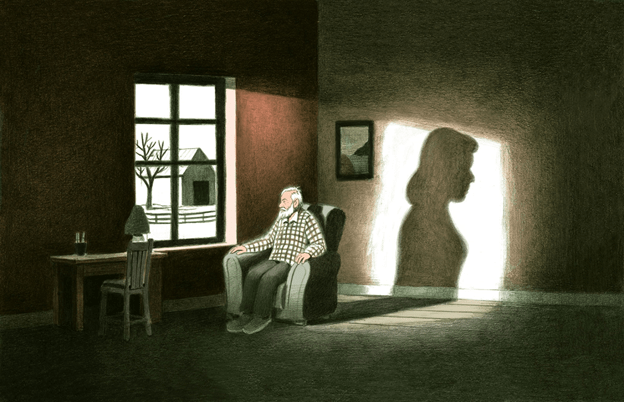
Man sitting alone in a chair, looking out a window.
Illustration by Antoine Maillard

At eighty-seven, I am solitary. I live by myself on one floor of the 1803 farmhouse where my family has lived since the Civil War. After my grandfather died, my grandmother Kate lived here alone. Her three daughters visited her. In 1975, Kate died at ninety-seven, and I took over. Forty-odd years later, I spend my days alone in one of two chairs. From an overstuffed blue chair in my living room I look out the window at the unpainted old barn, golden and empty of its cows and of Riley the horse. I look at a tulip; I look at snow. In the parlor’s mechanical chair, I write these paragraphs and dictate letters. I also watch television news, often without listening, and lie back in the enormous comfort of solitude. People want to come visit, but mostly I refuse them, preserving my continuous silence. Linda comes two nights a week. My two best male friends from New Hampshire, who live in Maine and Manhattan, seldom drop by. A few hours a week, Carole does my laundry and counts my pills and picks up after me. I look forward to her presence and feel relief when she leaves. Now and then, especially at night, solitude loses its soft power and loneliness takes over. I am grateful when solitude returns.

Born in 1928, I was an only child. During the Great Depression, there were many of us, and Spring Glen Elementary School was eight grades of children without siblings. From time to time I made a friend during childhood, but friendships never lasted long. Charlie Axel liked making model airplanes out of balsa wood and tissue. So did I, but I was clumsy and dripped cement onto wing paper. His models flew. Later, I collected stamps, and so did Frank Benedict. I got bored with stamps. In seventh and eighth grade, there were girls. I remember lying with Barbara Pope on her bed, fully clothed and apart while her mother looked in at us with anxiety. Most of the time, I liked staying alone after school, sitting in the shadowy living room. My mother was shopping or playing bridge with friends; my father added figures in his office; I daydreamed.

In summer, I left my Connecticut suburb to hay with my grandfather, on this New Hampshire farm. I watched him milk seven Holsteins morning and night. For lunch I made myself an onion sandwich—a thick slice between pieces of Wonder Bread. I’ve told of this sandwich before.

At fifteen, I went to Exeter for the last two years of high school. Exeter was academically difficult and made Harvard easy, but I hated it—five hundred identical boys living two to a room. Solitude was scarce, and I labored to find it. I took long walks alone, smoking cigars. I found myself a rare single room and remained there as much as I could, reading and writing. Saturday night, the rest of the school sat in the basketball arena, deliriously watching a movie. I remained in my room in solitary pleasure.

At college, dormitory suites had single and double bedrooms. For three years, I lived in one bedroom crowded with everything I owned. During my senior year, I managed to secure a single suite: bedroom and sitting room and bath. At Oxford, I had two rooms to myself. Everybody did. Then I had fellowships. Then I wrote books. Finally, to my distaste, I had to look for a job. With my first wife–people married young back then; we were twenty and twenty-three–I settled in Ann Arbor, teaching English literature at the University of Michigan. I loved walking up and down in the lecture hall, talking about Yeats and Joyce or reading aloud the poems of Thomas Hardy and Andrew Marvell. These pleasures were hardly solitary, but at home I spent the day in a tiny attic room, working on poems. My extremely intelligent wife was more mathematical than literary. We lived together and we grew apart. For the only time in my life, I cherished social gatherings: Ann Arbor’s culture of cocktail parties. I found myself looking forward to weekends, to crowded parties that permitted me distance from my marriage. There were two or three such occasions on Friday and more on Saturday, permitting couples to migrate from living room to living room. We flirted, we drank, we chatted–without remembering on Sunday what we said Saturday night.

After sixteen years of marriage, my wife and I divorced.

For five years I was alone again, but without the comfort of solitude. I exchanged the miseries of a bad marriage for the miseries of bourbon. I dated a girlfriend who drank two bottles of vodka a day. I dated three or four women a week, occasionally three in a day. My poems slackened and stopped. I tried to think that I lived in happy license. I didn’t.

Jane Kenyon was my student. She was smart, she wrote poems, she was funny and frank in class. I knew she lived in a dormitory near my house, so one night I asked her to housesit while I attended an hour-long meeting. (In Ann Arbor, it was the year of breaking and entering.) When I came home, we went to bed. We enjoyed each other, libertine liberty as much as pleasures of the flesh. Later I asked her to dinner, which in 1970 always included breakfast. We saw each other once a week, still dating others, then twice a week, then three or four times a week, and saw no one else. One night, we spoke of marriage. Quickly we changed the subject, because I was nineteen years older and, if we married, she would be a widow so long. We married in April, 1972. We lived in Ann Arbor three years, and in 1975 left Michigan for New Hampshire. She adored this old family house.

For almost twenty years, I woke before Jane and brought her coffee in bed. When she rose, she walked Gus the dog. Then each of us retreated to a workroom to write, at opposite ends of our two-story house. Mine was the ground floor in front, next to Route 4. Hers was the second floor in the rear, beside Ragged Mountain’s old pasture. In the separation of our double solitude, we each wrote poetry in the morning. We had lunch, eating sandwiches and walking around without speaking to each other. Afterward, we took a twenty-minute nap, gathering energy for the rest of the day, and woke to our daily fuck. Afterward I felt like cuddling, but Jane’s climax released her into energy. She hurried from bed to workroom.

For several hours afterward, I went back to work at my desk. Late in the afternoon, I read aloud to Jane for an hour. I read Wordsworth’s “Prelude,” Henry James’s “The Ambassadors” twice, the Old Testament, William Faulkner, more Henry James, seventeenth-century poets. Before supper I drank a beer and glanced at The New Yorker while Jane cooked, sipping a glass of wine. Slowly she made a delicious dinner—maybe veal cutlets with mushroom-and-garlic gravy, maybe summer’s asparagus from the bed across the street—then asked me to carry our plates to the table while she lit the candle. Through dinner we talked about our separate days.

Summer afternoons we spent beside Eagle Pond, on a bite-sized beach among frogs, mink, and beaver. Jane lay in the sun, tanning, while I read books in a canvas sling chair. Every now and then, we would dive into the pond. Sometimes, for an early supper, we broiled sausage on a hibachi. After twenty years of our remarkable marriage, living and writing together in double solitude, Jane died of leukemia at forty-seven, on April 22, 1995.

Now it is April 22, 2016, and Jane has been dead for more than two decades. Earlier this year, at eighty-seven, I grieved for her in a way I had never grieved before. I was sick and thought I was dying. Every day of her dying, I stayed by her side—a year and a half. It was miserable that Jane should die so young, and it was redemptive that I could be with her every hour of every day. Last January I grieved again, this time that she would not sit beside me as I died.

By Donald Hall, October 15, 2016

Leave a comment

Filed under 2020, Essay

The Single Reason Why People Can’t Write, According to a Harvard Psychologist

https://getpocket.com/explore/item/the-single-reason-why-people-can-t-write-according-to-a-harvard-psychologist?utm_source=pocket-newtab

“Why is so much writing so hard to understand? Why must a typical reader struggle to follow an academic article, the fine print on a tax return, or the instructions for setting up a wireless home network?”

These are questions Harvard psychologist Steven Pinker asks in his book, The Sense of Style: The Thinking Person’s Guide to Writing in the 21st Century. They’re questions I’ve often encountered –and attempted to tackle– throughout my career as a business writer and editor. Whenever I see writing that is loaded with jargon, clichés, technical terms, and abbreviations, two questions come immediately to mind. First, what is the writer trying to say, exactly? And second, how can the writer convey her ideas more clearly, without having to lean on language that confuses the reader?

For Pinker, the root cause of so much bad writing is what he calls “the Curse of Knowledge”, which he defines as “a difficulty in imagining what it is like for someone else not to know something that you know. The curse of knowledge is the single best explanation I know of why good people write bad prose.”

“Every human pastime –music, cooking, sports, art, theoretical physics –develops an argot to spare its enthusiasts from having to say or type a long-winded description every time they refer to a familiar concept in each other’s company. The problem is that as we become proficient at our job or hobby we come to use these catchwords so often that they flow out of our fingers automatically, and we forget that our readers may not be members of the clubhouse in which we learned them.”

People in business seem particularly prone to this “affliction.” You could argue that business has developed its own entirely unique dialect of English. People are exposed to an alphabet soup of terms and acronyms at business school, which they then put into use in their day-to-day interactions once they enter the working world.

And what starts out as a means of facilitating verbal communication between people becomes the primary mode with which people communicate their ideas in writing, from email to chat apps to business proposals and presentations.

“How can we lift the curse of knowledge?” asks Pinker. “A considerate writer will…cultivate the habit of adding a few words of explanation to common technical terms, as in ‘Arabidopsis, a flowering mustard plant,’ rather than the bare ‘Arabidopsis.’ It’s not just an act of magnanimity: A writer who explains technical terms can multiply her readership a thousandfold at the cost of a handful of characters, the literary equivalent of picking up hundred-dollar bills on the sidewalk.”

“Readers will also thank a writer for the copious use of for example, as in, and such as, because an explanation without an example is little better than no explanation at all.”

Whenever I write a sentence that makes me pause and wonder about what it means, I assume that other readers might react in the same way. If a sentence is not clear to me, it might not be clear to others. It’s an approach that I recommend to anyone who is trying to improve his own writing.

Before hitting publish and sending your writing out to the world, it’s better to be honest with yourself about how much your reader is likely to understand a given passage or sentence. Before you commit your writing to print– or to the internet– take a few moments to make sure that what you write is clear and understandable by as many of your intended readers as possible.

As Richard Feynman, the Nobel prize-winning physicist, once wrote, “If you ever hear yourself saying, ‘I think I understand this,’ that means you don’t.”

Leave a comment

Filed under 2020, writing

I Trained Myself to Be Less Busy — and it Dramatically Improved My Life

https://getpocket.com/explore/item/i-trained-myself-to-be-less-busy-and-it-dramatically-improved-my-life?utm_source=pocket-newtab

I am a robot, programmed to obliterate my to-do list. During the day, I direct a research laboratory, write papers, and teach classes as a professor of psychology at the University of Arizona. Come 4:30 pm, I run a kid limousine service, shuttling between various activities, preparing dinner, helping with homework and the evening routine. I scurry through these activities — often missing the moments of joy embedded in everyday life — until I have some sort of nightly electrical shortage, then crash out on the couch. I reboot in the morning and do it all again.

I am addicted to busyness. I am embarrassed to say it, largely because I am lucky to have a wonderful life and a great career, and, to be fair, the struggles, demands, and slings and arrows are all of my own doing (especially the part about having kids; I know I was there for that).

I created this mess — a life at breakneck speed from the moment I wake until I finally watch 30 minutes of Netflix before drifting off. But, I recently hit rock bottom, feeling as if I was going through the motions of my life rather than truly living it.

I’m not the only one who feels overwhelmed — you probably do too

I don’t think I am alone in my feelings about busyness, nor do I think these feelings are especially new for the average working adult. I might be alone at my rock bottom, but there are many indicators that we are feeling more overcommitted, overscheduled, overtired, and overburdened than ever before.

Brigid Schulte, in her 2014 book, Overwhelmed, writes incisively about this trend, “So much do we value busyness, researchers have found a human ‘aversion’ to idleness and need for ‘justifiable busyness.’” My favorite example from her book: Researchers can track the rise of busyness in holiday cards dating back to the 1960s. In holiday cards, Americans used to share news about our lives (the joys and sorrows of the year), but now we’re more likely than ever to mention how busy we are as well.

As a clinical psychologist, I have worked with many people who are trying to make substantial changes — from improving a marriage to overcoming generalized anxiety or depression. The idea that these changes begin with acknowledging that there’s a problem is a truism. Personal responsibility is the vehicle for behavior change. When it came to my busyness, though, I had what might be described as extreme difficulty looking beyond the hamster wheel. (Professionally, people in my line of work call this “very little insight.”)

I don’t think I am busier than anyone else. My wife and friends are just as busy as me. I think the difference is that I became aware of my busyness and started to hate it. I was feeling claustrophobic in my own life. I asked my wife if I could retire and get some time back in the day. (She said no.) Then I started to wonder about the opposite of busyness. I thought immediately of the slow food movement. I needed a slow food movement in my everyday life.

I realized busyness had devoured my values

The first change took root for me about 18 months ago when the graduate program that I direct started teaching Acceptance and Commitment Therapy (pronounced as the single word ACT) to our doctoral students, who are future clinical psychologists. ACT is a scientifically validated psychotherapy treatment for a range of mental health problems. Basically, it’s a form of talk therapy.

A central tenet of ACT is that emotional pain is driven in large part by getting over-involved in difficult experiences and thoughts (that is, going over and over things in our mind, getting stuck in our experiences, and being unable to create any psychological distance between yourself and the terribleness of things). Consequently, when we become stuck on or in our emotional pain, we go through each day in a way that is disconnected from our core values — the essential principles that, ideally, come to guide our lives. In ACT, value-centered living is paramount, and a big part of the treatment is to help people separate themselves from the painful language in their heads (“This is so awful. I feel so terrible.”)to get on with the business of living a meaningful life.

As I learned more about ACT and started incorporating its methods into my psychotherapy practice with clients, something important dawned on me: Busyness devoured my values. I was working, parenting, loving, emailing, and exercising in a sort of mindless way, just doing and doing. Busyness is not, nor was it ever, a guiding principle in my life. Yet, I had let the inertia of doing take deep root without realizing what was happening to me. To get more out of life — more meaning, more joie de vivre I needed to start doing less and to become more conscious about my choices.

How I started to reclaim my life from busyness

I started with a simple value: being outside. I am a regular exerciser, but I was losing touch with being outside and moving my body through space. I began walking more, that’s all. It was not a hard change to make — I just park a little farther from work and hoof it a bit more, or I go for a nice stroll during lunch. It would not be an overstatement to say that an additional 40 minutes a day of walking just two or three times a week has changed me in a profound way. Walking provides time to think, to be energized by nature, and to feel less frenzied. Quite dramatically, I am much less of a robot and much more of a human being.

Next, I focused on valuing idleness. I do not mean being a sloth, only that I was coming to see the value of doing as little as possible for long periods of time. I just finished Tim Kreider’s incredibly thoughtful and hilarious book of essays We Learn Nothing. The audiobook includes a bonus chapter called “Laziness: A Manifesto.” Kreider writes, “This busyness serves as a kind of existential reassurance, a hedge against emptiness. Obviously your life cannot possibly be silly, or trivial, or meaningless if you are so busy, completely booked every hour of the day. All this noise, and rush, and stress seem contrived to cover up some fear at the center of our lives.”

I cannot say if I my busyness was a hedge against some sort of existential emptiness, but all the doing certainly left me feeling empty in the end. Now, with idleness in mind, I just park myself on the couch as often as possible and see what happens. Mostly, I am looking for an opportunity to enjoy the moments of life in an unstructured way; I am looking for more play. In my idleness last night, I spent a long time just tickling my 5-year-old daughter, pretending to scare her, and lying on my back with her in “airplane position” while she perfected a move she called the hummingbird. That was the best half-hour of my year so far. What is more, I’ve found that the less I work, the better my work actually is in the end, from the ability to attend to students and clients to the creative energies needed for doing science.

As part of my effort to create time and space for doing less, I also got off Facebook. At first, I was simply trying to escape the toxicity of the election on social media. In time, though, I realized I was also escaping an attentional black hole, one with an incredible gravitational pull. I would never willfully stand in the middle of a room noisy room with everyone screaming for my attention, yet this is best metaphor I can think of to describe my mind on Facebook. I was weak and could not resist its forces, fair enough, but I also started to see it as filler and fluff. When I got past my FOMO and let it go, I gained back many moments in my day.

I’ve also tried to get serious about laughing more. For me, busyness’s neighbor is seriousness. Seriousness is overrated, and I feel much healthier and even childlike when I am not taking myself so seriously, and when I am trying to make other people laugh.

Finally, my relationships. In my days of busyness, I loathed the work pop-in — too many unscheduled interruptions. Now, I’m coming to appreciate people dropping by to say hello and to joke around (see: laughter). My door is a little more open, so to speak. I am also focusing on my local drinking club, where a few friends have been going for beers together for several years. Sometimes I am too busy and have to miss, but that really bothers me now. Friendships are sustenance, just like food.

Have I sustained these changes? Sort of. I am working as much as ever and find it hard to not get sucked into the trappings of busyness. Sometimes I look at my schedule shout to myself, “Too much, too much!” When this is the case, I just go for a walk. Or I just get on the floor and mess with my kids. Or I follow the mantra of our club: “Relax, have a homebrew.” (If my busyness freakout is in the morning, I do wait for the homebrew, in case you’re wondering. At least until lunch.)

By and large, though, I am feeling better than I have in a long time — more deliberate in the choices I make, more connected to the people around me, and more energized for the demands of the day. The surprising irony here, for me at least, is that by doing less, I am getting way more out life. I have banished my inner robot.

David Sbarra, PhD, is a professor of psychology at the University of Arizona. His new ebook, Love, Loss, and the Space Between, is available on Amazon.

Leave a comment

Filed under 2020, life studies

John le Carré wins $100,000 prize for ‘contribution to democracy’ | Books | The Guardian

Alison Flood and Sian CainFri 10 Jan 2020 00.45 EST

Source: John le Carré wins $100,000 prize for ‘contribution to democracy’ | Books | The Guardian

John le Carré has been named the latest recipient of the $100,000 (£76,000) Olof Palme prize, an award given for an “outstanding achievement” in the spirit of the assassinated Swedish prime minister.

Won in the past by names including whistleblower Daniel Ellsberg, who exposed the US government’s secret intelligence about the Vietnam war in 1971, the Olof Palme prize is intended to reward “an outstanding achievement in any of the areas of anti-racism, human rights, international understanding, peace and common security”.

Announcing Le Carré’s win early on Friday morning, the prize organisers praised the 88-year-old author, whose real name is David Cornwell, “for his engaging and humanistic opinion-making in literary form regarding the freedom of the individual and the fundamental issues of mankind.

“Attracting worldwide attention, he is constantly urging us to discuss the cynical power games of the major powers, the greed of global corporations, the irresponsible play of corrupt politicians with our health and welfare, the growing spread of international crime, the tension in the Middle East and the alarming rise of fascism and xenophobia in Europe and the US,” the organisers said, calling his career “an extraordinary contribution to the necessary fight for freedom, democracy and social justice”.

Le Carré said he would donate the winnings to the international humanitarian NGO Médecins Sans Frontières.

Le Carré, the acclaimed author of some of the last century’s most enduring works, from Tinker, Tailor, Soldier, Spy to The Spy Who Came in from the Cold, has been consistently outspoken about abuses of power in his fiction, his targets including governments, big pharma and arms dealing. Agent Running in the Field, his most recent book – which he has hinted will be his last – depicts collusion between Donald Trump’s US and the British security services with the aim of undermining the European Union.

The author has long steered clear of honours. In 2011, when he was nominated for the Man Booker International prize, he asked for his name to be withdrawn, saying that while he was “enormously flattered”, he did not compete for literary prizes.

Few authors have won the Olof Palme prize, named for the Social Democrat who led his country for 11 years and was mysteriously gunned down in a Stockholm street in 1986 after leaving the cinema. Playwright and political dissident Václav Havel won in 1989, soon before becoming president of Czechoslovakia, Danish novelist Carsten Jensen won in 2009 and the Italian journalist and author of Gomorrah Roberto Saviano won in 2011.

Le Carré will receive his award at a ceremony in Stockholm on 30 January.

Leave a comment

Filed under 2020, author, author tribute, awards

My New Year reading resolution? Less guilt for giving up on books | Books | The Guardian

Sat 11 Jan 2020 03.00 EST

Source: My New Year reading resolution? Less guilt for giving up on books | Books | The Guardian

As we enter 2020, and I enter your lives as a regular columnist, here are my reading resolutions for the coming year. First, I have to read more. The political climate feels mighty exclusionary, and reading narratives unlike our own seems the best way to access different perspectives, and to remind ourselves that the society we live in holds so many different stories.

Resolution two: as someone who mostly reads non-fiction for fear of accidentally adopting someone else’s voice, I’m getting back into fiction (fear be gone, Candice, get over yourself), plus poetry and plays. Inua Ellams’s powerful transposing of Chekhov’s Three Sisters from Russia to Nigeria at the National Theatre reminded me that a script offers a unique narrative; movement and tone are still there, but the starkness of description allows us to focus on exactly what’s being said.

My third resolution is to stop reading a book if it doesn’t vibe with me, give it to someone else, and to remember that guilt is a wasted emotion. But before all of that, let’s try and get through winter. Why is summer seen as prime reading time? What else are we going to do in January but lock ourselves away and read? Or listen. I’m listening to Tomi Adeyemi’s Children of Virtue and Vengeance. Bahni Turpin’s voice brings the words to rich and transporting life.

Candice Carty-Williams wrote Queenie and co‑created the Guardian 4th Estate BAME short story prize.

Leave a comment

Filed under 2020, books

The Lost Books of Jane Austen by Janine Barchas review – how Austen’s reputation has been warped | Books | The Guardian

A deliciously original study of the cheap editions of Pride and Prejudice and other novels – ignored by literary scholars – casts new light on Austen’s readership

Source: The Lost Books of Jane Austen by Janine Barchas review – how Austen’s reputation has been warped | Books | The Guardian

Jane Austen aficionados think that they know the story of their favourite author’s posthumous dis-appearance and then re-emergence. For half a century after she died in 1817, her books were little known or read. A few discriminating admirers such as George Henry Lewes and Lord Macaulay kept the flame of her reputation burning, but most novelists and novel readers were oblivious to her. Then, in 1869, her nephew James Edward Austen-Leigh published a memoir about her and the public got interested. Her novels started being republished and widely read. She has never looked back.

Janine Barchas’s The Lost Books of Jane Austen puts us right. Her book about books is a beautifully illustrated exploration, indeed compendium, of the popular editions of Austen’s novels that have appeared over the last two centuries. This includes those decades when Austen was supposedly lost from sight. The first chapter is a “vignette” on a copy of Sense and Sensibility, published in 1851 for George Routledge’s Railway Library (books suitable for reading on the train). It cost one shilling and was bought for the 13-year-old Gertrude Wallace, the youngest daughter of a Plymouth naval officer. It is the first of many examples of cheap and popular editions of Austen’s work that kept it alive for ordinary readers and that literary scholars have largely ignored.

After Austen’s death, the copyrights to her novels were bought by the publisher Richard Bentley, who issued them in his Standard Novels series in 1833, in single volumes at six shillings each – much cheaper than the triple decker editions selling for a guinea and a half, but still out of reach of all but the affluent. He cut his prices in the 1840s, but already there were alternatives. By the late 1840s, there were what we would call paperback editions of her novels cheaply available and aimed at train travellers. Pioneering publishers such as Simms & M’Intyre produced Austen novels for a shilling a shot, and then for sixpence each in their Books for the People series. (They paid no attention to the fact that Bentley officially still owned the copyright to some of these.)

“Cheap books make authors canonical,” proclaims Barchas’s first sentence. Thousands of mid-century readers consumed “yellowback” versions of Austen’s novels, so-called because of the yellow paper stuck to the back of them on which advertisements were printed. The sheer proliferation of cheaply produced editions of Austen’s fiction has been invisible because very few of these books have survived. Paradoxically, the expensive first editions of Austen’s novels are now easier to find than the mass-market editions of the Victorian age. Barchas has clearly relished her detective work (and apparently amassed quite a collection herself). She not only describes them, she shows us what they looked like.

Photographs are essential to this book. There in front of you is the 1851 Parlour Library reprint of Mansfield Park, with its red design and lettering on a startling acid green cover, in waxed paper boards. It retailed at WH Smith at British railway stations for two shillings. The willingness of publishers to spice up Austen’s novels is caught in the 1870 Chapman & Hall edition of Pride and Prejudice, whose cover depicts Lydia Bennet flirting with officers at their camp in Brighton, or the 1887 sixpenny Sense and Sensibility, featuring Colonel Brandon and Willoughby pointing their duelling pistols at each other (neither scene was actually included in either novel).

Tracking down these endlessly repackaged reprints, Barchas is in terra incognita. Scholarly bibliographers have minutely recorded the various respectable editions of Austen’s fiction, but most of these cheap popular products, never having made it on to the library shelf, remained unknown to bibliographers. These are volumes that scarcely feature in the catalogues of the great research libraries of Britain and North America. The existing record is, as Barchas characteristically says, “gobsmackingly incomplete”. Her style is sometimes informal, but her attention to print history is painstaking.

She explains the importance of stereotyping processes, whereby printers could mould and then cast in metal the expensively assembled type of a new edition. The resultant stereotyple plates could be used over and over again. Routledge would go on to use his same stereotype plates to produce seven more editions of Sense and Sensibility over the next three decades. (Barchas gives us a photograph of all of them in their very various liveries.) Austen stereotype plates would be sold on from one publisher to another, the resultant type becoming more and more faded as one printing succeeded another.

There clearly was a new enthusiasm for the novels after 1870. Barchas shows us the flurry of colourfully jacketed Austen volumes that began appearing, some evidently intended for the juvenile reader. In America, where publishers treated Austen’s texts with greater literary respect, the market for her work was much quieter in the mid-19th century, but appears to have taken off in the 1870s. Her novels became available for a dime or 15 cents each. In Britain, the sixpenny novel became standard. Soon Austen was being serialised.

In the 1890s, radical publishers produced a library of “famous books” for working-class readers at a penny per volume, which included Sense and Sensibility. At the same time Pride and Prejudice was being boiled down by two thirds for William Stead’s Penny Prose Classic series for young readers. In the 1890s the soap manufacturers Lever Brothers published their own editions of the two novels as prizes for teenage consumers who sent in the largest number of soap wrappers. Barchas dedicates a whole chapter to her researches into the Sunlight Library, calculating that the company gave away some 1.5m books over the course of seven years (though perhaps more by Sir Walter Scott than Jane Austen).

Another chapter chronicles the surprising religious and morally improving uses of her fiction. In the 1840s her novels were included in a multi-volume library of nonconformist tomes aimed at right-minded female readers. Often, they were given as prizes in Sunday schools (despite the creepy vicars she depicts). In the 1890s, editions of Austen were commissioned by a Christian temperance society for distribution to labourers in the West Midlands: Mansfield Park was presented as an alternative to another visit to the pub.

Barchas follows popular editions of Austen well into the 20th century, looking at how publishers began to take images from Hollywood films such as the 1940 MGM Pride and Prejudice to lend excitement to new editions.

A final chapter charts “The Turn to ‘Chick Lit’”, with Barchas arguing that it was only really in the 1960s that “gendered marketing strategies” created the false sense that Austen was a women’s novelist. Among the dizzying variety of 1960s paperback covers that she displays – from austerely antiquarian to lividly psychedelic – are examples of “pinked” editions, deploying the colour wherever possible as a “consumer signal to women”. Sales seem to have risen even further.

Barchas enjoys quoting such writers as Mark Twain and Henry James, as they huff and puff about Austen’s mere popularity. The lesson of this delicious book is that she was even more popular for even longer with an even greater variety of readers than we ever thought. When you look at all the uses to which she was put, you think of Frank Kermode’s definition of a literary classic as a work that “sub-sists in change, by being patient of interpretation”. Austen’s novels have long been very patient.

• John Mullan’s What Matters in Jane Austen? is published by Bloomsbury.


Leave a comment

Filed under 2019, author commentary, books

The Commas That Cost Companies Millions

For most people, a stray comma isn’t the end of the world. But in some cases, the exact placement of a punctuation mark can cost huge sums of money.

Source: The Commas That Cost Companies Millions

How much can a misplaced comma cost you?

If you’re texting a loved one or dashing off an email to a colleague, the cost of misplacing a piece of punctuation will be – at worst – a red face and a minor mix-up.

But for some, contentious commas can be a path to the poor house.

In 2018, a dairy company in the US city of Portland, Maine settled a court case for $5m because of a missing comma.

Three lorry drivers for Oakhurst Dairy claimed that they were owed years of unpaid overtime wages, all because of the way commas were used in legislation governing overtime payments.

The state’s laws declared that overtime wasn’t due for workers involved in “the canning, processing, preserving, freezing, drying, marketing, storing, packing for shipment or distribution of: 1) agricultural produce; 2) meat and fish products; and 3) perishable foods”.

The drivers managed to successfully argue that because there was no comma after “shipment” and before “or distribution”, they were owed overtime pay. If a comma had been there, the law would have explicitly ruled out those who distribute perishable foods.

Workers load milk onto trucks at the Oakhurst dairy plant in 2013. Credit: Getty Images.

Because there was confusion, the US Court of Appeals ruled in their favour, benefiting around 120 of the firm’s drivers. David Webbert, the lawyer who helped bring the case against the company, told reporters at the time that the inclusion of a comma in the clause “would have sunk our ship”. (He didn’t respond to interview requests from the BBC.)

The slip-up shows that the slightest misstep in punctuating a clause in a contract can have massive unintended consequences.

“Punctuation matters,” says Ken Adams, author of A Manual of Style for Contract Drafting. But not all punctuation is made equal: contractual minefields are not seeded with semicolons or em-dashes (here’s one: – ) waiting to explode when tripped over.

“It boils down to commas,” says Adams. “They matter, and exactly how depends on the context.”

Delivering Definition

Commas in contracts link separate clauses in a non-definitive way, leaving their reading open to interpretation. While a full stop is literally that – a full and complete stop to one thought or sentence, and the signal of the start of another – commas occupy a linguistic middle ground, and one that’s often muddled. “Commas are a proxy for confusion as to what part of a sentence relates to what,” Adams explains.

The English language is fluid, evolving and highly subjective. Arguments have been fought over the value of so-called Oxford commas (an optional comma before the word “and” or “or” at the end of a list). There might be good arguments on either side of the debate, but this doesn’t work for the law because there needs to be a definitive answer: yes or no. In high-stakes legal agreements, how commas are deployed is crucial to their meaning. And in the case of Oakhurst Dairy against its delivery drivers, the Oxford comma is judged to have favoured the latter’s meaning.

But just because you mean to say something, it doesn’t mean that a court will agree with you, says Jeff Nobles, a Texas-based appellate lawyer who was involved in an insurance case that hinged, in part, on the punctuation of a contract.

According to Nobles, most US courts will say it doesn’t really matter what the parties subjectively intended; it’s the objective intent in the written terms of their contract. “Punctuation sometimes will change the meaning of a sentence,” he says.

Nobles represented an insurance company in a Texas Supreme Court case concerning insurance coverage for a worker who died on the job.

Nobles argued successfully that punctuation mattered for a contractual indemnity provision, when the company tried to trigger coverage under its umbrella insurance policy after a subcontracted employee died on the job. It set a precedent in the state’s legal system, he believes.

He says US courts have become increasingly textual – “they’ve looked more and more at the words on the paper rather than the testimony of the people who used those words on the paper.”

Yet arguments over commas have been raging for more than a century.

‘An Expensive Comma’

In 1872, an American tariff law including an unwanted comma cost taxpayers nearly $2m (the equivalent of $40m today). The United States Tariff Act, as originally drafted in 1870, allowed “fruit plants, tropical and semi-tropical for the purpose of propagation or cultivation” to be exempt from import tariffs.

For an unknown reason, when revised two years later, a stray comma sneaked in between “fruit” and “plants”. Suddenly all tropical and semi-tropical fruits could be imported without any charge.

An 1872 tiff over tariffs and tropical fruit cost taxpayers $40m – all caused by a comma. Credit: Getty Images.

Members of the US Congress debated the issue and the problem was fixed – but not before the New York Times bemoaned the use of “An Expensive Comma.” It wouldn’t be the last such error.

“Contract language is limited and stylised,” says Adams. He compares it to software code: do it right and everything works smoothly. But make a typo and the whole thing falls apart.

When errors are introduced into legal documents, they’re likely to be noticed far more than in any other form of writing, he says. “People are more prone to fighting over instances of syntactic ambiguity than in other kinds of writing.”

Muddying the Waters

Of course, in some circumstances, those drafting contracts may want to introduce ambiguities. Getting different countries to sign up to the same principles can be challenging, particularly for climate change agreements.

Early climate change conventions included this line:

The Parties have a right to, and should, promote sustainable development.”

The sentence ensures those signing the agreement have the ability to promote sustainable development – and should do so.

But in its original draft, the second comma was placed after “promote”, not before it:

The Parties have a right to, and should promote, sustainable development.”

Some countries weren’t happy with the original wording because they didn’t necessarily want to be locked into promoting sustainable development. Moving the comma kept the naysayers happy while placating those who wanted stronger action.

“By being slightly creative with punctuation, countries can feel like their interests have been addressed,” explains Stephen Cornelius, chief advisor on climate change with the WWF, who has represented the UK and EU at UN climate change negotiations. “You’re trying to get an agreement that people can substantially agree with.”

Most people try to make contract language as clear as possible – but sometimes leaving a bit of ambiguity can help both sides negotiate better. Credit: Getty Images.

Tricks of the Trade

Such linguistic flexibility happens more often than you’d think.

“In diplomacy, even though you try to have a single agreement, it’s very common to change the meaning for different parties,” says climate change negotiator Laura Hanning Scarborough. “You can use terms like ‘inter alia’, or ‘this includes, amongst other things’ to blur the lines to include anything. You can use commas as part of that, too. There are so many language tricks you use to appease people.”

For most people, however, making sure that contracts are unambiguous is important. For that reason, it’s crucial to test contract language to breaking point by giving it to someone who will test its limits – someone who will read it in the most awkward, unhelpful way, says Tiffany Kemp, a commercial contracting trainer for the International Association for Contract and Commercial Management.

One of the biggest cases battled over a comma was a dispute between two Canadian telecommunications companies. Rogers Communications and Bell Aliant fought a legal battle worth CAD$1m ($760,000) over a contract to replace utility poles across the country.

The argument stemmed from a single sentence:

“This agreement shall be effective from the date it is made and shall continue in force for a period of five (5) years from the date it is made, and thereafter for successive five (5) year terms, unless and until terminated by one year prior notice in writing by either party.”

The two sides argued that the comma after “five (5) year terms” meant something different: Bell Aliant said that the single year’s notice of termination applied at any time, Rogers that it only applied after the first five-year term ended.

This was important as Rogers had struck a great deal under their reading of the contract: when they signed a contract to lease the poles from Bell Aliant in 2002, they were paying just CAD$9.60 per pole. By 2004, the cost had nearly doubled. Bell Aliant, understandably, wanted to terminate the contract and renegotiate at the new, higher price. Rogers didn’t.

Successive courts were equally uncertain about the agreement: Canada’s Radio-Television and Telecommunications Commission first declared in favour of Bell Aliant in 2006; a year later, it changed its mind after consulting the French language version of the contract, which didn’t include the same ambiguity.

This dispute wasn’t brought about by wilful ignorance, reckons Kemp. “Sometimes there are genuinely different understandings,” she explains. “That little comma was put in a place that you would put in a place for a breath if you’re reading it out loud.”

Deadly Punctuation

How do these misplaced or misused commas make their way into complicated contracts that have been drafted by professionals? Part of the problem, says Adams, is technology. “Drafting contracts has long been a function of copying and pasting from precedent contracts, and that results in a kind of heedlessness, a detachment from the nitty gritty of how you’ve expressed what you want to express in a contract,” he says. “It’s easy to miss this sort of problem.”

In one extreme example, a misplaced comma was at the heart of a death-penalty trial.

Roger Casement, an Irish nationalist, was hanged in 1916 under the 1351 Treason Act. He had incited Irish prisoners of war being held in Germany to band together to fight against the British. The debate over whether Casement was guilty hinged on the wording of the 14th Century Treason Act and the use of a comma: with it, Casement’s actions in Germany were illegal; without it, he would get away with it.

Roger Casement, an Irish nationalist, was hanged in 1916. Credit: Getty Images.

Despite Casement’s lead counsel’s assertion that “crimes should not depend on the significance of breaks or of commas”, and “if a crime depended on a comma, the matter should be determined in favour of the accused, and not of the Crown”, the court ruled that the comma mattered. Casement was found guilty and executed.

Though today life and death doesn’t hinge on the use of commas – but big money, insurance policies and environmental agreements certainly do.

For that reason, it’s important to carefully check any contracts we sign, the experts say – and that means not just dotting the Is and crossing the Ts but also making sure every comma is in the correct place.

People sign contracts not because they’ve negotiated their meanings, but based on their own understanding of what they’re agreeing to, explains Nobles. Contracts written by lawyers on behalf of a business might have a different meaning than what the lay person understands.

So it pays to pay attention. If a piece of punctuation seems out of place or introduces ambiguity, speak up.

“The purpose of a contract is to help people get the outcomes they both expected, and to know what they’re supposed to do and get from the other side,” says Kemp.

“If there’s a misunderstanding, you owe it to both of you to get it sorted out. Have the argument today, rather than tomorrow.”

It could prevent a lot of pain in the future.

Leave a comment

Filed under 2019, punctuation

Best children’s books of 2019: from picture books to young adult | Books | The Guardian

Imogen Russell Williams picks beautiful illustrations, fun books to read aloud and new YA from Malorie Blackman and Philip Pullman

Source: Best children’s books of 2019: from picture books to young adult | Books | The Guardian

Picture books

Jackie Morris’s The Secret of the Tattered Shoes (Tiny Owl) is an atmospheric retelling of the story of “The Twelve Dancing Princesses”, in which the hero ultimately refuses to marry one of the callous princesses, choosing instead to search for the mysterious forest woman who helped him. Ehsan Abdollahi’s marionette-like collaged illustrations transport the reader deep into the heart of the tale, where gilded tree branches glisten and opalescent fruit begs to be plucked.

Also in fairytale vein is Oliver Jeffers, whose story The Fate of Fausto (HarperCollins) warns quietly against hubris. Arrogant Fausto believes he owns the world; everywhere he goes, his “subjects” bow to him, from trees to mountains – until he attempts to demand homage from the sea. Spacious, luminous lithographic illustrations combine with stark hand-set text in this powerful, beautiful fable.

Bouncy and mischievous, Sally Nicholls’s The Button Book (Andersen) is illustrated with giddy, infectious energy by Bethan Woollvin. What happens when the book’s different “buttons” are pressed? Some prompt tickles, some hugs – and one a very rude noise indeed – but all contribute to a rising tide of giggles, ebbing calmly away to a wind-down bedtime message; the best sort of interactive, read-aloud fun.

Five to eight years

Slightly older fairytale fans, especially those who enjoy Rebel Girls-style empowerment, will relish the interconnected stories in Eight Princesses and a Magic Mirror (Zephyr) by Natasha Farrant, enriched by Lydia Corry’s delicious full-colour pictures. When an enchantress flings her magic mirror into our world, the girls it reflects are bold, courageous and determined – from the desert princess who protects her people from war to the tower-block princess who saves a community garden.

From award-winning writer David Long, and brought deftly to life by Sarah McMenemy’s intricate images, The Story of the London Underground (Bloomsbury) plots the development of the tube from the fume-filled, steam-powered London Metropolitan Railway to the present-day network with its millions of passengers, via fascinating facts about ghost stations, bizarre lost property and carriages divided by class. Meticulous and fascinating, it will appeal to readers with a taste for the secret quirks of history.

For wildlife aficionados, Ben Rothery’s oversized Hidden Planet (Ladybird) is filled with stunning illustrations: a komodo dragon on whose skin every scale is visible, two pages of milling, dazzling zebras, a meditative octopus and a poised satanic leaf-tailed gecko. The engaging text is full of intriguing detail, such as orderly queues of hermit crabs waiting for the right-sized shell to be vacated, or the barn owl’s heart-shaped face, which acts like a radar dish to guide sounds into its ears.

Eight to 12 years

Handsomely slip-cased in psychedelic colours, James Rhodes’s Playlist (Wren & Rook) is the classical pianist’s introduction to seven notable composers, complete with irreverent biographical detail (Beethoven peeing into a chamber pot under the piano), accessible and intriguing analysis, helpful definitions of terms such as étude, and a Spotify playlist of introductory teasers from pieces such as Mozart’s Requiem and Chopin’s “Nocturne No 2”. Subtitled “The Rebels and Revolutionaries of Sound”, at its heart is Rhodes’ passionate determination to demonstrate classical music’s iconoclastic and emotional power.

When her beloved grandfather is swindled out of his home, the indomitable Vita, undaunted by a polio-weakened foot, gathers a motley crew of circus kids and pickpockets and plans a heist to redress the balance in Katherine Rundell’s The Good Thieves (Bloomsbury). This fast-paced, thrilling story has it all – a charismatic 1920s New York setting, a sensationally sinister villain, a determined, likable heroine and feats of daring couched in engaging prose.

Nicola Skinner’s debut Bloom (HarperCollins) is illustrated with vine-wreathed charm by Flavia Sorrentino. Good girl Sorrel, best-behaved child in the sad town of Little Sterilis, is horrified when Surprising Seeds sprout on the top of her head, making her crave sunlight and hear voices – how can she possibly win the most obedient pupil prize now? A riotous, original and timely reminder that sometimes rules are made to be broken.

More sophisticated is the subaqueous Deeplight (Macmillan) by Costa-winner Frances Hardinge. In the Myriad archipelago, terrifying gods with razor-grille teeth and glass tentacles once drowned islands and swamped ships – until, one day, they tore each other apart. Now Hark and Jelt scrape a living scavenging the powerful detritus of dead gods – but Jelt is about to plunge Hark into trouble. Hardinge’s surreal powers of world-building combine with her astute understanding of human relationships to create a weird, wonderful, beguiling novel.

YA

Malorie Blackman returns to the world of Noughts & Crosses (where the black Crosses dominate society, and white Noughts are seen as inferior) in Crossfire (Penguin), and the political stakes are high. Though a Nought prime minister is in office for the first time, he is about to be accused of murder, and must turn to his oldest friend, dual-heritage Callie-Rose, for help. When two teenagers are kidnapped, tensions run higher still in this compelling, all-too-relevant story.

In The Secret Commonwealth (David Fickling/Penguin), the second volume of Philip Pullman’s Book of Dust trilogy, Lyra is now a student in her early 20s. Estranged from her daemon, Pantalaimon, she is plunged into danger after he witnesses the murder of a botanist, and Lyra herself comes into possession of some perilous secrets. Featuring painful ruptures, shocking violence, the ominous rise of the Magisterium and the appearance of a grown-up Malcolm Polstead, this huge, challenging novel asks the reader more questions than it answers.

Finally, Chinglish (Andersen) is Sue Cheung’s highly illustrated, lightly fictionalised account of her turbulent adolescence living over her parents’ Chinese takeaway in 1980s Coventry. Dealing with casual racism, her father’s abusive rages, annoyingly perfect cousins and the grisly fate of the family goat, Jo wonders whether she will ever fit in, look right, get a boyfriend – or be able to leave home. Funny and moving, with poignant, traumatic elements and comic cartoons, it will resonate with any teenage reader who feels alien or left out.

2020 will be…

… a defining year. These are perilous times. And we’re asking for your help as we prepare for 2020. Over the last three years, much of what the Guardian holds dear has been threatened – democracy, civility, truth. This US administration is establishing new norms of behaviour. Anger and cruelty disfigure public discourse and lying is commonplace. Truth is being chased away. But with your help we can continue to put it center stage.

Rampant disinformation, partisan news sources and social media’s tsunami of fake news is no basis on which to inform the American public in 2020. The need for a robust, independent press has never been greater, and with your help we can continue to provide fact-based reporting that offers public scrutiny and oversight. We are also committed to keeping our journalism open and accessible to everyone and with your help we can keep it that way.

“Next year America faces an epic choice – and the result could define the country for a generation. It is at a tipping point, finely balanced between truth and lies, hope and hate, civility and nastiness. Many vital aspects of American public life are in play – the Supreme Court, abortion rights, climate policy, wealth inequality, Big Tech and much more. The stakes could hardly be higher. As that choice nears, the Guardian, as it has done for 200 years, and with your continued support, will continue to argue for the values we hold dear – facts, science, diversity, equality and fairness.” – US editor, John Mulholland


Leave a comment

Filed under 2019, book list, books