Tag Archives: sales

Poetry sales soar as political millennials search for clarity | Books | The Guardian

Record £12m sales last year were driven by younger readers, with experts saying hunger for nuance amid conflict and disaster were fuelling the boom

Source: Poetry sales soar as political millennials search for clarity | Books | The Guardian

A passion for politics, particularly among teenagers and young millennials, is fuelling a dramatic growth in the popularity of poetry, with sales of poetry books hitting an all-time high in 2018.

Statistics from UK book sales monitor Nielsen BookScan show that sales grew by just over 12% last year, for the second year in a row. In total, 1.3m volumes of poetry were sold in 2018, adding up to £12.3m in sales, a rise of £1.3m on 2017. Two-thirds of buyers were younger than 34 and 41% were aged 13 to 22, with teenage girls and young women identified as the biggest consumers last year.

Rupi Kaur, a 26-year-old Canadian poet with 3.4 million followers on Instagram, leads the bestsellers list and was responsible for almost £1m of sales. “You tell me to quiet down / cause my opinions make me less beautiful,” she writes in Milk and Honey, the No 1 bestselling collection of 2018, “but I was not made with a fire in my belly / so I could be put out.”

Works by Leonard Cohen, John Cooper Clarke, Seamus Heaney, Carol Ann Duffy and Homer also sold well.

Andre Breedt, for Nielsen, said that sales were booming because in times of political upheaval and uncertainty, people turn to poems to make sense of the world: “Poetry is resonating with people who are looking for understanding. It is a really good way to explore complex, difficult emotions and uncertainty.”

He added that the form’s brevity also meant it could be easily consumed on phones and shared on social media.

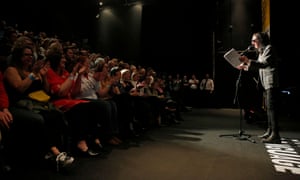
In the immediate aftermath of the Manchester bombing, Tony Walsh’s reading of his poem, This Is the Place, at Manchester town hall was shared thousands of times online and became instantly famous worldwide. Ben Okri’s poem Grenfell Tower, June, 2017, written in the aftermath of the fire, followed a similar trajectory.

“At these moments of national crisis, the words that spread and the words that were heard were not the words of politicians, they were the words of poets,” said Susannah Herbert, director of the Forward Arts Foundation, which runs the Forward prizes for poetry and National Poetry Day. “Almost everything a politician says is incredibly forgettable. There is a hunger out there for more nuanced and memorable forms of language.”

People wanted to cut through the verbiage of Brexit to see the bigger picture in 2018, she said: “Language gets stale in politics. Words begin to lose their meaning. Poetry occupies a different space to the humdrum. It is a way of renewing what words actually mean. It offers you a different way of looking at the world.”

A comparable boom in the popularity of poetry was seen during the miners’ strike in the 1980s and during the rise of Chartism in the 19th century, according to Katy Shaw, professor of contemporary writings at Northumbria University.

“To me, it’s no coincidence that poetry as a form is being used to critically discuss events like Grenfell, the Manchester bombing and Brexit as well,” she said. “It’s being repurposed as this really dynamic and vital form that can capture, in a very condensed way, the turbulent nature of contemporary society – and give us the space to struggle with our desire to understand and negotiate a lot of what is going on at the moment.”

Like the miners and Chartists did before them, people are reading and sharing poetry not to passively reflect on what’s going on in society, but as a way of engaging, said Shaw. “Poetry as a form can capture the immediate responses of people to divisive and controversial current events. It questions who has the authority to put their narrative forward, when it is written by people who don’t otherwise hold this power,” she said. “Writing poetry and sharing it in this context is a radical event, an act of resistance to encourage other people to come round to your perspective.”

Social media and technology have made poetry much easier to access and pass along, magnifying its impact, Shaw said: “In the miners’ strike, we had poetry being written on the side of instruction manuals and printed on typewriters, distributed by hand or sent through the post. Similarly, we have evidence of a lot of Chartist poetry being publicly read out and shared between different groups of workers.

“But poetry has a strong oral tradition – it wasn’t always written down, people would learn it and recite it. The one great advantage we have now is the speed at which we can share new work.”

Leave a comment

Filed under 2019, news, poetry

Turned the page?

Bookstore Sales Up 6.1% In First Half of 2016

by Jim Milliot

Source: http://www.publishersweekly.com/pw/by-topic/industry-news/bookselling/article/71190-bookstore-sales-up-6-1-in-first-half-of-2016.html?utm_source=Publishers+Weekly&utm_campaign=f50a3e33e6-UA-15906914-1&utm_medium=email&utm_term=0_0bb2959cbb-f50a3e33e6-305883061

For the first half of the year, bookstore sales were 6.1% ahead of the comparable period in 2015. According to estimates released by the U.S. Census Bureau, bookstores totaled $5.44 billion in the January-June 2016 span, up from $5.13 billion a year ago.

Bookstore sales in 2016 rose every month compared to 2015, including in June when sales increased 5.0% to $770 million.

The bookstore sector performed better than the entire retail segment. Sales for all of retail rose 3.3% in June over the comparable month in 2015 and were up 3.1% for the first half of 2016.

The solid bookstore performance in the first six months of 2016 follows a 2.5% increase for all of 2015, the first time bookstore sales posted an annual gain since 2007.

Leave a comment

Filed under 2016, bookstore

The return of the printed book

Books are back. Only the technodazzled thought they would go away

The hysterical cheerleaders of the e-book failed to account for human experience, and publishers blindly followed suit. But the novelty has worn off

by Simon Jenkins

Source: http://www.theguardian.com/commentisfree/2016/may/13/books-ebook-publishers-paper?CMP=fb_gu

At last. Peak digital is at hand. The ultimate disruptor of the new information age is … wait for it … the book.

Chair in the last bookshop

Books are back

Shrewd observers noted the early signs. Kindle sales initially outstripped hardbacks but have slid fast since 2011. Sony killed off its e-readers. Waterstones last year stopped selling Kindles and e-books outside the UK, switched shelf space to books and saw a 5% rise in sales.

Amazon has opened its first bookshop.

Now the official Publishers’ Association confirms the trend. Last year digital content sales fell last year from £563m to £554m. After years on a plateau, physical book sales turned up, from £2.74bn to £2.76bn.

They have been boosted by the marketing of colouring and lifestyle titles, but there is always a reason. The truth is that digital readers were never remotely in the same ballpark. The PA regards the evidence as unmistakable, “Readers take a pleasure in a physical book that does not translate well on to digital.” Virtual books, like virtual holidays or virtual relationships, are not real. People want a break from another damned screen.

What went wrong? Clearly publishing, like other industries before (and since), suffered a bad attack of technodazzle: It failed to distinguish between newness and value. It could read digital’s hysterical cheerleaders, but not predict how a market of human beings would respond to a product once the novelty had passed. It ignored human nature. Reading the meaning of words is not consuming a manufacture: it is experience.

As so often, the market leader was the music business. Already, by the turn of the 21st century, its revenues were shifting dramatically from reproduction to live. This was partly because recording and distributing music became so cheap there was no profit margin, but it was largely because the market had changed. Buyers, young and old, wanted to witness music played in the company of like minds, and were prepared to pay for the experience – often to pay lots. Soon the same was true for live sport, live theatre, even live talks. The festival has become king. The money is back at the gate.

Books must be the ultimate test. Admittedly some festivals now give away books for free and charge instead to hear the writers speak.

But just buying, handling, giving and talking about a book seems to have caught the magic dust of “experience”. A book is beauty. A book is a shelf, a wall, a home.

The book was declared dead with the coming of radio. The hardback was dead with the coming of paperbacks. Print-on-paper was buried fathoms deep by the great god, digital. It was rubbish, all rubbish. Like other aids to reading, such as rotary presses, Linotyping and computer-setting, digital had brought innovation to the dissemination of knowledge and delight. But it was a means, not an end.

Since the days of Caxton and Gutenberg, print-on-paper has shown astonishing longevity. The old bruisers have seen off another challenge.

Leave a comment

Filed under 2016, book publishing, books