

Tag Archives: Rod Serling
Rod Serling on writing help

May we all have a chance to help someone.
Filed under 2022, writing tip, Writing Tip Wednesday
Imagine, if you will…

Imagine, if you will…
Imagine, if you will,
A people so shrill,
They scream for their rights,
But are ready to kill.
Responsibility — not theirs
And they have no cares,
Except to fight,
When asked to community share.
To wear a simple mask
Is an onerous task,
And with all their might,
Many refused to get vaxxed.
They have their excuses
Or claim it’s all ruses.
It’s all government oversight
Or power abuses.
The hospitals are clogged,
And the cases are logged,
“Unvaccinated flight”
Leaves healthcare workers agog.
Now children are dying,
But GOP politicians are crying.
They say their dead right
To stop even trying.
Go get some invermectin,
Or your grandma’s canning pectin.
Take it tonight to fight
Left-wing insurrection.
It will rid you of parasites
And any sense of the real right,
Like civil responsibility,
To all lives: one and many.
090721
Filed under 2021, photo, poetry, Poetry by David E. Booker, political humor, politicians
Photo finish Friday (and haiku): “Devil’s Future”
The machine answers. /
Your future it will bestow /
For a Devil’s nickel.
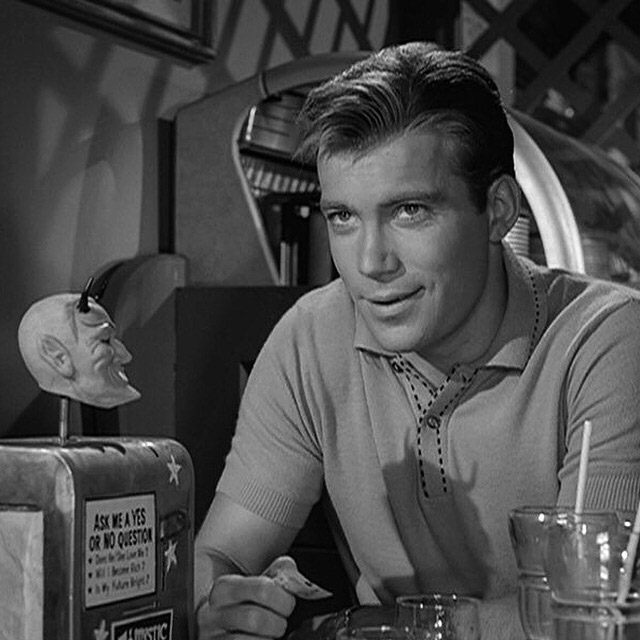
Filed under 2019, Photo Finish Friday, poetry by author
10 episodes that take viewers into the depths of The Twilight Zone · TV Club 10 · The A.V. Club
 Rod Serling’s classic anthology series offers horror, sci-fi, and political subtext.
Source: 10 episodes that take viewers into the depths of The Twilight Zone · TV Club 10 · The A.V. Club
Rod Serling was a smart, skeptical man—smart enough to know where his talents lay and skeptical enough to doubt that those talents ever rose to the level of art. In the last few years of his life, before he died of a heart attack in 1975 at age 50, Serling gave college lectures in which he encouraged his students to rip his legacy apart. Serling had become a sensation at 30, thanks to his Emmy-winning teleplay “Patterns,” and he went on to win Emmys in successive years for his scripts “Requiem For A Heavyweight” and “The Comedian,” both of which are still considered among the highlights of live TV’s “golden age.” Serling then created the science-fiction anthology series The Twilight Zone, and won writing Emmys for its first two seasons. But throughout his rise, Serling battled with network executives and sponsors and worried that he capitulated too easily. Serling wrote some of the best-loved, most powerful television dramas in the history of the medium, but he also worked so quickly and so constantly that he failed to make the most of some of his best ideas. And he knew it. When Serling met with those college kids in the ’70s, he accepted their assessment that even his best scripts were moldy. “They’ve aged like bread,” he nodded.
It’s that awareness of his own human weakness that made Serling’s Twilight Zone so great so often. The idea for the show came to Serling after he got tired of seeing his most politically and socially conscious scripts get gutted by the network suits. Regarding his poorly received 1956 teleplay “The Arena,” Serling wrote, “To say a single thing germane to the current political scene was absolutely prohibited… In retrospect, I probably would have had a much more adult play had I made it science fiction, put it in the year 2057, and peopled the Senate with robots.” So after Serling had an unexpected hit with his sci-fi drama “The Time Element” on a 1958 installment of Desilu Playhouse, he sold CBS on a weekly dose of the uncanny, in freaky half-hour episodes shot on film, derived from original stories and adaptations of some of the best fantasy fiction on the pulp market at that time. The Twilight Zone’s format suited Serling’s purple prose and punchy moralizing, and with the help of some talented writers, directors, and character actors, the show quickly became the standard against which other science-fiction shows were measured.
Emmys and fan esteem aside, The Twilight Zone was never a huge hit during its original run, and Serling ultimately found himself fighting with his bosses again. The production briefly shifted from film to videotape to save money, and after a brief cancellation, Serling got The Twilight Zone back on the air by agreeing to fill an open one-hour time slot. Neither of those compromises served the show well. Neither did Serling’s habit of using a dictating machine to “write” whole scripts in mere hours, which encouraged him to be unsubtle and unoriginal. Serling swiped ideas from other writers—unconsciously, he always claimed—and sometimes, his Twilight Zone episodes had little more to offer than a crazy twist ending or a heavy-handed message.
Yet there’s a reason why The Twilight Zone is still a favorite in syndication, and why it inspired a hit-or-miss movie and pretty good revival series in the ’80s (plus another not-so-good revival in the ’00s). Even the worst Twilight Zones—and there are plenty of those to choose from—are rooted in Serling’s understanding that it doesn’t take much for the normal to shift just a bit and become abnormal. Serling turned small towns, suburban homes, and city streets into staging grounds for the nightmares his audience was already having, often suggesting that the human capacity for superstition and paranoia could be more powerful than any magic spell or alien invasion. The deep creepiness of The Twilight Zone sprung from Serling’s cynicism about institutions, human nature, and himself.
Eventually, entire generations would gorge on the Twilight Zone marathons that local UHF stations would broadcast throughout the ’70s and ’80s on Halloween, Friday the 13th, or New Year’s Eve, and these marathons were a major force in securing Serling’s reputation. In single doses, The Twilight Zone can offer a little eerie drama with a pleasant tingle at the end. Taken in bulk, it has the power to knock viewers off their moorings, pushing them to see irony in every uncanny twist—on the show, and in real life.
As our own Twilight Zone TV Club Classic reviews return February 23, here are 10 episodes designed to explore all the darkest corners of Serling’s show.
“Where Is Everybody?” (season one, episode one): In October 1959, Serling introduced The Twilight Zone to American TV audiences with “Where Is Everybody?,” an episode starring Earl Holliman as a man who wanders through a recently abandoned town until he flips out, driven mad by loneliness. The big climactic reveal of what exactly caused Earth’s population to vanish established a Twilight Zone tradition of starting with the bizarre and ending with the plausible. “Where Is Everybody?” ends with an unexpected but realistic—and poignant—explanation for how the world went topsy-turvy. (Another prime example of this approach comes in the Richard Matheson-penned second-season episode “Nick Of Time,” which stars William Shatner as a man who believes his destiny is being controlled by a roadside diner’s tabletop fortune-telling machine, until he realizes it’s really his own superstition and paranoia guiding his decisions.)
“Walking Distance” (season one, episode five): Serling was keen enough to realize that science fiction didn’t always have to involve rocket ships and rubber monsters. He won over less genre-friendly critics early in The Twilight Zone’s run with “Walking Distance,” starring Gig Young as a man who’s transported back to his own past and given the opportunity to talk to himself as a boy. As always, there’s a twist ending, born of the common Serling idea that time is a closed loop, unalterable. But what stands out more is the call of nostalgia in “Walking Distance,” as a grown-up walks through his childhood idyll—a town that Serling would acknowledge was inspired by his own hometown of Binghamton, New York. The Twilight Zone would continue to play with this notion of the past pulling characters back, most notably in Serling’s “A Stop At Willoughby,” in which a neurotic executive escapes in his mind to an imaginary turn-of-the-century small town, and Matheson’s “Young Man’s Fancy,” in which a mama’s boy visits the house of his late mother, and reverts to childhood right in front of his new wife’s eyes.
“Time Enough At Last” (season one, episode eight): Easily one of the top five most remembered Twilight Zone episodes, “Time Enough At Last” was adapted by Serling from Lynn Venable’s short story about a henpecked bookworm (played by Burgess Meredith) who survives an apocalypse and is finally left alone to do as much reading as he likes. This being The Twilight Zone, complications occur—because more often than not on this show, when people get what they think they want, they’re profoundly unhappy with the results. (See also: Serling’s cruel season-five episode “Uncle Simon,” in which a woman who’s been waiting her whole life for a mean, rich old relative to die gets a rude surprise when he finally passes.) “Time Enough At Last” is a classic not just because of its O. Henry ending, but because when the meek Meredith steps out onto a depopulated city street, his reaction encompasses all the loneliness—and paradoxical yearning for loneliness—that was one of the show’s recurring motifs.
“The Monsters Are Due On Maple Street” (season one, episode 22): One of the reasons Serling created The Twilight Zone was so he could tell stories about real-world social problems without calling those problems by name. “The Monsters Are Due On Maple Street” tackles foolish human prejudice, showing how neighbor turns against neighbor when a power outage leads some to suspect an alien invasion. The madness of crowds has long been a staple of thrillers, and it’s a premise that The Twilight Zone would tackle often—as in Serling’s more ham-fisted season-three episode “The Shelter,” in which neighbors come to blows over space in a friend’s fallout shelter. “The Monsters Are Due On Maple Street” is more pointed than most. From its location—a backlot that had previously been used for the wholesome Andy Hardy movie series—to its “just because you’re paranoid doesn’t mean they’re not after you” ending, this episode argues that even when there’s a real external threat, ordinary Americans will overreact and do the enemy’s job for it.
“The Eye Of The Beholder” (season two, episode six): It’s hard to describe some of the most famous Twilight Zone episodes to newcomers without revealing their endings, and since sometimes the ending is the best part of a Twilight Zone, it’d be unfair to spoil them. (Warning: The book To Serve Man in “To Serve Man” is… well, no, best not say.) But sometimes, even when the best Twilight Zone sucker-punches are fairly obvious, there are other redeeming qualities. In “The Eye Of The Beholder,” a woman awaits the results of a plastic surgery designed to make her look “normal”—a word that turns out to have a very different meaning in the place where she lives. Because all the characters’ faces are carefully hidden from the audience for nearly 20 minutes, it’s clear early on that some reversal is coming, but the expressionistic lighting and the meditation on the significance of “beauty” make “The Eye Of The Beholder” powerful regardless. It’s another one of the Twilight Zone episodes that often leaps to mind immediately when casual viewers talk about the show.
“The Invaders” (season two, episode 15): Though the Matheson-penned “The Invaders” has one of the most genuinely surprising twist endings in Twilight Zone history (albeit one that the show tried more than once), that’s not what makes it a series standout. No, what’s remarkable about “The Invaders” is how effectively stripped-down it is. Agnes Moorehead plays a mute woman who fights off a tiny flying saucer manned by creatures in bulbous space suits. And that’s it. There’s almost no dialogue and not much in the way of setup or story. It’s just one lone person fighting for her life for 20 minutes: an exercise in raw terror.
“Long Distance Call” (season two, episode 22): The Twilight Zone wasn’t cheap to produce, with new sets every week and often-fantastical makeup and special effects. To cut costs, CBS asked Serling to try shooting on video in the middle of the second season, and while Serling’s years of working in live TV had made him familiar with writing and staging for video, the show never really felt right with the constrictions that the medium demanded. Still, there are a few winners among the six video-shot Twilight Zones. The first of the batch, “The Lateness Of The Hour,” is another of Serling’s irony-filled examinations of prejudice, following the comeuppance of a young woman who resents her family’s android servants. And the last of the batch, “Long Distance Call,” is one of the show’s creepiest half-hours. Written by William Idelson and Charles Beaumont, “Long Distance Call” is about a toy telephone through which a child receives messages from his dead grandmother, urging him to join her in the afterlife. The limited setting pays off here, in an episode where drab reality contrasts with the imagination of people and places beyond.
“Person Or Persons Unknown” (season three, episode 27): One of the reasons why The Twilight Zone resonated as it did is because Serling and his writers touched so often on common anxieties. In the Beaumont-written “Person Or Persons Unknown,” an everyman played by Richard Long wakes up to discover that none of his friends or family members recognize him, and instead consider him a dangerous lunatic. It’s not just that there’s no record of the man’s existence; the hell of it all is that he has unshakeable emotional attachments to people who now regard him as a stranger. That’s what sets up this episode’s devastating twist ending, where circumstances are inverted and the protagonist becomes lonelier than ever.
“Miniature” (season four, episode eight): The Twilight Zone was effectively canceled at the end of its third season, when the show had trouble attracting a sponsor. CBS gave Serling a reprieve when he agreed to let The Twilight Zone be a mid-season replacement, taking over a timeslot vacated by an hourlong drama. By then, Serling’s co-producer, Buck Houghton, had decided to move on, and Serling himself was contributing fewer scripts. Generally speaking, the 18 hourlong episodes of season four are significantly hobbled by the extra screen time. The Twilight Zone was a show that relied on the simple idea and the quick hit, neither of which was suited to sprawl. But they’re not all losers in season four. Beaumont’s touching “Miniature” stars Robert Duvall as a social misfit who becomes obsessed with a doll he watches at a museum, convinced that the toy is leading a sad little life, just like him. Duvall’s performance is full of nuance, and Beaumont’s script is more like the film Marty than a typical Twilight Zone. The episode makes a nice companion piece to Serling’s season-one classic “The Lonely,” in which an isolated prisoner of the future has to choose between his robot companion and a full pardon. Here, Duvall has to decide whether to live in an ersatz world or commit to the real one.
“Living Doll” (season five, episode six): Though primarily a science-fiction series, The Twilight Zone developed a reputation as one of the scariest shows on TV, dating back to season one’s horrific ghost story “The Hitch-Hiker.” In its fifth and final season, The Twilight Zone went to the horror well more often, producing several of the series’ most memorable episodes (including “Nightmare At 20,000 Feet,” in which William Shatner plays a nervous flyer who sees a gremlin on the wing of a jet airliner). Among those memorably scary—and funny—season-five episodes is “Living Doll,” written by Beaumont and Jerry Sohl, and starring Telly Savalas as a crank who resents the money his wife spends on toys for his stepdaughter. When one of those toys—a talking doll voiced by the legendary June Foray—threatens to kill him, the stepdad initially laughs it off, and then learns that an inanimate object can be pretty dangerous. The Twilight Zone wasn’t as sharp in its final round of episodes as it had been over its first three years, but “Living Doll” is true to the show’s mission of taking the ordinary and making it seem alien.
And if you like those, here are 10 more: “Third From The Sun” (season one, episode 14), “A World Of Difference” (season one, episode 23), “People Are Alike All Over” (season one, episode 25), “A Penny For Your Thoughts” (season two, episode 16), “The Silence” (season two, episode 25), “It’s A Good Life” (season three, episode eight), “Five Characters In Search Of An Exit” (season three, episode 14), “The Changing Of The Guard” (season three, episode 37), “The Old Man In The Cave” (season five, episode seven), “The Masks” (season five, episode 25)
Filed under 2016, Rod Serling
Binghamton, New York’s Rod Serling Gazebo remembers the creator of The Twilight Zone.

Source: Binghamton, New York’s Rod Serling Gazebo remembers the creator of The Twilight Zone.
Martin Sloane realizes he has slipped back in time when he sees his younger self carving his name on a gazebo in a park containing an old carousel. Martin has accidentally returned to his childhood town after a 25-year absence and is astounded to discover nothing has changed.
So begins the plot of “Walking Distance,” the fifth episode of The Twilight Zone, which aired in 1959. The setting of the story is based on a real carousel that has been in continuous operation since 1925 in Recreation Park in Binghamton, New York, where the visionary creator of the famous television series grew up.
Many Twilight Zone locations are based on real places. “Mirror Image” takes place at the Greyhound station with a rider waiting for his bus to Cortland. The streets in “The Monsters are Due on Maple Street” eerily resemble Binghamton’s West Side. The carousel at Recreation Park is one of six built by George F. Johnson as a gift to the workers of the Endicott-Johnson company. All six are still running, and if you ride them all in one summer you will earn a pin to commemorate the effort. The Rec Park carousel has 60 mounts and runs all day in the warmer months.
Rod Serling is Binghamton’s favorite local boy–done-good, and his name and face adorn parks, stages, and festivals across Broome County. The moment where Martin Sloane realizes he has returned home has been commemorated as well. A large gazebo with titanic pillars was erected on the hill overlooking the carousel. A plaque in the center reads, “Rod Serling, Creator of The Twilight Zone, ‘Walking Distance.’ ”
Filed under 2016
Twilight Zone script: “Walking Distance”
From the Famous Writers Course. Part of the Famous Writers School in Westport, CT. I don’t believe the school or the course is in existence today.

Front cover of the facsimile script.

Inside, first page.
“There is a fifth dimension beyond that which is known to man. It is a dimension as vast as space, and as timeless as infinity. It is the middle ground between land and shadow — between science and superstition. And it lies between the pit of man’s fears and the summit of his knowledge. It is an area which we call The Twilight Zone.
Filed under 2015, The Twilight Zone
Which Episode Of “The Twilight Zone” Best Describes Your Love Life?
“That’s not fair… that’s not fair at all!”
by NIA ALVAEZOS
To take the love quiz, go to: http://www.buzzfeed.com/niaalavezos/which-twilight-zone-episode-describes-your-love-1jrcx#.ta21zoo0l
What lies between the summit of man’s knowledge and the pit of his fears? What’s ha sign post up ahead? Your Twilight Zone Love Life.

Let Rod Serling be your Love Doctor and The Twilight Zone be your guide.
Filed under 2015, The Twilight Zone, TV show
The 10 Best Episodes of ‘The Twilight Zone’ (as Ranked by IMDb)
Rod Serling and The Twilight Zone
The 10 Best Episodes of 'The Twilight Zone' (as Ranked by IMDb) | Fox News Magazine.
But where is “Walking Distance”? It should be on this list.
It’s hard to choose a favorite episode of “The Twilight Zone.” Just when you think you’ve narrowed it down, you catch a classic rerun on late-night TV that makes you rethink your top choice. Heck, it’s been 55 years since the show premiered on CBS (October 2, 1959 to be exact) and we still can’t choose a favorite.
Maybe that’s because every episode was so different from the last. Sure, they all started nearly the same — with creator Rod Serling welcoming us to his otherworldly dimension — but each proved to be wonderfully weird in its own unique way. One week, we’d be treated to a macabre murder mystery, and the next, a spooky science fiction story. And more often than not, each teleplay contained an underlying moral message or a twist ending that kept our minds racing long after the episode’s end.
It’s no wonder we can’t choose a number one!
The folks over at IMDb, on the other hand, don’t seem to share our problem. They’ve handily ranked every single episode from best to worst based on the ratings of their users. And you know what? It’s kind of hard to argue with their results.
To see the list, go to: http://magazine.foxnews.com/celebrity/10-best-episodes-twilight-zone-ranked-imdb
But where is “Walking Distance”? It should be on this list.


 Booker's Blog
Remembering
“As long as they talk about you, you’re not really dead, as long as they speak your name, you continue. A legend doesn’t die, just because the man dies.”
AS I KNEW HIM: My Dad Rod Serling
Share this:
Leave a comment
Filed under author, author commentary, Uncategorized
Tagged as photo, remembering, Rod Serling, speak