Tag Archives: punctuation

Monday (morning) writing joke: “Punctuation humor, part 1”

• An Oxford comma walks into a bar, where it spends the evening watching the television, getting drunk, and smoking cigars.

• A dangling participle walks into a bar. Enjoying a cocktail and chatting with the bartender, the evening passes pleasantly.

• A bar was walked into by the passive voice.

• An oxymoron walked into a bar, and the silence was deafening.

• Two quotation marks walk into a “bar.”

Leave a comment

Filed under 2020, Monday morning writing joke

The Commas That Cost Companies Millions

For most people, a stray comma isn’t the end of the world. But in some cases, the exact placement of a punctuation mark can cost huge sums of money.

Source: The Commas That Cost Companies Millions

How much can a misplaced comma cost you?

If you’re texting a loved one or dashing off an email to a colleague, the cost of misplacing a piece of punctuation will be – at worst – a red face and a minor mix-up.

But for some, contentious commas can be a path to the poor house.

In 2018, a dairy company in the US city of Portland, Maine settled a court case for $5m because of a missing comma.

Three lorry drivers for Oakhurst Dairy claimed that they were owed years of unpaid overtime wages, all because of the way commas were used in legislation governing overtime payments.

The state’s laws declared that overtime wasn’t due for workers involved in “the canning, processing, preserving, freezing, drying, marketing, storing, packing for shipment or distribution of: 1) agricultural produce; 2) meat and fish products; and 3) perishable foods”.

The drivers managed to successfully argue that because there was no comma after “shipment” and before “or distribution”, they were owed overtime pay. If a comma had been there, the law would have explicitly ruled out those who distribute perishable foods.

Workers load milk onto trucks at the Oakhurst dairy plant in 2013. Credit: Getty Images.

Because there was confusion, the US Court of Appeals ruled in their favour, benefiting around 120 of the firm’s drivers. David Webbert, the lawyer who helped bring the case against the company, told reporters at the time that the inclusion of a comma in the clause “would have sunk our ship”. (He didn’t respond to interview requests from the BBC.)

The slip-up shows that the slightest misstep in punctuating a clause in a contract can have massive unintended consequences.

“Punctuation matters,” says Ken Adams, author of A Manual of Style for Contract Drafting. But not all punctuation is made equal: contractual minefields are not seeded with semicolons or em-dashes (here’s one: – ) waiting to explode when tripped over.

“It boils down to commas,” says Adams. “They matter, and exactly how depends on the context.”

Delivering Definition

Commas in contracts link separate clauses in a non-definitive way, leaving their reading open to interpretation. While a full stop is literally that – a full and complete stop to one thought or sentence, and the signal of the start of another – commas occupy a linguistic middle ground, and one that’s often muddled. “Commas are a proxy for confusion as to what part of a sentence relates to what,” Adams explains.

The English language is fluid, evolving and highly subjective. Arguments have been fought over the value of so-called Oxford commas (an optional comma before the word “and” or “or” at the end of a list). There might be good arguments on either side of the debate, but this doesn’t work for the law because there needs to be a definitive answer: yes or no. In high-stakes legal agreements, how commas are deployed is crucial to their meaning. And in the case of Oakhurst Dairy against its delivery drivers, the Oxford comma is judged to have favoured the latter’s meaning.

But just because you mean to say something, it doesn’t mean that a court will agree with you, says Jeff Nobles, a Texas-based appellate lawyer who was involved in an insurance case that hinged, in part, on the punctuation of a contract.

According to Nobles, most US courts will say it doesn’t really matter what the parties subjectively intended; it’s the objective intent in the written terms of their contract. “Punctuation sometimes will change the meaning of a sentence,” he says.

Nobles represented an insurance company in a Texas Supreme Court case concerning insurance coverage for a worker who died on the job.

Nobles argued successfully that punctuation mattered for a contractual indemnity provision, when the company tried to trigger coverage under its umbrella insurance policy after a subcontracted employee died on the job. It set a precedent in the state’s legal system, he believes.

He says US courts have become increasingly textual – “they’ve looked more and more at the words on the paper rather than the testimony of the people who used those words on the paper.”

Yet arguments over commas have been raging for more than a century.

‘An Expensive Comma’

In 1872, an American tariff law including an unwanted comma cost taxpayers nearly $2m (the equivalent of $40m today). The United States Tariff Act, as originally drafted in 1870, allowed “fruit plants, tropical and semi-tropical for the purpose of propagation or cultivation” to be exempt from import tariffs.

For an unknown reason, when revised two years later, a stray comma sneaked in between “fruit” and “plants”. Suddenly all tropical and semi-tropical fruits could be imported without any charge.

An 1872 tiff over tariffs and tropical fruit cost taxpayers $40m – all caused by a comma. Credit: Getty Images.

Members of the US Congress debated the issue and the problem was fixed – but not before the New York Times bemoaned the use of “An Expensive Comma.” It wouldn’t be the last such error.

“Contract language is limited and stylised,” says Adams. He compares it to software code: do it right and everything works smoothly. But make a typo and the whole thing falls apart.

When errors are introduced into legal documents, they’re likely to be noticed far more than in any other form of writing, he says. “People are more prone to fighting over instances of syntactic ambiguity than in other kinds of writing.”

Muddying the Waters

Of course, in some circumstances, those drafting contracts may want to introduce ambiguities. Getting different countries to sign up to the same principles can be challenging, particularly for climate change agreements.

Early climate change conventions included this line:

The Parties have a right to, and should, promote sustainable development.”

The sentence ensures those signing the agreement have the ability to promote sustainable development – and should do so.

But in its original draft, the second comma was placed after “promote”, not before it:

The Parties have a right to, and should promote, sustainable development.”

Some countries weren’t happy with the original wording because they didn’t necessarily want to be locked into promoting sustainable development. Moving the comma kept the naysayers happy while placating those who wanted stronger action.

“By being slightly creative with punctuation, countries can feel like their interests have been addressed,” explains Stephen Cornelius, chief advisor on climate change with the WWF, who has represented the UK and EU at UN climate change negotiations. “You’re trying to get an agreement that people can substantially agree with.”

Most people try to make contract language as clear as possible – but sometimes leaving a bit of ambiguity can help both sides negotiate better. Credit: Getty Images.

Tricks of the Trade

Such linguistic flexibility happens more often than you’d think.

“In diplomacy, even though you try to have a single agreement, it’s very common to change the meaning for different parties,” says climate change negotiator Laura Hanning Scarborough. “You can use terms like ‘inter alia’, or ‘this includes, amongst other things’ to blur the lines to include anything. You can use commas as part of that, too. There are so many language tricks you use to appease people.”

For most people, however, making sure that contracts are unambiguous is important. For that reason, it’s crucial to test contract language to breaking point by giving it to someone who will test its limits – someone who will read it in the most awkward, unhelpful way, says Tiffany Kemp, a commercial contracting trainer for the International Association for Contract and Commercial Management.

One of the biggest cases battled over a comma was a dispute between two Canadian telecommunications companies. Rogers Communications and Bell Aliant fought a legal battle worth CAD$1m ($760,000) over a contract to replace utility poles across the country.

The argument stemmed from a single sentence:

“This agreement shall be effective from the date it is made and shall continue in force for a period of five (5) years from the date it is made, and thereafter for successive five (5) year terms, unless and until terminated by one year prior notice in writing by either party.”

The two sides argued that the comma after “five (5) year terms” meant something different: Bell Aliant said that the single year’s notice of termination applied at any time, Rogers that it only applied after the first five-year term ended.

This was important as Rogers had struck a great deal under their reading of the contract: when they signed a contract to lease the poles from Bell Aliant in 2002, they were paying just CAD$9.60 per pole. By 2004, the cost had nearly doubled. Bell Aliant, understandably, wanted to terminate the contract and renegotiate at the new, higher price. Rogers didn’t.

Successive courts were equally uncertain about the agreement: Canada’s Radio-Television and Telecommunications Commission first declared in favour of Bell Aliant in 2006; a year later, it changed its mind after consulting the French language version of the contract, which didn’t include the same ambiguity.

This dispute wasn’t brought about by wilful ignorance, reckons Kemp. “Sometimes there are genuinely different understandings,” she explains. “That little comma was put in a place that you would put in a place for a breath if you’re reading it out loud.”

Deadly Punctuation

How do these misplaced or misused commas make their way into complicated contracts that have been drafted by professionals? Part of the problem, says Adams, is technology. “Drafting contracts has long been a function of copying and pasting from precedent contracts, and that results in a kind of heedlessness, a detachment from the nitty gritty of how you’ve expressed what you want to express in a contract,” he says. “It’s easy to miss this sort of problem.”

In one extreme example, a misplaced comma was at the heart of a death-penalty trial.

Roger Casement, an Irish nationalist, was hanged in 1916 under the 1351 Treason Act. He had incited Irish prisoners of war being held in Germany to band together to fight against the British. The debate over whether Casement was guilty hinged on the wording of the 14th Century Treason Act and the use of a comma: with it, Casement’s actions in Germany were illegal; without it, he would get away with it.

Roger Casement, an Irish nationalist, was hanged in 1916. Credit: Getty Images.

Despite Casement’s lead counsel’s assertion that “crimes should not depend on the significance of breaks or of commas”, and “if a crime depended on a comma, the matter should be determined in favour of the accused, and not of the Crown”, the court ruled that the comma mattered. Casement was found guilty and executed.

Though today life and death doesn’t hinge on the use of commas – but big money, insurance policies and environmental agreements certainly do.

For that reason, it’s important to carefully check any contracts we sign, the experts say – and that means not just dotting the Is and crossing the Ts but also making sure every comma is in the correct place.

People sign contracts not because they’ve negotiated their meanings, but based on their own understanding of what they’re agreeing to, explains Nobles. Contracts written by lawyers on behalf of a business might have a different meaning than what the lay person understands.

So it pays to pay attention. If a piece of punctuation seems out of place or introduces ambiguity, speak up.

“The purpose of a contract is to help people get the outcomes they both expected, and to know what they’re supposed to do and get from the other side,” says Kemp.

“If there’s a misunderstanding, you owe it to both of you to get it sorted out. Have the argument today, rather than tomorrow.”

It could prevent a lot of pain in the future.

Leave a comment

Filed under 2019, punctuation

One space between each sentence, they said. Science just proved them wrong. – The Washington Post

Obviously, there needs to be a standard. But do we really want to leave it to science?

Source: One space between each sentence, they said. Science just proved them wrong. – The Washington Post

In the beginning, the rules of the space bar were simple.  Two spaces after each period.  Every time.  Easy.

That made sense in the age of the typewriter. Letters of uniform width looked cramped without extra space after the period. Typists learned not to do it.

But then, at the end of the 20th century, the typewriter gave way to the word processor, and the computer,  and modern variable-width fonts.  And the world divided.

Some insisted on keeping the two-space rule.  They couldn’t get used to seeing just one space after a period.  It simply looked wrong.

Some said this was blasphemy. The designers of modern fonts had built the perfect amount of spacing, they said. Anything more than a single space between sentences was too much.

And so the rules of typography fell into chaos. “Typing two spaces after a period is totally, completely, utterly, and inarguably wrong,” Farhad Manjoo wrote in Slate in 2011.  “You can have my double space when you pry it from my cold, dead hands,” Megan McArdle wrote in the Atlantic the same year.  (And yes, she double-spaced it.)

This schism has actually existed throughout most of typed history, the writer and type enthusiast James Felici once observed (in a single-spaced essay).

The rules of spacing have been wildly inconsistent going back to the invention of the printing press. The original printing of the U.S. Declaration of Independence used extra long spaces between sentences. John Baskerville’s 1763 Bible used a single space. WhoevenknowswhateffectPietroBembowasgoingforhere.Single spaces. Double spaces.  Em spaces.   Trends went back and forth between continents and eras for hundreds of years, Felici wrote.It’s not a good look.

And that’s just English. Somewrittenlanguageshavenospacesatall and o thers re quire a space be tween ev e ry syl la ble.

Ob viously, thereneed to be standards. Unless    you’re doing avant – garde po e try, or    something , you  can’tjustspacew ords ho w e v   e    r   y      o        u            want.     That would be insanity. Or at least,

obnoxious.

Enter three psychology researchers from Skidmore College, who decided it’s time for modern science to sort this out once and for all.

“Professionals and amateurs in a variety of fields have passionately argued for either one or two spaces following this punctuation mark,” they wrote in a paper published last week in the journal Attention, Perception, & Psychophysics.

They cite dozens of theories and previous research, arguing for one space or two.  A 2005 study that found two spaces reduced lateral interference in the eye and helped reading.  A 2015 study that found the opposite.  A 1998 experiment that suggested it didn’t matter.

“However,” they wrote, “to date, there has been no direct empirical evidence in support of these claims, nor in favor of the one-space convention.”

So the researchers,  Rebecca L. Johnson,  Becky Bui  and Lindsay L. Schmitt,  rounded up 60 students and some eye tracking equipment,  and set out to heal the divide.

First, they put the students in front of computers and dictated a short paragraph, to see how many spaces they naturally used. Turns out, 21 of the 60 were “two-spacers,” and the rest typed with close-spaced sentences that would have horrified the Founding Fathers.

The researchers then clamped each student’s head into place, and used an Eyelink 1000 to record where they looked as they silently read 20 paragraphs. The paragraphs were written in various styles: one-spaced, two-spaced,  and strange combinations like two spaces after commas,  but only one after periods.  And vice versa, too.

And the verdict was: two spaces after the period is better.  It makes reading slightly easier.  Congratulations, Yale University professor Nicholas A. Christakis.  Sorry, Lifehacker.

Actually, Lifehacker’s one-space purist Nick Douglas pointed out some important caveats to the study’s conclusion.

Most notably, the test subjects read paragraphs in Courier New, a fixed-width font similar to the old typewriters, and rarely used on modern computers.

Johnson, one of the authors, told Douglas that the fixed-width font was standard for eye-tracking tests, and the benefits of two-spacing should carry over to any modern font.

Douglas found more solace in the fact that the benefits of two-spacing, as described in the study, appear to be very minor.

Reading speed only improved marginally, the paper found, and only for the 21 “two-spacers,” who naturally typed with two spaces between sentences.  The majority of one-spacers, on the other hand, read at pretty much the same speed either way.  And reading comprehension was unaffected for everyone, regardless of how many spaces followed a period.

The major reason to use two spaces, the researchers wrote, was to make the reading process smoother, not faster.  Everyone tended to spend fewer milliseconds staring at periods when a little extra blank space followed it.

(Putting two spaces after a comma,  if you’re wondering,  slowed down reading speed,  so don’t do that.)

The study’s authors concluded that two-spacers in the digital age actually have science on their side, and more research should be done to “investigate why reading is facilitated when periods are followed by two spaces.”

But no sooner did the paper publish than the researchers discovered that science doesn’t necessarily govern matters of the space bar.

Johnson told Lifehacker that she and her co-authors submitted the paper with two spaces after each period — as was proper. And the journal deleted all the    extra spaces anyway.

Note: An earlier version of this story published incorrectly because, seriously, putting two spaces in the headline broke the web code.

Leave a comment

Filed under 2018, punctuation

And that’s punctuation. Period.

September 24th was National Punctuation Day. If interested, you can read more about it here: http://www.nationalpunctuationday.com/.

Punctuation is important to writing, whether it be a novel or a set of instructions on how to operate a new gadget. For example, does the panda eat, shoots, and leaves or does the panda eat shoots and leaves? There are even books devoted to punctuation: how to use it, when to use it, and even some about why to use it.

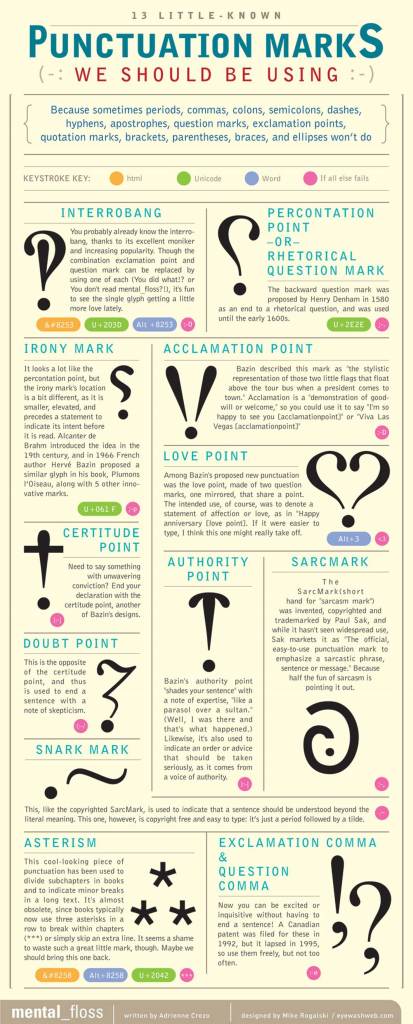
Though belated (Is there a punctuation mark for that?), below is a chart of some little known and rarely — if ever — used punctuation marks.

little-known-punctuation-marks

Leave a comment

Filed under 2016, punctuation

The end of the end (stop)?

Period. Full Stop. Point. Whatever It’s Called, It’s Going Out of Style

http://www.nytimes.com/2016/06/10/world/europe/period-full-stop-point-whatever-its-called-millennials-arent-using-it.html

By DAN BILEFSKY

LONDON — One of the oldest forms of punctuation may be dying

The period — the full-stop signal we all learn as children, whose use stretches back at least to the Middle Ages — is gradually being felled in the barrage of instant messaging that has become synonymous with the digital age

David Crystal

David Crystal

So says David Crystal, who has written more than 100 books on language and is a former master of original pronunciation at Shakespeare’s Globe theater in London — a man who understands the power of tradition in language

The conspicuous omission of the period in text messages and in instant messaging on social media, he says, is a product of the punctuation-free staccato sentences favored by millennials — and increasingly their elders — a trend fueled by the freewheeling style of Facebook, WhatsApp and Twitter

“We are at a momentous moment in the history of the full stop,” Professor Crystal, an honorary professor of linguistics at the University of Wales, Bangor, said in an interview after he expounded on his view recently at the Hay Festival in Wales

“In an instant message, it is pretty obvious a sentence has come to an end, and none will have a full stop,” he added “So why use it?”

In fact, the understated period — the punctuation equivalent of stagehands who dress in black to be less conspicuous — may have suddenly taken on meanings all its own

Increasingly, says Professor Crystal, whose books include “Making a Point: The Persnickety Story of English Punctuation,” the period is being deployed as a weapon to show irony, syntactic snark, insincerity, even aggression

If the love of your life just canceled the candlelit, six-course, home-cooked dinner you have prepared, you are best advised to include a period when you respond “Fine.” to show annoyance

“Fine” or “Fine!,” in contrast, could denote acquiescence or blithe acceptance

“The period now has an emotional charge and has become an emoticon of sorts,” Professor Crystal said “In the 1990s the internet created an ethos of linguistic free love where breaking the rules was encouraged and punctuation was one of the ways this could be done”

Social media sites have only intensified that sense of liberation

Professor Crystal’s observations on the fate of the period are driven in part by frequent visits to high schools across Britain, where he analyzes students’ text messages

Researchers at Binghamton University in New York and Rutgers University in New Jersey have also recently noted the period’s new semantic force

They asked 126 undergraduate students to review 16 exchanges, some in text messages, some in handwritten notes, that had one-word affirmative responses (Okay, Sure, Yeah, Yup) Some had periods, while others did not

Those text message with periods were rated as less sincere, the study found, whereas it made no difference in the notes penned by hand

Geoffrey Nunberg, a linguist who teaches at the University of California, Berkeley, noted that the 140-character limit imposed by Twitter and the reading of messages on a cellphone or hand-held device has repurposed the punctuation mark

“It is not necessary to use a period in a text message, so to make something explicit that is already implicit makes a point of it,” he said “It’s like when you say, ‘I am not going – period’ It’s a mark It can be aggressive It can be emphatic It can mean, ‘I have no more to say’

Can ardent fans of punctuation take heart in any part of the period’s decline? Perhaps.

The shunning of the period, Professor Crystal said, has paradoxically been accompanied by spasms of overpunctuation

“If someone texts, ‘Are you coming to the party?’ the response,” he noted, was increasingly, “Yes, fantastic!!!!!!!!!!!”

But, of course, that exuberance would never be tolerated in a classroom

At the same time, he said he found that British teenagers were increasingly eschewing emoticons and abbreviations such as “LOL” (laughing out loud) or “ROTF” (rolling on the floor) in text messages because they had been adopted by their parents and were therefore considered “uncool”

Now all we need to know is, what’s next to go? The question mark

Leave a comment

Filed under 2016, syntax

Famous punctuation

The Surprising Punctuation Habits Of Famous Authors, Visualized

Hemingway actually used denser punctuation than Jane Austen, William Faulkner, or Charles Dickens.

by John Brownlee

Source: http://www.fastcodesign.com/3057101/infographic-of-the-day/the-surprising-punctuation-habits-of-famous-authors-visualized/

As writers, we’re endlessly fascinated by the idiosyncrasies of authors and the way they use punctuation. Yet how much can the way authors use punctuation really reveal about their style? Plenty, it turns out.

Over on Medium, Adam Calhoun decided to strip eight of his favorite novels down to just the punctuation. The novels he chose were James Joyce’s Ulysses, Jane Austen’s Pride and Prejudice, Mark Twain’s Huckleberry Finn, Charles Dickens’s Great Expectations, Mary Shelley’s Frankenstein, Cormac McCarthy’s Blood Meridian, Lewis Carroll’s Alice in Wonderland, Ernest Hemingway’s A Farewell to Arms, and William Faulkner’s Absalom! Absalom!.

how-famous-authors-punctuate-copy

Like previous efforts to cut away everything but punctuation from famous novels, this left just a stream-of-consciousness staccato of commas, periods, question marks, quotation marks, and the occasional semi-colon to represent each book. But instead of merely turning his efforts into pretty posters, Calhoun actually analyzed them, visualizing the punctuation of these novels in a way that put their punctuation use in perspective.

His resulting charts aren’t visually sophisticated, but they are informative. For example, in one chart, Calhoun visualizes punctuation density, or how many words (on average) an author puts in a row before he throws in a punctuation mark. Surprisingly, Hemingway actually uses punctuation more densely than Jane Austen, William Faulkner, or Charles Dickens, a finding that might have more to do with Hemingway’s short, crisp sentences than anything else.

Calhoun also breaks down each novel by most-used punctuation mark, highlighting each author’s favorite. Commas and periods tend universally to be the most used marks, but some authors have a fondness for apostrophes (Mark Twain), exclamation points (Lewis Carroll), and semi-colons (William Faulkner).

The rest at: http://www.fastcodesign.com/3057101/infographic-of-the-day/the-surprising-punctuation-habits-of-famous-authors-visualized/

Leave a comment

Filed under 2016, authors, punctuation

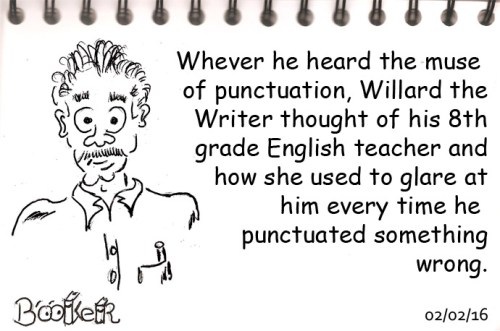
cARtOONSdAY: “pUNCT-U-ALL”

Sometimes the muse was not a-musing.

Sometimes the muse was not a-musing.

1 Comment

Filed under 2016, cartoon by author, CarToonsday

Photo finish Friday: “License”

Inquiring minds want to know where the hunting dogs keep their permit so that it is easily available? Plus, how many dogs can hunt on one permit?

Inquiring minds want to know where the hunting dogs keep their permit so that it is easily available? Plus, how many dogs can hunt on one permit?

Leave a comment

Filed under 2015, photo by David E. Booker, Photo Finish Friday

Photo finish Friday: “Missing”

Lost souls? Lost comma? Lost apostrophe? Oh, heavens.

Lost souls? Lost comma? Lost apostrophe? Oh, heavens.

If you have read Eats, Shoots and Leaves by Lynne Truss, you know the power of the comma, the apostrophe, and other well-placed parts of punctuation. Far be it for me to comment on a man’s beliefs (Okay, maybe not that far be it.), but in this case, I think it is more a matter of the missing-in-action comma and apostrophe. As it is, this church signage can lead one to believe this church is devoted to deprogramming the devout, to redirecting the religiously inclined, to subduing the souls of those who believe.

The name of the church, which is Christian, would make more sense if the sign read, “Overcoming, Believers’ Church.” As it is, the name, particularly in large white letters on a large slate-gray building (the photo only shows a part of the church exterior) looks a bit like something out of the X-Files. The aliens have stolen our apostrophes!

1 Comment

Filed under Photo by author, Photo Finish Friday

National Punctuation Day

Happy National Punctuation Day!

http://www.nationalpunctuationday.com/

Why not take a period (.) to dinner? Maybe even two: (.) (.) You know, take them out for some period food.

Leave a comment

Filed under holiday