Tag Archives: publishers

The price creep of e-books

This is an interesting companion piece to the one on self-publishing that I posted earlier. If interested in writing, this is also a good blog to follow. Tom Dupree has many years experience as an editor, and it would be worth your time to tap into that knowledge.

http://tomdup.wordpress.com/2011/12/15/e-customers-creeped-out-by-price-creep/

E-Customers Creeped Out By Price Creep

By Tom Dupree

There’s a piece on page 1 of today’s Wall Street Journal about e-book sticker shock, another good job by the Journal’s book-beat reporter Jeff Trachtenberg. I’ve been railing about this issue ever since Apple persuaded the six major publishers to disallow any discounting by retailers on e-books. As Mr. Trachtenberg points out, this restriction doesn’t apply to print books, so you have the increasingly common phenomenon of e-editions equaling, and even surpassing, the discounted print edition at retailers like Amazon.com. In at least one instance (emphasis on “at least”), Ken Follett’s doorstop FALL OF GIANTS, the publisher’s e-book price is $18.99 – but the paperback edition can be bought new for $16.50.

Let’s re-emphasize what’s actually going on here. The major players in an industry which faces massive headwinds, book publishing, is deliberately overpricing its most promising and fastest-growing revenue stream, specifically to dampen e-demand and reduce “cannibalization” of “higher-margin” hardcover and trade paperback editions. Mr. Trachtenberg points out that under the “retail model,” by which Amazon was charging $9.99 for new bestsellers, it was the retailer who took the loss; the author and publisher still received roughly half of the full retail price. But under the current “agency model,” the publisher retains 70%, and the retailer gets the rest. No more “loss leaders,” and essentially no more $9.99 bestsellers.

But look closer at the Follett. Dutton’s suggested retail price for this 985-page tome in hardcover is $36. Under the “retail model,” it collected $18 per e-copy, just as it did for a hardcover, and Amazon could give it away if they liked. Of course, that’s no way to run a business: “How do we do it? Volume!” What Amazon was trying to do was to jump-start a nonexistent e-book market and worry about coaxing it into profitability later; they’ve always been forward-thinking in that way. But under the “agency model,” Dutton gets 70% of $18.99, the highest price I’ve encountered for a commercial trade e-book, which is $13.30 per e-copy, and all retailers receive the same $5.70 (I rounded both numbers to the next penny). $13.30 — and remember, this is the absolute Beluga of e-pricing — is $4.70 less than $18. But who’s counting?

My point exactly.

Now let’s consider Apple’s motives. It’s a wonderful company, but it’s no less ruthless just because its antagonizer-in-chief has passed away. When Apple was the “first mover” in digital music, it used the leverage of its huge installed iPod base to oppose the big record labels by dampening the retail price from $15-$16 for a whole CD to 99 cents for an individual song (boy, that price rings a bell. And it’s increased since then, too). But in e-books, Apple found itself, uncharacteristically, in Amazon’s wake (Steve Jobs had infamously sniffed at the Kindle’s launch: “People don’t read any more”). So now what it had to do was eliminate Amazon’s price advantage – and, amazingly, in a reversal of its effect on the music business, it succeeded in propping up the retail price of e-books! Justice is now looking into whether preventing discounting constitutes illegal collusion among the major publishers (as are European authorities), and I don’t know much about the law so can’t speculate, but it does sound fishy, and it protects retailers (guaranteed profit) at the expense of consumers (higher prices).

I have some friends in the book biz who’ve read my previous musings and have some pretty good arguments that nobody seems to be considering. For example, it’s an age-old fact that for big bestselling authors like Mr. Follett, or Stephen King or John Grisham or Danielle Steel or Nora Roberts, publishers pay way too much up front as an “advance,” otherwise known as a “guarantee against royalties.” First, it’s necessary because everybody else is waving huge paychecks around, and you have to be there to compete. Second, a major author can be a tentpole for the rest of your list: if you, Ms. Retailer, want the new Grisham, you’ll have to hear about all the other great stuff we have. Third, there’s the intangible prestige factor, as authors and agents want to be with the house that publishes XXX. But these millions represent a nonrefundable guarantee which has to “earn out” before a book realizes its true potential for perennial profit down the road. (I’ve heard that Mr. King has a deal which plays down the guarantee in favor of a larger participation on the back end, like major movie stars sometimes do.) A surprise hit like THE HELP is very profitable immediately, but big bestsellers from well-known authors always start out deep in the red, and I’d love to know what Kathryn Stockett’s agent has in mind for her next contract.

That means you have to scramble for every penny you can find during the hot new-release period with the ads and the DAILY SHOW spots, very much like movie studios do. My question is: why aren’t the big publishers doing so?

Mr. Trachtenberg quotes a publisher as saying people are realizing the advantages of e-books and are willing to pay a premium for them. I’ve heard that too from some consumers. But $18.99? (P.S.: Book prices never go anywhere but up.) He shares more ominous quotes from others. A reader says it’s hard to justify a $10-$15 e-book when you can pick up a used print copy for $2 or $3 on Amazon. If that was the Ken Follett, the author and publisher made no money on the used-copy resale, when they could have received $18 for a “retail-priced” e-book. Also, the ability to self-publish and shop online is hitting the major publishers from the low end. As an industry consultant says, some e-buyers may opt for “five-star-reviewed” self-published mysteries or romances which are going for $2.99 or $3.99. Plus, if it’s digital it’s stealable, and remember that millions of otherwise law-abiding kids believed downloading from Napster was justifiable because CD prices were too high.

I think it’s fair to say that most e-reading devices have been purchased since “agency pricing” went into effect about two years ago, so possibly it’s only the early adopters like me who recoil against $12.99 and $14.99 books, or e-editions which cost more than paperbacks. Most new e-reader owners may think that’s the going rate you pay for not having to lug the physical book around, being able to read it on damn near every mobile device there is, etc. Yet as a “veteran,” I’d still be willing to wait, even a whole year, so the publishers have time to sell every hardcover they possibly can, if they’d only then give me a fairly-priced e-edition so I could fairly pay the author and publisher instead of ignoring them.

As it is, I have a list of saved backlist books that I’ll never buy in print editions; I just want to read them once. Every month or so I check on them, and every so often a publisher will experiment with a temporary lower price (this is why the publishers will probably survive any accusation of price-fixing; each one is free to charge anything it likes). I will either get the price I want, or the publisher will lose a sale which I would guess is sorely needed. It’s as simple as that.
Leave a comment

Filed under e-book, publishers, publishing, Tom Dupree, writing, writing tip

You have your book written — what now?

If anyone is interested in publishing a book — fiction or nonfiction — the Knoxville Writers’ Guild has a great workshop this Saturday.

Chris Hebert is an acquisitions editor at the University of Michigan Press. He’s the guy at the receiving end of author query letters and can provide invaluable advice on what works and what doesn’t. He also knows what it’s like from the author’s end: HarperCollins is publishing his first novel, The Boiling Season, next year. (His wife has also published a novel with Simon & Schuster).

This is a rare chance to talk at length with a publishing insider about selling a book.

The workshop will be held from 1 to 3:30 p.m. on Saturday, June 4 at the Redeemer Church, 1642 Highland Ave., Knoxville, TN. Cost is $20 for members and $25 for nonmembers. To register, go to http://www.knoxvillewritersguild.org/orderpaypal.htm

Leave a comment

Filed under editor, Knoxville Writers' Guild, publishers, publishing, writer, writing, writing tip

Ripped from the headlines

From the world of the absurd to your door.

With so many deserving authors out there, why this?

Bristol Palin Memoir Set To Hit Shelves This Summer
(I think hit is the appropriate word here. Or maybe Flog the Shelves this Summer would be better.)

Bristol Palin, daughter of former Alaska Gov. Sarah Palin, will soon be able to add “author” to her resume with the release of an as-yet-untitled memoir set to hit bookshelves this summer.

As noted by Political Wire, an Amazon listing for an “Untitled Bristol Palin Memoir” — in hardcover no less — has been created, announcing that the 304-page book will be available for a little over $17.

PopEater reported late last year that the 20-year-old mother was exploring a variety of options to cash in on the visibility provided by her successful, but not victorious, run on ABC’s hit show, “Dancing With the Stars.” Apart from the book deal and speaking engagements — which no longer include a panel at Washington University’s “Sex Week” — a source also told PopEater that future jobs might include a role on another reality-TV show and as a spokeswoman for a fashion line.

According to the Amazon page, the book bill be published by William Morrow & Co for release on June 21.

www.huffingtonpost.com/2011/02/07/bristol-palin-memoir-untitled_n_819850.html?

Leave a comment

Filed under absurdity, publishers, publishing, Random Access Thoughts, theater of the absurd, writing

Pictures at an exhibition

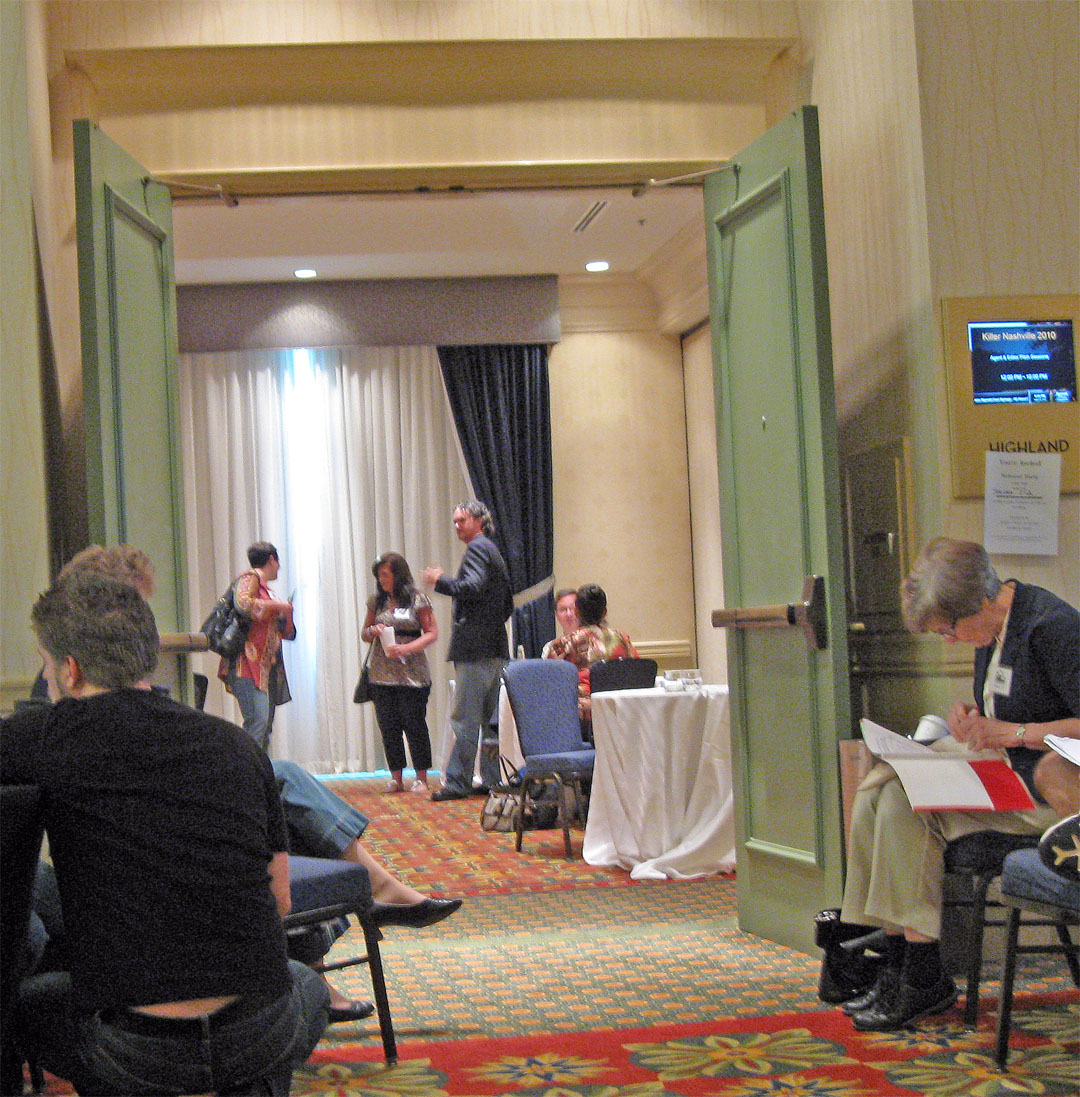
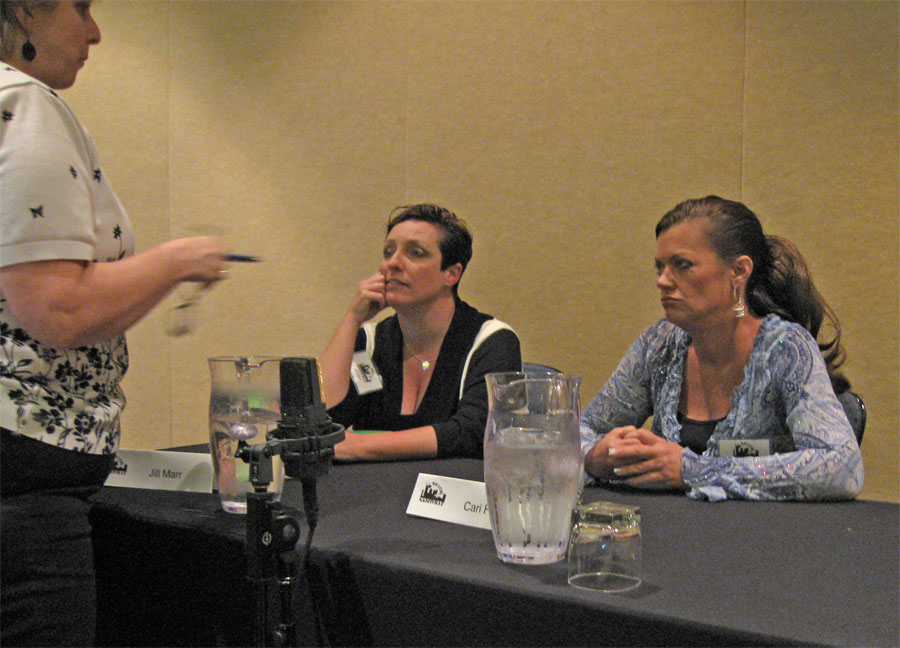
Below are a few photos of agents and editors taken while at Killer Nashville this past August 20 – 22, 2010. Consider this visual reference for the names of people mentioned in some of my earlier posts on pitching your novel to editors or agents.

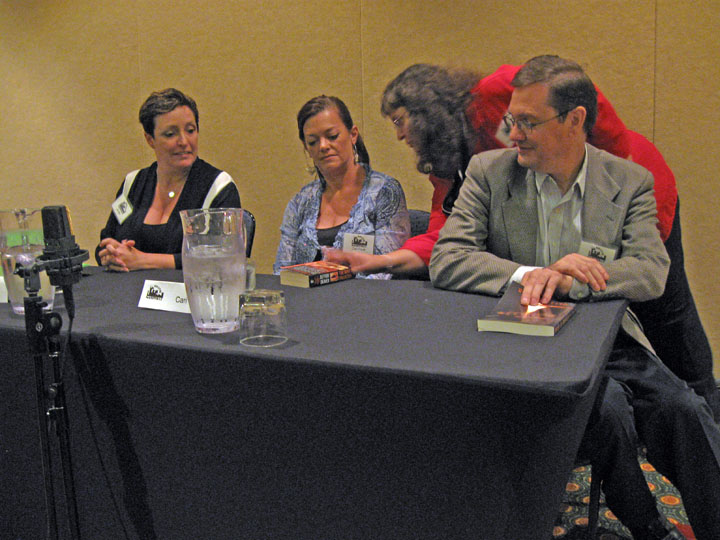
From left, agents Jill Marr, Cari Foulk, and Jeff Gerecke. Beth Terrell, author and Killer Nashville Executive Driector, leaning over behind them.

Jill Marr (seated left) and Cari Foulk listening to a question at Killer Nashville 2010.

Jill Marr (seated left) and Cari Foulk listening to a question at Killer Nashville 2010.

Agents Jill Marr (left) and Cari Foulk standing for a few moments after listening to pitches.

Agents Jill Marr (left) and Cari Foulk standing for a few moments after listening to pitches.

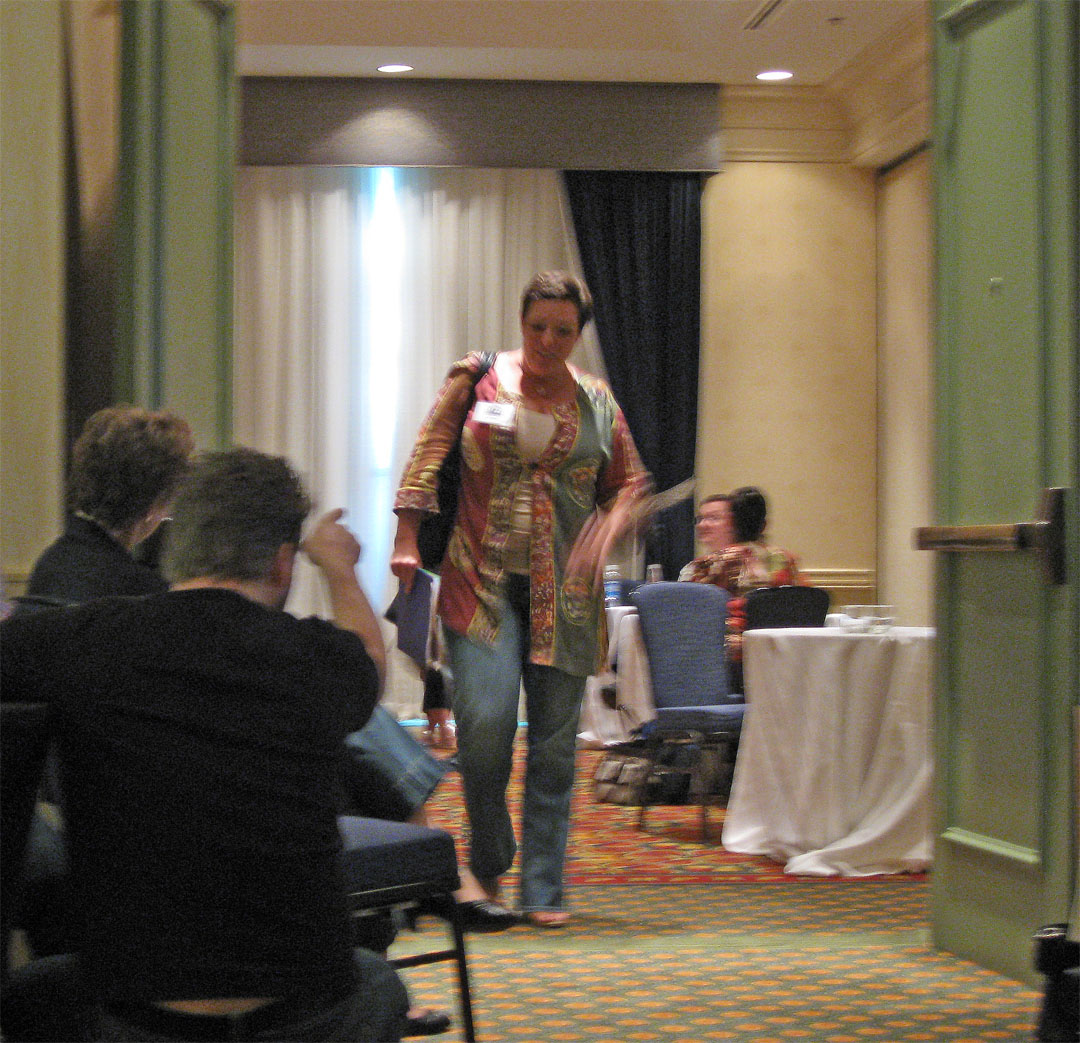
Agent Jill Marr walking out of the Pitch Room.

Agent Jill Marr walking out of the Pitch Room at Killer Nashville 2010.

Leave a comment

Filed under agents, editor, Killer Nashville, Perils of writing, publishers, Random Access Thoughts, the perils of writing, writing, writing conference, writing tip

The pitches

Killer Nashville badge

Killer Nashville badge

Below are two of my pitches. I used the The Painted Beast pitch on all the agents and editors I talked with at Killer Nashville. I was able to use The Small Resurrection pitch once or twice.

Two pieces of advice, one I have said before: Practice the pitch and make it as natural as you can. Two: Think of a pitch as a spoken version of the back-cover blurb you read on many paperback books.

The Painted Beast

Ex-cop Stephen York was once a hero. Decorated and lionized from uncovering corruption in the police department and bringing down a criminal enterprise, he now works two or three menial jobs in order to hold body and soul together, not only for himself but also his thirteen-year-old step-daughter and eight-year-old daughter. One night his ex-wife, who has escaped from prison, returns home and terrorizes him. He escapes from her and she from him, but shortly thereafter she kidnaps their daughters. In order to save them, Stephen has to kill her, which puts him under suspicion for murder and under the thumb of a police detective who has personal as well as professional reasons for wanting to grind Stephen down further. In addition, his step-daughter’s biological father steps forward to kidnap her with the intention of leading her into a life of child pornography and prostitution in order to get money to help re-establish the criminal empire that Stephen had helped take down. This time, in order to save his step-daughter, Stephen, who has not been a particularly good father, has to offer his life in order to save his step-daughter’s. In so doing, he learns another definition of hero. At its core this novel’s theme asks and answers the question: Can a fallen hero be a hero again?

Limerick version:
There once was an ex-cop who did poorly
At being a father and what’s more he
Killed his ex-wife,
Then offered up his life
To save his daughter from a life in pornography.

***

A Small Resurrection

Is believing in what you see the same thing as seeing what you believe in?

Knoxville, Tennessee, is the last place T. Xavier Gabriel wants to be. But the director of the 8th highest grossing film in Hollywood has come to town to ask his ex-wife for forbearance in paying the large alimony and possibly also for a loan to help restart his fallen career. She, however, has other plans. She wants him to

Pitching your novel

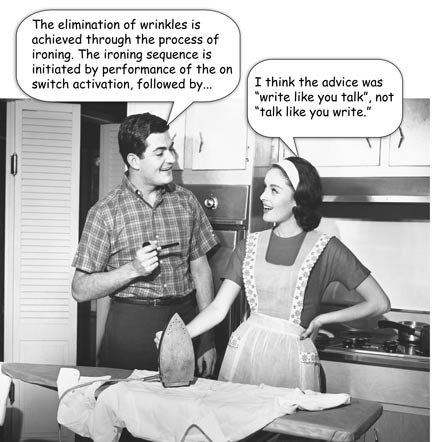
Use conversational voice when talking about your novel

rescue their 22-year-old daughter from the undue influences of a 24-year-old evangelical preacher. Gabriel wants nothing to do with that, having already admitted to be a failure once as a father, he doesn’t want a second bite of the apple. But when he finds his daughter keeping company with a resurrected Rod Serling, he sees a chance to use this Serling look-alike to resurrect his own career. But getting Serling away from his daughter puts her in jeopardy, and Gabriel must decide if he is going to save her or save his career. To save her, he must enlist the aid of Serling, who is not quite sure who he is or why he has been resurrected, and in saving her he puts an end ever resurrecting his career.

Limerick version:
There once was a director named Gabriel
Whose life was a broken down fable
Then along came Rod Serling
And an offer so sterling
That it could save Gabe if he was able.

Two final notes:
1) The limerick versions were not something I pitched, though I thought about it. It was my way of have a pitch that could be done in 15 seconds or less.

2) Some pitch advice says you need to have antecedents as part of your pitch. Antecedents are novels that are like yours. Something similar to your novel. This is supposed to show that you know about your novel’s market and where it might fit. While I had that prepared for The Painted Beast, it did not seem to be something those I pitched to at Killer Nashville were interested in. That could have been a mistake on my part. But I had the feeling that these agents wanted to be the ones to decide where it belongs.

Leave a comment

Filed under advice, agents, characters, Killer Nashville, limerick, Perils of writing, pitches, publishers, story, the perils of writing, words, writing, writing conference, writing tip

Pitch aside: dealing with contradictory information

This information comes from agent Nathan Bransford, and while he is aiming the information at query letters, I think the same advice can apply for pitches, with a little modification:

1. Take a Deep Breath: As long as you’re getting the big stuff right, you’re going to be fine. You don’t need to have every single little teeny tiny thing perfect. You can get my name or gender wrong and I still might request your pages (just did this last week in fact). I’m not going to reject you because you sent me the first five pages of Chapter 1 instead of your Prologue if I like the idea and your writing. Don’t sweat the small stuff. Because really: if an agent is going to reject your query over some small niggling detail, are they someone you’d want to work with anyway?

2. Remember That Agent Blogs Are Just Trying to Help: I know how tempting it is to throw up your hands and just think that literary agents are so many Goldilocks with completely different ideas of how hot the porridge should be. Please just remember that we offer so much advice because people ask. We get e-mails and comments all the time asking about everything from paper size to fonts to anglicized spelling to serial commas. So we try to help, and we’re not always going to agree on everything. Personally, when I’m wearing my author hat I’d rather have too much information than too little, so I tend to err on the side of dispensing too much agent advice. It’s up to you to decide which advice you agree with and which you don’t. Just remember that we’re trying to help, not trying to make your life miserable.

3. Not All Publishing Advice is Created Equal: I went back and looked at some of my early blog posts, and holy cow after just four years they’re already wildly out of date. Consider the source, consider the freshness of the advice, and beware of anyone who tries to tell you that there’s one way and only one way to find successful publication. Occasionally an author out there somewhere will have a sense that the way they found success is The Way That Should Work For Everyone, whereas people who have worked across the publishing spectrum have seen the proverbial cat skinned in an impossibly vast number of ways.

4. Try As Best You Can to Meet an Agent’s Specifications, But Don’t Go Crazy Trying to Do It: If you happen to remember that Rachelle wants you to query with your pen name and I want to hear from the real you: great! Query accordingly. But don’t go creating a massive spreadsheet with every agent’s particular individual preferences. No agent expects you to do that.

5. If You Think the Contradictory Query Advice is Mind Boggling, Just Wait Until You Reach the Publication Stage: In case you haven’t noticed, this business is an art, not so much a science. There’s no one way to do things, and you’re going to face conflicting advice and opinions about your manuscript, cover art, marketing plan, you name it. There are even more opinions out there than people (sometimes people can’t even decide what they think and have multiple opinions). At the end of the day, all you can do is just take all the advice into account, and choose the route that works best for you.

Leave a comment

Filed under advice, agents, editor, Killer Nashville, novel, Perils of writing, pitches, publishers, Random Access Thoughts, the perils of writing, words, writing, writing conference, writing tip

Pitch aside: some resources

Research and reference books

Some pitch reference sites to consider

Below are a few links with information on pitches. Not all the information here is going to agree with all the other information. And some of these links focus on “one line pitches,” or distilling your novel into one sentence. Sometimes a one-sentence pitch might also be called a log line.

This blog entry from agent Nathan Bransford is one of many of Nathan Bransford’s blog entries. He is interesting and you can certainly sign up to receive his blog entries yourself: One sentence pitch.

Another blog entry about pitching, this time called the One-Sentence Hook.

Some information from another agent, Rachelle Gardner. This blog entry focuses on longer pitches. Notices that she says she wants a little information about the author up front, which is something that Michael Hauge says should be at the last, if at all. He even says it is not necessary to start with the title.

Here is additional information on the Guide to Literary Agents blog. Note the information about such things as practicing and attire.

I’m sure there are other blog entries and web sites with information as well as books and articles in magazines. After all, writers write, and sometimes writers write about writing.

Pen up.

Leave a comment

Filed under agents, conference, editor, humor, Killer Nashville, Perils of writing, pitches, publishers, words, writing, writing tip

What makes for a good pitch? The thou shalts.

Killer Nashville badge

Killer Nashville badge


By now you may (or maybe not) be wondering what makes for a good pitch to agents or editors when you approach them at conferences such as Killer Nashville.

1) Sincerity. Even with your nervousness, if you don’t believe in what you’ve written, don’t expect the agent or editor to. I once had a published author answer the question of how do you know when you’ve finished writing and editing a novel by saying, when you’re tired of looking at it. You may have reached that stage with the mechanics of your novel, but if you’ve also edited out the sincerity, then you’ve probably gone too far and it will show in your pitch.

man on books

Believe in what you've written

2) Passion. In his book, Selling Your Story in 60 Seconds: The Guaranteed Way to Get Your Screenplay or Novel Read by Michael Hauge, one of the things mentioned is passion, i.e. belief in your novel. If you don’t believe in it, nobody else will. Now, maybe you are like me, and when you are nervous, you can slip into talking in a flat, almost monotonous tone. At such times, an old-fashioned metronome has more passion in its back and forth swing than my voice does. It also happens when I am trying to remember to get everything in my pitch that I believe should be there and keep out the things I’ve decided shouldn’t be.

How do you overcome that? A friend of mine who was also pitching at Killer Nashville said he was going to add passion to his pitches by being sure to move his arms. Physical gestures can be effective in loosening you up to allow some of the passion to come through. After all, many passionate people are often moving their arms for emphasis. Another thing you can do is remember to breath and realize that while you don’t have a lot of time, you do have enough time if you’re prepared, if you’ve practiced your pitch. You may also want to practice varying the delivery pace of your sentences. Pause a little longer between some sentences than others. Think of what you’re doing more as a conversation.

3) Be prepared. That means having written out or in some other way constructed your pitch and have practiced it. A few of us who were going to Killer Nashville practiced our pitches. I facilitate a writing group. We meet once a month to review each others’ works. During part of a couple of those sessions, a few of us practiced pitches for the novels we had written, and we let the other members of the group offer their comments. Even after that, I practiced a few more times, often going through my pitch as I was driving to work. (I’m sure people the cars around me wondered what crazy song I was singing to or what medication I had failed to take that morning.)

I even practiced once with my wife, and once with the friend I rode over with to Killer Nashville. He did his pitch and I listened and offered comments. And I did mine. (Actually, I did two, because I had one for a second novel I have written.) Both my wife and my friend said I needed to convey a little more passion in my pitch. That’s when I asked my friend, “How are you going to convey passion in yours?”

“I’m going to wave my arms,” he said.

I did do some hand gestures with my pitches (all three of them), and I hoped it helped. Since there is no copyright on arm waving or hand gestures, I don’t think I owe him more than a thank you. As I said in an earlier post, I also admitted to my nervousness up front with the first agent. Sometimes it helps to make things a little easier to do that. And somehow our conversation lead to my getting to do a partial version of the pitch for my other novel as well as the one I had sat down to pitch.

4) Be prepared to be interrupted. The person on the other side of the table will probably have questions for you, particularly if she or he is interested. So be prepared for that. The questions may come at the end. If so, then you’ll have little or no interruptions. Or the questions may come during your pitch. I experienced both. If interrupted, you’ll have to do your best to remember where you were in your pitch and get back to it as naturally as possible.

5) The best pitches are not the longest ones. I had the times for my second and third pitches eaten into because the persons before me when a longer than the ten minutes allotted. If your pitch session is scheduled for 10 minutes, don’t have a pitch over five minutes in length. And if you can have one even shorter, probably better. Remember point number 4, be prepared to be interrupted. That interruption might even occur before you get to sit down.

The agents and editors are hearing these pitches back to back to back. Filling your presentation with wall to wall sound won’t necessarily make your book more memorable. If you’re done before your ten minutes is up, great. Even if the editor or agent doesn’t bite and want to see all or part of your manuscript, you could still leave a favorable impression by being polite and precise in your presentation. The editor or agent might not be interested in this novel, but who knows about the next one. Besides, if he or she didn’t want to read a sample of the novel, there is no need to waste your time or the agent’s or the editor’s. There could be a multitude of reasons why the editor or agent isn’t interested. For example, one agent my friend pitched to told him she wasn’t interest because her agency was already representing a book with a similar structure to it. Literary agencies and publishers generally don’t want to handle books that they believe are similar to ones they already have in hand. Unfortunately, there is not much you can do about that, other than move on.

I have written enough for now. Next time, a few “Thou Shalt Nots” in terms of pitches.

1 Comment

Filed under agents, conference, editor, humor, Killer Nashville, Perils of writing, publishers, Random Access Thoughts, story, writing, writing tip

Attire aside — bring a sweater

More about agents and queries and pitches in future posts, but I thought I would toss in a quick aside on attire. No, I am not going to tell you to wear plaid pants or flowing scarf around your neck. And I don’t think a tuxedo or strapless evening gown is necessary.

I would recommend casual business attire. After all, as I heard over and over, publishing is a business, and if you’ve come to pitch to agents or editors, looking clean and neat will help create a good impression. Think of it as you would applying for a job. I did see some guys in ties and blue Oxford shirts. I’m not sure a tie is necessary, but it certainly won’t hurt. (And if you’re wondering, I didn’t wear a tie. I did, however, almost pull the floor-length-and-more table cloth off one of the small circular tables I sat at to make a pitch to an agent. It was my attempt at a poor imitation of Buster Keaton or Chevy Chase. We do what we can to make an impression.)

But if nothing else, when attending a summer conference in the South, bring a sweater or at least one long-sleeve shirt. Why? It was over 90 degrees F outside the conference hotel. Inside the conference rooms it was somewhere in the mid-60s to low-70s. Not cold enough to hang meat, but cool enough at times to make you wonder. After all, the conference was called Killer Nashville.

Leave a comment

Filed under agents, conference, hotel, humor, Killer Nashville, Perils of writing, publishers, Random Access Thoughts, writing, writing tip

“Life is like a box of chocolates,” but …

Killer Nashville badge

Killer Nashville badge


… but don’t send one to your agent.

At least don’t send one to an agent you are trying to get to represent you.

I recently attended a writing conference, Killer Nashville (www.killernashville.com) and will be posting some of what I learned, along with some impressions and comments.

One agent talked about receiving a query for representation that included an Indian charm in it. He said he didn’t know what to do with it. While he was not superstitious, he was afraid to give it away or even throw it away. In the end, he tossed into the back of his desk drawer, where it still resides.

Other items received by agents included a large plastic cockroach wrapped up and included in envelope along with a letter saying how the author was just buggy to have the agent represent him. Another writer sent a query letter in a large envelope “bulked up” with shredded paper to increase the chances the agent would see it.

Photoshoping the agent’s head on top of the body of a friend, with your arm draped over your agent/friend doesn’t work either.

Also, sending in a query on colored or scented paper, or in envelopes marked “urgent” or “time sensitive” won’t help you.

And lest you think that it is only the magical or the madcap you shouldn’t send, don’t send the more mundane or mouth-watering either. No homemade goodies; no store-bought ones. And certainly don’t send cash.

Life might be like a box of chocolates, and your mama might have told you that, but also remember the rest of the quote, particularly from the agent’s point of view: “You never know what you’re going to get.”

So, surprise the agent with a memorable query letter pitch he or she can’t forget, and not a surprise the agent will pitch into the trash or back of the desk drawer.

4 Comments

Filed under agents, how to, humor, Killer Nashville, Perils of writing, publishers, writing, writing tip