Tag Archives: poet

The (Still) Mysterious Death of Edgar Allan Poe

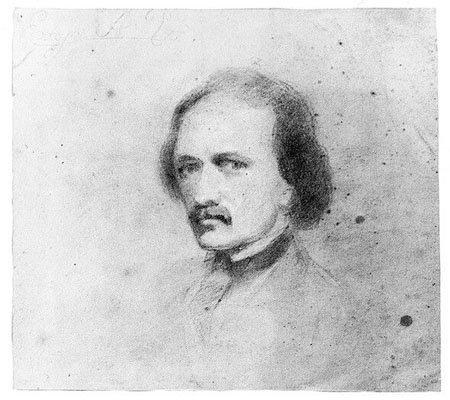
Edgar Allan Poe -- self-portrait

Edgar Allan Poe — self-portrait

Was the famous author killed from a beating? From carbon monoxide poisoning? From alcohol withdrawal? Here are the top nine theories

By Natasha Geiling

Source: http://www.smithsonianmag.com/history/still-mysterious-death-edgar-allan-poe-180952936/#vV6aWAfTgq8vGGWu.99
Give the gift of Smithsonian magazine for only $12! http://bit.ly/1cGUiGv
Follow us: @SmithsonianMag on Twitter

t was raining in Baltimore on October 3, 1849, but that didn’t stop Joseph W. Walker, a compositor for the Baltimore Sun, from heading out to Gunner’s Hall, a public house bustling with activity. It was Election Day, and Gunner’s Hall served as a pop-up polling location for the 4th Ward polls. When Walker arrived at Gunner’s Hall, he found a man, delirious and dressed in shabby second-hand clothes, lying in the gutter. The man was semi-conscious, and unable to move, but as Walker approached the him, he discovered something unexpected: the man was Edgar Allan Poe. Worried about the health of the addled poet, Walker stopped and asked Poe if he had any acquaintances in Baltimore that might be able to help him. Poe gave Walker the name of Joseph E. Snodgrass, a magazine editor with some medical training. Immediately, Walker penned Snodgrass a letter asking for help.

Baltimore City, Oct. 3, 1849
Dear Sir,

There is a gentleman, rather the worse for wear, at Ryan’s 4th ward polls, who goes under the cognomen of Edgar A. Poe, and who appears in great distress, & he says he is acquainted with you, he is in need of immediate assistance.

Yours, in haste,
JOS. W. WALKER
To Dr. J.E. Snodgrass.

On September 27—almost a week earlier—Poe had left Richmond, Virginia bound for Philadelphia to edit a collection of poems for Mrs. St. Leon Loud, a minor figure in American poetry at the time. When Walker found Poe in delirious disarray outside of the polling place, it was the first anyone had heard or seen of the poet since his departure from Richmond. Poe never made it to Philadelphia to attend to his editing business. Nor did he ever make it back to New York, where he had been living, to escort his aunt back to Richmond for his impending wedding. Poe was never to leave Baltimore, where he launched his career in the early 19th- century, again—and in the four days between Walker finding Poe outside the public house and Poe’s death on October 7, he never regained enough consciousness to explain how he had come to be found, in soiled clothes not his own, incoherent on the streets. Instead, Poe spent his final days wavering between fits of delirium, gripped by visual hallucinations. The night before his death, according to his attending physician Dr. John J. Moran, Poe repeatedly called out for “Reynolds”—a figure who, to this day, remains a mystery.

Poe’s death—shrouded in mystery—seems ripped directly from the pages of one of his own works. He had spent years crafting a careful image of a man inspired by adventure and fascinated with enigmas—a poet, a detective, an author, a world traveler who fought in the Greek War of Independence and was held prisoner in Russia. But though his death certificate listed the cause of death as phrenitis, or swelling of the brain, the mysterious circumstances surrounding his death have led many to speculate about the true cause of Poe’s demise. “Maybe it’s fitting that since he invented the detective story,” says Chris Semtner, curator of the Poe Museum in Richmond, Virginia, “he left us with a real-life mystery.”

Read more: http://www.smithsonianmag.com/history/still-mysterious-death-edgar-allan-poe-180952936/#vV6aWAfTgq8vGGWu.99

The nine theories include: beating, cooping (voter fraud), alcohol (related to cooping), poisoning (carbon monoxide or heavy metal), murder, and flu.

1 Comment

Filed under poet, writer

Monday morning writing joke: “arresting development”

Cop to poet: “Did you meet her?”

Poet to cop: “I had no rhyme or reason to do so.”

Leave a comment

Filed under Monday morning writing joke

Monday morning writing joke: “Poet’s corner”

An advertising copy writer, a newspaper man, and a poet walk into an almost empty bar and the owner / bartender offers each one the chance at a drink, in exchange for a glowing piece of writing.

The ad man says, “I can write you ad copy that pack them in.”

The newspaper man says, “I can write a feature story that will bring them in from miles around to see this fine establishment and you in person.”

The poet says, “I don’t know if anything that I write will pack them in or make them come from miles around, but I do know many a struggling poet that needs a good place to drown his sorrows.”

Guess which one the owner gave the drink to?

Leave a comment

Filed under Monday morning writing joke

Wendell Berry: Poet & Prophet | Moyers & Company | BillMoyers.com

Wendell Berry: Poet & Prophet | Moyers & Company | BillMoyers.com.

Leave a comment

Filed under authors

Monday morning writing joke: “The bill”

To celebrate the recent publication of his chapbook, a poet walks into a local bar and orders drink and drink and drink, until closing time, when the waitress presents him with the bill.

Inebriated and irritated, the poet looks at the bar tab and yells, “This bill has no rhyme or meter. I refuse to recognize this … this repulsive, wreckage requiring recompense. This is pure assonance!”

He stands up from his table and sloshes toward the door, whereupon he is greeted by the bartender holding a Grecian urn over his head. Staring at the poet, he says, “You will pay what is ode.”

Leave a comment

Filed under joke by author, Monday morning writing joke

Freeform Friday II: Limerick: “Poet from Maine”

There once was a poet from Maine
whose haiku would cause others in vain
to say that they could do, too,
the verse and rhythm that he knew,
but it drove many who attempted insane.

5 Comments

Filed under Freeform Friday, poetry by author, rhyming poetry

cARtOONSDAY: jUST A gIGOLO pOET, take 2

Just a gigolo poet, version 2

Sometimes it’s hard to do a good cartoon.

Thought I would try this version. You can decide which one you prefer, if either. The earlier one appeared on Tuesday, July 17, 2012. You can also click on CarToonsday in the links below and it will bring up that CarToonsday cartoon as well as others.

Leave a comment

Filed under cartoon by author, CarToonsday, writing

Epic fight to put awesome in its place

http://www.latimes.com/news/local/la-me-holland-20120106,0,2183189.column

Trying to drive a stake through a conversational staple

British-born poet and journalist John Tottenham says that saying ‘awesome’ in his presence is like ‘waving a crucifix in a vampire’s face.’

Gale Holland, Los Angeles Times

January 6, 2012

“Awesome,” according to one dictionary of slang, is “something Americans use to describe everything.”

The linguistic overkill horrifies John Tottenham. So the British-born L.A. poet, painter and journalist has launched what he calls the Campaign to Stamp Out Awesome, or CPSOA.

“Saying the word in my presence is like waving a crucifix in a vampire’s face,” Tottenham says. “It’s boiled down to one catchall superlative that’s completely meaningless.”

I met with Tottenham last week at CSPOA headquarters inside Stories, the Echo Park bookstore he is trying to turn into the world’s first awesome-free zone. “Ground zero for a quiet revolution,” Tottenham calls the cafe and shop, where he has a day job. The group’s manifesto is posted at the counter, and no-awesome stickers with the usual diagonal slash are on sale, with T-shirts to follow, Tottenham said.

“It’s a matter of semantic satiation,” Tottenham told me. “Sometimes I’m sitting in a crowd and I hold my breath until someone says it. Seldom do I die of asphyxiation as a result.”

There’s no arguing with Tottenham’s premise that “awesome” is seen and heard everywhere, from the sign on the tchotchke aisle at the 99-cent store to the lips of supermarket cashiers. UC Santa Barbara linguist Mary Bucholtz says that from its dusky origins, perhaps in 1970s surfer slang, it’s spread to Australia and English-speaking India.

But Tottenham failed to convince me it’s a bad thing. What’s wrong with bathing everything in the sunny light of superlativity? I asked him.

I admire the “awesome” generation’s ability to talk at all with only a few words at its disposal.

The economy of expression is poetic, I argued. The conversations go like this:

Caller 1: Dude?

Caller 2: Dude.

Caller 1: Whadup?

Caller 2: Chillin.

Caller 1: Awesome. Want to kick it?

Caller 2: I’m down.

Caller 1: Now?

Caller 2: Awesome. I’m out.

Caller 1: Peace.

Somewhere, DEA agents are holed up in a hotel room listening to this for hours on end and going out of their minds.

But there’s a subtle genius in language that has been wiped clean of almost all content. Nobody has to risk expressing a real thought or sentiment. Bland affirmation is an impenetrable defense. No one can object. As Syme, the language specialist in charge of shrinking the dictionary in George Orwell’s dystopian novel “1984” put it, “It’s a beautiful thing, the destruction of words.”

Tottenham was having none of it.

“The bogus sense of positivity has a demoralizing effect,” he said. “People resent it if you don’t say you’re doing great.”

Bucholtz, the linguist, pointed out that every generation thinks the next one is wrecking the English language. Tottenham, an old punk rocker who fled dreary old England for the Wild West, gave that point some consideration. But in the end, he rejected it.

“I hated it when I was young, ” Tottenham said. “It is the most irritating word.”

Tottenham said his linguistic cleansing movement has mostly been embraced, at least within “the two-block radius of Echo Park where I am a minor celebrity.” One Stories customer bristled when he tried to get her to honor the awesome ban, though.

“But I’m from California,” she said. “I can’t help it.”

As we chatted, a man in a cowboy shirt came up to congratulate Tottenham on his recent performance of an anti-awesome screed at a local gallery.

“That was awesome,” the man said, grinning widely.

Tottenham smiled back sourly.

“I know I’m setting myself up as a target to be churlishly bombarded by people who use the word to irritate me,” Tottenham said. “People who know about the campaign and want to further express their lack of verbal ingenuity….They do it because they think it’s witty, which it isn’t.”

“But I’m willing to take it on the nose in an honorable cause,” he said.

Tottenham already is looking toward other cliches to conquer.

“Other words will be addressed once we get rid of awesome,” Tottenham promises. “‘It’s all good.’ That’s definitely crying out to be done.”

But as with all social engineering movements, Tottenham has hit unexpected obstacles. As we chatted, we walked to a nearby cafe that had posted his no-awesome sticker in the window. The waitress stopped by to say the restaurant had been forced to take the sign down.

“The staff vetoed it,” she said. “They’re afraid people are going to think the restaurant is not awesome.”

gale.holland@latimes.com

Copyright © 2012, Los Angeles Times

[Blog editor’s note: The title of this blog entry is mine, and is done a bit tongue-in-cheek. I approve this poet’s efforts, as all writers should. Poor and inadequate as they are at times, words are all we have to build our stories, poems, essays, novels, and other word constructs for examining life and who we are. Words are our tools and they deserve our respect.]

1 Comment

Filed under awesome, words, writer, writing, writing tip