Tag Archives: plot

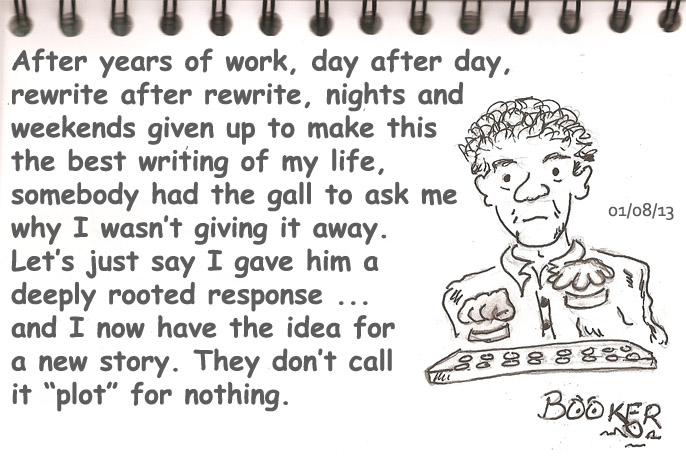
cARtOONdAY: tHE gROWTH OF iNSPIRATION

Inspiration can come from almost any dirty little part of your life.

Inspiration can come from almost any dirty little part of your life.

Leave a comment

Filed under cartoon by author, CarToonsday, inspiration, noir

Writing Tip Wednesday: Should Character or Plot power your Synposis

SHOULD CHARACTER OR PLOT POWER YOUR SYNOPSIS?

By Teri Brown

www.teribrownbooks.com.

What is the difference between a character-based synopsis and a plot-based synopsis? That’s the question I asked myself early last spring, when opportunity came knocking unexpectedly on my door.

Six months prior, I’d landed a great contract with Balzer+Bray for a young adult series set in the twenties. I thought I was done pursuing new contracts for a while, but after watching, (and loving!), Downton Abbey, I mentioned in an email to my agent that we should pitch an Edwardian anthology. Two weeks later, I had an editor who didn’t want an anthology with different authors; she wanted a three book series and wanted me to write it.

Even though this is for a “new adult” series– which I had never written before– I told her I could do it. To make the series happen in the short time frame she wanted, she needed a synopsis and two chapters of the first book as soon as possible.

A BETTER WAY
I wondered how I could possibly write a synopsis for a book and characters that hadn’t even existed two weeks before. I usually write the synopsis after most of the book had been written. Like many authors, I dread the synopsis, and so I immediately went into research mode, because there HAD to be a better way than pulling my hair out and winging it like I usually did.

Turns out, there is, and unless instructed otherwise, this is how I’ll approach synopses from here on out.

As I discovered through the process, you have to have great characters no matter how good your concept is, so it makes perfect sense to start with the characters and not the concept/plot. For me, that is the fundamental difference between a plot-based synopsis and a character synopsis.

Instead of starting with a plot, I started out with characters, added in the events and social issues of the time period and hoped that somehow, miraculously, a book would emerge. To my surprise it did, and the experiment ended up in a very nice three book deal.

FOCUS ON CHARACTER
Here are some tips on how you can craft your own character synopsis:

— Who are your main characters? If you have three main characters, as I did, that is how many parts of the synopsis you will have. It’s all about telling the story from their point of view.

— Get to know them. I’m not talking about their favorite colors; I’m talking about the desires of their hearts. If he/she could have anything, what would it be? It’s important to know your characters because you (and the editor) need to know why they react to the plot the way they do.

— Pick a lead. Even though my book would have three main characters and three POV’s, one of the character’s journeys would be stressed more in this particular book. I began with her and told her story as simply as I could. Then I told the next character’s story and then the next. Their stories intersected, but each main event was told from differing points of view.

Each character reacts differently to the same event because they have different emotions, problems and issues. For instance, when an evil uncle forces Prudence into service, Prudence is devastated, Victoria is righteously angry, and Rowena feels guilty because she had made a bargain with their uncle to keep Prudence with them. One event, three different reactions followed by three different actions.

— Like a plot synopsis, make sure you have the main plot points, but stress how each character reacts.

For me, writing a character synopsis is simpler because I begin with people and write their story as opposed to starting with story and then creating characters–you’ll still end up with a novel outline, either way, but this way, the characters have breathed life into it.

About: Teri Brown is proud of her two children but coming in a close second is the fact that she parachuted out of a plane and beat the original Legend of Zelda video game. She is a word scribbler, head banger, math hater, book reader, rule breaker, food fixer, novel writer, kitty keeper, and city slicker. You can find her online at www.teribrownbooks.com.

The above is taken from the e-newsletter Bruce Hale’s THE INSIDE STORY, December 2012. To learn more about Bruce Hale or his newsletter, go to www.brucehalewritingtips.com/

Leave a comment

Filed under Writing Tip Wednesday

cARtOONSDAY rEDUX: tHE gREAT eSCAPE

Man hanging from cliff

Sometimes, plot happens.

[Editor’s note: Apparently, in addition to needing talent, I can also use an editor. I had an extra “y” dangling in the earlier version, which I only caught a little while ago. Possibly the best letter to have dangling at the end of a word considering the subject. Above is a slightly updated version, sans extra “y.”]

Leave a comment

Filed under cartoon by author, CarToonsday

cARtOONSDAY: tHE gREAT eSCAPE

Man hanging from side of cliff

Sometimes, plot happens.

Leave a comment

Filed under cartoon by author, CarToonsday

Writing Tip: Plotting backwards

[Editor’s note: the essay below is taken from an e-mail newsletter sent out by the writer Bruce Hale. you can find his web site at: http://www.brucehalewritingtips.com/. You can also sign up for his e-newsletter at that site. Each electronic newsletter comes with other information, including a writing joke.]

WHY BACKWARDS IS BEST WHEN PLOTTING A MYSTERY

By BRUCE HALE

When I wrote my first mystery, I hadn’t a clue. I tried writing it straight through, plotting as I went, and ended up falling flat on my face. Why? I hadn’t yet learned that backwards is best.

You see, contrary to the way most fiction is mapped out, mysteries are backwards creatures. They’re easiest to write when plotted backwards from the ending, rather than forward from the beginning. Mysteries, by their nature, are a complex tangle, and if you’re not careful, you’ll get stuck in it.

As I learned the hard way, if you write from the beginning, you’ll be left flatfooted with your detective, trying to figure out how to solve the mystery.

Better to go the easy way: work from the solution. Start from the ultimate revelation of whodunit and work your way backwards to mystery writing success. Here’s how:

– DECIDE WHODUNIT, WHY, AND HOW
First, pick the crime to be solved and the culprit. Suss out why they committed the crime – and the less obvious the reason, the better. Your villain (or clues from him) should be part of the story from fairly early on, but his motives and actions must remain hidden until the twist reveals them. Hide your villain in plain
sight – heck, you could even go so far as to make them a seeming ally of your hero.

– PLAN YOUR TWIST
This is the dramatic reveal, the “It’s not Snape, it’s Quirrell!” moment. (Sorry if I spoiled Harry Potter I for you.) The twist should occur at the least convenient moment, preferably when the hero is most vulnerable. Usually the twist occurs at or just before the climax.

To make the twist work, you need to come up with at least one or two plausible culprits, then show why they didn’t commit the crime.

– LAY OUT YOUR RED HERRINGS
These are the likely culprits, the leads your detective follows that turn out to be dead ends. Be sure the herrings are motivated as well, and if you can disguise their motivations or make them ambiguous, so much the better. Anything to make them *more* plausible, and your true villain *less* plausible.

– SCATTER YOUR CLUES
What tips your hero off to the fact that the villain is guilty? A latticework of little clues (usually connected much too late). You must always play fair with the reader, so be sure the clues are there, even if the detective and her trusty assistant initially dismiss them.

The key with clues is to use misdirection — have them seem insignificant, or be misinterpreted. You can’t make it too easy for the detective, or the reader!

– START WITH A BANG
And last, but not least, come up with a grabber of an opening that plunges us right into the heart of the mystery. Ideally, it should contain some small clue that points us toward the true culprit.

With all that in place, now you’re ready to write your first words. Happy mystery writing, and may the spirit of Chandler and Hammett be with you!

2 Comments

Filed under Bruce Hale, plot, writer, writing, writing blog, writing tip