
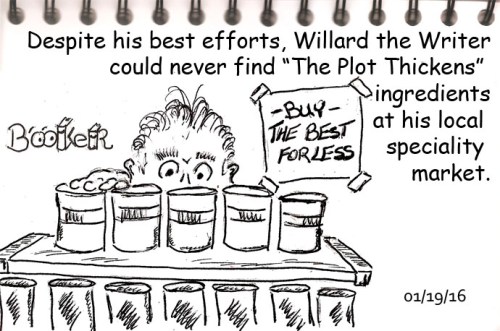
He did find some interesting okra.
He did find some interesting okra.
Filed under 2016, cartoon by author, CarToonsday
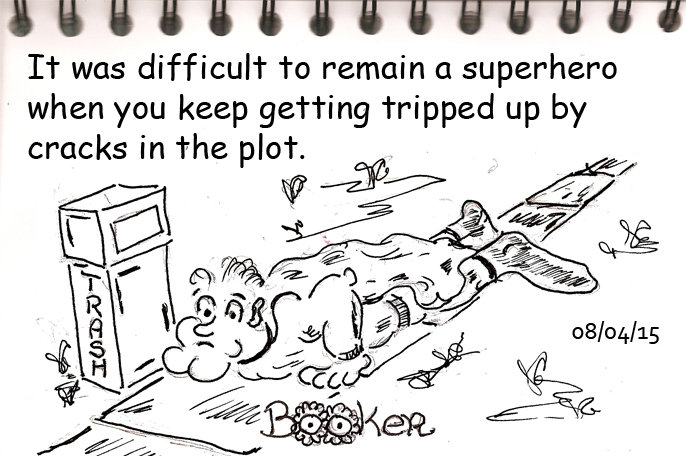
Sometimes those cracks on the sidewalk weren’t much help, either.
Filed under 2015, cartoon by author, CarToonsday

Willard now understood why they offered him a disguise at the sign in table.
Filed under 2015, cartoon by author, CarToonsday

Bigger than a pot hole. Deeper than an incomplete sentence. More powerful than a null and void. It’s a plot hole.
Filed under cartoon by author, CarToonsday
THREE WAYS TO MAKE YOUR PLOT JUICIER
by BRUCE HALE
http://www.brucehalewritingtips.com/
Plots are like Christmas turkeys — we’re always looking for ways to fatten them up. Juicier plots feel more complex, more satisfying. They keep readers up late turning the pages, and keep editors asking for more.
How do you make sure your book’s plot is a juicy one? Here are three quick tips to help.
1. UP THE “UH-OH” FACTOR
Throw roadblocks into your character’s path. Disappoint him or her. Frequently. Give your hero bad luck.
(Bad luck is bending over to pick a four-leaf clover and being infected by poison ivy.)
Yes, I know – your main character is a version of yourself. Few people would knowingly put themselves in jeopardy, but you’ve got to cold-bloodedly throw your surrogate into the soup — even more than you think you do.
Always be asking, “How can I make it worse?”
The more danger, the better. It can be physical, emotional, or spiritual danger, or a threat to life and limb. By piling on troubles, you hook readers into wanting to find out how the hero gets out of it. I call it the “UH-OH factor.” They read it and go, “uh-oh, she’s really gonna get it now.”
2. RAISE THE STAKES
You see this in movies all the time. A regular schmo is trying to solve some small problem in his life – like a romantic breakup – and then he stumbles into an even bigger problem. Or something happens to make it even more urgent that he solve his small problem (like his ex decides to get married and he has to win her back before the wedding).
In movies, the stakes often become “the end of the world as we know it.” No need to go that far, unless your story warrants it. But you can always up the ante in smaller ways.
For example, in my book, FAREWELL, MY LUNCHBAG, Chet Gecko is hired by his friendly cafeteria lady to discover why her food is going missing. But then, while Chet’s on stakeout, the real crook frames him for the thefts. Chet then has an even stronger reason for solving the case: clearing his name.
3. MAKE HIM FACE HIS FLAW
If you want to make it even harder for your hero to solve the story’s central problem, give them a flaw and put them in a situation where they have to overcome it.
(Warning: This technique can be over-used, but if done with finesse, it adds another layer of richness to the story.)
For example, if your hero is afraid of the dark, let her come up against this fear a few times and get off fairly easy — not investigating that dark alleyway, or enlisting a friend with a flashlight to help her. But at the climax, when it’s do-or-die time, stick her in a cave as black as midnight. She must overcome her fear in order to find the missing kid/treasure/whatever.
Simple enough? Absolutely. But employing any of these tips can add a juiciness to your story that makes a reader want to dig it with gusto.
___________

Bruce Hale
About Bruce…
Bruce Hale began his career as a writer while living in Tokyo, and continued it when he moved to Hawaii in 1983. Before entering the world of children’s books, he worked as a magazine editor, surveyor, corporate lackey, gardener, actor, and deejay.
Bruce has written and illustrated over 25 books for kids. His Underwhere series includes Prince of Underwhere and Pirates of Underwhere. His Chet Gecko Mysteries series includes: The Chameleon Wore Chartreuse, The Big Nap, The Malted Falcon, Hiss Me Deadly, and others. More at http://www.brucehale.com/
Filed under Writing Tip Wednesday
MAKE PLOTTING EASIER WITH THE PLOTCLOCK – PART 2
By JOYCE SWENEY
FROM LOW POINT TO DENOUEMENT
Plotting takes time.
Act 2 is usually a series of failures, losses and attempts to navigate the new world using the old skills. Events will punish the main character for refusing to change until they are at a breaking point and all seems lost. Fun to observe that at this point in stories, main character is often actually shown making a physical descent of some kind, like a symbolic falling to their knees. The story “breaks” them here and opens them to:
THE CHANGE
Right after The Low Point in the beginning of Act 3, the main character makes a major tactical change, the one the reader has been hoping for: the shy person starts to speak up, for instance. In Act 3, the main character is rewarded for the change by gaining strength and power. But at the same time, the forces against her react and also become stronger.
Stakes and hopes for the reader begin to climb in Act 3, but reader is encouraged to think no one can stop our Main Character now until:
THE TURNING POINT
More like a curveball, this is a surprise that comes from left field and changes the game, raising the stakes and making the eventual climax look much more difficult for the main character than we ever could have guessed. This is the most often overlooked plot point and probably the one that separates a good plotter form a great plotter. The classic example would be Luke Skywalker doing very well in his battle with Darth Vadar until….”Luke, I am your father.”
THE CLIMAX
Another moveable plot point, this is the mother-of-all battles in the novel, when the main character gets his final exam, as it were… when all the marbles are at stake and tension is at the highest. The climax will change everything one way or another. In action/adventure, it’s literally a battle, but there should be a high stakes climax even in the quietest, most literary work.
A main character who stands up to a bully might just do it with words, but it should still be big and powerful as a moment. In a very commercial story, the climax comes almost at the end (because who cares about denouement when the monster is dead?) In a literary story you can take almost a quarter of the book to clean up the emotional havoc wreaked at the climax.
THE DENOUNEMENT
Whatever you need to clean up the mess and let the reader know what they need to know about how things turned out after the battle was won. No more, no less.
The joy of The Plot Clock is this: that it guides you when you’re lost, helps you realize which plot points you might be missing, clears up the terror on where to begin, and just in general, is a good friend to hold your hand as you plot your novel. If you’re a plotter, you probably will consult it before you even start to write. If you like to plunge and discover as you go, it’s a great revision tool.
—-
Joyce Sweeney is the author of 14 novels for young adults and one book of poetry. A writing teacher and mentor to aspiring authors, she runs writer’s workshops, critiques manuscripts, and conducts classes and seminars throughout the state of Florida. This article is just one of the ten lessons included in her Fiction Writing Essentials which starts in July and is taking registrations now at: www.sweeneywritingcoach.com.
[Editor’s note: This entry comes courtesy of Bruce Hale. Bruce has written and illustrated over 25 books for kids. His Underwhere series includes Prince of Underwhere and Pirates of Underwhere. His Chet Gecko Mysteries series includes: The Chameleon Wore Chartreuse, The Big Nap, The Malted Falcon, Hiss Me Deadly, and others. More at http://www.brucehale.com/]
Filed under Writers on writing, Writing Tip Wednesday
MAKE PLOTTING EASIER WITH THE PLOTCLOCK – PART 1
By JOYCE SWENEY
WHAT IT IS
Plotting takes time.
But you can certainly plot a novel *without* this tool, have high points where the clock suggests low points, follow another map, etc., and you’ll
be fine. It’s just a great map for writers like me who get very lost when trying to plot a novel.
WHY IT WORKS:
I believe there’s a basic ‘story’ hardwired into all our brains. We can’t articulate it, but we know it when we see it and we respond emotionally to it. It is the story of the character we love, overcoming all odds to do the thing they must do and somehow gaining something in the end. The highs and lows
of this are surprisingly similar and predictable, hence the effectiveness of The Clock.
HOW TO USE IT:
The story should begin in the main character’s ordinary world. But the early scene/scenes in this world should suggest to the reader something is lacking. I don’t like ‘What does the main character want?’ Who cares what they want?
A better question is, ‘What needs to happen to a person like this?’ So a shy person should be propelled, lured or trapped into a story where they will have to speak up. The ordinary world should make the reader say…I like this person but I wish they would ______. And then comes …..
The Inciting Event – the thing that makes that wish come true. This new thing crosses the main character’s path and invites them into the Special World of the story. In some novels it happens pretty quickly; in others, much closer to the Binding Point. In memoir, for reasons I haven’t figured out, the inciting event tends to come first, with the Ordinary World shown in flashback. But in fiction, it seems to be better the other way.
The Binding Point – comes about a quarter into the story and begins Act 2. Since the Inciting Event, the main character has probably been resisting or avoiding the Special World (because who wants to get involved in something that might change you?), but at the binding point they agree, are lured, tricked or shanghaied into the Special World. Dorothy in Oz is an easy binding point to understand. She can’t go back the way she came, so she now has to follow the Yellow Brick Road all the way through a story to get home.
Next time: From Low Point to Denouement
—-
Joyce Sweeney is the author of 14 novels for young adults and one book of poetry. A writing teacher and mentor to aspiring authors, she runs writer’s workshops, critiques manuscripts, and conducts classes and seminars throughout the state of Florida. This article is just one of the ten lessons included in her Fiction Writing Essentials which starts in July and is taking registrations now at: www.sweeneywritingcoach.com.
[Editor’s note: This entry comes courtesy of Bruce Hale. Bruce has written and illustrated over 25 books for kids. His Underwhere series includes Prince of Underwhere and Pirates of Underwhere. His Chet Gecko Mysteries series includes: The Chameleon Wore Chartreuse, The Big Nap, The Malted Falcon, Hiss Me Deadly, and others. More at http://www.brucehale.com/]
Filed under Writing Tip Wednesday
WHY DOESN’T MY PLOT WORK?
by BRUCE HALE and MICHAEL STEARNS
http://www.brucehalewritingtips.com/
Getting perspective on your own writing is tougher than two-year-old Halloween caramels. You squint at the story, mull it over, and suspect something isn’t working, but it’s hard to say what, exactly.
At a recent conference, my friend and former editor, Michael Stearns, offered up one of the best cures I’ve seen for this problem. His series of diagnostic questions can help you turn your plot from wimpy to wicked-strong.
Reprinted with his permission, here’s an excerpt from Michael’s list of questions, together with my explanations.
1. Do you have something pulling the character forward?
Every character needs a powerful goal or desire. Make sure it’s compelling enough to believably motivate them.
2. Do you have something pushing the character from behind?
Add a meddlesome mom, a pursuing villain, an obnoxious rival — someone who applies pressure.
3. Have you remembered clocks?
This refers to a deadline that must be met, or else. Think of Marty McFly in Back to the Future, who must drive his time machine
past the clock tower at the right moment, or remain stuck in the past.
4. Have you made the character lie — to others and to us?
Everybody lies. And whether it’s a big lie or a little one, the truth wants to come out. This energy helps invigorate your plot.
5. Do you know your character’s motives inside and out?
Often, plots bog down when you lose sight of why your hero wants to do something. Unmotivated action rings false.
6. Does all the above apply to even minor characters?
The villain, the best friend, even the bit players have a reason for doing what they do. And when you get clear on that reason, their actions will be make more sense.
7. Have you buried the ends of chapters?
Don’t immediately resolve the issue or question that gets raised near the chapter’s end. Resolve it in the next chapter — or better yet, the chapter after that. Your readers will curse you while they keep on reading.
8. Have you been as mean as possible to your characters?
We’re talking about Job mean, Sophie’s Choice mean, evil-punk-the-reader-will-hate-you-forever mean. Don’t just give your hero grief, give her the worst day imaginable.
9. Do you always go for the extreme?
What keeps readers reading is high-stakes action. In the words of Spinal Tap, dial it up to 11. The higher the stakes, the better the book.
Michael Stearns is an agent and partner of Upstart Crow Literary Agency. You can visit his website at: http://clicks.aweber.com/y/ct/?l=O8uEK&m=IsxyiV6D9FLsQz&b=7cPIzxf9UuUk28zsEYoWSw
___________
Bruce Hale
Bruce has written and illustrated over 25 books for kids. His Underwhere series includes Prince of Underwhere and Pirates of Underwhere. His Chet Gecko Mysteries series includes: The Chameleon Wore Chartreuse, The Big Nap, The Malted Falcon, Hiss Me Deadly, and others. More at http://www.brucehale.com/
Filed under writing tip, Writing Tip Wednesday
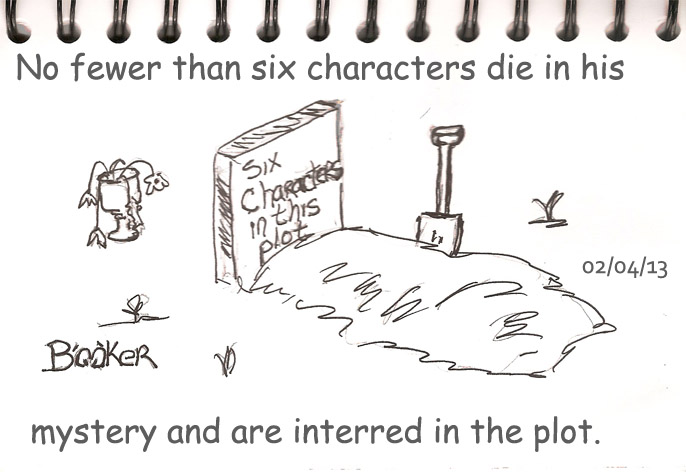
The real mystery was how he managed to come up with that many characters to begin with.
Filed under cartoon by author, Monday morning writing joke


 Booker's Blog