Tag Archives: obituary

Gene Wolfe, Acclaimed Science Fiction Writer, Dies at 87 – The New York Times

Gene Wolfe, a prolific science fiction and fantasy writer whose best works, full of inventive language, mysteries and subtly conveyed themes, are considered to be among the genre’s finest, died on Sunday in Peoria, Ill. He was 87.

His daughter Therese Goulding said the cause was heart disease.

Mr. Wolfe broke through in 1972 with “The Fifth Head of Cerberus,” a novella (which he soon expanded to three novellas) whose narrator, an inhabitant of the twin planetary system of St. Croix and St. Anne, tells the story of how he came to kill his father.

His most acclaimed work was the four-novel series “The Book of the New Sun,” published from 1980 to 1983.

“The publication of his brilliant ‘Fifth Head of Cerberus’ in 1972 earned him a place among the small band of accomplished stylists in science fiction, along with Samuel R. Delany, Thomas M. Disch, Joanna Russ and one or two others,” Gerald Jonas wrote in The New York Times when the final book of the series, “The Citadel of the Autarch,” appeared. “The completed ‘Book of the New Sun’ establishes his pre-eminence, pure and simple.”

Mr. Wolfe also wrote numerous short stories and published several collections. The most recent of his 30 or so novels were “The Land Across” (2013), an earthbound story about a travel writer who explores an obscure East European country, and “A Borrowed Man” (2015), a futuristic noir.

Mr. Wolfe was much admired by his fellow writers.

“He’s the finest living male American writer of SF and fantasy — possibly the finest living American writer,” Neil Gaiman wrote in 2011 in The Guardian. “Most people haven’t heard of him. And that doesn’t bother Gene in the slightest. He just gets on with writing the next book.”

Gene Rodman Wolfe was born on May 5, 1931, in Brooklyn. His father, Emerson Leroy Wolfe, was a salesman; after the family moved to Houston in about 1937, he and Mr. Wolfe’s mother, Mary Olivia (Ayers) Wolfe, also ran a diner. In the days before readily available air-conditioning, the Texas heat made an impression on young Gene.

The publication of Mr. Wolfe’s “The Fifth Head of Cerberus” in 1972, one critic wrote, “earned him a place among the small band of accomplished stylists in science fiction.”

The publication of Mr. Wolfe’s “The Fifth Head of Cerberus” in 1972, one critic wrote, “earned him a place among the small band of accomplished stylists in science fiction.”

“I stood and read in front of an electric fan,” Mr. Wolfe told the MIT Technology Review in 2014. “That’s what we kids did in that hot weather.”

After graduating from Lamar High School in Houston, he enrolled at Texas A&M, where he wrote his first short stories while studying engineering. But his grades were poor and he dropped out; he then was drafted into the Army, serving during the Korean War as a combat engineer. He returned from Korea “a mess,” as he put it.

“I’d hit the floor at the slightest noise,” he later recalled. His marriage to Rosemary Dietsch in 1956 helped him find stability, he said.

After graduating from the University of Houston on the G.I. Bill he became an engineer at Procter & Gamble, where his accomplishments included developing the machine used to cook the dough for Pringles potato chips. (“I developed it,” he clarified in an interview in the 2007 book “Shadows of the New Sun: Wolfe on Writing, Writers on Wolfe,” in response to the perception that he had come up with the concept. “I did not invent it. That was done by a German gentleman.”) He started looking for a side income, and resumed what he had done at Texas A&M.

“If you have a wife and four children, as I do,” he told The Washington Post in 1983, “you tend to be scraping around for ways to make a bit of additional income.”

In 1965 he finally sold a story, “The Dead Man,” to “one of those skin magazines, a poor man’s Playboy,” as he put it. His fortunes began to improve when the science fiction writer and magazine editor Damon Knight began buying his work.

His first novel, “Operation Ares,” appeared in 1970. “The Fifth Head of Cerberus” appeared two years later and was nominated for both a Nebula and a Hugo, the top awards in the genre. (He lost out on the Nebula to Arthur C. Clarke and on the Hugo to Ursula K. Le Guin.)

Despite the acclaim and more novels — “Peace” in 1975, “The Devil in a Forest” in 1976 and “The Shadow of the Torturer” (the first of the “New Sun” series) in 1980 — writing remained a sideline. From 1972 to 1984 Mr. Wolfe was an editor for Plant Engineering, a trade journal.

“We had a staff of 24, and all of us had several jobs,” he said. “It seemed to me that I had more than most. I was the robot editor; I was the screws editor, the glue editor, the welding editor. I was in charge of power transmission belts, and gears, and bearings, and shafts, and all sorts of stuff like that.”

“The Citadel of the Autarch” was the fourth and final book of the series “The Book of the New Sun,” Mr. Wolfe’s most acclaimed work, published from 1980 to 1983.

“The Citadel of the Autarch” was the fourth and final book of the series “The Book of the New Sun,” Mr. Wolfe’s most acclaimed work, published from 1980 to 1983.

With the success of the “New Sun” series, he became a full-time writer. The series, set in the distant future, involves the journeys of Severian, an apprentice torturer who as the saga begins violates code by showing mercy to a prisoner. He then proceeds to wander the land, encountering giants, cults and more.

“A wise reader will keep a dictionary nearby, but it won’t always prove useful,” The New Yorker said of the series in a 2015 article about Mr. Wolfe. “Though Wolfe relies merely on the strangeness of English — rather than creating a new language, like Elven or Klingon — he nonetheless dredges up some truly obscure words: cataphract, fuligin, metamynodon, cacogens.”

Mr. Wolfe liked to employ the unreliable-narrator technique, keeping readers guessing about what was true and what wasn’t. His stories could be bleak, but they also had dashes of comedy.

“I have been told often enough that I have a sense of humor that makes strong men faint and women reach for weapons,” he said in the introduction to “Castle of Days,” a 1995 story collection.

He returned to the “New Sun” universe with two later series, but he also kept exploring. “The Wizard Knight,” a two-book series published in 2004, had a medieval-inspired setting. “The Land Across,” his recent book about a travel writer, explored a fictional land that, as Alan Cheuse put it in a review for NPR, “appears to have more affinity with Kafka country than any other.”

Mr. Wolfe won numerous awards, including two Nebulas, and in 2013 he was named a Science Fiction and Fantasy Writers of America grand master, one of the field’s most prestigious titles.

His wife died in 2013, and a son, Roy, died in 2017. In addition to Ms. Goulding, he is survived by another daughter, Madeleine Fellers; a son, Matthew; and three granddaughters.

In a 1988 interview with the literary critic Larry McCaffery, Mr. Wolfe talked about the genesis of his often intricate stories, how ideas would knock around inside his head and eventually gel into something.

“There’s a wonderful ‘Peanuts’ cartoon that pretty much describes what I’m talking about,” he said. “Snoopy is on the top of his doghouse and he writes something like: ‘A frigate appeared on the edge of the horizon. The king’s extravagances were bankrupting the people. A shot rang out. The dulcet voice of a guitar sounded at the window.’ Then he turns and looks at the reader and says, ‘In the last chapter I’m going to pull all this together!’ ”

Leave a comment

Filed under 2019, author tribute

Harlan Ellison, Intensely Prolific Science Fiction Writer, Dies at 84 – The New York Times

By Richard Sandomir

Harlan Ellison, Intensely Prolific Science Fiction Writer, Dies at 84

9-12 minutes

By Richard Sandomir

Harlan Ellison, a furiously prolific and cantankerous writer whose science fiction and fantasy stories reflected a personality so intense that they often read as if he were punching his manual typewriter keys with his fists, died on Wednesday at his home in Los Angeles. He was 84.

His wife, Susan Ellison, confirmed his death but said she did not know the cause. He had had a stroke and heart surgery in recent years.

Mr. Ellison looked at storytelling as a “holy chore,” which he pursued zealously for more than 60 years. His output includes more than 1,700 short stories and articles, at least 100 books and dozens of screenplays and television scripts. And although he was ranked with eminent science fiction writers like Ray Bradbury and Isaac Asimov, he insisted that he wrote speculative fiction, or simply fiction.

“Call me a science fiction writer,” Mr. Ellison said on the Sci-Fi Channel (now SyFy) in the 1990s. “I’ll come to your house and I’ll nail your pet’s head to a coffee table. I’ll hit you so hard your ancestors will die.”

Mr. Ellison’s best-known work includes “A Boy and His Dog” (1969), a novella set in a postapocalyptic wasteland of the United States, which was made into a 1975 movie; “I Have No Mouth and I Must Scream” (1967), a short story about a computer that tortures the last five humans on earth; “The City on the Edge of Forever,” a beloved back-in-time episode of the “Star Trek” television series in 1967; and “ ‘Repent, Harlequin!’ Said the Ticktockman” (1965), about a futuristic society in which time is regimented by a fearsome figure called the Ticktockman.

“But no one called him that to his mask,” Mr. Ellison wrote. “You don’t call a man a hated name, not when that man, behind his mask, is capable of revoking the minutes, the hours, the days and nights, the years of his life. He was called the Master Timekeeper to his mask.”

Mr. Ellison was a fast-talking, pipe-smoking polymath who once delighted talk-show hosts like Merv Griffin and Tom Snyder with his views on atheism, elitism, violence and Scientology.

He could be wild, angry and litigious. He said that he lost his job with the Walt Disney Company — on the first day — when he stood up in its commissary (with company executives watching) and described how he wanted to make an animated pornographic film starring Mickey and Minnie Mouse.

He is said to have sent a dead gopher to a publisher and attacked an ABC executive, breaking his pelvis.

He frequently criticized studios and television producers when he believed they had copied his stories. His many lawsuits included one against the makers of the movie “The Terminator,” which accused them of plagiarizing “Soldier,” a script he wrote in 1964 for the TV series “The Outer Limits.”

And he remained upset for years that Gene Roddenberry, the creator of “Star Trek,” and others had made rewrites to his script for “The City on the Edge of Forever.” Decades later, he sued CBS Paramount TV for merchandising royalties that he felt he was owed from the episode.

Ms. Ellison said that her husband eventually put his “Star Trek” imbroglio behind him. But he would never watch the classic episode.

“Let’s not go that far,” she said in a telephone interview.

Harlan Jay Ellison was born on May 27, 1934, in Cleveland. His father, Louis, was a dentist and jeweler, and his mother, Serita (Rosenthal) Ellison, worked in a thrift store. Growing up, partly in Painesville, Ohio, about 30 miles northeast of Cleveland, he was bullied in school, largely for being Jewish. The experience made him feel like an outsider and fueled his anger.

“I survived their tender mercies with nothing more debilitating to show for it than a lifelong, blood-drenched obsession for revenge,” he wrote in “Harlan Ellison’s Watching,” a collection of film reviews first published in 1989.

That anger imbued his writing, said James Gunn, the founding director of the Gunn Center for the Study of Science Fiction at the University of Kansas in Lawrence.

“Some writers were able to detach themselves and write objectively,” Mr. Gunn said in a telephone interview, “but you could always sense that Harlan was in there yelling. You could hear Bradbury in his stories, but he was not violent at all; he had a melancholy attitude.”

After his father died, Harlan moved back to Cleveland with his mother and his sister, Beverly, in 1949 and started the Cleveland Science Fiction Club, became a frequent moviegoer and worked as a runner for local mobsters, he told The Plain Dealer of Cleveland.

He left home several times, traveling around the country and variously working on a tuna boat, as a truckdriver and as a short-order cook, among other jobs.

Mr. Ellison attended Ohio State University but left after two years. At one point he punched an English professor who had told him that he did not see any writing talent in him. Thereafter, Mr. Ellison sent copies of his published stories to the professor.

In the mid-1950s he began publishing a torrent of work — in publications like Galaxy and Fantastic Science Fiction — that would continue for years. He wrote stories, novels and novellas. He edited anthologies like “Dangerous Visions” (1967) and a sequel. And he wrote episodes of television series like “Route 66,” “The Man From U.N.C.L.E.,” “The Alfred Hitchcock Hour,” the 1980s revival of “The Twilight Zone” and, improbably, “The Flying Nun” (an episode in which Sally Field’s character, Sister Bertrille, and two other nuns land on a remote island).

In 1965, he found he had become a character in Gay Talese’s celebrated New Journalism article “Frank Sinatra Has a Cold, published in Esquire magazine. By Mr. Talese’s account, Sinatra, annoyed at the boots that Mr. Ellison was wearing in the pool room of a private club in Beverly Hills, asked him what he did for a living.

“I’m a plumber,” Mr. Ellison answered.

When someone interjected that Mr. Ellison had written the screenplay of “The Oscar,” a forthcoming film, Sinatra replied: “Oh, yeah? Well, I’ve seen it, and it’s a piece of crap.”

Mr. Ellison then said, “That’s strange, because they haven’t even released it.” (It was released in 1966.)

He left after few more testy exchanges with Sinatra. (Sinatra, coincidentally, had a cameo role in “The Oscar.”)

By the time he encountered Sinatra, Mr. Ellison was already reviewing movies and writing essays about buddy films and other genres.

Most of the movies he reviewed were mainstream productions like “Rosemary’s Baby” (which he loved) and “Star Trek: The Motion Picture” (which he called “stultifyingly predictable”).

In a review of “Harlan Ellison’s Watching” in The New York Times in 1989, Robert Moss wrote that “one is never tempted to stop reading” despite Mr. Ellison’s occasional windiness. His criticism, Mr. Moss added, “has some of the spellbinding quality of a great nonstop talker with a cultural warehouse for a mind.”

In recent years, Mr. Ellison wrote a graphic novel, “7 Against Chaos” (2013),” with the artist Paul Chadwick for DC Comics. About 30 of his stories were reissued digitally. He published “None of the Above,” an unproduced screenplay based on “Bug Jack Barron,” a story by Norman Spinrad, a science fiction writer who had been his friend since the 1950s.

Mr. Ellison was also the star of “Dreams With Sharp Teeth” (2008), a documentary feature about his life directed by Erik Nelson. In the film, which showcases Mr. Ellison’s fierce, volcanic and argumentative personality, he is described as a “hurricane,” “an alternately impish and furious 11-year-old boy” and, by his friend Robin Williams, “a skin graft on a leper.”

In describing her husband’s friendship with Mr. Williams, Ms. Ellison said, “Talent will find talent.”

His marriage to Susan Toth, his only immediate survivor, was his fifth; his four previous marriages ended in divorce.

Isaac Asimov once called Mr. Ellison “one of the best writers in the world.” But he lamented that Mr. Ellison had too often been sidetracked by his furies.

“It is simply terrible that that he should be constantly embroiled in matters which really have nothing to do with his writing and which slow him down tragically,” Mr. Asimov wrote in 1994 in his autobiography, “I, Asimov.”

He added: “He claims he is five feet four inches tall, but it doesn’t really matter. In talent, energy and courage, he is eight feet tall.”

Leave a comment

Filed under 2018, author obituary, author tribute

Leonard Nimoy obituary: “Star Trek’s” Spock, dies at 83 – LA Times

Source: http://www.latimes.com/local/obituaries/la-me-leonard-nimoy-20150227-story.html#page=1.

Kirk (left) and Spock (right).

Kirk (left) and Spock (right).

When Leonard Nimoy was approached about acting in a new TV series called “Star Trek,” he was, like any good Vulcan contemplating a risky mission in a chaotic universe, dispassionate.

“I really didn’t give it a lot of thought,” he later recalled. “The chance of this becoming anything meaningful was slim.”

By the time “Star Trek” finished its three-year run in 1969, Nimoy was a cultural touchstone — a living representative of the scientific method, a voice of pure reason in a time of social turmoil, the unflappable and impeccably logical Mr. Spock.

He was, as The Times described him in 2009, “the most iconic alien since Superman” – a quantum leap for a character actor who had appeared in plenty of shows but never worked a single job longer than two weeks.

Nimoy, who became so identified with his TV and film role that he titled his two memoirs, somewhat illogically, “I Am Not Spock” (1975) and “I Am Spock” (1995), died Friday at his home in Bel-Air. He was 83.

The cause was end-stage chronic obstructive pulmonary disease, said his son, Adam.

Nimoy revealed last year that he had the disease, a condition he attributed to the smoking he gave up 30 years earlier.

While he was best known for his portrayal of the green-tinted Spock, Nimoy more recently made his mark with art photography, focusing on plus-sized nude women in a volume called “The Full Body Project” and on nude women juxtaposed with Old Testament tales and quotes from Jewish thinkers in “Shekhina.”

He also directed films, wrote poetry and acted on the stage.

As Spock, he was the pointy-eared, half-Vulcan, 23rd-Century science officer whose vaulted eyebrows seemed to express perpetual surprise at the utterly illogical ways of the humans who served with him on the starship Enterprise.

Spock could barely wrap his mind around feelings. He was the son of a human mother and a father from Vulcan – a planet whose inhabitants had chosen pure reason as the only way they could survive. When he thwarted deep-space evil-doers, it was with logic simple enough for a Vulcan but dizzying for everyone else, including his commanding officer, Capt. James T. Kirk, played by William Shatner.

While worlds apart from the racial strife and war protests of the 1960s, “Star Trek” explored such issues by setting up parallel situations in space, “the final frontier.”

“Spock was a character whose time had come,” Nimoy later wrote. “He represented a practical, reasoning voice in a period of dissension and chaos.”

He also turned Nimoy into an unlikely sex symbol.

More at: http://www.latimes.com/local/obituaries/la-me-leonard-nimoy-20150227-story.html#page=1

1 Comment

Filed under 2015

Death of a young author: “The mystery of Marsha Mehran”

The mystery of Marsha Mehran:
The best-selling young novelist who died a recluse in a rubbish-strewn cottage on Ireland’s west coast

by Cahal Milmo

Source: http://www.independent.co.uk/arts-entertainment/books/features/the-mystery-of-marsha-mehran–the-bestselling-young-novelist-who-died-a-recluse-in-a-rubbishstrewn-cottage-on-irelands-windswept-west-coast-9953073.html

From the moment of her arrival in Lecanvey, Marsha Mehran cut a solitary figure.

The few times she was seen were when she would sit, in the depths of winter, on a bench in the shadow of Ireland’s holiest mountain and open her laptop to catch the Wi-Fi from the village pub opposite.

The Dawson family, who run Staunton’s Pub in a crook of the meandering road that tracks the stark beauty of County Mayo’s Atlantic coast, repeatedly invited the striking young woman into the warmth.

Once or twice in four months, she accepted. But most of the time the 36-year-old politely declined, explaining that she needed to get back home. Visitors to her nearby rented house overlooking a rocky beach were greeted with a sign: “Do not disturb. I’m working.”

As Therese Dawson, the landlady of the homely boozer in the shadow of the 2,500ft Croagh Patrick, put it: “I suppose she needed our Wi-Fi and she’d be out there in all weathers. Of course we invited her in. We told her she didn’t have to worry about buying anything. But I sensed from her that she preferred to be alone.”

Just how alone only became clear shortly before 1pm on 30 April last year.

After days of messages and door knocks had gone unanswered, Teresa Walsh, the letting agent for the boxy, unlovely bungalow on nearby Pier Road, rented by Marsha since late January, used her spare keys to get inside.

Some 18 days earlier, Marsha had sent a text saying she could not deal with a question about her tenancy because she had been “vomiting blood for the last few weeks”. The estate agent’s response – asking if she had seen a doctor and offering help – met with no answer.
Marsha Mehran: obituary

Mrs Walsh found her Iranian-born tenant lying face down on the bedroom floor, wearing only a woollen cardigan. She had been dead for about a week and around her lay the detritus of her increasingly marginal existence in the previous weeks and months: dozens of empty mineral water bottles and the wrappers of the large chocolate bars that had become her chief source of sustenance.

Amid the squalor, her sole tangible financial assets were a single euro coin and a $5 note.

It was a grim, lonely passing that might otherwise have gone unremarked beyond Lecanvey and its windswept beaches, but for one thing: Marsha Mehran was an internationally best-selling author, read in dozens of countries, pursued by film directors, garlanded with rave reviews and, according to those who knew her, a free spirit with a rare zest for life and many more books to write.

Rest of the article at: http://www.independent.co.uk/arts-entertainment/books/features/the-mystery-of-marsha-mehran–the-bestselling-young-novelist-who-died-a-recluse-in-a-rubbishstrewn-cottage-on-irelands-windswept-west-coast-9953073.html

Leave a comment

Filed under author obituary, author write up

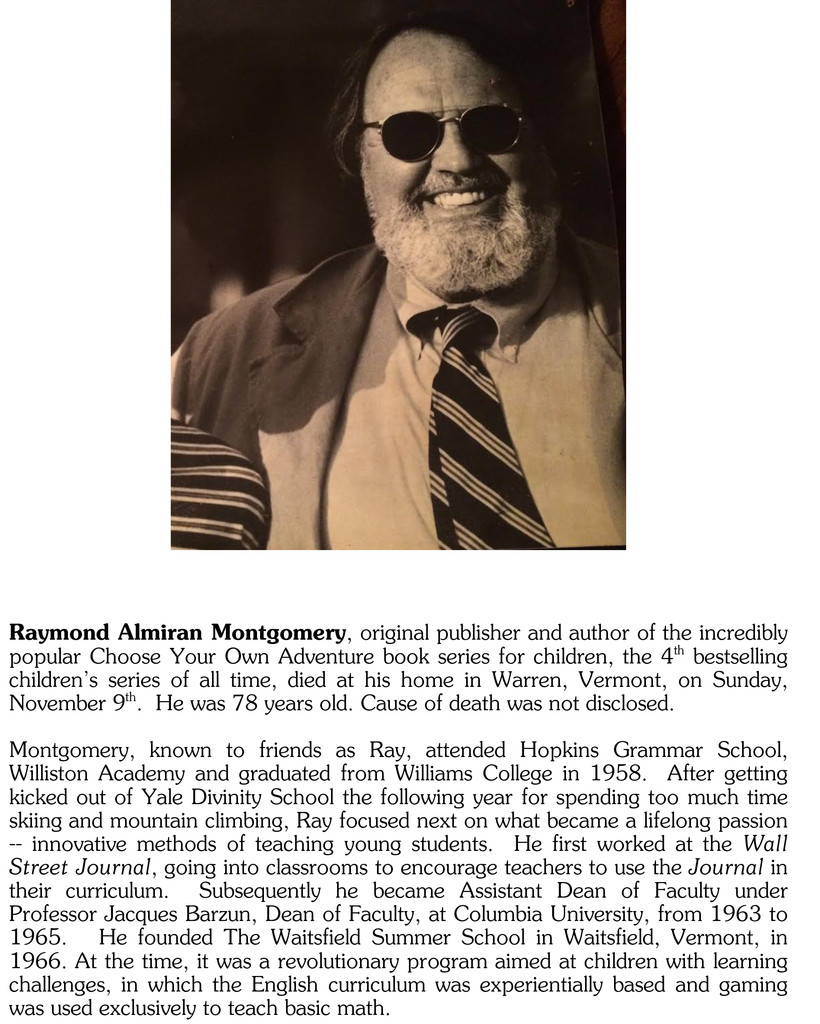
“Choose Your Own Adventure” author and publisher dies

R. A. Montgomery 1936 – 2014

R.A. Montgomery Obit for FAcebook and others_obb_rb

Rest of the obituary: http://www.cyoa.com/pages/r-a-montgomery-1936-2014

1 Comment

Filed under writer

Writing tip Wednesday: “The final selfie”

[Editor’s note: I admit that this is a bit of a stretch in terms of a writing tip. However, writing your own obituary might be you last chance to say something about yourself in the way that is uniquely you. The man below, Kevin McGroarty, did just that, and his obituary became a minor Internet event. I guess you could call it your final selfie.

You could also use the obituary “format” as a way to write obituary for the characters in your novel or short story. You could even have your character(s) write his, her, or their own obituary notice(s). So, read this and I hope you enjoy. I did. And it made me think what I might say about myself. I put together a poem, which I may post at some point.]

Link to obituary and guest book:http://www.legacy.com/obituaries/timesleader/obituary.aspx?n=kevin-j-mcgroarty&pid=171858898&fhid=4786

Kevin J. McGroarty

Kevin J. McGroarty

WEST PITTSTON, PA — McGroarty Achieves Room Temperature!

Kevin J. McGroarty, 53, of West Pittston, died Tuesday, July 22, 2014, after battling a long fight with mediocracy.

Born 1960 in the Nesbitt Hospital, he was the bouncing baby boy of the late Lt. Col. Edward M. McGroarty and Helen Jane (Hudson) McGroarty, whom the New York Times should have noted as extraordinary parents.

He was baptized at St. Cecilia Church, Exeter, which later burned to the ground, attended Butler Street Elementary, which was later torn down, and middle school at 6th Street in Wyoming, now an apartment building.

He enjoyed elaborate practical jokes, over-tipping in restaurants, sushi and Marx Brother’s movies. He led a crusade to promote area midget wrestling, and in his youth was noted for his many unsanctioned daredevil stunts.

He was preceded in death by brother, Airborne Ranger Lt. Michael F. McGroarty, and many beloved pets, Chainsaw, an English Mastiff in Spring 2009, Baron, an Irish Setter in August 1982, Peter Max, a turtle, Summer 1968; along with numerous house flies and bees, but they were only acquaintances.

McGroarty leaves behind no children (that he knows of), but if he did their names would be son, “Almighty Thor” McGroarty; and daughter, “Butter Cup Patchouli.”

McGroarty was a veteran of the advertising industry since 1983. McGroarty was a pioneer in Apple computing, purchasing one of the first in the Wyoming Valley in 1985. He would like to remind his friends: “Please, don’t email me, I’m dead.”

McGroraty was a founding partner of Pyramid Advertising, and finally principal owner of award-winning Rhino Media until 2006. He was also an adjunct instructor at Luzerne County Community College, from 2005-2009.

He will be laid to rest at Mount Olivet Cemetery, section 7N. He asks to please make note of his new address. McGroarty’s headstone reads: “I’ll Be Right Back,” one of his favorite sayings. He leaves this world with few regrets, one being told in grade school, his adult life would see the Hershey candy bar rise in cost to over a dollar. He maintained given the resources and initiative, he would rally the good citizens of the Commonwealth to a revolution that would force that price to its original 35-cent market value, a dream he was not able to fulfill, by his own admission the reason: “I was distracted by many beautiful women.”

In lieu of flowers, friends are asked to please give generously to the Pennsylvania State Police Troop “P” Camp Cadet Fund.

A Mass of Christian Burial will be held at 10 a.m. Monday in St. Cecilia Church of St. Barbara Parish, 1700 Wyoming Ave., Exeter, following a brief rant of how the government screwed up all of the Bugs Bunny cartoons trying to censor violence. This will be presented by his attorney, Bret Zankel, Esq. Friends may call from 9 to 10 a.m. Monday in the church.

McGroarty leaves behind a thought for all to ponder, given years of gathering wisdom from different religions and deep study of the Greek philosophers: “It costs nothing to be nice” and “Never stick a steak knife in an electrical outlet.”

Arrangements by the Metcalfe-Shaver-Kopcza Funeral Home Inc., 504 Wyoming Ave., Wyoming.

Leave a comment

Filed under Writing Tip Wednesday