Tag Archives: new words

New words to live by: “Loopid”

It is the first weekend of the month and time again for a new word to live by. This is a word or phrase not currently in use in the U.S. English lexicon, but might need to be considered. Other words, such as obsurd, crumpify, subsus, flib, congressed, and others, can be found by clicking on the tags below. Today’s New Word is a merging of two words: Loop and Stupid. Without further chattering, Loopid is the new word for this month:

Loop, n. an object, such as a string, rope, or wire folded or turned back on itself, sometimes so that what goes out will come back on itself. Example, a feedback loop when the original signal keeps repeating itself.

Stupid, adj. dull, foolish, senseless, either a person or idea.

Loopid, adj. When you are so stupid, you don’t know how stupid you are and because of that, you continue to remain stupid, but may nonetheless think you are smart. Also known as a Loop Stupid.

n. One who is Loop Stupid.

To further explain the concept here is a short video.

Leave a comment

Filed under new word, New words to live by

New words to live by: “law of the inverse square”

It is the second weekend of the month and time again for a new word to live. This is a word or phrase not currently in use in the U.S. English lexicon, but might need to be considered. Other words, such as obsurd, crumpify, subsus, flib, congressed, and others, can be found by clicking on the tags below. This month’s New Word is related to aging and being a parent: law of the inverse square.

Inverse-square law

Inverse-square law

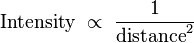
Inverse-square law = In physics, this means the further you stand from an electromagnetic source (For example, light), the less radiation you will receive? That depends on how far from the source you stand. If you stand two feet further back from where you were, you will receive ¼ th the amount. If you stand six feet back, you will receive 1/36th the amount.

An expression that could elicit "the look."

An expression that could elicit “the look.”

Law of the inverse square = the further you get from your childhood in terms of age and maturity (at least to some degree), the more you will start sounding like at least one of your parents. This can be in tone of voice, mannerisms, phrases, and temperament. In this case, the further away in time you travel, the more pronounced these things become. You become the “square” (parent) you promised yourself you wouldn’t be when you grew up, particularly the stern side of your parents. The law giver

For example, as your child grows up and asks the 20th time why something has to be done, you snap back with the same tone and inflection as your father, “Because I said so.”

Or, if you’re a mother, you give your child “the look,” which was the same look your mother gave you.

Training is not required. It happens, in an eerie, secretive, delayed genetic development sort of way.

1 Comment

Filed under new word, New words to live by

New words to live by: “corpfare” and “corpsefare”

It is the first weekend of the month and time again for a new word to live. This is a word or phrase not currently in use in the U.S. English lexicon, but might need to be considered. Other words, such as obsurd, crumpify, subsus, flib, congressed, and others, can be found by clicking on the tags below. This month’s New Words are related and are the merging of corporation and welfare to create corpfare, and the merging of corpse and welfare to create corpsefare.

Corporation, n. an association of individuals or groups, created not by nature or God, but by law or under authority of law, having an ongoing existence independent of those of its members, exercising powers and liabilities distinct from those of its members, and deemed by the U.S. Supreme Court to have many of the same rights as a human adult, but little of the responsibilities. Oftentimes words such as large, multinational or international accompany the word corporation.

Welfare, n. 1a) government assistance, financial or other, to an individual or family from a city, state, or national government.

Many dictionaries don’t recognize the word welfare as applying to corporations or other businesses, most of them quite large. So to fill the gap:

Corpfare, n. government assistance, financial or other, to a business, company, or corporation.

For example, in 2011, on the federal level, $57 billion was spent on individual or family welfare. Yet also in 2011, on the federal level, $94 billion was spent on “corpfare = corporate welfare.” When tax breaks, financial incentives, and things like TIF (Tax Increment Financing) and PILOT (Payment in Lieu of Taxes) on the state and local levels are thrown in, the balance by some estimates is a true 2 to 1 in favor of corporations, businesses, industries, etc. vs. individuals and families.

Corpse, n. Someone or something no longer useful or viable.

Corpsefare, n. 1) Corpfare to the point that the public coffers are sucked dry by the corporations. 2) the misguided belief that this is a good thing. v. the act of sucking dry the public coffers.

For example, Biglittle Corporation corpsefared the city and then left without completing any of the proposed projects. Or Biglittle Corporation completed all its projects, but in so doing corpsefared the city.

Leave a comment

Filed under New words to live by

New words to live by: “Al-Gore-rhythm”

It is the second full weekend of the month and time again for a new word to live. This is a word or phrase not currently in use in the U.S. English lexicon, but might need to be considered. Other words, such as obsurd, crumpify, subsus, flib, congressed, and others, can be found by clicking on the tags below. Today’s New Word is a merging of two words: quagmire and muffin. Without further chattering, and in honor of the “father” of the Internet, Al-Gore-rhythm is the new word for this month:

Al-Gore-rhythm =
a set of strictures by conservatives for solving a problem in a finite number of steps by blaming it all on Al Gore.

Conservatives have a problem with loyalty of today’s youth.

Al Gore speaks to the youth about an issue, such as climate change a/k/a global warming.

Al Gore is undermining respect for authority by encouraging them to ask questions.

Example, In 2009 when Glenn Beck accused Al Gore of trying to create a Hitler Youth-type movement by encouraging young kids to ask questions of their parents about global warming. In short, blame Al Gore for undermining family values by encouraging the youth to think and question.

Or put another way, Al Gore is the conservatives’ straw man and boogeyman all rolled into one.

Leave a comment

Filed under new word, New words to live by

New words to live by: “trumpmuffin”

It is the first weekend of the month and time again for a new word to live. This is a word or phrase not currently in use in the U.S. English lexicon, but might need to be considered. Other words, such as obsurd, crumpify, subsus, flib, congressed, and others, can be found by clicking on the tags below. Today’s New Word is a merging of two words: quagmire and muffin. Without further chattering trumpmuffin is the new word for this month:

Trump, v. to surpass, outdo, excel.

Muffin, n. small, cup-shaped quick breads made with cornmeal, wheat flour, or something similar and baked in a muffin pan creating a series of cuplike breads. Slang., an “attractive” person. Example:, a stud muffin = attractive male.

Trumpmuffin, n. 1) a person who feels the need to outdo the previous person. Example: tell the biggest fish story. 2) a person who has to get the last word in. 3) a person who has to get the last word in regardless of being right or wrong, and is often wrong. Example: Donald Trump is a trumpmuffin (particularly when you consider his hair) regardless of whether he is right or wrong when he speaks.

Use in a sentence: “Don is such a trumpmuffin,” Gail said, getting in the last word in her group of friends.

Leave a comment

Filed under new word, New words to live by

New words to live by: “Biercism”

A young Ambrose Bierce

A young Ambrose Bierce

“Cynic. A blackguard whose faulty vision sees things as they are, not as they ought to be.”
–Ambrose Bierce

Biercism, n. dry wit on par with that of Ambrose Bierce.

Old biercism (original): Love, n. A temporary insanity curable by marriage or by removal of the patient from the influences under which he incurred the disorder. This disease, like caries and many other ailments, is prevalent only among civilized races living under artificial conditions; barbarous nations breathing pure air and eating simple food enjoy immunity from its ravages. It is sometimes fatal, but more frequently to the physician than to the patient.

Modern biercism: Love, n. a meeting of the mind and the loins, one hopes somewhere around the heart. A volatile mixture often given to displays of insanity, vitriol, and occasionally violence. The world seems turned upside down by love – and often is. You fall in love and fall out of love, but the violence appears to be less to the shins, knees, hands, arms, or back, and more to the internal organs.

[Editor’s note: one might consider this both a new word to live byand a Devil’s Dictionary entry all mashed up (or rolled up) into one. In our continuing quest to revisit a classic, or even a curiosity from the past and see how relevant it is, we continue with The Devil’s Dictionary by Ambrose Bierce. Originally published in newspaper installments from 1881 until 1906. You might be surprised how current many of the entries are.

Click on Devil’s Dictionary in the tags below to bring up the other entries. Click on new word or new words below to see some other new words, such as congressed or obsurd or fogget or awfulizer. Words that should be in the modern lexicon, but aren’t … yet.]

Leave a comment

Filed under Ambrose Bierce, Devil's Dictionary, new word, New words to live by

New words to live by: “awfulizer”

It is the first weekend of the month and time again for a new word to live. This is a word or phrase not currently in use in the U.S. English lexicon, but should be considered. Other words, such as obsurd, crumpify, subsus, flib, congressed, and others, can be found by clicking on the tags below. The new word for March is awfulizer. This is a combination of the wore awful and the suffix “-izer” or sometimes “-iser,” as in someone who makes something happen. For example, a compromiser is some who makes compromises.

awful, n. 1. unpleasant, extremely bad; ugly. 2. terrible; dreadful; inspiring fear.

It can also mean inspiring awe, as in awful majesty of the ocean or solemn reverence, but in those cases most people tend toward the word awesome.

In this case, an awfulizer is someone inspiring fear, dreadfulness, and can be extremely unpleasant to be around. Maybe a haiku can help illustrate the new word’s meaning.

The awfulizer
catastrophizes all things,
her coworkers said.

Leave a comment

Filed under new word, New words to live by

New words to live by: “obsolute”

It is the second weekend of the month and time again for a new word to live. This is a word or phrase not currently in use in the U.S. English lexicon, but should be considered. Other words, such as obsurd, crumpify, subsus, flib, congressed, and others, can be found by clicking on the tags below. The new word for February is obsolute. This is a combination of obsolete and absolute.

Obsolete, adj. has several variations of meanings, but in general means: no longer in general use or fallen into disuse or a discarded or outmoded type, even something out of date.

Absolute, adj. also has several variations of meanings ranging from free from imperfection, complete or perfect.
2. not mixed or adulterated, pure.
3. complete or outright, such as an absolute lie; an absolute denial.
4. free from restriction or limitation.
5. unrestrained or unlimited by a constitution, counterbalancing group, etc.

Obsolute, adj. something completely or thoroughly no longer in general use.
2. a pure, unadulterated discard.
3. a complete or outright outdated mode of thinking, believing, speaking, or reasoning.

Examples: Often something obsolute is still believed or held by a few. An obsolute religion, an obsolute lie. Creationism or Intelligent Design are examples of an obsolute idea. Belief that President Obama was born in Kenya is an obsolute lie. Belief that the earth is flat is an obsolute belief.

Leave a comment

Filed under new word, New words to live by

New words to live by: “fogget”

It is the first weekend of the month and time again for a new word to live. This is a word or phrase not currently in use in the U.S. English lexicon, but should be considered. Other words, such as obsurd, crumpify, subsus, flib, congressed, and others, can be found by clicking on the tags below. The new word for January is fogget. This is a combination of fog and forget.

fog, n. has several meanings, from a meteorological condition to a metaphorical one. For example:

1. a cloud-like mass or layer of minute water droplets or ice crystals near the surface of the earth, appreciably reducing visibility.

2. a darkened state of the atmosphere, or the diffused substance that causes it.

3. a state of mental confusion or unawareness.

forgetful, n. means apt to forget, and forget, v. means to fail or cease to remember.

Fogget, v. means to apt to have a vague sense of where somebody or something is. You don’t cease to remember, but you don’t completely remember either.

For example, with three children under the age of five, Alice was always foggetting where she put the kids’ extra diapers, pacifiers, and sundry other accoutrements of babyhood and toddlerdum. She knew she had them; she just wasn’t sure exactly where she or one of her kids had left the object inducing the crisis of the moment. She could only hope that at some point the foggetting, like the baby’s need for strained peas, would pass.

Leave a comment

Filed under new word, New words to live by

New words to live by: “n3-n5 / n5-n3”

It is the first weekend of the month and time again for a new word to live. This is a word or phrase not currently in use in the U.S. English lexicon, but might need to be considered. Other words, such as obsurd, crumpify, subsus, flib, congressed, and others, can be found by clicking on the tags below. This month’s New Word is not so much a word as phrase that looks almost like a code or a chess notation. It refers to the placement of the letter “n” in two words. When placed in the third position of the word, we have a beloved holiday icon of good deeds, giving, and good will to all. When placed in the fifth position of the word, we have a reviled icon of misdeed, misgivings, and misanthropic intentions. The “word” for December is n3-n5. To turn Santa into Satan, take the “n” from the third letter position and move it to the fifth letter position.

n3-n5, v: To turn Santa into Satan, take the “n” from the third letter position and move it to the fifth letter position. To turn something good into something bad.

Example: “With his actions, Chuck has completely n3-n5ed the holidays for all of us.”

Of course, you can have the reverse:

n5-n3, v: Turning Satan into Santa. Turning something bad into something good.

Example: After stealing all the trappings of Christmas from Whoville, When the Grinch hears the Whos still singing on Christmas morning, he is n5-n3ed about the holiday.

Leave a comment

Filed under new word, New words to live by