Tag Archives: new word

New words to live by: “awfulizer”

It is the first weekend of the month and time again for a new word to live. This is a word or phrase not currently in use in the U.S. English lexicon, but should be considered. Other words, such as obsurd, crumpify, subsus, flib, congressed, and others, can be found by clicking on the tags below. The new word for March is awfulizer. This is a combination of the wore awful and the suffix “-izer” or sometimes “-iser,” as in someone who makes something happen. For example, a compromiser is some who makes compromises.

awful, n. 1. unpleasant, extremely bad; ugly. 2. terrible; dreadful; inspiring fear.

It can also mean inspiring awe, as in awful majesty of the ocean or solemn reverence, but in those cases most people tend toward the word awesome.

In this case, an awfulizer is someone inspiring fear, dreadfulness, and can be extremely unpleasant to be around. Maybe a haiku can help illustrate the new word’s meaning.

The awfulizer
catastrophizes all things,
her coworkers said.

Leave a comment

Filed under new word, New words to live by

New words to live by: “obsolute”

It is the second weekend of the month and time again for a new word to live. This is a word or phrase not currently in use in the U.S. English lexicon, but should be considered. Other words, such as obsurd, crumpify, subsus, flib, congressed, and others, can be found by clicking on the tags below. The new word for February is obsolute. This is a combination of obsolete and absolute.

Obsolete, adj. has several variations of meanings, but in general means: no longer in general use or fallen into disuse or a discarded or outmoded type, even something out of date.

Absolute, adj. also has several variations of meanings ranging from free from imperfection, complete or perfect.
2. not mixed or adulterated, pure.
3. complete or outright, such as an absolute lie; an absolute denial.
4. free from restriction or limitation.
5. unrestrained or unlimited by a constitution, counterbalancing group, etc.

Obsolute, adj. something completely or thoroughly no longer in general use.
2. a pure, unadulterated discard.
3. a complete or outright outdated mode of thinking, believing, speaking, or reasoning.

Examples: Often something obsolute is still believed or held by a few. An obsolute religion, an obsolute lie. Creationism or Intelligent Design are examples of an obsolute idea. Belief that President Obama was born in Kenya is an obsolute lie. Belief that the earth is flat is an obsolute belief.

Leave a comment

Filed under new word, New words to live by

New words to live by: “fogget”

It is the first weekend of the month and time again for a new word to live. This is a word or phrase not currently in use in the U.S. English lexicon, but should be considered. Other words, such as obsurd, crumpify, subsus, flib, congressed, and others, can be found by clicking on the tags below. The new word for January is fogget. This is a combination of fog and forget.

fog, n. has several meanings, from a meteorological condition to a metaphorical one. For example:

1. a cloud-like mass or layer of minute water droplets or ice crystals near the surface of the earth, appreciably reducing visibility.

2. a darkened state of the atmosphere, or the diffused substance that causes it.

3. a state of mental confusion or unawareness.

forgetful, n. means apt to forget, and forget, v. means to fail or cease to remember.

Fogget, v. means to apt to have a vague sense of where somebody or something is. You don’t cease to remember, but you don’t completely remember either.

For example, with three children under the age of five, Alice was always foggetting where she put the kids’ extra diapers, pacifiers, and sundry other accoutrements of babyhood and toddlerdum. She knew she had them; she just wasn’t sure exactly where she or one of her kids had left the object inducing the crisis of the moment. She could only hope that at some point the foggetting, like the baby’s need for strained peas, would pass.

Leave a comment

Filed under new word, New words to live by

New words to live by: “n3-n5 / n5-n3”

It is the first weekend of the month and time again for a new word to live. This is a word or phrase not currently in use in the U.S. English lexicon, but might need to be considered. Other words, such as obsurd, crumpify, subsus, flib, congressed, and others, can be found by clicking on the tags below. This month’s New Word is not so much a word as phrase that looks almost like a code or a chess notation. It refers to the placement of the letter “n” in two words. When placed in the third position of the word, we have a beloved holiday icon of good deeds, giving, and good will to all. When placed in the fifth position of the word, we have a reviled icon of misdeed, misgivings, and misanthropic intentions. The “word” for December is n3-n5. To turn Santa into Satan, take the “n” from the third letter position and move it to the fifth letter position.

n3-n5, v: To turn Santa into Satan, take the “n” from the third letter position and move it to the fifth letter position. To turn something good into something bad.

Example: “With his actions, Chuck has completely n3-n5ed the holidays for all of us.”

Of course, you can have the reverse:

n5-n3, v: Turning Satan into Santa. Turning something bad into something good.

Example: After stealing all the trappings of Christmas from Whoville, When the Grinch hears the Whos still singing on Christmas morning, he is n5-n3ed about the holiday.

Leave a comment

Filed under new word, New words to live by

Knee jerk reaction to “selfie”

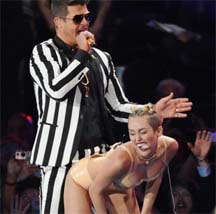
Miley Cyrus did all she could do to promote twerking.

Miley Cyrus did all she could do to promote twerking.

After all the work Miley Cyrus did to get the folks at the Oxford English Dictionary to select “twerk” or “twerking” as the next new word to be added, the judges at this bastion of English word deification and definition thumbed their noses at her and instead selected the warped word “selfie” to be included.

Anyway owning a smart cell(ular) (tele)phone with a front facing camera (And what self-respecting, self-involved dummy DOESN’T have one?) can engage in selfie-ism. Just pose, point, and click. Upload to your Facebook page, your blog, your Pinterest spot, your Twitter account, and anywhere else your digital self resides.

Personally, I am disappointed.

With all the work I have done to promote such new words as obsurd (obscure and absurd), face tedious (where you spend so much time on social media, commenting and in other ways inserting yourself, you become face tedious. Certainly, too many selfies can make that happen.), flib, and elastation just to name a few, why the judges lowered themselves to consider works like twerk and selfie is beyond me.

I can only surmise that their selection was some knee jerk reaction.

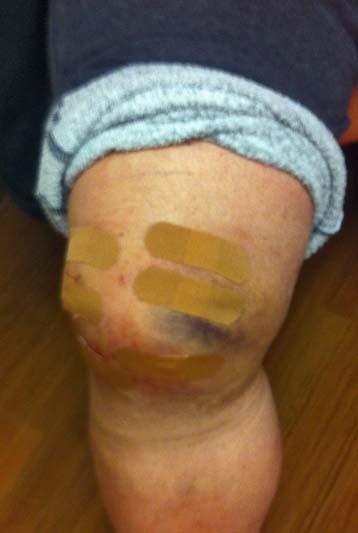
In honor of that, here is my selfie. My knee selfie. Take that, Oxford English Dictionary.
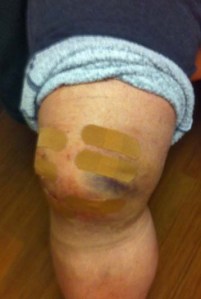
My knee selfie.

My knee selfie.

The reason I have not been blogging as much recently is because I recently had knee surgery. I had six holes cut into my knee and fifteen to twenty alien bodies removed. I assure you, they were not from outer space nor in this country illegally. To recover I am supposed to apply ice to swollen area and lay down with my knee elevated above my heart as much as possible.

It’s a little hard to blog from a supine position. Additionally (though math is not my strong suit at this time), some of the medication I am taking renders me time and space challenged. Therefore and henceforth, to wit from this knee jerking wit, you will probably be reading fewer entries from me for a while.

But look on the bright side (or brighter side as the case may be), at least I won’t be out anywhere twerking. With a knee that swollen, I am not even able to shake a leg, let alone anything else.

Happy Holidays.

4 Comments

Filed under Silly Saturday, writing humor

New words to live by: “quagmuffin”

It is the first weekend of the month and time again for a new word to live. This is a word or phrase not currently in use in the U.S. English lexicon, but might need to be considered. Other words, such as obsurd, crumpify, subsus, flib, congressed, and others, can be found by clicking on the tags below. Today’s New Word is a merging of two words: quagmire and muffin. Without further chattering quagmuffin is the new word for the month of November:

Quagmire, n. 1) an area of boggy or soggy ground, a bog. 2) a situation too easy to get into too hard to get out of.

Muffin, n. small, cup-shaped quick breads made with cornmeal, wheat flour, or something similar and baked in a muffin pan creating a series of cup-like breads.

Quagmuffin, n. 1) a food, particularly at parties or around the holidays, you are cajoled into trying and then find difficult to swallow and say something complimentary about while the host or cook looks expectantly at you. Quagmuffin can apply to any food, though originally believed to have started with muffins or cupcakes. 2) the way your mouth feels once you have bitten into the quagmuffin.

Example: Bob cajoled Sam into trying his wife’s newest holiday creation: the crabtastic cupcake. Bob took a bite and immediately felt his mouth had bitten a quagmuffin, especially when Sam stood nearby, expectantly waiting for Bob to say something good.

Leave a comment

Filed under new word, New words to live by

New words to live by: “acopalypse”

Time for the monthly installment: New words to live by. This month’s word is an example of a portmanteau word in which two other words are combined to form a new, third word.

The two words used:
Cop, n. U.S. slang for police officer, starting in the 1840 – 50 time frame. Believed to be short for copper, which is also slang for police officer. Believed by some to refer to the copper buttons on police uniforms. More likely a formation of the verb cop (meaning to take or steal, and still in use in phrases such as “cop a plea”) and the suffix -er, turning a verb into a noun, and then later dropped.

Apocalypse, n. originally a prophetic revelation — particularly in Jewish or Christian writings — in which a cataclysm brings about the final clash of good and evil, in which good is supposed to win.

The new word:
Acopalypse, n. A condition in which the truth is never know and the facts are never revealed. This condition can apply to society, to politics, to religion, or to a general feeling is which the trappings of order are maintained, but the actions creating these trappings and even the results flowing from these trappings are absurd. Example: the recent federal government shutdown. Franz Kafka’s novel The Trial could be considered an example of an acopalyptic novel.

[Editor’s note: other new words to live by can be found by clicking on the tag “new word” or “new words.”]

Leave a comment

Filed under new word, New words to live by

New words to live by: “elastation”

First Saturday of the month and it’s time for a new word. This is a word or phrase not currently in use in the U.S. English lexicon, but might need to be considered. Other words, such as obsurd, crumpify, subsus, flib, congressed, and others, can be found by clicking on the tags below. This month’s new word is:

elastation, n. = rubbery, slippery, idiotic intellectualization of reality.

An elastation can also be bent back on itself as needed and while others may recognize the contradictory absurdity of your elastation, you probably done.

For example, recent comments by Fox talking heads who attacked President Obama for not saying he would ask for Congressional approval before attacking Syria should the Syrian army use chemical agents on its opposition, and then when President Obama did seek Congressional support, attacking him for going back on his word.

Another elastation is the owner of a coal company saying only God can create global warming. After all, if God made the coal and man is made in God’s image, then couldn’t God be doing global warming with coal through man?

Leave a comment

Filed under new word, New words to live by

New Word to Live By: “Blankenstein”

First Saturday (or Sunday) of the month. Time for new words to live by. Once a month on the first Saturday (or Sunday) of each month, I will list a new word. This is NOT a word you are likely to find in the dictionary. It is a new word, often a portmanteau word, sometimes just a new word not made from merging two other words. Some of the previous words have included: obsurd, a combination of obscure and absurd, obscure absurdity means something obsurd. These new words might even be considered an exercise in obsurdity.

Here now is the new word.

Blankenstein, n., 1) The blank look on your computer monitor when the hard drive has crashed and all your files are gone, the program has crashed and your important work is gone, or your computer won’t start up for some reason, such as the motherboard gone band, and you can’t access your folders and files. In some cases, also known as “The Blue Screen of Death.”

Beware the Blankenstein!

Beware the Blankenstein!

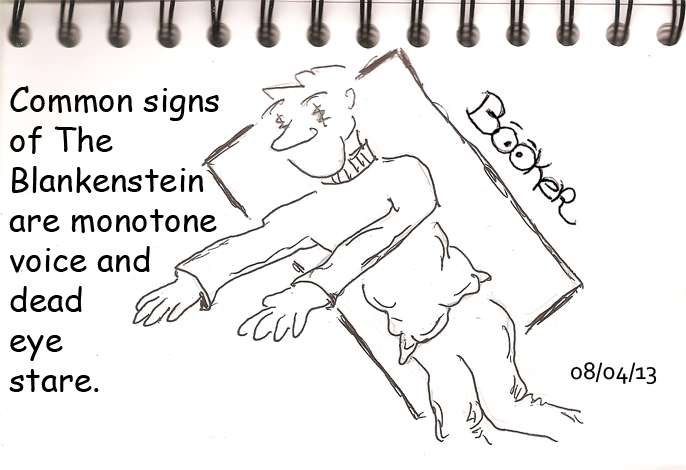
2) The blank look on a low level business or government functionary who, while claiming to help you, is actually doing nothing to aid your situation. The blank or dead eye look and the monotone voice are often signs of the Blankenstein in non-action. While this can sometimes be confused with being lost in thought, it is more the thought, on the part of the functionary, that you will get lost.

Leave a comment

Filed under new word, New words to live by

New Word: “Face tedious”

It is the first Saturday of the month and time again for a new word to live. This is a word or phrase not currently in use in the U.S. English lexicon, but might need to be considered. Other words, such as obsurd, crumpify, subsus, flib, congressed, and others, can be found by clicking on the tags below. Today’s New Word is actually a phrase instead of word maybe by merging two other words as has been the case before. Still, without further chattering is the new word for the month of July:

Face tedious, n. what you become to others when you spend too much time on Facebook and other social media commenting and posting too often with too little to actually say. In short, a virtual bore, or “vore.”

Example: Bob kept commenting on Sam’s vacation photos posted on Facebook. He had commented so much and so often that he was a face tedious to all of Sam’s other friends who had liked or commented on the photos, because they kept getting notifications that Bob had commented yet again. None of them “liked” Bob’s comments any more and many of them wished for a “vore” symbol to click to send Bob a message.

2 Comments

Filed under new word, New words to live by