Tag Archives: mystery writing

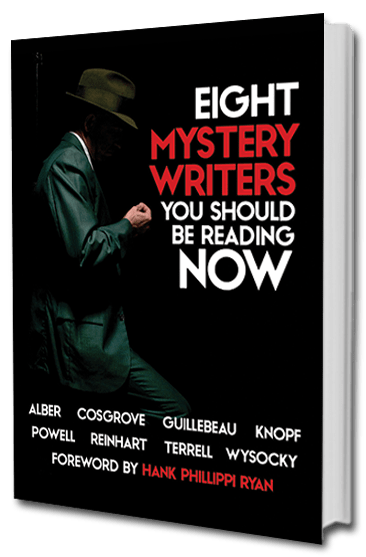
Eight Mystery Writers You Should Be Reading Now | Jaden Terrell

Eight Mystery Writers You Should Be Reading Now – if you don’t know who these mystery writers are, you should.

Source: Eight Mystery Writers You Should Be Reading Now | Jaden Terrell

If you don’t know who these mystery writers are, you’re missing out.

Now you can get it free when you subscribe to my email list.

My part in this book began on Halloween weekend at Killer Nashville 2015, when Michael Guillebeau asked me to be a part of a project he was working on—a sampler of eight mystery writers he admired, each of whom would contribute a short story, an interview, and a sample chapter from one of their novels.

To say I was honored would be an understatement. I’d read Michael’s work, and the guy has some serious writing chops. I mean, the guy can WRITE. Haven’t read him yet? Hie thee to his website and check out his novels right now. Seriously, I’ll wait.

Of course I said yes. And boy, am I glad I did. The other writers Michael lined up are all topnotch, and all a delight to work with. To top it off, bestselling author (and fabulous-in-every-way) Hank Phillippi Ryan came on board to write the introduction. If you don’t already know their work, I hope you’ll find enough in these pages to make you want to learn more.

The book isn’t a five-course meal. It’s more like the appetizer sampler you’d get at a good restaurant. Eight very different flavors. The hope is that you’ll find at least a few you love.

You can get a PDF or mobi copy of it for free by subscribing to my newsletter. The signup form is in the upper right corner of this page.

Since it would be hard to top Michael’s descriptions of the contributors, I’ll let him introduce us:

Lisa Alber – Mystery with a smattering of psychological suspense and tons of atmosphere. Beautifully written, complex stories set in the Irish countryside. Reminiscent of Erin Hart, Julia Spencer-Fleming, and Susan Hill. Rosebud Award and Pushcart Prize Nominee.

Kathleen Cosgrove – Florida weird with a middle-aged woman returning home. Kick-ass funny.

Michael Guillebeau – Broken war hero has to navigate the oddballs and save the girl to get back to the bar he’s been hiding in. Reminiscent of Elmore Leonard and Carl Hiaasen. Silver Falchion Finalist, and Library Journal Mystery Debut of the Month.

Chris Knopf – Hardboiled in the Hamptons. Ex-boxer Sam Acquillo is a noir descendent of Travis McGee and Spencer, and one of my favorite characters. Nero award winner. Chris was featured on my Crimereaders.com blog here.

Jessie Bishop Powell – Cozy noir mysteries that embrace the genre’s extremes. In The Marriage at the Rue Morgue, police suspect an orangutan of murder. Primatologists Noel Rue and Lance Lakeland have to save the ape and still find time to get married. Sounds light, but Powell’s stuff is as intense as it is funny.

Larissa Reinhart – If you like Janet Evanovich’s Stephanie Plum, you need to read Reinhart’s Cherry Tucker. A damaged artist with twice the depth, twice the funny of Plum and set in small-town Georgia. I dare you to put this down. Daphne du Maurier Finalist

Jaden Terrell – A “hardboiled hero with a soft-boiled heart,” Nashville PI Jared McKean has enough emotional issues to carry a book all by himself, and then Terrell throws him into big issues like human trafficking. Shamus Award Finalist.

Lisa Wysocky – Multiple awards for Lisa’s books about a horse trainer with a smart horse who helps her solve crimes. One of the most realistic and loving use of animals in mystery. Winner of American Horse Publication Awards, and the National Indie Excellence Awards.

“It’s easy to find a book. It’s hard to find the book, that new author, who sets your life on fire. That’s why we put this collection together.” – Michael Guillebeau, author of Josh Whoever, Silver Falchion finalist and Library Journal Mystery Debut of the Month

3 Comments

Filed under 2016, mystery

Killer Nashville, August 23 – 26, 2012

[Editor’s note: I have attended two Killer Nashville conferences and can say there is plenty to see and do and learn, even if what you write is not strictly thriller, suspense or mystery. To be clear, I have no stake in the conference, and will not make any money if you attend. I have written a few blog entries from my most recent attendance. You can find those by clicking on Killer Nashville in the tags below.]

Killer Nashville

A Conference for Thriller, Suspense, Mystery Writers & Literature Lovers
________________________________________
August 23-26, 2012
Thursday evening through Sunday afternoon
________________________________________
Nashville, TN

Guests of Honor for 2012 Killer Nashville are New York Times Bestselling Authors C.J. Box, Heywood Gould, & Peter Straub

Since 2006, Killer Nashville has become THE conference for mystery, thriller, and crime fiction authors and fans. Located in Nashville, Tennessee, Killer Nashville is held the fourth full weekend of every August.

Killer Nashville attracts bestselling authors from across the U.S., Canada, and beyond, plus scores of fans and budding authors.

Sponsored by numerous national organizations, attendees have included authors, screenwriters, playwrights, filmmakers, fans, attorneys, editors, agents, and publishers.

Killer Nashville’s objectives are to assist writers of all writing genres and formats; develop a better understanding of the craft of the mystery, thriller, suspense and true crime genres specifically; to discuss such topics as investigative techniques, verifying crime information, and submitting one’s manuscript for publication; and portray law enforcement and forensic science in a fair and accurate manner.

Killer Nashville is offered in five concurrent tracks including over 60 events ensuring the weekend has something for every lover of literature.

One track, the forensic/CSI track provides insight into the latest in forensic investigations and crime detection and is hosted by the TBI (Tennessee Bureau of Investigations), FBI, and other law enforcement branches. Event includes a realistic crime scene staged by the TBI and solved by conference guests.

Many writers have found agents, editors, and publication through networking at Killer Nashville.

Killer Nashville is a volunteer-produced event and was founded in 2006 by bestselling Franklin writer and filmmaker Clay Stafford.

Contact information:
Killer Nashville
P.O. Box 680759
Franklin, TN 37068-0759

(615) 599-4032
contact@killernashville.com
Website: killernashville.com.
Blog: http://killernashville.wordpress.com/

Leave a comment

Filed under Killer Nashville, writing, writing conference

Writing Tip: Plotting backwards

[Editor’s note: the essay below is taken from an e-mail newsletter sent out by the writer Bruce Hale. you can find his web site at: http://www.brucehalewritingtips.com/. You can also sign up for his e-newsletter at that site. Each electronic newsletter comes with other information, including a writing joke.]

WHY BACKWARDS IS BEST WHEN PLOTTING A MYSTERY

By BRUCE HALE

When I wrote my first mystery, I hadn’t a clue. I tried writing it straight through, plotting as I went, and ended up falling flat on my face. Why? I hadn’t yet learned that backwards is best.

You see, contrary to the way most fiction is mapped out, mysteries are backwards creatures. They’re easiest to write when plotted backwards from the ending, rather than forward from the beginning. Mysteries, by their nature, are a complex tangle, and if you’re not careful, you’ll get stuck in it.

As I learned the hard way, if you write from the beginning, you’ll be left flatfooted with your detective, trying to figure out how to solve the mystery.

Better to go the easy way: work from the solution. Start from the ultimate revelation of whodunit and work your way backwards to mystery writing success. Here’s how:

– DECIDE WHODUNIT, WHY, AND HOW
First, pick the crime to be solved and the culprit. Suss out why they committed the crime – and the less obvious the reason, the better. Your villain (or clues from him) should be part of the story from fairly early on, but his motives and actions must remain hidden until the twist reveals them. Hide your villain in plain
sight – heck, you could even go so far as to make them a seeming ally of your hero.

– PLAN YOUR TWIST
This is the dramatic reveal, the “It’s not Snape, it’s Quirrell!” moment. (Sorry if I spoiled Harry Potter I for you.) The twist should occur at the least convenient moment, preferably when the hero is most vulnerable. Usually the twist occurs at or just before the climax.

To make the twist work, you need to come up with at least one or two plausible culprits, then show why they didn’t commit the crime.

– LAY OUT YOUR RED HERRINGS
These are the likely culprits, the leads your detective follows that turn out to be dead ends. Be sure the herrings are motivated as well, and if you can disguise their motivations or make them ambiguous, so much the better. Anything to make them *more* plausible, and your true villain *less* plausible.

– SCATTER YOUR CLUES
What tips your hero off to the fact that the villain is guilty? A latticework of little clues (usually connected much too late). You must always play fair with the reader, so be sure the clues are there, even if the detective and her trusty assistant initially dismiss them.

The key with clues is to use misdirection — have them seem insignificant, or be misinterpreted. You can’t make it too easy for the detective, or the reader!

– START WITH A BANG
And last, but not least, come up with a grabber of an opening that plunges us right into the heart of the mystery. Ideally, it should contain some small clue that points us toward the true culprit.

With all that in place, now you’re ready to write your first words. Happy mystery writing, and may the spirit of Chandler and Hammett be with you!

2 Comments

Filed under Bruce Hale, plot, writer, writing, writing blog, writing tip

Four Clues to Writing a Mystery

[This is taken from an e-newsletter sent out by the writer Bruce Hale. You can find more information at Bruce Hale Writing Tips.]

When I wrote my first mystery, I had no idea how to do it. I
actually had characters tell my detective riddles that would lead
him to the next thing he needed to discover. To be honest, I had
no clue how to construct a clue.

But after you write a few of these things, you start to see how the
mystery is made. Herewith, four helpful hints on writing a mystery:

1. Play fair with the reader
Mystery readers hope that you’ll surprise them, but that surprise
must be a fair one. You can’t tease readers with three suspects
throughout your story, and then suddenly reveal that a character
they’ve never met is responsible. That’s not playing fair.

A Typewriter

Don't forget the unwritten rule: write!

Many mystery readers try to figure things out as they go along. To
play fair with these people, you need to plant a clue or two that
points toward your real culprit. Make it subtle, a throwaway line
perhaps, but make sure it’s there.

2. Keep your reader’s age in mind
Obviously, the mystery in a Cam Jansen chapter book is going to be
just a tad simpler than that in a Raymond Chandler tale. You want
to keep your reader guessing, but you don’t want things to be so
convoluted that he or she gets completely lost — especially in a
children’s book.

Your story should be just a little trickier than readers think they
can handle. If you have any doubts, ask a reader in your target
age range to take a look at the story. If your story leaves her
completely clueless, it’s time to simplify.

3. Merrily misdirect
One of the keys to successful mystery writing is misdirection.
Your readers should suspect every possible culprit but the real
one.

How do you do this? Make your clues point strongly toward one
character, then show that he’s innocent. Make your suspects take
actions that can have two interpretations, and let the reader and
detective erroneously assume the worst.

4. Write from the ending
Most mystery writers I talk with say that they figure out the
ending first — what’s the crime, who’s the culprit, why’d they do
it? — before plotting the rest of the book. Once you’ve got that
sorted out, it’s a matter of concealing it.

You’ll want your detective to take a circuitous route, often
running into brick walls. You’ll want her to think she’s got it
all solved, only to have the rug pulled out from under her.

Mysteries are all about the progressive unraveling of the unknown.
But it’s the *way* you unravel it — using misdirection, considering
your reader, and playing fair — that makes for a satisfying read.

Leave a comment

Filed under mystery, mystery writing, words, writer, writing, writing tip