
Q: What should a writer do when he comes across a fork in his story?
A: Change his metaphor.
A Newbie's Guide to Publishing: Fisking Lilith Saintcrow and the Hachette/Amazon Situation.
Sample of blog entry:
Fisking Lilith Saintcrow and the Hachette/Amazon Situation
People often disagree with my posts, and some do it in the comments section.
This promotes healthy debate and discourse. As long as people stay civil with each other, they can post whatever they like, including insulting me. I’ve only had to kick a few people out over the years, after giving them multiple chances to cool off.
One of the wonderful things about the Internet is the ability for people to engage with different viewpoints and test each others’ arguments.
I don’t know Lilith Saintcrow. She’s a writer with Hachette, and has just blogged about this situation. She’s wrong, which is fine. Normally that wouldn’t irk me. But in her comments section, she’s disemvoweling people who disagree with her (it’s a cute form of censuring where all the vowels are removed from the comment).
So now I’m going to bring the debate here, to A Newbie’s Guide, by explaining in detail how wrong Lili Saintcrow is. Normally I don’t take my peers to task like this, but I really dislike the way Lili is handling dissenters on her blog. She’s deliberately obstructing what could have been a healthy debate.
No offense intended, Lili. I’m sure you’re a wonderful person and a wonderful writer. And I do understand how you are frustrated at this situation. Your sales are suffering, and it is beyond your control, so naturally you want to place blame and voice your discontent.
But I believe you aren’t looking at the big picture, and cutting off comments on your blog isn’t how you, or anyone following you, can use this situation as a learning experience.
Blog post in its completeness: http://jakonrath.blogspot.com/2014/05/fisking-lilith-saintcrow-and.html
Filed under Uncategorized
First writer, pointing to his t-shirt: “See what it says?”
Second writer nods.
First writer: “It says, ‘will writer for food.'”
Second writer: “So whom are you going to write first?”
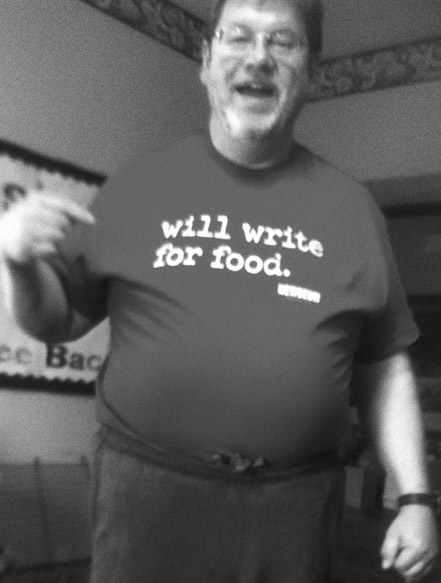
Whom will he try to write for food first? Will it work?
Filed under Monday morning writing joke
Cop to poet: “Did you meet her?”
Poet to cop: “I had no rhyme or reason to do so.”
Filed under Monday morning writing joke
Q.: What’s the last thing you should say to a writer whose jokes you don’t like?
A.: “Humor me.”
Filed under Monday morning writing joke
First writer: All my characters have a certain look.
Second writer: And what look is that?
First writer: The one they give me every time I try to get them to do something.
Filed under Monday morning writing joke
Two fifty-five-year-old authors were sitting together on a dais at a writer’s conference.
The first one looks at the photo and short biography of the third author who is scheduled to join them.
“Wow,” the first author says, “I must be getting old.”
“Why?” the second asks, “because she looks so young in the photo?”
“No. Because she says she’s twenty-seven and describes herself as middle-aged.”
“Yeah,” the second author sighs, “middle age is looking younger and younger to me, too.”
***
Age is an issue of mind over matter. If you don’t mind, it doesn’t matter.
–Mark Twain
Filed under Monday morning writing joke
Q: How many narcissists does it take to screw in a light bulb?
A: One. He holds it up, and the world revolves around him.
Filed under Monday morning writing joke
C, E Flat, and G walk into a bar.
The bartender says, “Sorry, no minors.”
Filed under Monday morning writing joke


 Booker's Blog