
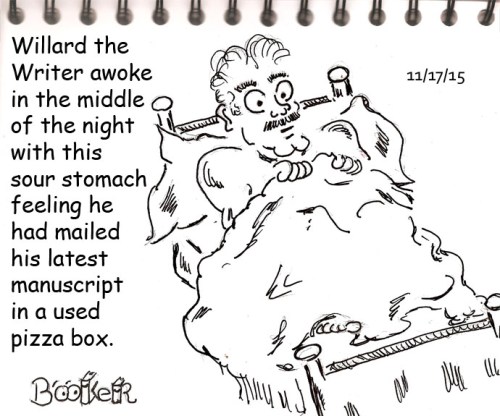
Willard’s concern was further justified when he opened the refrigerator and found a slice of pizza a padded envelope.
Willard’s concern was further justified when he opened the refrigerator and found a slice of pizza a padded envelope.
Filed under 2015, cartoon by author, CarToonsday
HOW TO MAP OUT YOUR HERO’S ADVENTURE IN YOUR MANUSCRIPT
How do the most successful authors of our time construct their stories? If you read them, and if you also read some ancient myths, you will begin to see parallels. You will feel smacked upside the head with parallels. You’ll realize that the top authors of today use storytelling techniques that writers used back when plans were being drawn up for the pyramids.
An excellent book about ancient myths is The Hero With a Thousand Faces by Joseph Campbell. The title says it all. Across cultures and generations, some variation of a hero figures into every beloved story. And the typical story is about an individual who goes on a quest or a journey. By the end, the individual becomes a hero. This is called the Hero’s Adventure.
The Hero’s Adventure is the most archetypal story of all because it’s the basis for more novels than any other kind of story. Novels of all different genres, from romances to thrillers to sci-fi, are based on the Hero’s Adventure.
So what is the Hero’s Adventure? You know it already, and you may even have elements of it in the story you’re working on. But I suspect you haven’t yet methodically and thoroughly appropriated it for yourself.
The Hero’s Adventure Basic Recipe

Joseph Campbell
The person who accepts the challenge and prevails is elevated to a special position, somewhere above human, somewhere below god. She is the hero.
For examples of this in literature: http://www.writersdigest.com/online-editor/how-to-map-out-your-heros-adventure-in-your-manuscript?et_mid=688770&rid=239626420
Filed under writing tip, Writing Tip Wednesday, writing tips
How to Write a Manuscript: 5 Key Tips
Getting started on any writing project is always the toughest. For years I talked about turning an idea I had from college into a novel so amazing that Oprah would beg to have me on—probably twice! I had notes for the novel in my head and, once in a blue moon, I’d actually sit down to try to write the damn thing. But what did I know about how to write a manuscript? The most I could ever hammer out was about 2,000 words. Considering most first-time novels fall between 80,000-100,000 words, I think it was safe to say that I was more likely to publish a sneeze than this book.
It wasn’t until I got serious about it that I started to make real progress (not on that manuscript, mind you, but on a nonfiction project). I don’t think I would have had any luck writing a manuscript if I hadn’t learned these five tips. I recommend them to anyone who is serious about writing a manuscript or has even toyed with the idea of writing novels. Here they are.
1. Don’t worry about format until you are finished.
Details like this only stand in your way from writing a great story. Worry about cooking the meal first before concerning yourself with presentation. You can wait until much, much later to adjust your manuscript and adhere to formatting guidelines. And, when you are ready, read this piece on how to format a manuscript.
2. Set aside 45-60 minutes a day to write your novel.
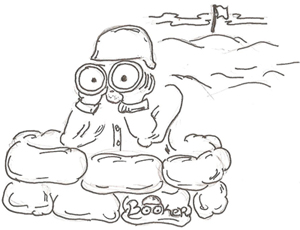
Sometimes, finding the time isn’t easy.
Other information includes outlining, first and lines sentences, and having fun. Details at: http://www.writersdigest.com/online-editor/how-to-write-a-manuscript-5-excellent-tips?et_mid=669375&rid=239626420
Filed under writing tip, Writing Tip Wednesday, writing tips

Life is like a box of words….
Filed under cartoon by author, CarToonsday

She threw the book at me!
I’m a writer and I don’t get no respect. Just the other day I hired an editor to help me with my manuscript, and the first thing she did was throw the book at me! The unabridged book at me. The one that defines words. You know it. D-i-k something something something.
Filed under Cartoon, cartoon by author, no respect, writing


 Booker's Blog