
There once was a writer from Nairobi
who had a strange tale that she told me.
About the dark of night
when Aliens came for her “delight”…
and then produced copies, which she sold me.

It was a dark and stormy story….
There once was a writer from Nairobi
who had a strange tale that she told me.
About the dark of night
when Aliens came for her “delight”…
and then produced copies, which she sold me.
It was a dark and stormy story….
Filed under cartoon by author, limerick, poetry by author, Workshop weekend
By Rachelle Gardner
Source: http://www.rachellegardner.com/2012/06/13-things-you-may-not-know-about-agents/
1. We really hate getting bad news and we hate sharing it with you, but we trust you’re adult enough to handle it.
2. If we say we don’t want to submit a particular project to editors, we’re probably trying to protect both of our reputations (the writer’s and the agent’s).
3. While many of us do a great deal of editing and polishing of your manuscripts and/or proposals, the bottom line is that it’s the writer’s job to provide a marketable book. Agents shouldn’t be counted on to make it sales-ready.
4. We are very invested in your book and often feel like it’s “our baby” too (even though we KNOW it’s yours!)
5. If it seems like we’re too busy, it’s because the economics of this industry demand we carry a certain amount of volume to make a living wage.
6. We prioritize taking care of current clients above the search for new clients. So typically, queries and writer’s conferences take a back seat.
7. We really are interested in your long-term career, not just the size of the next advance.
8. We hate the slowness of publishing just as much as you do!
9. We want to set you up with the publisher and editor who will be best for you, not just the one who’s offering the most money.
10. When we’ve tried to sell your book but we’re not successful, we’re probably almost as disappointed as you. Not only are we often emotionally invested, we’ve put in a lot of time for no paycheck.
11. When you send us a manuscript to read, we don’t do it during the work day. We read in the evenings (our “free time”) and on the weekends. With Kindles and iPads, we may even be reading your manuscript on the treadmill at the gym.
12. We’re aware of all the new options for writers these days, and we’re doing our best to help steer each client in the right direction.
13. If your writing career keeps you awake at night, there’s a good chance it has kept us awake on occasion, too.
Filed under agents, Rachelle Gardner, writing tip
By GERALD JONAS
Source: http://www.nytimes.com/2012/06/07/books/ray-bradbury-popularizer-of-science-fiction-dies-at-91.html
Ray Bradbury, a master of science fiction whose lyrical evocations of the future reflected both the optimism and the anxieties of his own postwar America, died on Tuesday in Los Angeles. He was 91.
His death was confirmed by his agent, Michael Congdon.
By many estimations Mr. Bradbury was the writer most responsible for bringing modern science fiction into the literary mainstream. His name would appear near the top of any list of major science-fiction writers of the 20th century, beside those of Isaac Asimov, Arthur C. Clarke, Robert A. Heinlein and the Polish author Stanislaw Lem.
In Mr. Bradbury’s lifetime more than eight million copies of his books were sold in 36 languages. They included the short-story collections “The Martian Chronicles,” “The Illustrated Man” and “The Golden Apples of the Sun,” and the novels “Fahrenheit 451” and “Something Wicked This Way Comes.”
Though none won a Pulitzer Prize, Mr. Bradbury received a Pulitzer citation in 2007 “for his distinguished, prolific and deeply influential career as an unmatched author of science fiction and fantasy.”
Mr. Bradbury sold his first story to a magazine called Super Science Stories before his 21st birthday, and by the time he was 30 he had made his reputation with “The Martian Chronicles,” a collection of thematically linked stories published in 1950.
The book celebrated the romance of space travel while condemning the social abuses that modern technology had made possible, and its impact was immediate and lasting. Critics who had dismissed science fiction as adolescent prattle praised “Chronicles” as stylishly written morality tales set in a future that seemed just around the corner.
Mr. Bradbury was hardly the first writer to represent science and technology as a mixed bag of blessings and abominations. The advent of the atomic bomb in 1945 left many Americans deeply ambivalent toward science. The same “super science” that had ended World War II now appeared to threaten the very existence of civilization. Science-fiction writers, who were accustomed to thinking about the role of science in society, had trenchant things to say about this threat.
But the audience for science fiction, published mostly in pulp magazines, was small and insignificant. Mr. Bradbury looked to a larger audience: the readers of mass-circulation magazines like Mademoiselle and The Saturday Evening Post. These readers had no patience for the technical jargon of the science fiction pulps. So he eliminated the jargon; he packaged his troubling speculations about the future in an appealing blend of cozy colloquialisms and poetic metaphors.
“The Martian Chronicles” remains perhaps Mr. Bradbury’s best-known work. It became a staple of high school and college English courses. Mr. Bradbury himself disdained formal education. He went so far as to attribute his success as a writer to his never having gone to college.
Instead, he read everything he could get his hands on, by authors including Edgar Allan Poe, Jules Verne, H. G. Wells, Edgar Rice Burroughs, Thomas Wolfe and Ernest Hemingway. He paid homage to them in 1971 in the autobiographical essay “How Instead of Being Educated in College, I Was Graduated From Libraries.” (Late in life he took an active role in fund-raising efforts for public libraries in Southern California.)
Mr. Bradbury referred to himself as an “idea writer,” by which he meant something quite different from erudite or scholarly. “I have fun with ideas; I play with them,” he said. “ I’m not a serious person, and I don’t like serious people. I don’t see myself as a philosopher. That’s awfully boring.”
He added, “My goal is to entertain myself and others.”
He described his method of composition as “word association,” often triggered by a favorite line of poetry.
Mr. Bradbury’s passion for books found expression in his dystopian novel “Fahrenheit 451,” published in 1953. But he drew his primary inspiration from his childhood in Illinois. He boasted that he had total recall of his earliest years, including the moment of his birth. Readers had no reason to doubt him. In his best stories and in his autobiographical novel, “Dandelion Wine” (1957), he gave voice to both the joys and fears of childhood.
As for the protagonists of his stories, no matter how far they journeyed from home, they learned that they could never escape the past.
Raymond Douglas Bradbury was born Aug. 22, 1920, in Waukegan, Ill., a small city whose Norman Rockwellesque charms he later reprised in his depiction of the fictional Green Town in “Dandelion Wine” and “Something Wicked This Way Comes,” and in the fatally alluring fantasies of the astronauts in “The Martian Chronicles.” His father, a lineman with the electric company, numbered among his ancestors one of the women tried as a witch in Salem, Mass.
An unathletic child who suffered from bad dreams, he relished the tales of the Brothers Grimm and the Oz stories of L. Frank Baum, which his mother read to him. An aunt, Neva Bradbury, took him to his first stage plays, dressed him in monster costumes for Halloween and introduced him to Poe’s stories. He discovered the science-fiction pulps and began collecting the comic-strip adventures of Buck Rogers and Flash Gordon. A conversation with a carnival magician named Mr. Electrico that touched on immortality gave the 12-year-old Bradbury the impetus to become a writer.
In 1934 the family moved to Los Angeles, where Mr. Bradbury became a movie buff, sneaking into theaters as often as nine times a week. Encouraged by a high school English teacher and the professional writers he met at the Los Angeles chapter of the Science Fiction League, he began a lifelong routine of turning out at least a thousand words a day on his typewriter.
His first big success came in 1947 with the short story “Homecoming,” narrated by a boy who feels like an outsider at a family reunion of witches, vampires and werewolves because he lacks supernatural powers. The story, plucked from the pile of unsolicited manuscripts at Mademoiselle by a young editor named Truman Capote, earned the 27-year-old Mr. Bradbury an O. Henry Award in 1947 as one of the best American short stories of the year.
With 26 other stories in a similar vein, “Homecoming” appeared in Mr. Bradbury’s first book, “Dark Carnival,” published by a small specialty press in 1947. That same year he married Marguerite Susan McClure, whom he had met in a Los Angeles bookstore.
Having written himself “down out of the attic,” as he later put it, Mr. Bradbury focused on science fiction. In a burst of creativity from 1946 to 1950, he produced most of the stories later collected in “The Martian Chronicles” and “The Illustrated Man” and the novella that formed the basis of “Fahrenheit 451.”
While science-fiction purists complained about Mr. Bradbury’s cavalier attitude toward scientific facts — he gave his fictional Mars an impossibly breathable atmosphere — the literary establishment waxed enthusiastic. The novelist Christopher Isherwood greeted Mr. Bradbury as “a very great and unusual talent,” and one of Mr. Bradbury’s personal heroes, Aldous Huxley, hailed him as a poet. In 1954, the National Institute of Arts and Letters honored Mr. Bradbury for “his contributions to American literature,” in particular the novel “Fahrenheit 451.”
“The Martian Chronicles” was pieced together from 26 stories, only a few of which were written with the book in mind. The patchwork narrative spans the years 1999 to 2026, depicting a series of expeditions to Mars and their aftermath. The native Martians, who can read minds, resist the early arrivals from Earth, but are finally no match for them and their advanced technology as the humans proceed to destroy the remains of an ancient civilization.
Parallels to the fate of American Indian cultures are pushed to the point of parody; the Martians are finally wiped out by an epidemic of chickenpox. When nuclear war destroys Earth, the descendants of the human colonists realize that they have become the Martians, with a second chance to create a just society.
“Fahrenheit 451,” Mr. Bradbury’s indictment of book-burning in a near-future America (the title refers to the temperature at which paper ignites), is perhaps his most successful book-length narrative. It was made into a well-received movie by François Truffaut in 1966. The cautionary tale of a so-called fireman, whose job is to start fires, “Fahrenheit 451” has been favorably compared to George Orwell’s “1984.”
As Mr. Bradbury’s reputation grew, he found new outlets for his talents. He wrote the screenplay for John Huston’s 1956 film version of “Moby-Dick,” scripts for the television series “Alfred Hitchcock Presents” and collections of poetry and plays.
In 2004, President George W. Bush and the first lady, Laura Bush, presented Mr. Bradbury with the National Medal of Arts.
While Mr. Bradbury championed the space program as an adventure that humanity dared not shirk, he was content to restrict his own adventures to the realm of imagination. He lived in the same house in Los Angeles for more than 5o years, rearing four daughters with his wife, Marguerite, who died in 2003. For many years he refused to travel by plane, preferring trains, and he never learned to drive.
He is survived by his daughters, Susan Nixon, Ramona Ostergen, Bettina Karapetian, and Alexandra Bradbury, and eight grandchildren.
Though the sedentary writing life appealed to him most, he was not reclusive. He developed a flair for public speaking, which made him a sought-after figure on the national lecture circuit. There he talked about his struggle to reconcile his mixed feelings about modern life, a theme that animated much of the fiction that won him such a large and sympathetic audience.
And he talked about the future, perhaps his favorite subject, describing how it both attracted and repelled him, leaving him with apprehension and hope.
Filed under obituary, Ray Bradbury, writer
[Editor’s note: I have attended two Killer Nashville conferences and can say there is plenty to see and do and learn, even if what you write is not strictly thriller, suspense or mystery. To be clear, I have no stake in the conference, and will not make any money if you attend. I have written a few blog entries from my most recent attendance. You can find those by clicking on Killer Nashville in the tags below.]
Killer Nashville
A Conference for Thriller, Suspense, Mystery Writers & Literature Lovers
________________________________________
August 23-26, 2012
Thursday evening through Sunday afternoon
________________________________________
Nashville, TN
Guests of Honor for 2012 Killer Nashville are New York Times Bestselling Authors C.J. Box, Heywood Gould, & Peter Straub
Since 2006, Killer Nashville has become THE conference for mystery, thriller, and crime fiction authors and fans. Located in Nashville, Tennessee, Killer Nashville is held the fourth full weekend of every August.
Killer Nashville attracts bestselling authors from across the U.S., Canada, and beyond, plus scores of fans and budding authors.
Sponsored by numerous national organizations, attendees have included authors, screenwriters, playwrights, filmmakers, fans, attorneys, editors, agents, and publishers.
Killer Nashville’s objectives are to assist writers of all writing genres and formats; develop a better understanding of the craft of the mystery, thriller, suspense and true crime genres specifically; to discuss such topics as investigative techniques, verifying crime information, and submitting one’s manuscript for publication; and portray law enforcement and forensic science in a fair and accurate manner.
Killer Nashville is offered in five concurrent tracks including over 60 events ensuring the weekend has something for every lover of literature.
One track, the forensic/CSI track provides insight into the latest in forensic investigations and crime detection and is hosted by the TBI (Tennessee Bureau of Investigations), FBI, and other law enforcement branches. Event includes a realistic crime scene staged by the TBI and solved by conference guests.
Many writers have found agents, editors, and publication through networking at Killer Nashville.
Killer Nashville is a volunteer-produced event and was founded in 2006 by bestselling Franklin writer and filmmaker Clay Stafford.
Contact information:
Killer Nashville
P.O. Box 680759
Franklin, TN 37068-0759
(615) 599-4032
contact@killernashville.com
Website: killernashville.com.
Blog: http://killernashville.wordpress.com/
Filed under Killer Nashville, writing, writing conference
[Editor’s commentary: “It was a dark and stormy night.” How many times have you as a writer been told not to copy. Don’t copy somebody’s homework. Don’t copy the way somebody looks. Seems somewhere along the line may have changed. Or, at least, knock-offs of something may be okay. Or at least what publishers are looking for. That’s what this article suggests. So, maybe what you need to do is find some best selling novel and “spice” it up in some way, and see if an agent or publisher will buy it. I say it with a bit of tongue-in-cheek. Therefore, I don’t know that I so much say this is a writing tip and maybe a way to get started writing if you feel stuck. Take something out there, a classic maybe, and bend it some, change it in some way. Many of the stories of King Arthur’s knights of the round table were retold in just such a fashion. Each new writer taking what had been written before about a certain knight and adding his own inflections to it. In some ways, we may not be quite as far beyond the Middle Ages as we would like to think.]
Source: http://www.hlntv.com/article/2012/05/14/fifty-shades-grey-knock-offs?hpt=hp_c2
By Matthew Carey
updated 11:31 AM EDT, Mon May 14, 2012
An erotic bestseller has publishers fantasizing… about how to repeat its runaway success.
The “Fifty Shades of Grey” trilogy by author E. L. James has sold an amazing three million copies in just a few weeks, seducing readers with its sadomasochistic tale of virginal college student Anastasia Steele and her troubled billionaire lover Christian Grey. Universal snapped up the film rights for a reported $5 million.
The “Fifty Shades” boom “is a very big deal,” says Jim Milliot of Publishers Weekly. “I think it’s safe to say it’s a mini-phenomenon.” Milliot says publishing houses are pouring over ideas hoping to duplicate “Shades’” achievement.
“This is a notoriously copycat industry… This industry jumps on whatever big thing comes along,” Millot explains.
But it’s tricky to imitate what you don’t quite understand — and many industry pros are baffled by the trilogy’s success.
“A lot of people are kind of scratching their heads about what has made this thing pop,” Milliot says. “It’s not just the sex thing that’s selling. There’s way more explicit stuff out there if you want it. It’s more than that.”
Milliot credits word of mouth, plus “Shades’” distinctive cover art (a silver necktie) and what he calls a “secret sauce” — that mystery ingredient that can turn something ordinary into a big hit.
Already, some rival publishers are promoting titles with their own recipe for “secret sauce”:
• “Bared to You” by Sylvia Day is described as a compelling combo of “love, lust and secrets.” Heroine: Young Eva Tramell. Troubled, rich boyfriend: Gideon Cross.
• “Big Game”, the latest in the “Vampire Vacation Inn” series by C. J. Ellisson, which could be called a cross between “Twilight” and “Fifty Shades of Grey.” Heroine: 580-year-old vampire Vivian. Sexy soulmate: Rafe.
Like “Fifty Shades,” Ellisson’s books contain a “heavy erotic element,” the author told HLN (though she notes the hot action involves a married couple). Ellisson began publishing her series before the “Shades” explosion, but all the media attention on James’ trilogy may benefit her sales too.
“I love that [“Fifty Shades of Grey”] has brought erotic literature into the mainstream. I think that’s terrific,” says Ellisson.
There’s an irony in publishers trying to imitate “Fifty Shades of Grey,” because it basically began as an imitation itself of Stephanie Meyer’s “Twilight” series. E.L. James’ story originated on a Twilight “fan fiction” website, and her main characters were first called Bella and Edward (not Anastasia and Christian).
Milliot says — imitation or not — “Shades” is not in “Twilight”‘s league, despite those impressive sales figures and a movie in the early stages of development.
“I think you see how books two and three (in the series) do and you have to see how the movie gets made and if the books have legs. It’s not there (yet) to be compared to ‘Twilight’ and ‘Harry Potter.’”
But Milliot adds, “It has the foundation to do that.”
Filed under knock-off, writing, writing tip
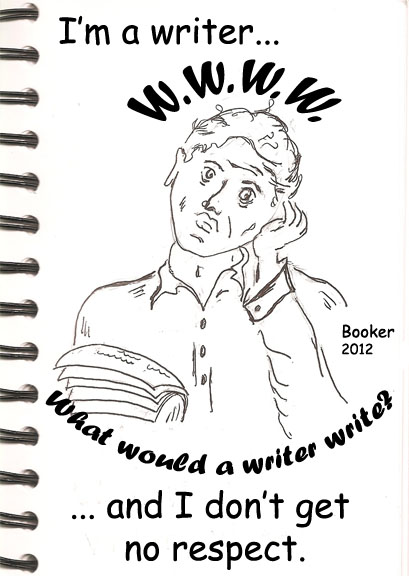
Sometimes I feel lower than a defeated politician….
Next to the defeated politician, the writer is the most vocal and inventive griper on earth. He sees hardship and unfairness wherever he looks. His agent doesn’t love him (enough). The blank sheet of paper is an enemy. The publisher is a cheapskate. The critic is a philistine. The public doesn’t understand. His wife doesn’t understand him. The bartender doesn’t understand him. –PETER MAYLE
Filed under cartoon by author, no respect, writer, writing humor
The last bookshop man in the world sat alone in his small store. There was a knock on the door. Startled, he looked up from his science fiction book to find the woman of his dreams standing in the doorway, wearing very little at all. And though she was an android, it had been a long time, so he proposed something indecent to her.

The last bookshop
She then turned and left the room.
He put the book back on the shelf and went to another section.
#
The last bookshop man in the world sat alone in his store. There was a knock on his door.
Before he could answer, the door swung open and a man in a fedora with a tommy gun barged in and started spraying the room with bullets.
The man with the machine gun aimed high, but was bringing his aim lower and lower, yelling over the noise that “The Boss” had sent him to get “the dame.” So where was she?
The last man barely had time to dive to the floor and even then he heard one speeding over his head.
The gun ran out of bullets. The man with the fedora backed out of the room and disappeared.
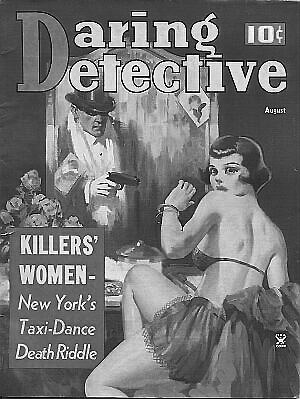
Old magazine from the shelves of the last bookshop
#
The last bookshop man in the world sat alone in his store.
This time a Conan-like brute with a broadsword did not bother to knock, but kicked the door open and charged into the room, swinging. He hit books, slicing the spines, knocking them off the shelves. He hit shelves, splintering wood, embedding his sword.
He yelled something about a woman, or that’s what the last man thought he heard.
Because the room was small, Conan-like was having trouble getting a full, strong swing of his massive sword. Still, as he stomped toward the last man, the last man was not sure how he would escape this one. The same thing preventing this Conan type from getting a complete swing of his sword was also prevent his escape.
The last bookshop man was sure this was going to be his last. Then the scantily clad android woman appeared in the door and announced, “I’m reformatted.”
The Conan-like man jerked his sword out of the shelf, turned, and lunged toward her.
She squealed in an almost mechanical way and ran away, the muscle-bound Conan-like in determined pursuit.
The last bookshop man slumped into his chair and waited for his heart rate to return to normal.
#
The last bookshop man in the world sat alone in his store. This time, there was a lock on his door. This time, he was reading haikus.
[Editor’s note: inspired by a visit to Central Street Books, dealer in old and rare books, in Knoxville, TN.]
Filed under bookshop, Found story, Photo by author, story, writing
The blathering idiot knew April was poetry month and he thought he could impress his on again, off again girl friend Zoey with a poem or two. But the month was running out and he had not yet thought of anything poetic to write, though he had taken the time to study some about poetry making.
Additionally, after the restaurant fiasco where he had waited and waited and waited for an employee to come and wash his hands because the sign in the rest room clearly said: Employees must wash hands, and this caused him to leave Zoey’s young daughter Xenia sitting by herself for over 30 minutes, which she then reported to her mother, well, his relationship with Zoey had cooled once again.
So, this was his chance, though a part of him was beginning to wonder why he should care.
He started with something at least a little familiar:
Roses are red and violets are blue
Your eyes are weird and you are, too.
The blathering idiot was proud to have gotten three rhymes in two lines, but the more he looked at the couplet, the more he realized Zoey would not appreciate his poetic efforts at assonance. At least that what he thought it was called. She would probably say he was just being one.
He then tried something that incorporated the month:
The month of poetry is about to end
The rains of April have been real thin.
A new month stands about to begin.
May nouns, verbs & rain come again.

Once upon a poem dreary....
There once was a man from Nantucket
Who went on a dinner date and got stuck with it.
Not the bill, I say,
though that, too, came his way,
but the knife in his heart and the luck of it.
He read it and reread it and re-reread it, and then finally decided to put it in an envelope and mail it to her. He wasn’t from Nantucket – wherever that was – but she knew that. And while it didn’t directly mention love, love was there. And while Zoey wasn’t mentioned directly, she was in there, too.
He could only hope it wouldn’t give her too many ideas.
Filed under blathering idiot, cartoon by author, poetry
by Jane Friedman
April 27, 2012
Source: http://writerunboxed.com/2012/04/27/should-you-focus-on-your-writing-or-your-platform/#more-14057
Craft!
Platform!
Craft!!
Platform!!
It’s a debate that might span eternity: how much time should you devote to writing versus platform building?
I don’t know if there was ever a real beginning to this debate, but if so, it was when editors and agents started telling nonfiction authors that their book was only viable if a platform was in place. Which made sense for technological and cultural reasons. Take the ease of word processing and affordable personal computers, add Baby Boomers with free time to pursue their dreams, and presto! Suddenly there were more people than ever trying to write a book and get it published, with limited skills and experience, and often no credentials.
So what does a well-meaning agent or editor say to one of these people? The easiest thing to say is: You need a platform.
Fast forward a decade or two, and we now live inside an unending media conversation wheel, where anyone can find a niche readership, do solid work on building a platform, and even put writing on the backburner—and still reasonably claim to be a writer.
I think there’s a backlash against some of these people, which I understand. It’s applying the entrepreneurial, get-rich-quick Tim Ferriss mindset to the world of literature, where we tend to believe that blood, sweat, and tears (and rejection) are demanded before you gain recognition.
Plus: Real writers write. (Right?) They don’t tweet, they don’t blog, they don’t connect with readers, at least not joyfully.
I exaggerate, but you know the people I’m talking about.
The horrible catch is—at least for beginning writers without fame and fortune, who are starting their careers in a transitioning industry—focusing on your writing work to the exclusion of all else can hamper you later down the road. If you shut yourself away and don’t learn to navigate the online world (the personalities, the flow of conversations, the tools), you’re terribly disadvantaged when it comes time to get a publisher, market your work, and find readers.
Excellent arguments reside on each side of this debate, which often boil down to: “Writing is all that matters,” and “audience is all that matters.”
But the truth is a little different for each of us, and that’s why it’s next to impossible to give general advice on platform. It necessarily varies based on the author and the work in question.
But it does rip me apart to hear very new writers feel anxious that they can’t figure out their platform, especially when they have not a single book or credit to their name.
Well, it’s not a mystery why platform is so confusing when you don’t know who you are yet as a writer!
This has been a very long preface to what I’d like to offer: a set of general guidelines to help any writer understand how to balance writing with platform building.
Balance is the key word here.
Focusing on your writing probably means spending 10%-25% of your available writing time on platform activities. I never recommend abandoning platform activities entirely, because you want to be open to new possibilities. Being active online—while still focused on your writing—could mean finding a new mentor or the perfect critique partner, connecting with an important influencer, or pursuing a new writing retreat or fellowship opportunity.
Without further ado, the list.
When to focus more on your writing:
If you are within the first five years of seriously attempting to write with the goal of publication
For novelists: If you have not yet completed and revised one or two full-length manuscripts
If you can tell that what you’re writing is falling short of where you want and need to be
If you see a direct correlation between the amount of writing you put out and the amount of money that comes into your bank account (the JA Konrath model)
If you are working on deadline.
When to focus more on your platform:
If you start to realize you’re on the verge of publication
If you have a firm book release date of any kind
If you want to sell a nonfiction book concept (non-narrative)
If you intend to profit from online/digital writing that you are creating, distributing, and selling on your own
If you need to prove to a publisher or agent that your work has an audience.
Brief Bio.: Jane Friedman is a professor of media and writing at the University of Cincinnati, and the former publisher of Writer’s Digest. Visit her at JaneFriedman.com, for regular insights into the future of publishing.
Filed under writer, writing, writing tip
Every now and then, it is good to revisit a classic, or even a curiosity from the past. The Devil’s Dictionary by Ambrose Bierce was originally published in newspaper installments from 1881 until 1906. You might be surprised how current many of the entries are.
For example, since April is poetry month, here is a definition for the words poetry and blank verse. The Old definition is Bierce’s. The New definition or comment are mine (and in this case a few other folks, too. Sometimes, you need help).
From time to time, just as it was originally published, we will come back to The Devil’s Dictionary, for a look at it then and how it applies today. Click on Devil’s Dictionary in the tags below to bring up the other entries.
OLD DEFINITIONS:
Poetry, n. A form of expression peculiar to the Land beyond the Magazines.
Blank verse, n. Unrhymed iambic pentameters — the most difficult kind of English verse to writer acceptably; a kind, therefore, much affected by those who cannot acceptably write any kind.
NEW DEFINITIONS:
Poetry, n. In this age of digital publishing, to say that poetry is peculiar to the Land beyond the Magazines is more prescient than sarcastic. Maybe I will call upon some other folks give a modern perspective, if not definition of poetry:
Poetry and consumption are the most flattering of diseases. –William Shenstone
(If I have to choose, I’ll take poetry, though I would probably be better at consumption.)
Poetry is nobody’s business except the poet’s, and everybody else can f*&k off. –Philip Larkin
(If true, no wonder poets feel misunderstood, unappreciated, and beyond the Land of Magazines.)
I know that poetry is indispensable, but to what I could not say. –Jean Cocteau
(Probably more indispensable than this blog.)
I think that one possible definition of our modern culture is that it is one in which nine-tenths of our intellectuals can’t read any poetry. –Randall Jarrell
(And what is the percentage of the non-intellectuals?)
Free verse, n. Free verse is like free love; it is a contradiction in terms. –G.K. Chesterton
(Yeah, but paid love is illegal in most states.)
Filed under Ambrose Bierce, definitions, Devil's Dictionary, poetry


 Booker's Blog