Tag Archives: LinkedIn

Plucked from the breadlines: Food Porn found near your toaster

News Flash!

Beware of this food porn creeping into your local food store. Spotted today was FlatJacks, an innocent looking addition to your diet, promising to make life easier and in two flavors: Original and “BarBQ.”

All you need is a toaster and about 5 minutes of your time, and all your fowl desires will be met!

Chicken from a toaster

Chicken from a toaster! What next? Will pigs fly?

When asked, the chief of police said: “FlatJacks is not to be trusted. He will lay your waist, and leave you with nothing to crow about. We have one of top detectives on this and he will get to the bottom of it, and then we will lay out the facts and seek prosecution of those trafficking in this chicken s&*^t operation.”

Psychiatrists are warning that what FlatJacks has to offer could be habit forming. Said one: “It’s almost magical, what FlatJacks is promising. ‘Chicken from your toaster!’ Who ever heard of such a thing? Pure fantasy! It would be as if I said if I had enough feather dusters, I could fly.”

Even one Republican Presidential candidate has weighed in, saying: “FlatJacks is free market capitalism at its finest. We politicians used to promise a chicken in every pot. We can now promise one in every toaster! That’s progress.”

Asked if he had tried one, the politician coughed and clucked as if to clear his throat and then referred the question to his aid.

When asked about FlatJacks, the Democratic candidate said he would form a commission to study the matter, and take that commission’s conclusions under advisement.

One local preacher took no time in condemning “this abomination to the very soul of Christianity.” Wiping away sweat as he spoke outside on the church grounds where an outdoor dinner and preaching was taking place.

He continued: “Young folks today do not know the true meaning of dinner on the grounds. In my day, the men dressed in their best Sunday clothes and women wore skirts and dresses, and often wore bonnets or hats, and they brought their best homemade fried chicken. It was a little friendly competition to see who had the best. Now, well now, look around here.” He waved his arm toward his brood. “They come in summer shorts – men and women – I say, and the women, well some of them wear the scantiest of things, and bring KFC chicken, and don’t even bother to take it out of the bucket. Now, now they will be bringing these FlatJack things and demanding we have toasters outside and long extension cords, and rows and rows of toasters. This will become one big stick it and click it dinner. Stick it in the toaster and click the lever down. Stick it and click it. This is Satan’s handiwork, I tell you. Satan’s handiwork.” In the distance a roster crowed for a second time and the preacher broke down and wept.

Leave a comment

Filed under absurdity, Chicken, church, FlatJacks, food porn, Found story, humor, puns, wit, word play

The blathering idiot and the sign

The blathering idiot had never stopped to read the sign until Xenia asked him about it. They were in a restaurant. One that she had selected and he had taken her to in order to help out his on-again, off-again girl friend Zoey. He was doing this to try to get back into her good graces.

But Xenia’s question was proving hard to answer. Maybe too hard. He stood in the rest room, hands over the sink, waiting for an answer, or even somebody to ask. But for ten minutes now nobody came in the rest room. No employee even bothered to poke his head in.

So, all he could do was stand, bent over the sink, hands under the dripping faucet, back twinging, and read the sign next to the mirror over and over and over again:

Employees must wash hands

Employees must wash hands

Sooner or later one of them had to come in, and at that moment, he would make that person wash his hands and then he would return to finish supper with Xenia, and he would never come to this restaurant ever again, particularly if he had to tip the employee for this slow service.


[Editor’s note: other blathering idiot “adventures” available by clicking on the “blathering idiot” tag below.]

Leave a comment

Filed under blathering idiot, hands, humor, sign, wash

The pen is mighter than the sword

“The pen is mightier than the sword, and considerably easier to write with.”

— Marty Feldman

Marty Feldman

Marty Feldman, comedian, writer, actor

http://en.wikipedia.org/wiki/Marty_Feldman

2 Comments

Filed under humor, no respect, pen, sword, wit, writing

Empty: Full

Open and empty
heart with a full measure of
empathy and love.

Leave a comment

Filed under haiku, heart, poem, poetry, words, writing

The Devil’s Dictionary: Big hats and Cause and Effect and Education

Every now and then, it is good to revisit a classic, or even a curiosity from the past. The Devil’s Dictionary by Ambrose Bierce was originally published in newspaper installments from 1881 until 1906. You might be surprised how current many of the entries are.

For example, here is a definition for the word miscreant The Old definition is Bierce’s. The New definition or comment are mine. From time to time, just as it was originally published, we will come back to The Devil’s Dictionary, for a look at it then and how it applies today. Click on Devil’s Dictionary in the tags below to bring up the other entries.

OLD DEFINITION:
Effect, n. The second of two phenomena which always occur together in the same order. The first, called a Cause, is said to generate the other — which is no more sensible than it would be for one who has never seen a dog except in pursuit of a rabbit to declare the rabbit the cause of the dog.

NEW DEFINITION:
Post hoc, ergo propter hoc

After it, therefore because of it. The link above takes you to a video highlighting the same thing as discussed in in the Old Definition, showing that things have not changed all that much.

Conclusion: some things never change. Maybe due to a lack of education.

OLD DEFINITION:
Education, n. That which discloses to the wise and disguises from the foolish their lack of understanding.

NEW DEFINITION:
Education, n. That which the foolish, most conservative and mostly Republican, believe is wise to wreck on behalf of faith is something unseen, basically fear and prejudice. See the Tennessee State Legislatures attempt to recreate “Monkey Laws.”

I'm a state legislator and I know science better than anyone.

Post hoc ergo propter hoc: "I'm a Republican state legislator and I can stand in the way of education, therefore, I am better than education."

http://www.knoxnews.com/news/2012/mar/19/anti-evolution-class-discussions-get-senates-ok/

Anti-evolution class discussions get Senate’s OK

By Tom Humphrey

Monday, March 19, 2012

NASHVILLE — The Senate approved a bill Monday evening that deals with teaching of evolution and other scientific theories while the House approved legislation authorizing cities and counties to display the Ten Commandments in public buildings.

The Senate voted 24-8 for HB368, which sponsor Sen. Bo Watson, R-Hixson, says will provide guidelines for teachers answering students’ questions about evolution, global warming and other scientific subjects. Critics call it a “monkey bill” that promotes creationism in classrooms.

The bill was approved in the House last year but now must return to that body for concurrence on a Senate amendment that made generally minor changes. One says the law applies to scientific theories that are the subject of “debate and disputation” — a phrase replacing the word “controversial” in the House version.

The measure also guarantees that teachers will not be subject to discipline for engaging students in discussion of questions they raise, though Watson said the idea is to provide guidelines so that teachers will bring the discussion back to the subjects authorized for teaching in the curriculum approved by the state Board of Education.

All eight no votes came from Democrats, some of whom raised questions about the bill during brief debate.

Sen. Tim Barnes, D-Clarksville, said he was concerned that the measure was put forward “not for scientific reasons but for political reasons.” And Sen. Andy Berke, D-Chattanooga, said teachers were doing just fine teaching science without the Legislature’s involvement.

“We are simply dredging up the problems of the past with this bill and that will affect our teachers in the future,” Berke said.

Watson said the purpose of the legislation is to encourage teachers in helping their students learn to challenge and debate ideas to “improve their thinking skills.”

Critics of the HB368 labeling the measure “monkey bill” ranged from the American Civil Liberties Union to the National Center for Science Education. In a statement sent to legislators, the eight Tennesseans who are members of the National Academy of Science said that, in practice, the bill will likely lead to “scientifically unwarranted criticisms of evolution.”

“By undermining the teaching of evolution in Tennessee’s public schools, HB368 and SB893 would miseducate students, harm the state’s national reputation, and weaken its efforts to compete in a science-driven global economy,” said the statement signed by Stanley Cohen, who won the Nobel Prize in physiology of medicine in 1986, and seven other scientists.

The bill authorizing display of the Ten Commandments in public buildings — HB2658 — is sponsored by Rep. Matthew Hill, R-Jonesborough, who said it is in line with court rulings. In essence, courts have often declared displays of the biblical commandments unconstitutional standing along, but permissible as part of a display of “historic documents.”

The bill authorizes all local governments to display “historic documents” and specifically lists the commandments as being included.

Hill said the bill will prevent city and county governments from “being intimidated any further by special interest groups” opposed to displaying of the Ten Commandments. It passed 93-9 and now goes to the Senate.

****

Commentary: Republicans DO NOT want smaller government. They simply want THEIR form of Big (Brother) Government. One where they govern your thoughts and morality. Your gun may be loaded, but your brain will be full of blanks.

Leave a comment

Filed under Ambrose Bierce, Blank, Cartoon, cause, Devil's Dictionary, educated, education, effect, GOP, Republicans, Uncategorized

Touching Nature

Touch Nature

Top of young tree broken by human hand just leaves are budding out.

Touch Nature’s beauty;
even the hand that twists the
tree free of its growth.

Leave a comment

Filed under haiku, poem, poetry, tree, words, writing

I’m a writer and I don’t get no respect

[Editor’s note: I believe it was the late Rodney Dangerfield who had a comedy routine based on “I don’t get no respect.” The lack of respect could come from anybody, anywhere, including his wife. Below is a playwright Rodney could empathize with. He writes to Dear Abby, and she responds. I have known one or two other writers in the same situation. Maybe you, do, too.]

Rodney Dangerfield

Sometimes respect is hard to come by for a writer, or a comic. Just ask Rodney Dangerfield.

DEAR ABBY: I am an amateur playwright. Our local theater sponsors an annual playwriting contest. The prize isn’t monetary, but something far more important to an author – full scale production of the play.

I have won this prize four times – more than any other writer in the history of the contest. But is my family impressed? Not at all! My wife told me she thinks I write everything the same way and have simply repeated myself four times.

I am up in years. It’s unlikely I will ever again win this prize. So how do I respond to such indifference? What do you do when you feel you have accomplished something important and the response is, “so what else is new?”

–Looking for Validation in Florida

DEAR LOOKING FOR VALIDATION: My hat’s off to you. That you have won this prize more than any other writer in the history of the contest is a notable achievement. Attend the production, take your well-earned bow in the spotlight, and accept that the less you look to your wife for validation, the happier your life will be.

Leave a comment

Filed under advice, Dear Abby, humor, respect, Rodney Dangerfield, writer, writing

Noah’s Ark for books: another side of digital publishing divide

[Editor’s note: yesterday I posted an article about the Encyclopedia Britannica going online only. Now, here is a New York Times article about a California man and family working to preserved physical copies of books, a sort of Noah’s Ark for books. I guess there won’t be future copies of the Encyclopedia Britannica in this collection.]

March 3, 2012

In a Flood Tide of Digital Data, an Ark Full of Books

By DAVID STREITFELD

http://www.nytimes.com/2012/03/04/technology/internet-archives-repository-collects-thousands-of-books.html?_r=3

RICHMOND, Calif. — In a wooden warehouse in this industrial suburb, the 20th century is being stored in case of digital disaster.

Forty-foot shipping containers stacked two by two are stuffed with the most enduring, as well as some of the most forgettable, books of the era. Every week, 20,000 new volumes arrive, many of them donations from libraries and universities thrilled to unload material that has no place in the Internet Age.

Destined for immortality one day last week were “American Indian Policy in the 20th Century,” “All New Crafts for Halloween,” “The Portable Faulkner,” “What to Do When Your Son or Daughter Divorces” and “Temptation’s Kiss,” a romance.

“We want to collect one copy of every book,” said Brewster Kahle, who has spent $3 million to buy and operate this repository situated just north of San Francisco. “You can never tell what is going to paint the portrait of a culture.”

As society embraces all forms of digital entertainment, this latter-day Noah is looking the other way. A Silicon Valley entrepreneur who made his fortune selling a data-mining company to Amazon.com in 1999, Mr. Kahle founded and runs the Internet Archive, a nonprofit organization devoted to preserving Web pages — 150 billion so far — and making texts more widely available.

But even though he started his archiving in the digital realm, he now wants to save physical texts, too.

“We must keep the past even as we’re inventing a new future,” he said. “If the Library of Alexandria had made a copy of every book and sent it to India or China, we’d have the other works of Aristotle, the other plays of Euripides. One copy in one institution is not good enough.”

Mr. Kahle had the idea for the physical archive while working on the Internet Archive, which has digitized two million books. With a deep dedication to traditional printing — one of his sons is named Caslon, after the 18th-century type designer — he abhorred the notion of throwing out a book once it had been scanned. The volume that yielded the digital copy was special.

And perhaps essential. What if, for example, digitization improves and we need to copy the books again?

“Microfilm and microfiche were once a utopian vision of access to all information,” Mr. Kahle noted, “but it turned out we were very glad we kept the books.”

An obvious model for the repository is the Svalbard Global Seed Vault, which is buried in the Norwegian permafrost and holds 740,000 seed samples as a safety net for biodiversity. But the repository is also an outgrowth of notions that Mr. Kahle, 51, has had his entire career.

“There used to be all these different models of what the Internet was going to be, and one of them was the great library that would offer universal access to all knowledge,” he said. “I’m still working on it.”

Mr. Kahle’s partners and suppliers in the effort, the Physical Archive of the Internet Archive, are very glad someone is saving the books — as long as it is not them.

The public library in Burlingame, 35 miles to the south, had a room full of bound periodicals stretching back decades. “Only two people a month used it,” said Patricia Harding, the city librarian. “We needed to repurpose the space.”

Three hundred linear feet of Scientific American, Time, Vogue and other periodicals went off to the repository. The room became a computer lab.

“A lot of libraries are doing pretty drastic weeding,” said Judith Russell, the University of Florida’s dean of libraries who is sending the archive duplicate scholarly volumes. “It’s very much more palatable to us and our faculty that books are being sent out to a useful purpose rather than just recycled.”

As the repository expands — from about 500,000 volumes today toward its goal of 10 million — so does its range. It has just started taking in films.

“Most films are as ephemeral as popcorn,” said Rick Prelinger, the Internet Archive’s movie expert. “But as time passes, the works we tried to junk often prove more interesting than the ones we chose to save.”

At Pennsylvania State University, librarians realized that most of their 16-millimeter films were never being checked out and that there was nowhere to store them properly. So the university sent 5,411 films here, including “Introducing the Mentally Retarded” (1964), “We Have an Addict in the House” (1973) and “Ovulation and Egg Transport in the Rat” (1951).

“Otherwise they probably would have ended up in a landfill,” said William Bishop, Penn State’s director of media and technology support services.

Not everyone appreciates Mr. Kahle’s vision. One of the first comments on the Internet Archive’s site after the project was announced in June came from a writer who said he did not want the archive to retain “any of my work in any form whatsoever.”

Even some librarians are unsure of the need for a repository beyond the Library of Congress.

“I think the probability of a massive loss of digital information, and thus the potential need to redigitize things, is lower than Brewster thinks,” said Michael Lesk, former chairman of the department of library and information science at Rutgers. But he conceded that “it’s not zero.”

If serious “1984”-style trouble does arrive, Mr. Lesk said, it might come as “all Internet information falls under the control of either governments or copyright owners.” But he made clear he thought that was unlikely.

Under a heated tent in the warehouse’s western corner the other day, Tracey Gutierres, a digital records specialist, worked on a new batch. If a volume has a bar code, she scans it to see if the title is already in the repository. If there is no bar code, she checks the International Standard Book Number on the copyright page. If the book is really old, she puts it aside for manual processing.

Before the books make it the 150 feet to the shipping containers for storage, some will have to travel 12,000 miles to China. The Chinese, who are keen to build a digital library, will scan the books for themselves and the archive and then send them back. The digital texts will be available for the visually impaired and other legal purposes.

As word about the repository has spread, families are making their own donations.

Carmelle Anaya had no idea what to do with the 1,200 books her father, Eric Larson, left when he died. Then she heard about the project. “He’d be thrilled to think they would be archived so maybe someone could check them out a hundred years from now,” said Ms. Anaya, who lives in California’s Central Valley.

Her daughter Ashley designed a special bookplate. Any readers across the centuries will know where the copies came from. “The books will live on,” Ms. Anaya said, “even if the people can’t.”

Leave a comment

Filed under books, preserving, publishing

A byte of a tome: encylopedia goes online only

http://www.boston.com/news/nation/articles/2012/03/14/last_entry_for_encyclopaedia_britannica_book_form/

CHICAGO—Hours after Encyclopaedia Britannica Inc. announced it will stop publishing print editions of its flagship encyclopedia for the first time in more than 200 years, someone among the editing minions of free online rival Wikipedia made an irony-free note of that fact.

“It was announced that after 244 years, the Encyclopaedia Britannica is going out of print, instead focusing on its online encyclopedia,” the entry read.

The book-form of Encyclopaedia Britannica has been in print since it was first published in Edinburgh, Scotland, in 1768. It will stop being available when the current stock runs out, the company said. The Chicago-based company will continue to offer digital versions.

Officials said the end of the printed, 32-volume set has been foreseen for some time.

“This has nothing to do with Wikipedia or Google,” Encyclopaedia Britannica Inc. President Jorge Cauz said. “This has to do with the fact that now Britannica sells its digital products to a large number of people.”

The top year for the printed encyclopedia was 1990, when 120,000 sets were sold, Cauz said. That number fell to 40,000 just six years later in 1996, he said. The company started exploring digital publishing in the 1970s. The first CD-ROM edition was published in 1989 and a version went online in 1994.

The final hardcover encyclopedia set is available for sale at Britannica’s website for $1,395.

“The sales of printed encyclopedias have been negligible for several years,” Cauz said. “We knew this was going to come.”

The company plans to mark the end of the print version by making the contents of its website available free for one week, starting Tuesday.

Online versions of the encyclopedia now serve more than 100 million people around the world and are available on mobile devices, the company said. The encyclopedia has become increasingly social as well, Cauz said, because users can send comments to editors.

“A printed encyclopedia is obsolete the minute that you print it,” Cauz said. “Whereas our online edition is updated continuously.”

Lynne Kobayashi of the Language, Literature & History section of the Hawaii State Library notes some people will always prefer using print sources, but that readers are becoming attuned to online searching because of a proliferation of electronic publishing.

“There are many advantages to online searching, chief among them the ability to search within the text,” Kobayashi said. “The major disadvantage is the need for a computer or devices with access to the Internet.”

Kobayashi said her decision to use traditional or online resources depends on the question she wants answered.

“Sometimes subject knowledge and familiarity with standard resources may get faster results than keying in a search and sifting through results,” she said. “If the search is broader, searching across several online sources may yield more options.”

Britannica has thousands of experts’ contributors from around the world, including Nobel laureates and world leaders such as former President Bill Clinton and Archbishop Desmond Tutu. It also has a staff of more than 100 editors.

“To me, the most important message is that the printed edition was not what made Britannica,” Cauz said. “The most important thing about Britannica is that Britannica is relevant and vibrant because it brings scholarly knowledge to an editorial process to as many knowledge seekers as possible.”

Kobayashi said as information professionals, librarians see an important part of their role as directing patrons to trustworthy information sources.

“While Wikipedia has become ubiquitous, the Britannica remains a consistently more reliable source,” she said.

——

Online: http://www.britannica.com

Leave a comment

Filed under encylopedia, online, publishing

Nothing and the Philosopher

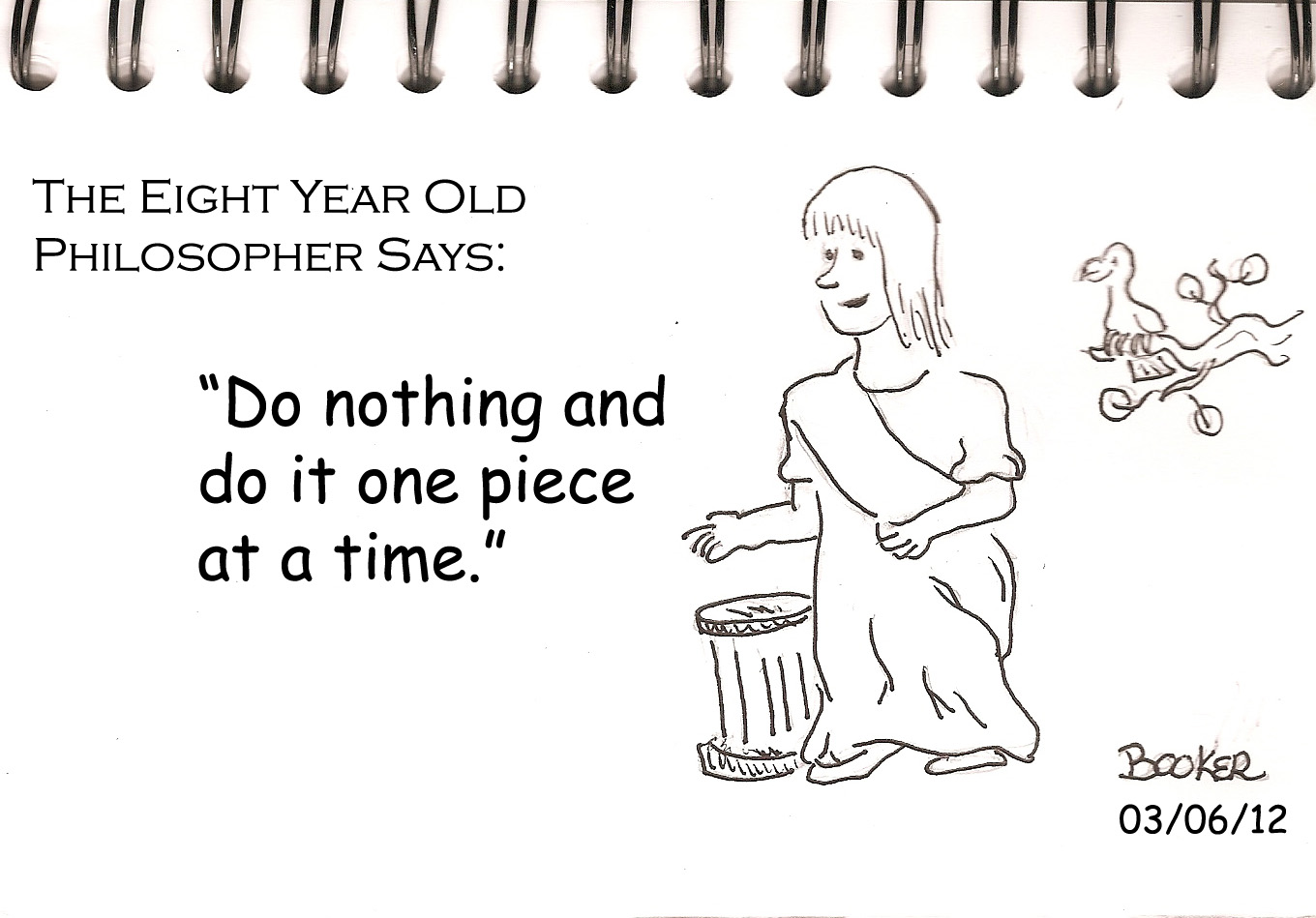
Do Nothing and do it one piece at a time.

Doing nothing should not be rushed.

Leave a comment

Filed under Cartoon, humor, Philosopher