Tag Archives: library

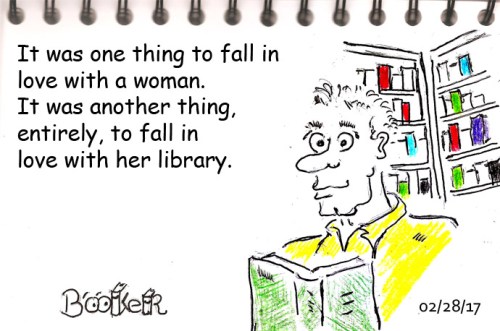
cARtOONSdAY: “lIBRARY … lOVE”

But the most difficult part of all was deciding which he loved more.

Leave a comment

Filed under 2017, cartoon by author, CarToonsday

Garbage Collector Rescues Books From The Trash For Low-Income Kids | The Huffington Post

Source: Garbage Collector Rescues Books From The Trash For Low-Income Kids | The Huffington Post

José Alberto Gutiérrez is known as the “Lord of the Books” to the thousands of book-loving children he’s helped in Bogotá, Colombia.

The garbage collector, takes discarded books from wealthy neighborhoods and adds them to a makeshift library in his home. The collection of over 20,000 books is open to the kids in the low-income neighborhood where he lives on the weekends.

“This should be in all neighborhoods, on each corner of every neighborhood, in all the towns, in all departments, and all the rural areas,” Gutiérrez told The Associated Press in 2015. “Books are our salvation and that is what Colombia needs.”

Gutiérrez started salvaging discarded books 20 years ago, according to the AP. He credits his work to his mother, who read to him every night despite not being able to afford keeping him in school.

“The first book I found was Anna Karenina by Leo Tolstoy, and that little book ignited the flame and [set in motion this] ball that has never stopped rolling,” Gutiérrez says in the AJ+ video.

Save

Leave a comment

Filed under 2017, books

cARtOONDdAY: “lOVE IN THE lIBARARY”

But the most difficult part of all was deciding which he loved more.

But the most difficult part of all was deciding which he loved more.

Leave a comment

Filed under 2017, cartoon by author, CarToonsday

Protect Your Library the Medieval Way, With Horrifying Book Curses | Atlas Obscura

Medieval scribes protected their work by threatening death, or worse.

Source: Protect Your Library the Medieval Way, With Horrifying Book Curses | Atlas Obscura

by Sarah Laskow

In the Middle Ages, creating a book could take years. A scribe would bend over his copy table, illuminated only by natural light—candles were too big a risk to the books—and spend hours each day forming letters, by hand, careful never to make an error. To be a copyist, wrote one scribe, was painful: “It extinguishes the light from the eyes, it bends the back, it crushes the viscera and the ribs, it brings forth pain to the kidneys, and weariness to the whole body.”

Given the extreme effort that went into creating books, scribes and book owners had a real incentive to protect their work. They used the only power they had: words. At the beginning or the end of books, scribes and book owners would write dramatic curses threatening thieves with pain and suffering if they were to steal or damage these treasures.

They did not hesitate to use the worst punishments they knew—excommunication from the church and horrible, painful death. Steal a book, and you might be cleft by a demon sword, forced to sacrifice your hands, have your eyes gouged out, or end in the “fires of hell and brimstone.”

“These curses were the only things that protected the books,” says Marc Drogin, author of Anathema! Medieval Scribes and the History of Book Curses. “Luckily, it was in a time where people believed in them. If you ripped out a page, you were going to die in agony. You didn’t want to take the chance.”

Drogin’s book, published in 1983, is the most thorough compendium of book curses ever compiled. A cartoonist and business card designer, Drogin had taken an adult-education class in Gothic letters and became entranced with medieval calligraphy. While researching his first book, he came across a short book curse; as he found more and more, hidden in footnotes of history books written in the 19th century, his collection grew to include curses from ancient Greece and the library of Babylon, up to the Renaissance.

To those historians, the curses were curiosities, but to Drogin they were evidence of just how valuable books were to medieval scribes and scholars, at a time when even the most elite institutions might have libraries of only a few dozen books.

The curse of excommunication—anathema—could be simple. Drogin found many examples of short curses that made quick work of this ultimate threat. For example:

May the sword of anathema slay
If anyone steals this book away.

Si quis furetur,
Anathematis ense necetur.

If a scribe really wanted to get serious, he might threaten “anathema-maranatha”—maranatha indicating “Our Lord has Come” and serving as an intensifier to the basic threat of excommunication. But the curses could also be much, much more elaborate. “The best threat is one that really lets you know, in specific detail, what physical anguish is all about. The more creative the scribe, the more delicate the detail,” Drogin wrote. A scribe might imagine a terrible death for the thief:

“If anyone take away this book, let him die the death; let him be fried in a pan; let the falling sickness and fever size him; let him be broken on the wheel, and hanged. Amen.”

Or even more detailed:

“For him that stealeth, or borroweth and returneth not, this book from its owner, let it change into a serpent in his hand & rend him. Let him be struck with palsy & all his members blasted. Let him languish in pain crying aloud for mercy, & let there be no surcease to his agony till he sing in dissolution. Let bookworms gnaw his entrails in token of the Worm that dieth not, & when at last he goeth to his final punishment, let the flames of Hell consume him for ever.”

Drogin’s book had dozens of such curses in it, and he had collected at least a dozen more to include in the second edition, which was never published. Inside his copy of the book, he still has a baggie of antique file cards, full of book curses.

As Drogin collected curses, he started to find repeats. Not all scribes were creative enough to write their own curses. If you’re looking for a good, solid book curse, one that will serve in all sorts of situations, try this popular one out. It covers lots of bases, and while it’s not quite as threatening as bookworms gnawing at entrails, it’ll get the job done:

“May whoever steals or alienates this book, or mutilates it, be cut off from the body of the church and held as a thing accursed.”

Leave a comment

Filed under 2017, books, library

How ‘Sherlock of the library’ cracked the case of Shakespeare’s identity | Culture | The Guardian

Literary detective Heather Wolfe reveals how her passion for manuscripts helped unravel mystery of who the bard really was
heather-wolfe

By Robert McCrum

https://www.theguardian.com/culture/2017/jan/08/sherlock-holmes-of-the-library-cracks-shakespeare-identity?CMP=share_btn_link

Deep in the Folger Library, in Washington DC, Heather Wolfe says that studying Shakespeare makes an ideal preparation for the onset of Trump’s America. You can see her point: Shakespeare would have revelled in the mad excesses, the sinister vanities and the pervasive stench of cronyism and corruption surrounding the president-elect as America makes the painful transition from Barack Obama.

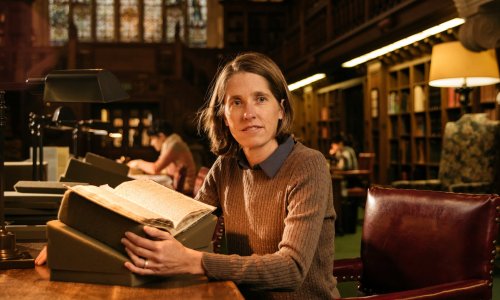
Dr Wolfe is a willowy, bright-eyed manuscript scholar, a paleographer specialising in Elizabethan England who in certain moods of candour might put you in mind of Portia or perhaps Cordelia. She’s also a Shakespeare detective who, last year, made the career-defining discovery that is going to transform our understanding of Shakespeare’s biography. In the simplest terms, Wolfe delivered the coup de grace to the wild-eyed army of conspiracy theorists, including Vanessa Redgrave and Derek Jacobi, who contest the authenticity, even the existence, of the playwright known to contemporaries as Master Will Shakespeare.

Wolfe is an accidental sleuth. Her scholar’s passion is as much for old manuscripts as for the obscurities surrounding our national poet. Project Dustbunny, for example, one of her initiatives at the Folger Shakespeare Library, has made some extraordinary discoveries based on microscopic fragments of hair and skin accumulated in the crevices and gutters of 17th-century books.

DNA forensics aside, Wolfe’s role as a curator at the Folger is to bring her expertise to bear on the tantalising mass of documents that survives from the late 16th century. And yet, despite a heap of legal, commercial and matrimonial evidence, Shakespeare the man continues to slip through scholars’ fingers. Four centuries after his death, apart from a handful of crabbed signatures, there is not one manuscript, letter or diary we can definitively attribute to the poet, sponsoring the pervasive air of mystery that surrounds his genius. Indeed, the most intimate surviving Shakespeare document remains that notorious will, in which he bequeathed his wife his “second best bed”.

Before Wolfe arrived on the scene, all that scholars could be certain about was that a man named Shaxpere, Shaxberd or Shakespear was born in Stratford in 1564, and that he was an actor whose name is printed in the collected edition of his work published in 1623. We also know that he married Anne Hathaway, and died in 1616, according to legend, on his birthday, St George’s Day. The so-called “Stratfordian” case for Shakespeare rested on these, and a few other facts, but basically, that was it.

Into this vacuum, a bizarre fraternity, including Mark Twain, Charlie Chaplin and Sigmund Freud, have projected a “Shakespeare” written by a more obviously accomplished writer: Edward de Vere (the 17th earl of Oxford), Sir Francis Bacon and the playwright Christopher Marlowe, to name the leading contenders in a field that includes Sir Walter Raleigh, and even Elizabeth, the Virgin Queen herself.

In the absence of reliable data, a mountain of speculation has morphed into the weirdest fantasy, notably the 2011 film, Anonymous. Wolfe has no time for this. Speaking exclusively for the first time to the Observer, she says: “Without the evidence for other contenders, it’s hard for me to engage with this line of inquiry.”

Wolfe’s appetite for manuscript corroboration has led her into many dusty corners of the Elizabethan archives. It was this research instinct that first led her to reopen the file on the coat of arms granted to Shakespeare’s father, the small-town glover, in 1596.

John Shakespeare, from Stratford-upon-Avon, was ambitious to rise in the world. He was certainly not the first Englishman keen to put his origins as a provincial tradesman behind him. Among his contemporaries in Stratford, he was a figure of fun for his social climbing. English class snobbery has a long pedigree. His son, who would continue the quest for official recognition after his father’s death, also attracted metropolitan disdain as “an upstart crow beautified with our feathers”. In 1601, after his father’s death, Shakespeare the upstart returned to the college of arms to renew the family application for a coat of arms. He had made a small fortune in the theatre, and was buying property in and around Stratford. Now he set out to consolidate his reputation as a “Gentleman”. Under the rules that governed life at the court of Elizabeth I, only the Queen’s heralds could grant this wish.

A much-reproduced sketch for a coat of arms crystallised Shakespeare’s hopes for legitimacy in the antique jargon of heraldry: “Gould, on a Bend Sables, a Speare of the first steeled argent. And for his Crest, a falcon, his winges displayed Argent, supporting a Speare Gould …” The needy applicant also attached a motto: Non Sanz Droit (“Not Without Right”). All this, and much more, is buried in the archives of the college of arms in London.

Wolfe’s fascination with Shakespeare’s quest for a family crest grew out of her immersion in the manners and customs of late Elizabethan England, in particular the College of Heralds. These court officials were required to administer the complex rituals governing the lives of the knights, barons and earls surrounding Queen Elizabeth.

An adjunct to the court, the College of Heralds was not exempt from its own secret feuds. In 1602, the internecine rivalry between Sir William Dethick, the Garter King of Arms, and another herald, Ralph Brooke, burst into the open when Brooke released a list of 23 “mean persons” whose applications for crests (he claimed) had been wrongfully preferred by Dethick. When “Shakespeare the Player” found himself on this list, his campaign for social advancement seemed in jeopardy. A bitter row broke out at court between two factions. Shakespeare himself became an object of ridicule. Another rival, Ben Jonson, in his satire Every Man out of his Humour, poked fun at him as a rustic buffoon who pays £30 for a ridiculous coat of arms with the humiliating motto “Not Without Mustard”.

It’s at this point in the story that Wolfe discovered “the smoking gun”. In the Brooke-Dethick feud, it becomes clear that “Shakespeare, Gent. from Stratford” and “Shakespeare the Player” are the same man. In other words, “the man from Stratford” is indeed the playwright. Crucially, in the long-running “authorship” debate, this has been a fiercely contested point. But Wolfe’s research nails any lingering ambiguity in which the Shakespeare deniers can take refuge.

Wolfe is circumspect about making extravagant claims. Speaking carefully, she says that her manuscript discoveries fill in gaps, illuminating Shakespeare’s character. “They point to someone actively involved in defining and defending his legacy in 1602, shortly after his father’s death.”

For Wolfe, it’s Shakespeare the man who breaks cover here. “He’s defending his legacy not only as a playwright but, most importantly to him, as a gentleman.” The derogatory references to arms belonging to “Shakespeare ye player”, she says, show that “he’s playing the same game as everyone else in the period, purchasing land in Stratford to support his case to ‘ancient’ gentility, rather than through his astonishing professional success”.

James Shapiro, bestselling author of 1599, who is persuaded by Wolfe’s discoveries, compares her to “a Sherlock Holmes of the archives”. Shapiro says that Wolfe “has had the intellectual independence to see what others have overlooked, the skills to make sense of what she has stumbled upon and the modesty not to trumpet the larger implications of those finds. But make no mistake: they are enormously consequential.”

For Shapiro, Wolfe’s work suggests future breakthroughs. “I doubt that these are the last archival treasures she will unearth. Her recent finds sharpen our sense of Shakespeare’s dogged pursuit of upward mobility. And it is one more nail in the coffin of those who can’t bring themselves to acknowledge that the glover’s son from Stratford was also the successful man of the theatre who left us so many extraordinary plays.”

Wolfe says she looks forward to “poking about” in the archives, and is convinced that Shakespeare’s identity no longer needs re-confirmation. “There is such a wealth of evidence out there that he’s the playwright.” She adds: “I’m sure there’s more untapped material waiting to be uncovered. Additional finds will certainly help us understand his life – as much as we can understand anyone’s life from 400 years ago.”

Leave a comment

Filed under 2017, author tribute, author write up

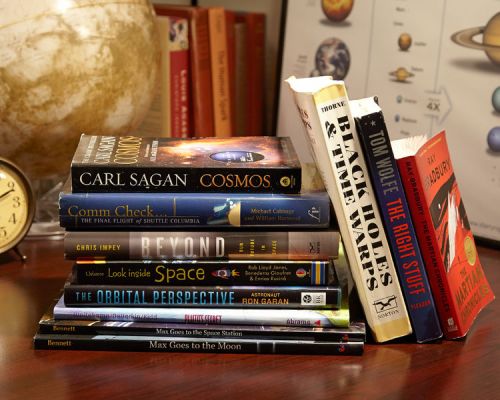
Best Space Books and Sci-Fi: A Space.com Reading List

Space.com’s editors present a reading list for space and sci-fi lovers, as well as children who are interested in astronomy and spaceflight.

Source: Best Space Books and Sci-Fi: A Space.com Reading List

There are plenty of great books out there about space — so many, in fact, that it can feel a little overwhelming to figure out where to start. So the editors and writers at Space.com have put together a list of their favorite books about the universe. These are the books that we love — the ones that informed us, entertained us and inspired us. We hope they’ll do the same for you.

We’ve divided the books into five categories, which each have their own dedicated pages. On this page, we feature books we’re reading now and books we’ve recently read, which we will update regularly. Click to see the best of:

  • Astronomy and Astrophysics
  • Spaceflight and Space History
  • Space Photography
  • Space Books for Kids
  • Science Fiction

We hope there’s something on the list for every reader of every age. We’re also eager to hear about your favorite space books, so please leave your suggestions in the comments, and let us know why you love them. You can see our ongoing Space Books coverage here.

Leave a comment

Filed under 2016, books

Sci-Fi & Fantasy Library Sweepstakes – Unbound Worlds

Source: Sci-Fi & Fantasy Library Sweepstakes – Unbound Worlds

A chance to build your science fiction and fantasy library.

Leave a comment

Filed under 2016, books

Monday morning writing joke: “Checked out”

A newspaper columnist scurries into a library. She needs every book they have on Harry Houdini. She asks the librarian for help. “It’s for an article I have to turn in today.”

The librarian finds where the books are located and he leads the woman to the shelves to check out what they have.

They find the spot. They both stare at the shelves for a moment, then he turns to the columnist and says, “Looks like they have all disappeared.”

Leave a comment

Filed under 2016, Monday morning writing joke

Library cat fur-loughed

Library Cat is Being Taken Away from the Place He Calls Home After 6 Years

Source: http://www.lovemeow.com/save-library-cat-browser-1889260522.html

Browser being evicted from only home he's known.

Browser being evicted from only home he’s known.

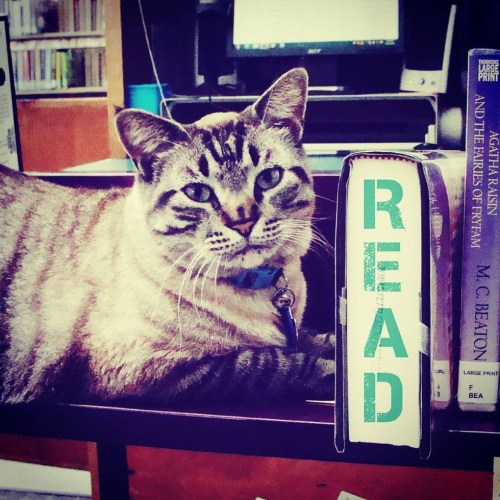
A cat that has been a loyal worker and family to a library for six years is being taken away from the place he calls home.

Browser has been living at the Friends of the White Settlement Public Library (White Settlement, TX) for six years. He’s done great to contribute to fixing the library’s rodent problem and is loved by everyone there. However, things took a different turn, when suddenly he was asked to move out of the place he calls home.

This friendly feline has been a fixture at the library and people from all ages adore him and his purrsonality.

“I don’t have any animals. But this cat is so gentle and so lovable and he brings so much comfort to so many people, it seems like a shame to take him away,” Lillian Blackburn, president of the library, told Star Telegram.

It all happened after a city employee complained to the city council that they weren’t allowed to bring their puppy to work, but also pointed out the fact that Browser was allowed to stay at the library.

Despite “an outpouring of support for the cat”, the White Settlement City Council voted to evict the cat.

Ironically, it was the city council that voted to allow the library to have a cat to help them with pest control.

Mayor Ron White, a nonvoting council moderator, also wants Browser to stay.

“That cat doesn’t have anything to do with whether somebody can have their puppy at City Hall. That cat doesn’t hurt anybody,” he said to Star-Telegram.

Browser is a wonderful cat and always so helpful around the library.

Not only does he keep the rodents at bay, he helps his humans with their work too.

Browser, the supercat, protecting the library from rodents.

What a hero!

He helps kids and adults pick good reads and brings a big smile to everyone that walks in.

Mayor White hopes they could reconsider its decision at the next council meeting on July 12, two days before Browser has to move out.

“Browser is still at the library for now,” White Settlement Public Library told Love Meow.

If you’d like to show your support in favor of keeping Browser the cat at the library, you can contact White Settlement council members at this link.

Leave a comment

Filed under 2016, library

Libraries: the hauntingly beautiful and the beautifully haunted

The World’s Most Beautiful Library Is In Prague, Czech Republic

Source: http://www.boredpanda.com/beautiful-library-prague-czech-clementinum/

The Klementinum library

The Klementinum library

The Klementinum library, a beautiful example of Baroque architecture, was first opened in 1722 as part of the Jesuit university, and houses over 20,000 books. It was voted as one of the most beautiful and majestic libraries in the world by our readers!

The ceiling frescoes were painted by Jan Hiebl. In 1781, director Karel Rafael Ungar established Biblioteca Nationalis, a collection of Czech language literature. Some of the rare historical books from this collection have been sent to Google for scanning and will eventually be available on Google Books.

Just as the library is a rare and little-known treasure, so is it associated with several little-known facts: the Klementinum used to be the third largest Jesuit college in the world; recording of local weather began there in 1775 and has continued ever since; it is featured in a novel by famous Spanish-language writer Jorge Luis Borges.

Photos of the library can be seen here: http://www.boredpanda.com/beautiful-library-prague-czech-clementinum/

***

Phantoms among the Folios: A Guide to Haunted Libraries

Source: http://americanlibrariesmagazine.org/2015/10/28/phantoms-among-folios-guide-to-haunted-libraries/

In the fall, a journalist’s fancy lightly turns to thoughts of ghosts. Newspapers and magazines that haughtily refrain from printing news of the paranormal for 11 months of the year eagerly jump on the Halloween coach in October to regale their audiences with dubious tales of the preternatural.

American Libraries is no exception. However, unlike less reputable media, we go to original sources whenever possible to ascertain whether or not our spooks are spurious. And in so doing we have uncovered a hauntful of genuinely eerie events hiding amid the folktales.

Libraries are haunted?

Bleak mansions and somber castles usually spring to mind when we think of haunted places. But ghostly phenomena—whatever the cause—can manifest in well-lit, modern offices as well as crumbling Carnegies. Of course, it helps if you inadvertently build your library on top of a graveyard.

Haunted libraries fall into two types. First, there is the “building with a reputation,” where a convenient murder, curse, or other tragedy has occurred. Library staff can then blame the odd noise, the occasional book falling off the shelf, or glitches in the air conditioning on the resident “scapeghost.” No one reports anything too spooky, and the children’s librarians have a good time with it at story hour.

Second, there are libraries where credible, responsible people observe enigmatic human shapes, hear disembodied voices, and witness other classic parapsychological events. Glib explanations about how the building must be settling ring about as hollow as those mysterious footsteps late at night on the upper floorboards. The library staff learns to live with its wraith, usually by accepting the paranormal as a normal working condition.

Both categories of haunted libraries are described here. Like a good journalist I will begin with Type One, forcing you to read through to the end to get the good stuff. Just make sure you don’t finish this article alone in bed, late at night, during a violent thunderstorm.

’Tis the curse of service

As if library directors didn’t have enough to worry about, a curse would be sufficient to send stress levels over the line. Fortunately, the curse on Peoria (Ill.) Public Library directors seem to have lifted long ago. Uttered in 1847 by the lawyer-plagued woman who owned the land where the library now stands, the curse is said to have been responsible for the untimely deaths of three directors: The first was killed in a streetcar accident in 1915, the second died from a heart attack suffered after a heated debate at a library board meeting in 1921, and the third committed suicide in 1924 by swallowing arsenic. Since then, Peoria directors have lived long, fruitful lives.

Trisha Noack, ‎manager of Public Relations at Peoria Public Library, said their Main Library was remodeled and reopened in December 2010.

“Most of these reports came from the stacks area, now known as LL1 and the home of our Art Gallery and Local History and Genealogy Room,” Noack said. “Since the stacks were eliminated (and) the entire library building (was) stripped down to the bare walls, there has been no further activity.”

Ruth did it

On October 11, 1947, Ruth Cochran, assistant librarian at the Umatilla County Public Library in Pendleton and president of the Eastern Oregon Library Association, suffered a cerebral hemorrhage as she was closing the building. She went to the basement to rest, but soon became too weak to move or summon help. The next day the custodian’s wife found her, still conscious, and she was taken to the hospital where she died, according to the Pendleton East Oregonian. Ever since, spooky events in the library have been blamed on Ruth’s ghost.

Harvey Thompson, a library patron who took an interest in Ruth, said there is “something in the building that makes people nervous.” Once a custodian was alone in the building painting the children’s room when the intercom system buzzed repeatedly. “The folklore was that Ruth was suffering in the basement trying to summon someone,” Thompson said.

The library, now called the Pendleton Public Library, moved to into a vacant remodeled junior high school building in November 1996, according to library director Mary Finney. Ruth’s old building has been converted into the Pendleton Center for the Arts. Former executive director Tom Hilliard said that he never saw or heard anything he couldn’t explain: “It was an old building [a Carnegie built in 1916]. Noises turned out to be pipes expanding or a bird in the attic.”

Rockin’ wraith

The Cairo (Ill.) Public Library boasts of a ghost that one young library patron has dubbed Toby. Director Monica Smith noted that Toby usually hangs out in the special collections room on the second floor of this 1884 building. “I’m here a lot of times by myself at night, and I do hear many different sounds like someone walking around upstairs,” Smith said. “Many times I come back and find the lights on that we turned off in that room. I definitely think there is a presence here.”

Former librarian Louise Ogg once saw a ghostly light rise up from behind a desk, pass slowly by her office, and disappear into the book stacks. Another staff member was with her and saw the same thing. There used to be a rocking chair in the library that made creaking noises by itself, as if someone were rocking in it. “You kind of get used to it,” Smith said.

More available at: http://americanlibrariesmagazine.org/2015/10/28/phantoms-among-folios-guide-to-haunted-libraries/

Leave a comment

Filed under 2015, library