

Such vulgar venality voices voluminous volumes verifying very vituperative vociferous vilification vouchsafing the vagabond verity of English’s vocabulary. Verily, I say.
Such vulgar venality voices voluminous volumes verifying very vituperative vociferous vilification vouchsafing the vagabond verity of English’s vocabulary. Verily, I say.
Filed under 2023, humor, word play, words, Words to live by
Why Your Story is Getting Rejected: Language
by Chelsea Henshey

Getting to the heart of the matter.
Now, as an editor, writer, and reader, I’m constantly on the lookout for crafted prose that’s evident from paragraph one. Crafted prose means the writer isn’t simply moving characters from point A to point B, but arranging images and syntax to create rhythm and evoke emotion.
While all levels of a story must be effective for publication, stilted language can stop an editor in her tracks before your plot even begins. To refine your own language, remember the following tips:
Choose Your Style
When I use the term style, I’m referring to minimalist, maximalist, or somewhere in between. Notice the difference between the passages from Raymond Carver’s “Cathedral” and Cormac McCarthy’s Child of God.
This blind man, an old friend of my wife’s, he was on his way to spend the night. His wife had died. So he was visiting the dead wife’s relatives in Connecticut. He called my wife from his in-law’s. Arrangements were made. He would come by train, a five-hour trip, and my wife would meet him at the station. She hadn’t seen him since she worked for him one summer in Seattle ten years ago.
They came like a caravan of carnival folk up through the swales of broomstraw and across the hill in the morning sun, the truck rocking and pitching the ruts and the musicians on the chairs in the truckbed teetering and tuning their instruments, the fat man with guitar grinning and gesturing to others in a car behind and bending to give a note to the fiddler who turned a fiddlepeg and listened with a wrinkled face.
Much of your style has to do with instinct. Do you cringe at the thought of sprawling descriptions, or could you describe a scene for pages? Whatever you choose, stay consistent. Don’t be minimalist on page one and switch to a maximalist style on page three.
Avoid Abstraction
Many writers rely on abstractions in their descriptions. The issue with abstractions is they do not ground your reader. When you say something is beautiful, hideous, terrible, amazing, etc. it doesn’t provide a concrete image the reader can see. Instead, abstractions remain different for everyone, with one person’s view of beauty drastically different from the author’s. If you don’t explain what beautiful looks like, your reader is lost, and your description has no effect.
Avoid Abstraction
Many writers rely on abstractions in their descriptions. The issue with abstractions is they do not ground your reader. When you say something is beautiful, hideous, terrible, amazing, etc. it doesn’t provide a concrete image the reader can see. Instead, abstractions remain different for everyone, with one person’s view of beauty drastically different from the author’s. If you don’t explain what beautiful looks like, your reader is lost, and your description has no effect.
Be Creative
When you meet a new person, how do you describe him to someone else? Do you say he’s 6-feet tall with blue eyes, brown hair, and a beard, or are you more likely to explain unique things about him? The same goes for setting. Are the mountains tall? Is the sky blue? Does the dining room have a table? As you write, move beyond the obvious and into the memorable.
But Watch for Runaway Similes and Metaphors
Runaway similes and metaphors are tricky. I can see the writer has good intentions, but the image has backfired. These comparisons are so unrelated, they depart from what they’re describing. For example, if you compare your character stretching his legs out to unrolling a sleeping bag, notice what happens: You’re going to jump to the sleeping bag and leave the character behind. I’ve written many metaphors like this in the past, and it usually takes a trusted reader to point them out. If you’re feeling particularly proud of an out-of-the-box image, use caution, and test it on a reader.
Other things to consider:
Listen to your writing
Eliminate Repetition
Proofread
Rest of the article: http://www.writersdigest.com/uncategorized/why-your-story-is-getting-rejected-language?platform=hootsuite
Filed under 2016, writing tip, Writing Tip Wednesday
Mysterious Indo-European homeland may have been in the steppes of Ukraine and Russia
by Michael Balter
What do you call a male sibling? If you speak English, he is your “brother.” Greek? Call him “phrater.” Sanskrit, Latin, Old Irish? “Bhrater,” “frater,” or “brathir,” respectively. Ever since the mid-17th century, scholars have noted such similarities among the so-called Indo-European languages, which span the world and number more than 400 if dialects are included. Researchers agree that they can probably all be traced back to one ancestral language, called Proto-Indo-European (PIE). But for nearly 20 years, scholars have debated vehemently when and where PIE arose.
Two long-awaited studies, one described online this week in a preprint and another scheduled for publication later this month, have now used different methods to support one leading hypothesis: that PIE was first spoken by pastoral herders who lived in the vast steppe lands north of the Black Sea beginning about 6000 years ago. One study points out that these steppe land herders have left their genetic mark on most Europeans living today.
The studies’ conclusions emerge from state-of-the-art ancient DNA and linguistic analyses, but the debate over PIE’s origins is likely to continue. A rival hypothesis—that early farmers living in Anatolia (modern Turkey) about 8000 years ago were the original PIE speakers—is not ruled out by the new analyses, most agree. Although the steppe hypothesis has now received a major boost, “I would not say the Anatolian hypothesis has been killed,” says Carles Lalueza-Fox, a geneticist at Pompeu Fabra University in Barcelona, Spain, who participated in neither of the new studies.
Up until the 1980s, variations of the steppe hypothesis held sway among most linguists and archaeologists tracking down Indo-European’s birthplace. Then in 1987, archaeologist Colin Renfrew of the University of Cambridge in the United Kingdom proposed that PIE spread with farming from its origins in the Fertile Crescent of the Middle East, moving west into Europe and east further into Asia; over time the languages continued to spread and diversify into the many Indo-European languages we know today.
Traditional linguists, meanwhile, painstakingly reconstructed PIE by extrapolating back from modern languages and ancient writings. (Listen to a short fable spoken in PIE here: http://news.sciencemag.org/2015/02/sound-proto-indo-european.) They disdained Renfrew’s idea of an Anatolian homeland, arguing for example that the languages were still too similar to have begun diverging 8000 years ago.
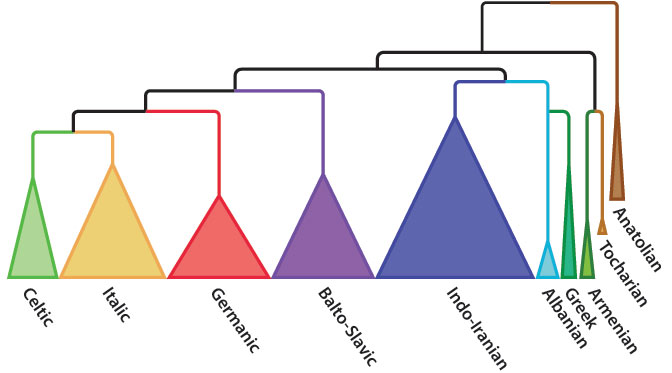
More than 400 Indo-European languages diverged from a common ancestral tongue; the earliest ones (top right), Anatolian and Tocharian, arose in today’s Turkey and China, respectively.
Rest of the article: http://news.sciencemag.org/archaeology/2015/02/mysterious-indo-european-homeland-may-have-been-steppes-ukraine-and-russia?utm_source=facebook&utm_medium=social&utm_campaign=facebook
The programmer’s wife tells him: “Run to the store and pick up a loaf of bread. If they have eggs, get a dozen.”
The programmer comes home with 12 loaves of bread.
Filed under Monday morning writing joke
What Do Y'All, Yinz, and Yix Call Stretchy Office Supplies? : The New Yorker.
Sample of quiz:
How well does this test of regional slang reveal where you’re from? Answer the questions below to find out.
What do you call sweetened carbonated beverages?
a. Soda
b. Pop
c. Coke
d. Dope
e. Horse
f. Fizz-bang
g. Explodo
h. Gentleman’s seltzer
i. Heaven bubbles
What do you call the stretchy office supplies used to hold items together?
a. Rubber bands
b. Elastics
c. Flippos
d. Snapshooters
e. Wigglers
f. Stretchums
g. Satan’s bracelets
How Y’all, Youse and You Guys Talk – Interactive Graphic – NYTimes.com.
Take the quiz. See if the answers match up with your “dialect.”
In an effort to help those who may have been hit by the onslaught of marketing slurry that passes through the English language, every now and then, I will post some words or phrases that are absurd, unless you are in marketing, sales, or some other line of work where junking up the language is simply a way of life. To start, I submit two:
Free Gift. By its definition, a gift is free, at least to the recipient. If somebody gives you a gift that’s not free, then it is not a gift.
Truly Unique. Can something be falsely unique? Unique means one of a kind. Doesn’t matter if it is a good one of a kind, or a bad one of a kind, it is a one of a kind. If it is unique, by its definition it is true to itself because it is one of a kind.


 Booker's Blog