
 The Jack Reacher author Lee Child investigates the unusual life of author John D Macdonald
Source: BBC Radio 4 – 21 Shades of Noir: Lee Child on John D MacDonald
Well worth a listen, for Jack Reacher and Travis McGee fans.
The Jack Reacher author Lee Child investigates the unusual life of author John D Macdonald
Source: BBC Radio 4 – 21 Shades of Noir: Lee Child on John D MacDonald
Well worth a listen, for Jack Reacher and Travis McGee fans.
Filed under 2016, John D. MacDonald, mystery writing
John D and me: David Morrell
by David Morrell
Source: http://ticket.heraldtribune.com/2016/02/12/john-d-and-me-david-morrell/

John D. MacDonald
I can’t explain why I hadn’t been aware of what I later called the MacDonald “color” series. After all, the McGee books had been around since “The Deep Blue Good-by” in 1964. But in 1979, “The Green Ripper” was published (about McGee confronting a group of domestic terrorists, long before most people imagined such a thing), and the clever title caught my eye. I read it with an intensity that matched its plot and immediately returned to the bookstore where I’d found “The Green Ripper.” I purchased the seventeen Travis McGee novels that preceded it, carrying the armload to my car. Every afternoon that summer, after I finished writing five pages of my own fiction, I luxuriated in the reward of sitting on my back porch, a cold beer at hand, reading them all.
What a joy. What a mythology. McGee’s houseboat, The Busted Flush, and the fascinating community at Bahia Mar marina in Fort Lauderdale. His economist companion, Meyer, whose words of wisdom about investing still ring true. McGee’s tragic girlfriends. His fondness for Boodles gin. Thanks to MacDonald’s vivid storytelling, I felt I was there and knew McGee and Meyer well enough to call them friends. There would be three more McGee books after “The Green Ripper,” concluding with “The Lonely Silver Rain” in 1985. Those final three were published over a span of six years. Now, instead of rushing through them, as I had with all those volumes in my greatest summer of reading, I savored them.
MacDonald died from heart-surgery complications in 1986. I have a letter from him, dated that year, in which he responded to a “thank you” note of mine—which brings me to his second gift to me. Back in 1972, when my debut novel, “First Blood,” was published, introducing the character of Rambo, MacDonald had honored me with my very first publicity quote, giving an unknown author a boost from a legend. I never forgot his generosity, and for some reason, in 1986, I felt compelled to thank him again.
Let’s jump forward to 1991. That summer, I was invited to give a talk at a reading festival in Fort Lauderdale, my first time in Florida. For the Saturday afternoon of that conference, I didn’t have any duties, so I used the opportunity to walk to nearby Bahia Mar marina. My goal was to find slip F-18 where The Busted Flush was supposedly moored.
I soon discovered that MacDonald had invented slip F-18. But I used my memory of the McGee novels to figure out where slip F-18 would be if it had existed, and in a moment as powerful to me as that summer twelve years earlier, I found this historical marker: “Dedicated to the ‘Busted Flush,’ home of Travis McGee, fictional hero & salvage consultant, created by John D. MacDonald, author, 1916-1986. Designated a literary landmark, February 21, 1987.”
I wept.
***
David Morrell is the author of “First Blood,” the novel in which Rambo was created. His latest is a Victorian mystery/thriller, “Inspector of the Dead.”
***
Source: http://ticket.heraldtribune.com/2016/02/12/john-d-and-me-david-morrell/
Filed under 2016, author tribute, authors
Book Review: John D. MacDonald Before Travis McGee – WSJ.
There’s a special kind of poignancy—amounting at times to pure excruciation—in seeing a great writer get famous for his worst books. When people bring up John D. MacDonald, they are almost always thinking of the dopey series of adventure stories he wrote about a Florida beach bum named Travis McGee. Ignored and forgotten are his early novels, 40 of them, which he poured out in one decadelong creative rush in the 1950s—thrillers, crime dramas, social melodramas, even science fiction—that taken together make him one of the secret masters of American pop fiction.
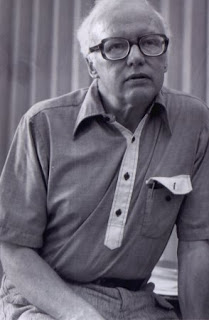
John D. MacDonald
They were meant to be commercial products, and their main appeal today is nostalgia. They’re a kind of mausoleum of postwar American machismo. McGee is the classic wish-fulfillment daydream: an idler on a permanent vacation, who lives on a houseboat on Florida’s Atlantic Coast. He is tanned, ruggedly handsome and muscular; irresistible to women (something about his rueful romantic melancholy and his preference for athletic, commitment-free sex); and intimidating to men (in the late and feeble “Free Fall in Crimson,” where McGee should by rights be filling out membership forms for AARP, his superior masculinity awes and humbles a motorcycle gang).
In novel after novel, nobody ever bests McGee, nobody ever seriously challenges him—though the bad guys do sneak up behind him and knock him unconscious so many times you wonder if he needs a neurologist on speed dial. Meanwhile, the action keeps grinding to a halt so McGee can vent his opinions on contemporary life: the best power tools, the perfect cocktail, the proper way to set up stereo speakers, the menace of air conditioning in grocery stores. These opinions are notable mainly for their unconscious philistinism—as when the perfect dinner menu proves to be this staccato bark: “medium rare, butter on the baked, Italian dressing.” No real man in those days ever ate anything but steak, potato and salad.
But then there’s the rest of MacDonald’s oeuvre. Random House is issuing these in a jumble of paperback reprints and e-book exclusives, but at least they’re there, and no longer need be scrounged out at ruinous prices from the secondhand market. These are the books MacDonald did before he invented McGee, when he was trying out every conceivable pop genre of the postwar market, from soft-core sex comedies to psychological horror.
Article continues at: http://online.wsj.com/news/articles/SB10001424127887323324904579040672688388630
Filed under book review, John D. MacDonald
John D. MacDonald
Pulp Serenade: John D. MacDonald on Words and Writing (2).
Recently, I came across an in-depth article on John D. MacDonald from around the time of the movie adaptation of Darker Than Amber. “The man who writes those Travis McGee stories: A look at John D. MacDonald” was written by Mike Baxter and was published in The Washington Post Times Herald on Feb 1, 1970. It was a fairly lengthy article, but below are excerpts of some of the most insightful parts:
[Mickey] Spillane visits [John D.] MacDonald’s home at intervals, and both write mysteries. As craftsmen, however, they are as close as Eldridge Cleaver and Sam Spade. Even Spillane can recognize the gulf. “I am a writer; you are an author,” The Mick once told MacDonald. There is more in that than semantic nonsense.
MacDonald writes on a beige IBM Selectric as if Doom were about to unplug it in the last great denouement…He devotes a business-like seven-to-nine hours a day writing, doing it until the lunch hour, then doing it again until the cocktail hour. Fast subtraction shows that this leaves “too little time, dammit” for other pursuits.
More at: http://www.pulpserenade.com/2011/10/john-d-macdonald-on-words-and-writing-2.html
Filed under John D. MacDonald, writing tip, writing tips
REWRITING? TRY SOME “HIGHER EDITING”
By DAN POLLOCK
“Do you like Kipling?” goes the old joke. Answer: “I don’t know, you naughty boy, I’ve never kippled.”
At age 23 Rudyard Kipling’s sensational debut was comparable to that of Charles Dickens. “The star of the hour,” aid Henry James when Rudyard was only 25. “Too clever to live,” said Robert Louis Stevenson.

Higher editing
“Higher Editing” he called it, and I’ll get to the specifics of his technique in a few moments.
My first thriller, Lair of the Fox, was sold on the basis of an outline and the first 100 pages to a small publisher (Walker & Co). The completed manuscript weighed in at 120,000 words – every one them perfect, I’ll have you know.
But my editor informed me that, in order to reduce their printing and binding costs, Walker never published trade books over 80,000 words. Would I mind cutting 40,000 words from my manuscript? I did it — with the help of Kipling’s “Higher Editing” method. And the book is much the better for it.
DIGEST YOUR WORDS
A famous American editor had this advice: “Play ‘digester’ to your manuscript; imagine that you are an editorial assistant on a digest magazine performing a first squeeze on the article to be digested. Can you squeeze out an unnecessary hundred words from each thousand in your draft?”
Mystery writer John D. MacDonald used the reductive process as an intrinsic part of his creative plan. A magazine profile once described him “tapping out the 1,000-page drafts that he whittles down to 300-page manuscripts in four months.”
For this reductive process to work, however, you have to put your heart and soul into that first draft, like Tom Wolfe or John MacDonald. Don’t edit or second-guess yourself the first time through; let yourself be driven forward by the compelling emotion of your story; to switch metaphors, trowel on the raw pigment, which you can shape later at leisure.
To quote editor Gorham Munson, “Write as a writer, rewrite as a reader.”
THE LEONARD METHOD
Elmore Leonard went from a journeyman paperback writer (westerns and detectives) to best-sellerdom and Hollywood fame by taking an opposite tack. He began to edit himself in advance – on his first draft. As he famously put it (his rule No. 10 of good writing): “Try to leave out the part that readers tend to skip.”
If you can do that, bravo! Most writers have to go back over their work and painfully cut out the deadwood.
Here is the method used by Belgian mystery master Georges Simenon:
INTERVIEWER: “What do you cut out, certain kinds of words?”
SIMENON: “Adjectives, adverbs, and every word which is there just to make an effect. Every sentence which is there just for the sentence. You know, you have a beautiful sentence — cut it. Every time I find such a thing in one of my novels it is to be cut.”
To quote Leonard again, “If it sounds like writing, I rewrite it.”
HIGHER EDITING
So we come, at last, to Kipling’s “Higher Editing.” Here he describes how he used it on his debut story collection, Plain Tales From the Hills:
“This leads me to the Higher Editing. Take of well-ground Indian Ink as much as suffices and a camel-hair brush proportionate to the interspaces of your lines. In an auspicious hour, read your final draft and consider
faithfully every paragraph, sentence and word, blacking out where requisite. Let it lie by to drain as long as possible.
“At the end of that time, re-read and you should find that it will bear a second shortening. Finally, read it aloud alone and at leisure. Maybe a shade more brushwork will then indicate or impose itself. If not, praise Allah and let it go, and ‘when thou hast done, repent not’…. The magic lies in the Brush and the Ink.”
—————-
Dan Pollock is the author of four thriller novels: Lair of the Fox, Duel of Assassins, Orinoco,and a specially commissioned “logistics” thriller, Precipice. He and his wife, Connie, a writer-editor, live in Southern California with their two children. You’ll find his blog at: http://clicks.aweber.com/y/ct/?l=O8uEK&m=IhM0eF8OM_LsQz&b=kuZLqdii5DpvdVIbrBuqlw
[Editor’s note: This entry comes courtesy of Bruce Hale. Bruce has written and illustrated over 25 books for kids. His Underwhere series includes Prince of Underwhere and Pirates of Underwhere. His Chet Gecko Mysteries series includes: The Chameleon Wore Chartreuse, The Big Nap, The Malted Falcon, Hiss Me Deadly, and others. More at http://www.brucehale.com/]
Filed under Writing Tip Wednesday


 Booker's Blog