Tag Archives: Hachette

Please read

James Patterson Would Like You to Read

By Troy Patterson

Source: http://www.newyorker.com/books/page-turner/james-patterson-would-like-you-to-read?mbid=rss

Author James Patterson would like you to read.

Author James Patterson would like you to read.

In the tradition of Don DeLillo, Salman Rushdie, and Joseph Heller, James Patterson drafted his early books by moonlight while holding a day job as an advertising copywriter. But none of those other guys ever won a Clio, much less rose to an executive suite at J. Walter Thompson, where the storytellers stoke mass desire on an industrial scale.

Patterson became the best-selling novelist of the twenty-first century on the strength of his superlative skills as an adman—his knack for the art of the sale, his gift for managing creative talent. Relying on a retinue of co-authors, he is the chief executive of an unsleeping pulp mill perpetually boosting capacity. He has placed nineteen books on the Times’ best-seller lists since January. He has three hundred and twenty-five million books in print and an annual income of something like ninety million dollars. He has a new pitch.

One recent afternoon, Patterson summoned this interviewer (no relation) to an expense-account joint in midtown. He inhabited his corner banquette with no airs, drank his Diet Coke with mild thirst, and spoke with a lot of Hudson Valley in his voice. Patterson was born sixty-nine years ago in Newburgh, New York—the town across from Beacon on the wrong side of the river—and his accent did something untranscribable when he mentioned his filing drawers. The drawers are in the home office at his winter palace, in Palm Beach. Very deep, they hold a hundred and seventeen fresh manuscripts, slender but all good to go.

Patterson has enticed Hachette Book Group to grant him reign over a new imprint called BookShots. Each volume runs twenty-five to thirty thousand words, or a hundred and twenty-five to a hundred and fifty pages, or somewhere between one full “Double Indemnity” and two-thirds a “Gatsby.” Tolstoy is a full meal; Turgenev is a fabulous dessert; a BookShot is a bag of Funyuns. “We have this convention of the novel that you have to know everything about the frigging characters,” Patterson said. “Like: What? You know, a lot of people don’t know their spouses that well.”

Patterson “grew up being a little literary snob” who matured into knowing his limits. “At a certain point, it occurred to me I couldn’t write ‘One Hundred Years of Solitude,’ but at that point I read ‘The Day of the Jackal.’ “ This he could maybe manage. He settled on a practical poetics: “Action reveals character even more than ‘bullshit, bullshit, bullshit’ in our heads.” BookShots is the natural extension of this philosophy. Why muck around with interiority? Why must a mass-market paperback aspire to the thickness of a foam travel pillow? Why not test the demand for low-commitment narratives priced at five dollars a hit? “I’m certainly not trying to break any new ground in terms of the structure of the novel,” Patterson said. “I just find that less seems to be more.”

One of the first BookShots—published this week, precisely a year after Patterson presented the concept—is “Cross Kill.” An installment of Patterson’s Alex Cross series, it is one of the few productions to flow from his solitary pen. Controlled prose, confirmed audience, a first printing of five hundred thousand copies, great. And Patterson plainly relishes collaborating with reporters on a true-crime horror show, titled “Filthy Rich,” about the highly affluent sex criminal Jeffrey Epstein. But most often he farms out the word processing to co-authors, who receive detailed outlines and send back work that ranges in quality from vibrant schlock to hectic dreck. He’s also curating a BookShots Flames series for readers who crave to imagine the love shared by, say, an Appletini-tippling city gal and a rodeo cowboy named Tanner. “I came up with title for that one,” Patterson said. The title for that one is “Learning to Ride.”

When I asked what inspired BookShots, Patterson said, “I was kinda blocked,” using the word in an awesome caricature of the opposite of its usual sense. He published seventeen books in 2015. Only seventeen! With all his ideas and his infrastructure? With so many pots potentially boiling in his institutional kitchen?! Hachette is scheduled to published twenty-three BookShots in 2016, plus fifteen other Patterson titles. These numbers are open to upward revision.

“My hope is that it increases the habit of reading,” Patterson said. He is sincere in this goal, which aligns both with his philanthropic support of literacy and his personal gripes about the electorate’s analytic skills. “We have this country of nincompoops now.” It is discouraging, for instance, to see the populace swayed by political promises of mass deportations: “Like thirty million cops come to their homes and walk them across the Rio Grande? I mean, stop it already.” (I wondered if the author still golfs at the Trump course in West Palm. “Yeah, I do sometimes,” he said. “I go there to golf, not to vote.”) “You go to Sweden”—a country of ten million people—“and they have books that sell a million copies there. Gas stations sell books. It’s good for people.”

When I wondered about Patterson’s commercial hopes for the new project, he evaded the question quite suavely. “You know, I remember a long time ago—uh, who’s the ‘Star Wars’ guy?” George Lucas? “Yeah, I met him a really long time ago, and we were talking about his idea of success, and he said, ‘My thing is, I just keep pushing the rock up the steep hill, and as long as I feel like I keep going up the hill it’s good.’ You know, same thing.”

“You do what you can do,” Patterson said. “I’m not an empire builder.”

Leave a comment

Filed under 2016, book publishing, books

Big Publishing is the Problem | Hugh Howey

Big Publishing is the Problem | Hugh Howey.

A few weeks ago, I speculated that Hachette might be fighting Amazon for the power to price e-books where they saw fit, or what is known as Agency pricing. That speculation was confirmed this week in a slide from Hachette’s presentation to investors:

So, no more need to speculate over what this kerfuffle is about. Hachette is strong-arming Amazon and harming its authors because they want to dictate price to a retailer, something not done practically anywhere else in the goods market. It’s something US publishers don’t even do to brick and mortar booksellers. It’s just something they want to be able to do to Amazon.

The biggest problem with Hachette’s strategy is that Hachette knows absolutely nothing about retail pricing. That’s not their job. It’s not their area of expertise. They don’t sell enough product direct to consumers to understand what price will maximize their earnings. Amazon, B&N, Kobo, and Apple have that data, not Hachette.

Beyond their ignorance of pricing strategy, Hachette also has a strong bias toward print books. Their existing relationships with major brick and mortar retailers gets in the way of their e-book pricing. This has been confirmed by my own publishers, who have admitted privately that they would like to experiment with digital pricing but don’t want to upset print book retailers. This puts their pricing strategy at odds with their investors’ needs, their authors’ needs, even their own profitability. In sum, they are making irrational decisions with their pricing philosophy. Hachette is making the same mistake that many publishers make, which is to think that harming Amazon somehow helps themselves.

The same presentation by Hachette to investors stressed the importance of DRM and

The rest of the article at: http://www.hughhowey.com/big-publishing-is-the-problem/

1 Comment

Filed under publishers, publishing, publishing news

SJ ROZAN: Russo’s Open Letter

SJ ROZAN.

2014-07-13 11:48 AM
Open letter from Richard Russo on Amazon vs. Hachette

Richard Russo is President of the Author’s Guild. This is long but, if you’re wondering what’s going on, worth reading. I’d like to say he took the words right out of my mouth, but he uses better words.

“The primary mission of the Authors Guild has always been the defense of the writing life. While it may be true that there are new opportunities and platforms for writers in the digital age, only the willfully blind refuse to acknowledge that authorship is imperiled on many fronts. True, not all writers are equally impacted. Some authors still make fortunes through traditional publishing, and genre writers (both traditionally published and independently published) appear to be doing better than writers of nonfiction and “literary” mid-list fiction. (The Guild has members in all of these categories.) But there’s evidence, both statistical and anecdotal, that as a species we are significantly endangered. In the UK, for instance, the Authors’ Licensing and Collecting Society reports that authors’ incomes have fallen 29 percent since 2005, a decline they deem “shocking.” If a similar study were done in the U.S., the results would be, we believe, all too similar.

“On Tuesday, Amazon made an offer to Hachette Book Group that would “take authors out of the middle” of their ongoing dispute by offering Hachette authors windfall royalties on e-books until the dispute between the companies is resolved. While Amazon claims to be concerned about the fate of mid-list and debut authors, we believe their offer – the majority of which Hachette would essentially fund – is highly disingenuous. For one thing, it’s impossible to remove authors from the middle of the dispute. We write the books they’re fighting over. And because it is the writing life itself we seek to defend, we’re not interested in a short-term windfall to some of the writers we represent. What we care about is a healthy ecosystem where all writers, both traditionally and independently published, can thrive. We believe that ecosystem should be as diverse as possible, containing traditional big publishers, smaller publishers, Amazon, Apple, Barnes & Noble and independent bookstores, as well as both e-books and print books. We believe that such an ecosystem cannot exist while entities within it are committed to the eradication of other entities.

To read the rest, go to: http://journalscape.com/sjrozan/2014-07-13-11:48/

Leave a comment

Filed under Amazon, publishing

Amazon Is NOT the Vladimir Putin of the Publishing World – The Daily Beast

Amazon Is NOT the Vladimir Putin of the Publishing World – The Daily Beast.

by Nick Gillespie

In its battle with Hachette, Amazon is being compared to Putin and the Mafia—by critics who want you to pay more for books.

Can you believe those…those…those…sons of bitches at Amazon? After launching almost 20 years ago and making virtually every book—new, used, dead-tree, electronic, audio, and I’m guessing any day now, olfactory—available to everyone in America at good-to-great prices, the company’s true character now stands revealed. It’s not pretty, folks. Despite a huge market share, Amazon apparently still wants books, especially the e-books that everyone agrees are the future of the medium, to be cheaper than what publishers and big-name authors want you to pay for them.

Just who the hell does Amazon think it is? Maybe a bare-chested tyrant who used to work for the KGB? Amazon is “like Vladimir Putin mobilizing his troops along the Ukrainian border,” a proprietor of an “e-book discovery site” tells The New York Times. “A bully,” offers Richard Russo, the novelist and president of the Authors Guild (which knows exactly how to bully mere “writers”). Amazon, says author James Patterson, who published 13 detective books last year, is waging “war” and doing unspeakable things for which “the quality of American literature will suffer.” No, wait. That’s all wrong. Amazon isn’t like a Russian despot waging a war, says Dennis Loy, proprietor of the small publisher Melville House. It’s more like “the Mafia.”


More at: http://www.thedailybeast.com/articles/2014/06/05/amazon-is-not-the-vladimir-putin-of-the-publishing-world.html

1 Comment

Filed under Amazon, book publishing, publishing

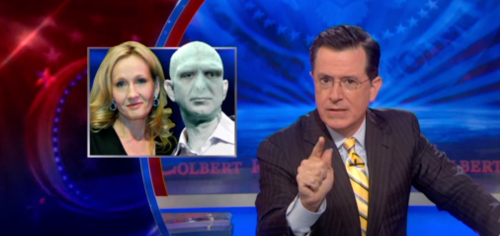
Stephen Colbert Gives Jeff Bezos the Finger — Twice

Stephen Colbert Gives Jeff Bezos the Finger — Twice.

Amazon is messing with the wrong guy.

A few days after best-selling author Malcolm Gladwell came out against the online retailer for raising prices and delaying shipments of his books because of a dispute with publisher Hachette, Colbert has done the same. Colbert’s plaint, however, is funnier.

During a segment on Wednesday night’s Colbert Report, Colbert announced he was “mad prime” at Amazon for its latest actions. In particular, Colbert mocked Amazon’s suggestion that consumers in the market for his books should buy a used copy.

[Editor’s note: I think writer Sherman Alexie is correct. This is a battle between two big companies and the person(s) to support are the authors, who are getting smashed by both sides in this battle.]

Source: http://mashable.com/2014/06/05/stephen-colbert-amazon/#:eyJzIjoiZiIsImkiOiJfbDN3ZHQ3eDIza3NsOXdmZCJ9

Leave a comment

Filed under Amazon, book publishing, publishing

A Newbie’s Guide to Publishing: Fisking Lilith Saintcrow and the Hachette/Amazon Situation

A Newbie's Guide to Publishing: Fisking Lilith Saintcrow and the Hachette/Amazon Situation.

Sample of blog entry:
Fisking Lilith Saintcrow and the Hachette/Amazon Situation

People often disagree with my posts, and some do it in the comments section.

This promotes healthy debate and discourse. As long as people stay civil with each other, they can post whatever they like, including insulting me. I’ve only had to kick a few people out over the years, after giving them multiple chances to cool off.

One of the wonderful things about the Internet is the ability for people to engage with different viewpoints and test each others’ arguments.

I don’t know Lilith Saintcrow. She’s a writer with Hachette, and has just blogged about this situation. She’s wrong, which is fine. Normally that wouldn’t irk me. But in her comments section, she’s disemvoweling people who disagree with her (it’s a cute form of censuring where all the vowels are removed from the comment).

So now I’m going to bring the debate here, to A Newbie’s Guide, by explaining in detail how wrong Lili Saintcrow is. Normally I don’t take my peers to task like this, but I really dislike the way Lili is handling dissenters on her blog. She’s deliberately obstructing what could have been a healthy debate.

No offense intended, Lili. I’m sure you’re a wonderful person and a wonderful writer. And I do understand how you are frustrated at this situation. Your sales are suffering, and it is beyond your control, so naturally you want to place blame and voice your discontent.

But I believe you aren’t looking at the big picture, and cutting off comments on your blog isn’t how you, or anyone following you, can use this situation as a learning experience.

Blog post in its completeness: http://jakonrath.blogspot.com/2014/05/fisking-lilith-saintcrow-and.html

Leave a comment

Filed under Uncategorized