
Source: 17 Science Fiction Books That Forever Changed The Genre | Lifehacker Australia
Speculative fiction is the literature of change and discovery. But every now and then, a book comes along that changes the rules of science fiction for everybody. Certain great books inspire scores of authors to create something new. Here are 21 of the most influential science fiction and fantasy books.
These are books which clearly inspired a generation of authors, and made a huge splash either in publishing success or critical acclaim. Or both. And these are in no particular order.
#1 The Hitchhiker’s Guide to the Galaxy by Douglas Adams (1979)
The first (maybe only) science-fiction-comedy-multimedia phenomenon, Hitchhiker’s was a radio drama before it was a book, and the book sold 250,000 copies in its first three months.The Guardian named it one of the 1000 novels everyone must read, and a BBC poll ranked it fourth, out of 200, in their Big Read poll.
Ted Gioia comments on Adams’ hilarious book about the trials and tribulations of Arthur Dent, the survivor of a destroyed Earth, across the universe:
“No book better epitomizes the post-heroic tone of sci-fi than Douglas Adams’ The Hitchhiker’s Guide to the Galaxy. As the name indicates, a certain louche bohemianism permeates its pages. This is star-hopping on the cheap, pursued by those aiming not to conquer the universe, but merely sample its richeson fewer than thirty Altairian dollars per day. You can trace the lineage of many later science fictions books, with their hip and irreverent tone, back to this influential and much beloved predecessor.”
#2 20,000 Leagues Under the Sea by Jules Verne (1870)
Verne’s whole career is full of works that have inspired generations of authors — but this tale of the underwater adventure of Captain Nemo and the Nautilus has also had a profound effect on science, and inspired real scientific advancement.
In the introduction to William Butcher’s book Verne’s Journey to the Centre of the Self Ray Bradbury wrote that, “We are all, in one way, children of Jules Verne. His name never stops. At aerospace or NASA gatherings, Verne is the verb that moves us to space.”
Verne translator and scholar F.P. Walter added:
“For many, then, this book has been a source of fascination, surely one of the most influential novels ever written, an inspiration for such scientists and discoverers as engineer Simon Lake, oceanographer William Beebe, polar traveller Sir Ernest Shackleton. Likewise Dr. Robert D. Ballard, finder of the sunken Titanic, confesses that this was his favourite book as a teenager, and Cousteau himself, most renowned of marine explorers, called it his shipboard bible.”
#3 Dhalgren by Samuel R. Delaney (1975)
Sam Anderson prefaced his interview with Samuel R. Delany with this praise for Dhalgren’s impact:
“In the 35 years since its publication, Dhalgren has been adored and reviled with roughly equal vigour. It has been cited as the downfall of science fiction (Philip K. Dick once called it “the worst trash I’ve ever read”), turned into a rock opera, dropped by its publisher, and reissued by others. These days, it seems to have settled into the groove of a cult classic. In a foreword in the current edition, William Gibson describes the book as “a literary singularity” and Jonathan Lethem called it “the secret masterpiece, the city-book-labyrinth that has swallowed astonished readers alive.”
Dhalgren has remained popular through the years, being reprinted 7 times since 1975. It was also dropped by Bantam, the original publisher, because of its willingness to tackle LGBT themes despite the fact that the Bantam version sold over a million copies and went through 19 printings.
#4 War of the Worlds by H.G. Wells (1898)
In his book about The War of the Worlds, a seminal look at an invasion of Earth by Martians, author Brian Holmsten states:
“Since 1898 the War of the Worlds has been translated into countless languages, adapted by comic books, radio, film, stage, and even computer games, and has inspired a wide range of alien invasion tales in every medium. Few ideas have captured the imagination of so many people all over the world in the last century so well.
“It is a tribute to H.G. Wells that his story of alien conquest was not only the first of its kind, but remains one of the best.”
The 1927 American reprint, it can be argued, was one of the touching-off points for the Golden Age of science fiction. It inspired John W. Campbell to write and commission invasion stories — which also prompted authors like Arthur C. Clarke, Clifford Simak, Robert A. Heinlein and John Wyndham to do the same.
#5 Foundation by Isaac Asimov (1951)
Foundation is a sweeping tale of pyschohistory and the battle for the intellectual soul of a civilisation. and According to the BBC:
“The Foundation series helped to launch the careers of three notable science fiction authors of the succeeding generation. Janet Asimov sanctioned these novels, which were published in the late 1990s: Foundation’s Fear by Gregory Benford, Foundation and Chaos by Greg Bear, and Foundation’s Triumph by David Brin.” And without a doubt it launched the imaginations of countless other writers.”
It is also worth mentioning that the Foundation series won the 1966 Hugo for best all-time series. An award that has not been given out since.
And this book’s influence goes beyond science fiction: Artificial intelligence pioneer Marvin Minsky classified Asimov “among the finest of modern philosophers,” and Nobel-prize-winning economist Paul Krugman describesFoundation as his version of Atlas Shrugged, “I didn’t grow up wanting to be a square-jawed individualist or join a heroic quest; I grew up wanting to be Hari Seldon, using my understanding of the mathematics of human behaviour to save civilisation.”
#6 Stranger in a Strange Land by Robert Heinlein (1961)
The first science-fiction work to enter the New York Times Book Review’s bestseller list, Stranger sold 100,000 copies in hardcover and over five million in paperback. This book’s influence can’t be overstated. Arthur D. Hlavaty refers to Heinlein as a prototypical science-fiction author, saying:
“One of the ways human beings organise the world is by prototypes. We define a set as a typical example and a bunch of other things that are like it. For instance, when I was growing up, the prototype Writer was Shakespeare, the Artist was Rembrandt, and the Composer was Beethoven. In that way, Robert A. Heinlein has often been taken as the prototype Science Fiction Writer, and as changes and new paradigms shake the field, he still sometimes represents the science fiction of the past.”
Writer Ted Gioia looks at Stranger in a Strange Land’s main character as a prototype for other similar characters in SF, saying: “Smith is more than a character. He is prototype of an alternative personality structure. The question of whether we can remake the human personality from the ground up.”
#7 Dangerous Visions, edited by Harlan Ellison (1967)
This series helped launch the careers of almost every major author of the New Wave. The first volume included Samuel R. Delany, Philip K. Dick, and J.G. Ballard. In his introduction to the 2002 reissue of Ellison’s anthology, contributor Michael Moorcock wrote of Ellison’s collections:
“He changed our world forever. And ironically, it is usually the mark of a world so fundamentally altered — be it by Stokely Carmichael or Martin Luther King Jr. or Lyndon Johnson, or Kate Millet — that nobody remembers what it was like before things got better. That’s the real measure of Ellison’s success.”
“Gonna Roll the Bones” by Fritz Leiber won a Hugo Award and a Nebula Award for Best novelette. “Riders of the Purple Wage” a novella by Philip José Farmer tied for the Hugo Award. Samuel R. Delany got the Nebula for Best Short Story for “Aye, and Gomorrah…” Ellison was given a commendation at the 26th World SF Convention for editing “the most significant and controversial SF book” published in 1967.
#8 Childhood’s End by Arthur C. Clarke (1953)
Arthur C. Clarke himself had reservations about this novel, yet it sold out its first printing, 200,000 copies, in just two months after publication. Author Jo Walton writes about the first book to feature benevolent aliens who try to help the human race evolve:
“Science fiction is a very broad genre, with lots of room for lots of kinds of stories, stories that go all over the place and do all kinds of things. One of the reasons for that is that early on there got to be a lot of wiggle room.
“Childhood’s End was one of those things that expanded the genre early and helped make it more open-ended and open to possibility.
“Clarke was an engineer and he was a solidly scientific writer, but he wasn’t a Campbellian writer. He brought his different experiences to his work, and the field is better for it.”
Childhood’s End was nominated for a retro Hugo award in 2004.
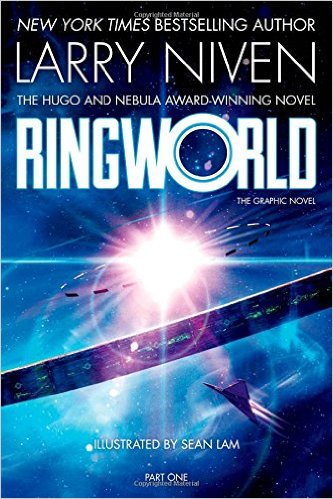
#9 Ringworld by Larry Niven (1970)
Sam Jordison of the Guardian had this to say about Ringworld, the masterpiece that is centered around around a theoretical ring-shaped space-habitat:
“Larry Niven’s 1970 Hugo award winner, Ringworld, is arguably one of the most influential science fiction novels of the past 50 years. As well as having had a huge impact on nearly all subsequent space operas (Iain M Banks’ Culture series and Alastair Reynolds’ House of Suns are just two), the book has helped generate a multi-billion-dollar industry.”
To add to this Jonathan Cowie, who wrote Essetial SF: A Concise Guide, called Ringworld “a landmark novel of planetary engineering (for want of a better term) that ranks alongside the late Bob Shaw’s Orbitsville.”
Niven later added four sequels and four prequels which tie into numerous other books set in Known Space; the fictional setting of about a dozen science fiction novels and several collections of short stories.
The other books are listed and discussed at: http://www.lifehacker.com.au/2016/09/17-science-fiction-books-that-forever-changed-the-genre/


 Booker's Blog