
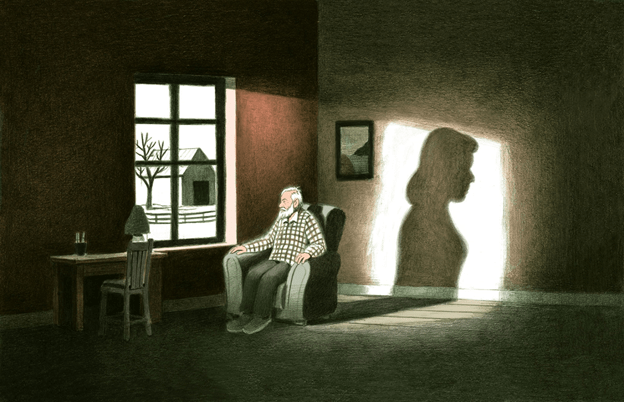
At eighty-seven, I am solitary. I live by myself on one floor of the 1803 farmhouse where my family has lived since the Civil War. After my grandfather died, my grandmother Kate lived here alone. Her three daughters visited her. In 1975, Kate died at ninety-seven, and I took over. Forty-odd years later, I spend my days alone in one of two chairs. From an overstuffed blue chair in my living room I look out the window at the unpainted old barn, golden and empty of its cows and of Riley the horse. I look at a tulip; I look at snow. In the parlor’s mechanical chair, I write these paragraphs and dictate letters. I also watch television news, often without listening, and lie back in the enormous comfort of solitude. People want to come visit, but mostly I refuse them, preserving my continuous silence. Linda comes two nights a week. My two best male friends from New Hampshire, who live in Maine and Manhattan, seldom drop by. A few hours a week, Carole does my laundry and counts my pills and picks up after me. I look forward to her presence and feel relief when she leaves. Now and then, especially at night, solitude loses its soft power and loneliness takes over. I am grateful when solitude returns.
Born in 1928, I was an only child. During the Great Depression, there were many of us, and Spring Glen Elementary School was eight grades of children without siblings. From time to time I made a friend during childhood, but friendships never lasted long. Charlie Axel liked making model airplanes out of balsa wood and tissue. So did I, but I was clumsy and dripped cement onto wing paper. His models flew. Later, I collected stamps, and so did Frank Benedict. I got bored with stamps. In seventh and eighth grade, there were girls. I remember lying with Barbara Pope on her bed, fully clothed and apart while her mother looked in at us with anxiety. Most of the time, I liked staying alone after school, sitting in the shadowy living room. My mother was shopping or playing bridge with friends; my father added figures in his office; I daydreamed.
In summer, I left my Connecticut suburb to hay with my grandfather, on this New Hampshire farm. I watched him milk seven Holsteins morning and night. For lunch I made myself an onion sandwich—a thick slice between pieces of Wonder Bread. I’ve told of this sandwich before.
At fifteen, I went to Exeter for the last two years of high school. Exeter was academically difficult and made Harvard easy, but I hated it—five hundred identical boys living two to a room. Solitude was scarce, and I labored to find it. I took long walks alone, smoking cigars. I found myself a rare single room and remained there as much as I could, reading and writing. Saturday night, the rest of the school sat in the basketball arena, deliriously watching a movie. I remained in my room in solitary pleasure.
At college, dormitory suites had single and double bedrooms. For three years, I lived in one bedroom crowded with everything I owned. During my senior year, I managed to secure a single suite: bedroom and sitting room and bath. At Oxford, I had two rooms to myself. Everybody did. Then I had fellowships. Then I wrote books. Finally, to my distaste, I had to look for a job. With my first wife–people married young back then; we were twenty and twenty-three–I settled in Ann Arbor, teaching English literature at the University of Michigan. I loved walking up and down in the lecture hall, talking about Yeats and Joyce or reading aloud the poems of Thomas Hardy and Andrew Marvell. These pleasures were hardly solitary, but at home I spent the day in a tiny attic room, working on poems. My extremely intelligent wife was more mathematical than literary. We lived together and we grew apart. For the only time in my life, I cherished social gatherings: Ann Arbor’s culture of cocktail parties. I found myself looking forward to weekends, to crowded parties that permitted me distance from my marriage. There were two or three such occasions on Friday and more on Saturday, permitting couples to migrate from living room to living room. We flirted, we drank, we chatted–without remembering on Sunday what we said Saturday night.
After sixteen years of marriage, my wife and I divorced.
For five years I was alone again, but without the comfort of solitude. I exchanged the miseries of a bad marriage for the miseries of bourbon. I dated a girlfriend who drank two bottles of vodka a day. I dated three or four women a week, occasionally three in a day. My poems slackened and stopped. I tried to think that I lived in happy license. I didn’t.
Jane Kenyon was my student. She was smart, she wrote poems, she was funny and frank in class. I knew she lived in a dormitory near my house, so one night I asked her to housesit while I attended an hour-long meeting. (In Ann Arbor, it was the year of breaking and entering.) When I came home, we went to bed. We enjoyed each other, libertine liberty as much as pleasures of the flesh. Later I asked her to dinner, which in 1970 always included breakfast. We saw each other once a week, still dating others, then twice a week, then three or four times a week, and saw no one else. One night, we spoke of marriage. Quickly we changed the subject, because I was nineteen years older and, if we married, she would be a widow so long. We married in April, 1972. We lived in Ann Arbor three years, and in 1975 left Michigan for New Hampshire. She adored this old family house.
For almost twenty years, I woke before Jane and brought her coffee in bed. When she rose, she walked Gus the dog. Then each of us retreated to a workroom to write, at opposite ends of our two-story house. Mine was the ground floor in front, next to Route 4. Hers was the second floor in the rear, beside Ragged Mountain’s old pasture. In the separation of our double solitude, we each wrote poetry in the morning. We had lunch, eating sandwiches and walking around without speaking to each other. Afterward, we took a twenty-minute nap, gathering energy for the rest of the day, and woke to our daily fuck. Afterward I felt like cuddling, but Jane’s climax released her into energy. She hurried from bed to workroom.
For several hours afterward, I went back to work at my desk. Late in the afternoon, I read aloud to Jane for an hour. I read Wordsworth’s “Prelude,” Henry James’s “The Ambassadors” twice, the Old Testament, William Faulkner, more Henry James, seventeenth-century poets. Before supper I drank a beer and glanced at The New Yorker while Jane cooked, sipping a glass of wine. Slowly she made a delicious dinner—maybe veal cutlets with mushroom-and-garlic gravy, maybe summer’s asparagus from the bed across the street—then asked me to carry our plates to the table while she lit the candle. Through dinner we talked about our separate days.
Summer afternoons we spent beside Eagle Pond, on a bite-sized beach among frogs, mink, and beaver. Jane lay in the sun, tanning, while I read books in a canvas sling chair. Every now and then, we would dive into the pond. Sometimes, for an early supper, we broiled sausage on a hibachi. After twenty years of our remarkable marriage, living and writing together in double solitude, Jane died of leukemia at forty-seven, on April 22, 1995.
Now it is April 22, 2016, and Jane has been dead for more than two decades. Earlier this year, at eighty-seven, I grieved for her in a way I had never grieved before. I was sick and thought I was dying. Every day of her dying, I stayed by her side—a year and a half. It was miserable that Jane should die so young, and it was redemptive that I could be with her every hour of every day. Last January I grieved again, this time that she would not sit beside me as I died.
By Donald Hall, October 15, 2016




 Booker's Blog