Tag Archives: ErNest Hemingway

Writing tip Wednesday: “Work Alone”

Work Alone: Ernest Hemingway’s 1954 Nobel Acceptance Speech

“Writing, at its best, is a lonely life.”

By Maria Popova

https://www.brainpickings.org/2013/03/21/ernest-hemingway-1954-nobel-speech/

“One can never be alone enough to write,” Susan Sontag observed. Solitude, in fact, seems central to many great writers’ daily routines — so much so, it appears, that part of the writer’s curse might be the ineffable struggle to submit to the spell of solitude and escape the grip of loneliness at the same time.

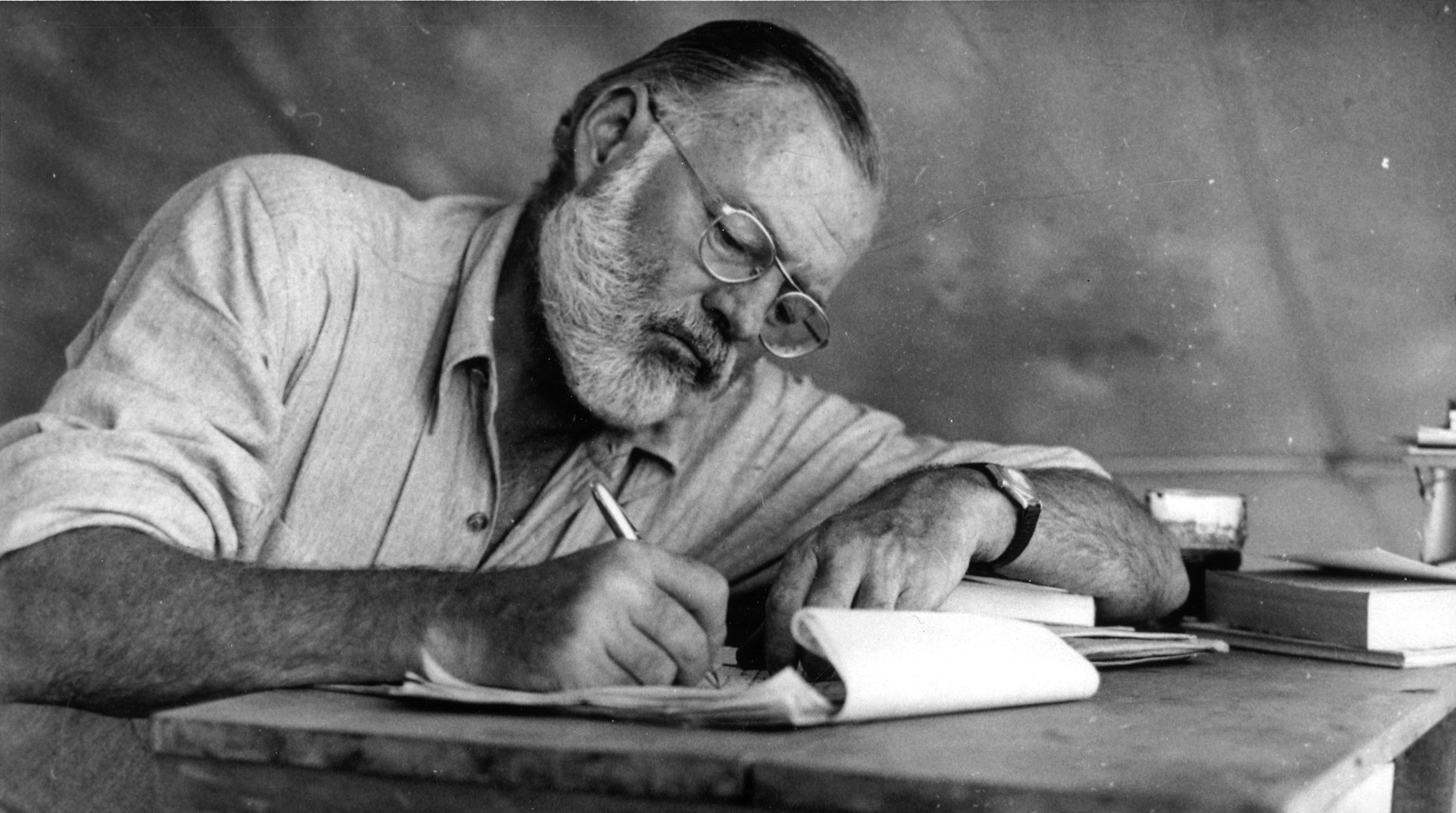
Ernest Hemingway

In October of 1954, Ernest Hemingway was awarded the Nobel Prize in Literature. But he didn’t exactly live every writer’s dream: First, he told the press that Carl Sandburg, Isak Dinesen and Bernard Berenson were far more worthy of the honor, but he could use the prize money; then, depressed and recovering from two consecutive plane crashes that had nearly killed him, he decided against traveling to Sweden altogether. Choosing not to attend the Nobel Banquet at the City Hall in Stockholm on December 10, 1954, Hemingway asked John C. Cabot, the United States Ambassador to Sweden at the time, to read his Nobel acceptance speech, found in the 1972 biography Hemingway: The Writer as Artist (public library). At a later date, Hemingway recorded the speech in his own voice. Hear an excerpt, then read the transcript of the complete speech below:

Having no facility for speech-making and no command of oratory nor any domination of rhetoric, I wish to thank the administrators of the generosity of Alfred Nobel for this Prize.

No writer who knows the great writers who did not receive the Prize can accept it other than with humility. There is no need to list these writers. Everyone here may make his own list according to his knowledge and his conscience.

It would be impossible for me to ask the Ambassador of my country to read a speech in which a writer said all of the things which are in his heart. Things may not be immediately discernible in what a man writes, and in this sometimes he is fortunate; but eventually they are quite clear and by these and the degree of alchemy that he possesses he will endure or be forgotten.

Writing, at its best, is a lonely life. Organizations for writers palliate the writer’s loneliness but I doubt if they improve his writing. He grows in public stature as he sheds his loneliness and often his work deteriorates. For he does his work alone and if he is a good enough writer he must face eternity, or the lack of it, each day.

For a true writer each book should be a new beginning where he tries again for something that is beyond attainment. He should always try for something that has never been done or that others have tried and failed. Then sometimes, with great luck, he will succeed.

How simple the writing of literature would be if it were only necessary to write in another way what has been well written. It is because we have had such great writers in the past that a writer is driven far out past where he can go, out to where no one can help him.

I have spoken too long for a writer. A writer should write what he has to say and not speak it. Again I thank you.
Leave a comment

Filed under 2019, writing tip, Writing Tip Wednesday

Writing tip Wednesday: “Work Alone: Ernest Hemingway’s 1954 Nobel Acceptance Speech”

“Writing, at its best, is a lonely life.”

By Maria Popova

https://www.brainpickings.org/2013/03/21/ernest-hemingway-1954-nobel-speech/

“One can never be alone enough to write,” Susan Sontag observed. Solitude, in fact, seems central to many great writers’ daily routines — so much so, it appears, that part of the writer’s curse might be the ineffable struggle to submit to the spell of solitude and escape the grip of loneliness at the same time.

Ernest Hemingway

In October of 1954, Ernest Hemingway was awarded the Nobel Prize in Literature. But he didn’t exactly live every writer’s dream: First, he told the press that Carl Sandburg, Isak Dinesen and Bernard Berenson were far more worthy of the honor, but he could use the prize money; then, depressed and recovering from two consecutive plane crashes that had nearly killed him, he decided against traveling to Sweden altogether. Choosing not to attend the Nobel Banquet at the City Hall in Stockholm on December 10, 1954, Hemingway asked John C. Cabot, the United States Ambassador to Sweden at the time, to read his Nobel acceptance speech, found in the 1972 biography Hemingway: The Writer as Artist (public library). At a later date, Hemingway recorded the speech in his own voice. Hear an excerpt, then read the transcript of the complete speech below:

Having no facility for speech-making and no command of oratory nor any domination of rhetoric, I wish to thank the administrators of the generosity of Alfred Nobel for this Prize.

No writer who knows the great writers who did not receive the Prize can accept it other than with humility. There is no need to list these writers. Everyone here may make his own list according to his knowledge and his conscience.

It would be impossible for me to ask the Ambassador of my country to read a speech in which a writer said all of the things which are in his heart. Things may not be immediately discernible in what a man writes, and in this sometimes he is fortunate; but eventually they are quite clear and by these and the degree of alchemy that he possesses he will endure or be forgotten.

Writing, at its best, is a lonely life. Organizations for writers palliate the writer’s loneliness but I doubt if they improve his writing. He grows in public stature as he sheds his loneliness and often his work deteriorates. For he does his work alone and if he is a good enough writer he must face eternity, or the lack of it, each day.

For a true writer each book should be a new beginning where he tries again for something that is beyond attainment. He should always try for something that has never been done or that others have tried and failed. Then sometimes, with great luck, he will succeed.

How simple the writing of literature would be if it were only necessary to write in another way what has been well written. It is because we have had such great writers in the past that a writer is driven far out past where he can go, out to where no one can help him.

I have spoken too long for a writer. A writer should write what he has to say and not speak it. Again I thank you.

Leave a comment

Filed under 2019, writing tip, Writing Tip Wednesday

6 Famous Authors With Shocking Beliefs | Inverse

Source: 6 Famous Authors With Shocking Beliefs | Inverse

When we fall in love with a novel, we sometimes believe we come to know its author just by reading the book. From reading the Harry Potter novels one can easily conclude that its author — J.K. Rowling — is intolerant of oppression, politically progressive, a strong believer in diversity, and most certainly, British. All of these things about Rowling are overwhelmingly true, though if we found out she hated children, we’d probably be totally scandalized. (She doesn’t, thankfully).

Similarly, if you read Robert A. Heinlein’s Stranger in a Strange Land you might erroneously assume the author was a free-love hippie, when in fact, Heinlein’s libertarian and conservative views couldn’t be further from the tone of that particular novel. With Robert Heinlein and Stranger in a Strange Land, it’s almost as if the novel’s free-love protagonist offers a mirror image to the novelist — it’s Dr. Jekyll to a Mr. Hyde, say — something that is true of other writers on this list. Here are six super-famous writers with beliefs that are either inversions of their literary reputations, or just straight-up fascinating.

Philip K. Dick Thought He Was a Robot and, Also, the Spirit of Elijah

Okay, so this one isn’t too shocking. In addition to believing he was contacted by intelligences from beyond, the prolific and visionary sci-fi writer Philip K. Dick also toyed with the idea that he may, in fact, have been a robot. While the events of many of his novels (notably Do Androids Dream of Electric Sheep?) certainly check with this passing fancy of Dick’s, he also flirted with the idea that he was possessed by the spirit of the biblical prophet Elijah. So, next time you’re at a Seder, ask if you can leave something out for Philip K. Dick and see if anyone gets it.

Sir Arthur Conan Doyle Believed in Fairies

In Conan Doyle’s short story “The Adventure of the Sussex Vampire” the protagonist — the great Sherlock Holmes — says, “This Agency stands flat-footed upon the ground and there it must remain. The world is big enough for us. No ghost need apply.” Throughout the 56 short stories and four novels chronicling the adventures of Sherlock Holmes, never once does the stoic detective flirt with a belief in the supernatural or paranormal. And yet, late in his life, the creator of the uber-rational Sherlock Holmes, Sir Arthur Conan Doyle himself, asserted frequently that he had seen fairies and other supernatural creatures. Perhaps when Conan Doyle attempted to kill off Sherlock Holmes, he was attempting to destroy his rational side to have more fun with fairy thoughts. Either that, or fairies are totally real.

Anne Rice Found God

The author of Interview With the Vampire briefly became extremely pious, and even authored Christian texts (including her novel Christ the Lord: Out of Egypt). While the steamy and grotesque nature of her vampire books seems to be in stark opposition to traditional Christianity, as of 2010, Anne Rice maintains that she is still “committed to Christ.” But to be clear, Rice did officially leave the Catholic Church because she felt that being a “Christian,” was “quarrelsome” and “hostile.” It’s unclear if there are any parallels between her feelings about quarrelsome religious folks and the frequently quarrelsome vampire, Lestat.

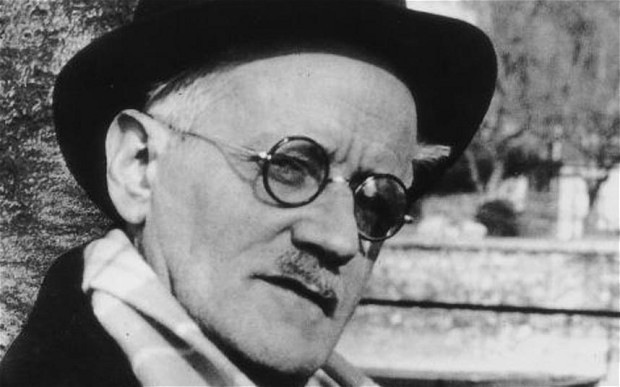
James Joyce Thought Radio Controlled the Weather

In Sylvia Beach’s excellent memoir, Shakespeare and Company, the publisher and proprietor of the famous Parisian bookstore recounts her fascinating dealings with the late author of Ulysses, James Joyce. One interesting tidbit was Joyce’s growing impatience with the rise of radios in culture. Specifically, Joyce thought there was obviously some kind of correlation between the surge of radios use and rainstorms in France. Climate change deniers, take that! Or actually, don’t. Let James Joyce have it.

Hemingway Wanted to Work for the KGB?

While this one is disputed, there is some indication that Ernest Hemingway was recruited by the KGB in 1941 and that he was a secret agent named “Argo.” The only problem is that apparently Hemingway was really bad at being a double agent — assuming he really wanted to be one — as he never really supplied the KGB with any good intelligence. While we tend to think of Hemingway as an American man of his time (as he’s portrayed in Midnight in Paris), his real-life political leanings were certainly all over the place. While it might be surprising that Hemingway had communist beliefs in the ‘40s, it’s not totally implausible.

Stephen King Hates Adverbs

Stephen King may be the undisputed master of horror, but there’s only one thing truly fears: adverbs. King maintains that adverbs were created with “the timid writer in mind.” He may be an extremely creative guy, but I don’t want to even think about how many grotesque and sickening adverbs I’ve overzealously employed to get my points across throughout the years.

Leave a comment

Filed under 2017, authors

Writing tip Wednesday: “Locked Room Challenge”

Stuck in your story and don’t know where to go? Maybe this will help.

by David E. Booker

Locked Room Challenge

Among some science fiction writers there is a challenge known as the shortest story. Someone once said the shortest science fiction story was: “Last man on Earth sat alone in a room. There was a knock on the door.” Then somebody else made it shorter by writing: “Last man on Earth sat alone in a room. There was a lock on the door.” Ernest Hemingway reportedly wrote the shortest story that went something like this: “Newspaper ad. For sale. Brand new baby shoes. Never used.”

What does this have to do with being struck?

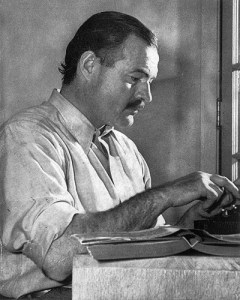
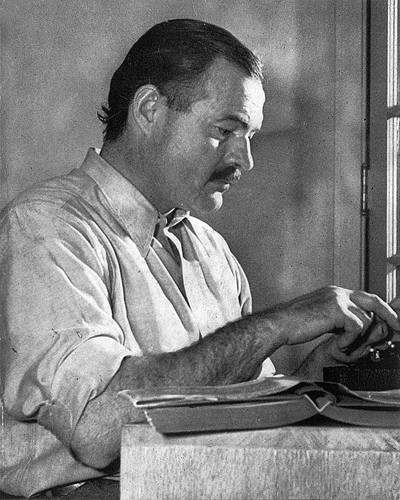
Ernest Hemingway at typewriter

Ernest Hemingway at typewriter

Maybe nothing, but maybe when you are, take your protagonist or even your antagonist and make him or her the last person on Earth. In a locked room. Then there is a knock on the door. What does he do? How does she react? Maybe it is a very small room and your character is already feeling very anxious because he hates being in confined spaces. Write out what your character would do. A few hundred words. Five hundred at most.

Or maybe your character reads the ad or has to place the ad. Why did he have to place the ad? Did he lose a child? Did she break up with a man who had a child and she can’t return the shoes because they are a discontinued brand, but she has to do something with them. Does she need the money? Maybe they were expensive shoes. Or maybe they were bought years ago and she forgot she had them still and is now moving and can’t take them with her.

Or think of a scene of your own. But it has to be a scene where an important decision has to be made and one that affects the character emotionally, physically, mentally, spiritually – at least two of the three.

Often a writer is stuck because he doesn’t understand something about at least one of his characters, and doing this can help uncover a layer of the character that is important to the story. Who knows, what you write might even become a scene in the story or novel you are working on.

Leave a comment

Filed under 2016, writing tip, Writing Tip Wednesday

Writing Quotes from Hemingway

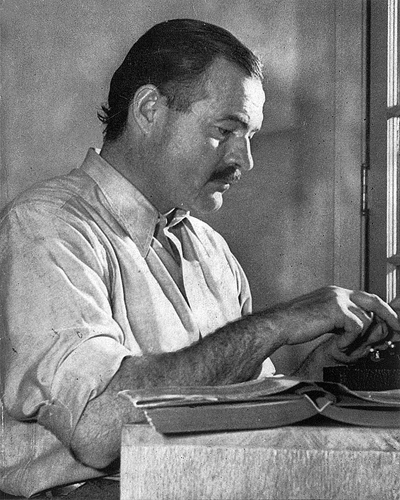
Ernest Hemingway at typewriter

Ernest Hemingway at typewriter

  1. If a writer knows enough about what he is writing about, he may omit things that he knows. The dignity of movement of an iceberg is due to only one ninth of it being above water.
  2. That is what we are supposed to do when we are at our best – make it all up – but make it up so truly that later it will happen that way.
  3. When writing a novel a writer should create living people; people not characters. A character is a caricature.
  4. All you have to do is write one true sentence. Write the truest sentence that you know.
  5. To F. Scott Fitzgerald: “Write the best story that you can and write it as straight as you can.”
  6. To an aspiring writer: “You shouldn’t write if you can’t write.”

Leave a comment

Filed under writing quotes, writing tip, writing tips