Tag Archives: e-book

The return of the printed book

Books are back. Only the technodazzled thought they would go away

The hysterical cheerleaders of the e-book failed to account for human experience, and publishers blindly followed suit. But the novelty has worn off

by Simon Jenkins

Source: http://www.theguardian.com/commentisfree/2016/may/13/books-ebook-publishers-paper?CMP=fb_gu

At last. Peak digital is at hand. The ultimate disruptor of the new information age is … wait for it … the book.

Chair in the last bookshop

Books are back

Shrewd observers noted the early signs. Kindle sales initially outstripped hardbacks but have slid fast since 2011. Sony killed off its e-readers. Waterstones last year stopped selling Kindles and e-books outside the UK, switched shelf space to books and saw a 5% rise in sales.

Amazon has opened its first bookshop.

Now the official Publishers’ Association confirms the trend. Last year digital content sales fell last year from £563m to £554m. After years on a plateau, physical book sales turned up, from £2.74bn to £2.76bn.

They have been boosted by the marketing of colouring and lifestyle titles, but there is always a reason. The truth is that digital readers were never remotely in the same ballpark. The PA regards the evidence as unmistakable, “Readers take a pleasure in a physical book that does not translate well on to digital.” Virtual books, like virtual holidays or virtual relationships, are not real. People want a break from another damned screen.

What went wrong? Clearly publishing, like other industries before (and since), suffered a bad attack of technodazzle: It failed to distinguish between newness and value. It could read digital’s hysterical cheerleaders, but not predict how a market of human beings would respond to a product once the novelty had passed. It ignored human nature. Reading the meaning of words is not consuming a manufacture: it is experience.

As so often, the market leader was the music business. Already, by the turn of the 21st century, its revenues were shifting dramatically from reproduction to live. This was partly because recording and distributing music became so cheap there was no profit margin, but it was largely because the market had changed. Buyers, young and old, wanted to witness music played in the company of like minds, and were prepared to pay for the experience – often to pay lots. Soon the same was true for live sport, live theatre, even live talks. The festival has become king. The money is back at the gate.

Books must be the ultimate test. Admittedly some festivals now give away books for free and charge instead to hear the writers speak.

But just buying, handling, giving and talking about a book seems to have caught the magic dust of “experience”. A book is beauty. A book is a shelf, a wall, a home.

The book was declared dead with the coming of radio. The hardback was dead with the coming of paperbacks. Print-on-paper was buried fathoms deep by the great god, digital. It was rubbish, all rubbish. Like other aids to reading, such as rotary presses, Linotyping and computer-setting, digital had brought innovation to the dissemination of knowledge and delight. But it was a means, not an end.

Since the days of Caxton and Gutenberg, print-on-paper has shown astonishing longevity. The old bruisers have seen off another challenge.

Leave a comment

Filed under 2016, book publishing, books

Court ruling against Apple over e-book pricing upheld

Apple’s mistake was hooking up with the book-publishing cartel

Source: http://fortune.com/2015/06/30/apple-court-books/

An appeal court’s decision finding Apple guilty of collusion with publishers reinforces just how cozy a cartel the industry was.

Apple may be trying to keep the spotlight on its latest foray into the streaming-music business, but it is also still trying to clean up the mess caused by its ham-handed entry into an earlier market: book publishing. A federal court on Tuesday rejected the company’s appeal of an earlier ruling that found it guilty of orchestrating a conspiracy with the major book publishers, in what the court said was a successful attempt to artificially inflate the price of e-books.

As Fortune‘s Jeff Roberts reports, the court found Apple AAPL -0.16% engaged in collusion with what amounted to an oligopoly—namely, Harper Collins, Penguin, Simon & Schuster, Hachette and Macmillan—and that its actions were a clear breach of antitrust law. Apple argued that the deal it cut with the publishers was necessary to blunt Amazon’s dominance in the e-book market, but the appeals court didn’t buy that argument. Judge Debra Ann Livingston wrote:

“Competition is not served by permitting a market entrant to eliminate price competition as a condition of entry, and it is cold comfort to consumers that they gained a new ebook retailer at the expense of passing control over all ebook prices to a cartel of book publishers.”

One reason the court failed to buy this argument is that the major publishers clearly had zero interest in actually competing on price—in fact, they wanted to do exactly the opposite. Their interest in doing a deal with Apple stemmed from a desire to maintain the existing favorable price structure for books, which allowed them to milk the market for high-priced hardcover versions of new novels before eventually releasing cheaper versions. Amazon’s AMZN 0.07% low-priced e-books were a threat.

Rest of the article: http://fortune.com/2015/06/30/apple-court-books/

***
One lawyer’s comments on the judgment:

The Passive Voice

Source: http://www.thepassivevoice.com/07/2015/apples-mistake-was-hooking-up-with-the-book-publishing-cartel/

After strong-arming Amazon into accepting the new “agency pricing” model—in which the publishers got to set the price for their books, rather than allowing the retailer to do so—the book industry got exactly what it wanted. According to research by the Justice Department, the price of newly released books rose by an average of 24% and bestsellers climbed by 40%.

It says a lot about the book-publishing business that doing this actually caused book sales to drop fairly dramatically across the board: research done by another expert using data from Random House showed that publishers who switched to the agency model sold close to 15% fewer books than they would have otherwise. So the industry was effectively willing to trade a short-term decline in sales for the increase in power that they got over pricing as a result of the deal with Apple.

Full blog entry at: http://www.thepassivevoice.com/07/2015/apples-mistake-was-hooking-up-with-the-book-publishing-cartel/

Leave a comment

Filed under 2015, book publishing

Big Publishing is the Problem | Hugh Howey

Big Publishing is the Problem | Hugh Howey.

A few weeks ago, I speculated that Hachette might be fighting Amazon for the power to price e-books where they saw fit, or what is known as Agency pricing. That speculation was confirmed this week in a slide from Hachette’s presentation to investors:

So, no more need to speculate over what this kerfuffle is about. Hachette is strong-arming Amazon and harming its authors because they want to dictate price to a retailer, something not done practically anywhere else in the goods market. It’s something US publishers don’t even do to brick and mortar booksellers. It’s just something they want to be able to do to Amazon.

The biggest problem with Hachette’s strategy is that Hachette knows absolutely nothing about retail pricing. That’s not their job. It’s not their area of expertise. They don’t sell enough product direct to consumers to understand what price will maximize their earnings. Amazon, B&N, Kobo, and Apple have that data, not Hachette.

Beyond their ignorance of pricing strategy, Hachette also has a strong bias toward print books. Their existing relationships with major brick and mortar retailers gets in the way of their e-book pricing. This has been confirmed by my own publishers, who have admitted privately that they would like to experiment with digital pricing but don’t want to upset print book retailers. This puts their pricing strategy at odds with their investors’ needs, their authors’ needs, even their own profitability. In sum, they are making irrational decisions with their pricing philosophy. Hachette is making the same mistake that many publishers make, which is to think that harming Amazon somehow helps themselves.

The same presentation by Hachette to investors stressed the importance of DRM and

The rest of the article at: http://www.hughhowey.com/big-publishing-is-the-problem/

1 Comment

Filed under publishers, publishing, publishing news

Writing tip Wednesday: “To Indie or not to Indie publish”

Most Amazon bestselling authors aren’t making minimum wage

By Charlie Jane Anders

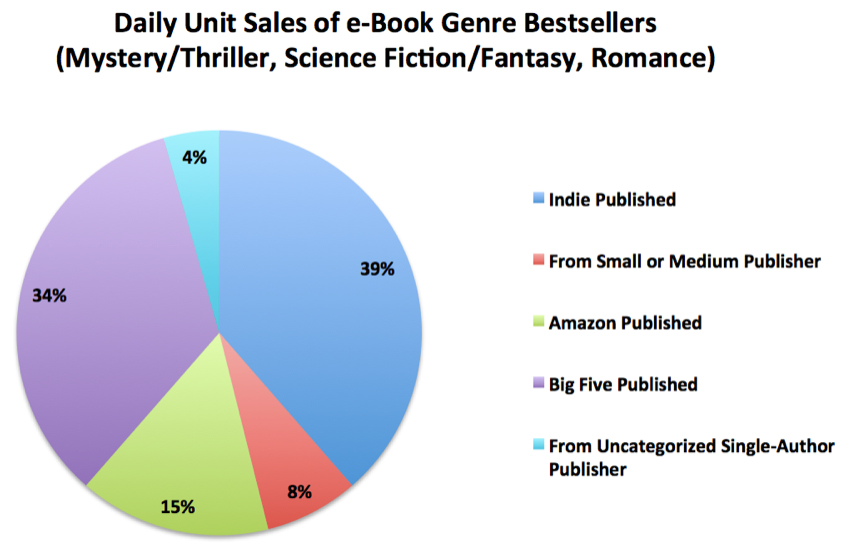
Yesterday we posted a chart from Hugh Howey’s new report on author earnings, showing indie and self-published authors pulling ahead of people published by the “big five” in terms of total unit sales. Now here’s another chart from an e-book publishing expert who’s calling some of Howey’s conclusions into question.

Chart:

E-book sales. Source: Hugh Howey

E-book sales. Source: Hugh Howey

Writing in Digital Book World, Dana Beth Weinberg points out that there are a number of questions about Howey’s data, even beyond the potential flaws that you’d already noticed. For one thing, Howey isn’t representing all self-published and indie authors — just the top 1.5 percent, or the cream of the crop. There are also some questionable assumptions in Howey’s methodology, writes Weinberg, and some statistical problems.

But leaving that stuff aside, even if you accept Howey’s data and his conclusions, it’s not clear that most of his indie/self-published authors are doing better than people published by the big mainstream publishers, argues Weinberg. What is clear, though, is that the people who are doing best, on Amazon e-book sales, are those published by Amazon’s own publishing imprints.

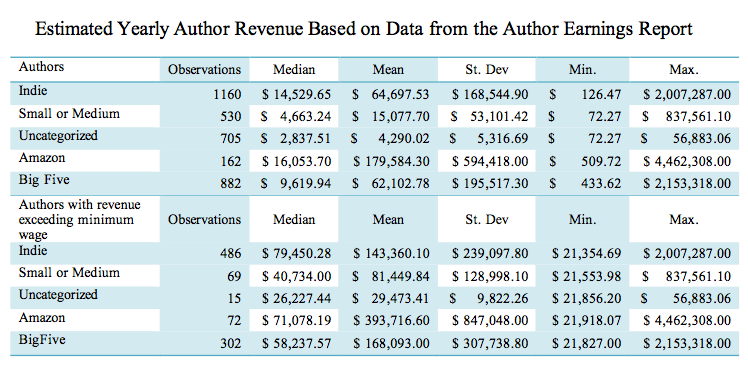
The really depressing thing? Weinberg estimates that most of the authors in the survey, whether self-published or published by a New York publishing house, are not making minimum wage:

Sales figures:

A different look at e-book sales.

A different look at e-book sales.

Full article at: http://io9.com/most-amazon-bestselling-authors-arent-making-minimum-w-1522482723

Source material at:
The Report, by Hugh Howey, Feb. 12, 2014
Full article at: http://authorearnings.com/the-report/

The Principal of Digital Abundance — thoughts on author earnings, by Damien G. Walter, Feb. 12, 2014
Full article at: http://damiengwalter.com/2014/02/12/the-principle-of-digital-abundance-thoughts-on-author-earnings/

Note: This post suggested by Research Assistant Ashlie

Leave a comment

Filed under writing tip, Writing Tip Wednesday

E-book battles: writers pawns and prize

[Editor’s note: while not directly related to the e-book lawsuit, it is related as it pertains to Amazon, probably the biggest seller of books and e-books. As before, to find out more about the e-book lawsuit, click on e-book in the “Filed under” section at the bottom of this blog post. Thanks for stopping by.]

Source: http://www.nytimes.com/2012/04/16/business/media/amazons-e-book-pricing-a-constant-thorn-for-publishers.html?src=recg

April 15, 2012

Daring to Cut Off Amazon

New York Times

By DAVID STREITFELD

TULSA, Okla. — Plenty of people are upset at Amazon these days, but it took a small publishing company whose best-known volume is a toilet-training tome to give the mighty Internet store the boot.

The Educational Development Corporation, saying it was fed up with Amazon’s scorched-earth tactics, announced at the end of February that it would remove all its titles from the retailer’s virtual shelves. That eliminated at a stroke $1.5 million in annual sales, a move that could be a significant hit to the 46-year-old EDC’s bottom line.

“Amazon is squeezing everyone out of business,” said Randall White, EDC’s chief executive. “I don’t like that. They’re a predator. We’re better off without them.”

It is an unequal contest. EDC has 77 employees, no-frill offices on an industrial strip here and a stock-market valuation of $18 million — hardly a threat to Amazon, a Wall Street darling worth $86 billion. But Mr. White’s bold move to take his 1,800 children’s books away from the greatest retailing success of the Internet era is more evidence of the extraordinary tumult within the book world over one simple question: who gets to decide how much a book costs?

The Justice Department last week sued five major publishers and Apple on price-fixing charges, simultaneously settling with three of the houses. The publishers say they were not illegally colluding but simply taking advantage of a new device platform — Apple’s iPad — to sell their e-books in a different way, where they controlled the prices.

The publishers wanted to stop Amazon from using what one of them called “the wretched $9.99 price point,” according to court papers. Selling e-books so cheaply, they feared, would solidify Amazon’s robust grip on the business while simultaneously building a low-price mind-set among consumers that could prove ruinous to other bookstores and the publishers themselves.

EDC does not produce e-books, but saw exactly this happening with its physical inventory. Amazon was buying EDC’s books from a distributor and discounting them to the bone, just as it does with everything it sells. This might have been a boon for readers, but it was creating trouble with other retailers who carry the company’s titles, as well as with EDC’s network of independent sales agents, who market its books from their homes.

“They were becoming showrooms for Amazon,” Mr. White said. “We were shooting ourselves in the foot.”

Amazon is generally reluctant to explain its business practices and declined to comment for this article. But its executives say it is shaking up an antiquated business model by eliminating middlemen and passing the savings on to consumers. Publishers that try to cling to the past, they have said, will die.

The retailer’s growing list of critics, however, argue that Amazon has $48 billion in revenue but hardly any profit, proof that its approach is opportunistic and unsustainable. When traditional publishers, booksellers and wholesalers are destroyed, these opponents say, Amazon will be left with a monopoly that will be detrimental to the larger health of the culture.

In recent months, the dispute over Amazon’s strategy of selling books below cost has boiled over from several directions.

During the holiday season, Amazon encouraged customers to use physical stores as showrooms before ordering more cheaply online, a move that infuriated bookstores in particular. Publishers and distributors say that Amazon, never exactly shy in negotiating terms, has been more assertive in its quest for ever-better deals.

In February, Amazon demanded better margins from the Independent Publishers Group, a Chicago distributor of dozens of small imprints. IPG balked, so Amazon removed nearly 5,000 of the company’s e-books from its site.

“Amazon wants the price of books to be very, very low — lower than the publishing community can support,” said Curt Matthews, IPG’s chief executive. “Making a book is still a craft industry. Books need to be edited, to be publicized. Someone needs to say this is good and this is not. If there is not enough money to support that whole chain, the system will break down.”

Publishers have often been ambivalent about Amazon. On the one hand, it offers an extraordinarily efficient method of distributing their wares. Readers anywhere can easily order the most obscure volume and have it delivered the next day. With e-books, access is even easier, but publishers’ vulnerability is compounded; Amazon controls not just the method of distribution but the actual device the text is consumed on.

“Last year was the best in our 37 years, mainly due to the way Amazon was pushing the books,” said Bryce Milligan of Wings Press in San Antonio, an IPG client. “Then Amazon cut us off because they couldn’t get a better deal. Now our e-books sales are down 50 percent.”

If publishers and wholesalers feel threatened, writers are caught in the middle — both pawns and prize.

Ted McClelland, a writer in Chicago, had two IPG e-books dropped by Amazon. He just got a royalty statement on one of them, “Horseplayers: Life at the Track.” Half of his modest income on the book came from Kindle sales on Amazon.

“I don’t know whether Amazon is being greedy or IPG is being cheap, but I’m caught in the middle,” Mr. McClelland said. “What matters to me is getting my books back on Kindle.”

Here in Tulsa, EDC operates out of offices on the eastern outskirts in a less-than-glamorous district of warehouses and auto supply shops. Like IPG, it is primarily a distributor, selling picture books developed in England by Usborne Books to toy stores and bookshops in the United States. Its publishing line, Kane Miller, produces the popular “Everyone Poops” book and its sequels.

EDC’s so-called consultants — a direct sales force of about 7,000 women — sell to friends and acquaintances as well as their local schools. For a while the party plan was successful. Sales more than doubled from 2000 to 2004.

In recent years, though, the consultants have found it rough going. They would pass around a picture book like “The Noisy Body Book” or “Guess How Much I Miss You,” talking it up, and then the customer would order it online. Sales fell about 20 percent. Frustrated consultants began quitting.

What happened in February to Christy Reed, a sales consultant in Pleasanton, Tex., was becoming all too routine. Her school district decided to order 16 copies of a science encyclopedia and a science dictionary but then completed the deal on Amazon.

“I worked so hard to sell those books,” Mrs. Reed said. “I had to talk to so many different people. Then I lost the sale to a couple of clicks on the computer.”

She acknowledged that the district saved a few dollars but added: “I’m here, in the neighborhood. I went to school here. My kids went to school here. Yes, they got the books for less. But my earnings go back into our community. Amazon’s do not.”

After Mr. White, EDC’s chief, heard about that episode, his exasperation with Amazon peaked. Several times in the past, he had grappled with the retailer. He tried to get it to lower its discount on his books three years ago, but a tentative deal did not stick, he said. He was outraged that the company did not collect sales tax, which had the effect of making its books even cheaper.

Two months ago, he asked his biggest wholesaler, Baker & Taylor, to stop selling all EDC books to Amazon. When Baker & Taylor refused, Mr. White canceled its account. Baker & Taylor declined repeated requests to comment about EDC.

Of EDC’s $26 million in annual revenue, Baker & Taylor was responsible for about 6 percent, most of which was because of Amazon. Mr. White, a trim 70, said that when he made the decision to bail out, his blood pressure soared. But he’s also reveling in the excitement, just a little. He commissioned a drawing of EDC in the role of David taking on the giant Amazon. “I’m Type A,” he said. “I don’t mind a fight.”

Somewhat to Mr. White’s surprise, EDC is doing better without Amazon, at least for the moment. (Some of its books are still available on Amazon from third-party sellers.) Sales in March rose, in part because of new accounts like a toy store in Round Rock, Tex., that placed an initial order for 61 books. And colleagues in the business have been congratulating the publisher, or at least expressing their admiration for Mr. White’s guts.

“I tell them, ‘You never had the chance to make 7,000 women happy in one day,’ ” he said.

Leave a comment

Filed under books, e-book, publishers, publishing

E-book publishing lawsuit article / opinion

Source: http://www.nytimes.com/2012/04/16/business/media/amazon-low-prices-disguise-a-high-cost.html?_r=1

April 15, 2012

Book Publishing’s Real Nemesis

By DAVID CARR

The Justice Department finally took aim at the monopolistic monolith that threatened to dominate the book industry. So imagine the shock when the bullet aimed at threats to competition went whizzing by Amazon — which not long ago had a 90 percent stranglehold on e-books — and instead, struck five of the six biggest publishers and Apple, a minor player in the realm of books.

That’s the modern equivalent of taking on Standard Oil but breaking up Ed’s Gas ’N’ Groceries on Route 19 instead.

Last week, the Justice Department sued in United States District Court in New York, charging that Apple, Hachette, HarperCollins, Macmillan, Penguin and Simon & Schuster had colluded to fix e-book prices. (Hachette, Simon & Schuster and HarperCollins have already agreed to settle.)

The suit has its roots in 2007, when Amazon released the Kindle and began selling some of the most sought-after books for $9.99 in order to bolster sales of its device. Not surprisingly, booksellers and publishers hated this price with the force of 10,000 suns because it made physical books sold for $25 or more seen outrageously overpriced.

Under the wholesale arrangement with Amazon, the publishers received half of the list price, which yielded better money, but gave them no control over the pricing of their product. With the introduction of the iPad, publishers got a crack at remaking their deal because Apple allowed them to set the price and then took a cut of 30 percent.

That so-called agency model developed with Apple allowed publishers, not just Amazon, to set the price and in a move that caught the interest of the Justice Department, they all came up with pretty much the same price. (Why the crumbling book business is worthy of so much attention from Justice while Wall Street skates is a broader question we’ll leave for another day.)

Let’s stipulate that there may have been some manner of price-fixing here, perhaps even arranged in “private rooms for dinner in upscale Manhattan restaurants,” as the complaint darkly charged. The Justice Department is entrusted with, among other things, protecting the interests of American consumers and, given a narrow focus on price, its move on the publishers make sense.

But pull back a few thousand feet and take a broader look at the interests of consumers From the very beginning and with increasingly regularity, Amazon has used its market power to bully and dictate. It leaned on the Independent Publishers Group in recent months for better terms and when those negotiations didn’t work out, Amazon simply removed the company’s almost 5,000 e-books from its virtual shelves. The Seattle Times just published a series with examples of how Amazon uses its scale not only to keep its prices low, but its competitors at bay.

As low-margin companies trapped in a declining business with fewer outlets, book publishers face an existential threat. “If we are fixing prices for our benefit, we don’t seem to be very good at it,” said one publishing executive mordantly. (He declined to be named criticizing the lawsuit because of his involvement in the settlement.)

The deal struck with Apple also allowed other players into the e-book business, including independent bookstores. Previously, Amazon’s $9.99 subprofit price was a virtually impenetrable barrier to entry for anyone who couldn’t afford to lose millions in order to gain market share. Remember that it was only after agency pricing went into effect that Barnes & Noble was able to gain an impressive 27 percent of the e-book market.

Now Amazon has the Justice Department as an ally to rebuild its monopoly and wipe out other players. If the decision to charge the publishers was good for competition, why had the stock price of Barnes & Noble dropped more than 10 percent since Wednesday? Borders is long gone, and the possible loss of Barnes & Noble would be bad for consumer choice, online or off.

There are some ironies here. Amazon views e-books as cheap software sold to animate device sales, in this case, the Kindle. And who does that remind you of? Ah yes, Apple, which shrank music to a 99-cent single business to propel the sale of iPods.

This time, Apple is on the side of the angels, mostly because the company doesn’t have the leverage of a dominant device. Peter Kafka at AllThingsD dug out a throwaway line in the middle of the complaint from the Justice Department that said, “Apple also contemplated illegally dividing the digital content world with Amazon, allowing each to ‘own the category’ of its choice — audio/video to Apple and e-books to Amazon.”

The counterargument to the publishers’ position runs like this: why should consumers be saddled with paying an extra few dollars just to keep competition alive? In the short term, the answer seems clear. But Richard Epstein, a professor at the New York University School of Law, pointed out, “it is not clear that lower prices are necessarily in the long-term interests of the public at large.”

He said that lower prices work both ways, spelling “low costs to consumers and low royalties to authors.” Anyone who has written a book, including me, can tell you that book publishing has always been a bit of a clubby business, with uniform practices in realms beyond pricing. Among many other standards: sell your book to any publisher you wish, but you will never get more than 15 percent of net royalties on the hardcover edition.

Robert F. Levine, a lawyer with an extensive practice in publishing, said there’s a practical reason for all that uniformity. The book business is both hermetic and dwindling.

“There is not a drop of new capital coming into this business,” he said. “The margins are low and there is almost no growth, so you end up with a rather small industry, with a handful of companies and a handful of players.” Scott Turow, a big-time author who is president of the Authors Guild, worries that the club is going to get a lot smaller. “It is breathtaking to stand back and look at this and believe that this is in the public interest,” he said. “The only rationale is e-book prices will go down, for how long? What happens when there is no one left to compete with them?”

I’d be lying if I said I didn’t get a little thrill when I found out on Amazon that I could get an e-book version of “Fifty Shades of Grey,” the No. 1 book on the New York Times best-seller list, for just $9.99. But after a week of watching the Justice Department and Amazon team up, I’ve learned that low prices come with a big cost. Maybe I’ll order it at my local bookstore instead.

carr@nytimes.com; Twitter: @carr2n

[Editor’s note: you can find additional entries on this subject, by clicking on e-book listed below.]

Leave a comment

Filed under e-book, publishers, publishing

E-book pricing: lawsuit filed

Source: http://www.latimes.com/entertainment/news/la-et-apple-authors-20120413,0,6062761.story

Lawsuit against Apple: Writers wary of action by Dept. of Justice

Michael Connelly and Sherman Alexie are among authors who view the Justice Department’s suit against Apple and five publishers as acting against writers’ interests.

By Carolyn Kellogg, Los Angeles Times

April 13, 2012

When the Department of Justice and state officials announced their lawsuits against Apple and five major publishers Wednesday, it sent a ripple of anxiety through the talent at the industry’s heart.

“I’m in a bit of an awkward position because this has pitted my publisher against the retailer that far and away sells more of my books than any other,” says Michael Connelly, the bestselling mystery novelist. “I don’t want to bite the hand that feeds me, and both of these hands feed me.”

Connelly is published by Little, Brown, which is owned by Hachette, one of the publishers named in the suits that has since agreed to settle.

The scrutiny given to Apple’s alleged arrangement with the publishers — they are accused of colluding to raise the price of e-books, which they have denied — is largely perceived in publishing as shifting the balance of power in bookselling to Amazon. Publishers rely on Amazon as a major source of print book sales and have generally cooperated with its policies. When it launched the Kindle, Amazon deeply discounted e-book prices and offset the loss with profits from other parts of its business. Apple has been the first significant alternative to Amazon as an e-book retailer.

“I think the DOJ’s suit is misguided,” explains Andrew Wylie, the most powerful agent in publishing, who counts a number of Nobel Prize-winners among his 800 clients. “I think it is acting against the interests of culture and diversity in publishing. I think it is acting against the interests of authors.”

In part, that’s because the pricing of e-books directly affects the way authors can earn a living — and the publishing ecosystem that sustains them. “I know for a fact that my publishers and my editors publish books that they know are going to lose money but they think should be of the world,” says National Book Award-winning writer Sherman Alexie. “The John Grishams of the world support the experimental nature of publishing.” The DOJ’s suit, he says, “gave Amazon explicit permission to go for a total monopoly.”

Connelly observes that the DOJ suit seems to be unbalanced. “I believe in fair play. So I feel that if the government is going to step in and put controls on how publishers act to ensure a competitive marketplace, then I hope the government will be just as vigilant in guarding this amazing, creative and important industry from being monopolized by one entity,” he says. ” Amazon spreads my work far and wide. You can’t beat that. I’m very grateful. But I don’t want a world where there are no bookstores or other venues for discovering my work or the work of any other writers.”

For a writer just starting out, the suit served as a reminder that publishing is in flux. “I love writing and am going to continue writing, but having all my eggs in one basket is kind of scary,” says Elliott Holt, whose debut novel will be published by Penguin in 2013.

carolyn.kellogg@latimes.com

Copyright © 2012, Los Angeles Times

[Editor’s note: while I read and enjoy the works of Michael Connelly and Sherman Alexie, I don’t think the lawsuit is “misguided.” I think colluding to fix prices is misguided and as history shows, only furthers to protect the profits of those on the inside (Those fixing the prices.) at the expensive of those on the outside (Those having to pay them). Apple should not be allowed to set prices and neither should Amazon, but in this case it appears that Apple with the aid of publishers was doing just that, which profited them at the expense of book buyers. To read earlier articles on this, click on one of the Category listings below: e-book, publishers, or publishing.]

Leave a comment

Filed under authors, e-book, publishers, publishing

E-book pricing: possible lawsuit

[Editor’s note: This is a follow up to an article posted on this blog on 12/18/2011. Click on Category listing “e-book” below to bring up that article by Tom Dupree.]

Source: http://www.huffingtonpost.com/2012/04/10/apple-lawsuit-ebooks-doj_n_1416473.html?ncid=edlinkusaolp00000003

Apple Lawsuit: DOJ May Sue Tech Company Over eBooks As Early As Wednesday

By Diane Bartz and Poornima Gupta

4/10/2012 8:17 PM (Eastern Time)

WASHINGTON/SAN FRANCISCO, April 10 (Reuters) – The Justice Department could sue Apple Inc as early as Wednesday over alleged electronic book price-fixing, while settling with several publishers as early as this week, two people familiar with the matter said.

The Justice Department is investigating alleged price-fixing by Apple and five major publishers: CBS Corp’s Simon & Schuster Inc; HarperCollins Publishers Inc; Lagardere SCA’s Hachette Book Group; Pearson and Macmillan, a unit of Verlagsgruppe Georg von Holtzbrinck GmbH.

A lawsuit against Apple, one of the parties not in negotiations over a potential settlement, could come as early as Wednesday but no final decision had been made, the people said.

Apple declined to comment. The Justice Department and the five publishers could not be reached for comment.

The Justice Department is investigating whether deals Apple cut two years ago with the quintet of major publishers – when the consumer electronics maker launched its iPad tablet computer – were done with the intent of propping up prices for digital books, sources have said.

As part of those agreements, publishers shifted to a model that allowed them to set the price of e-books and give Apple a 30 percent cut of sales, the sources have said.

Talks between the Justice Department and some publishers had been proceeding, with settlements expected as soon as this week, one of the two sources familiar with the matter said on condition of anonymity, because the discussions were not public.

A negotiated settlement is expected to eliminate Apple’s so-called “most favored nation” status, which had prevented the publishers from selling lower-priced e-books through rival retailers such as Amazon.com Inc or Barnes & Noble Inc , sources had told Reuters last month.

But the situation was fluid, those sources said at the time.

Leave a comment

Filed under e-book, publishers, publishing

The price creep of e-books

This is an interesting companion piece to the one on self-publishing that I posted earlier. If interested in writing, this is also a good blog to follow. Tom Dupree has many years experience as an editor, and it would be worth your time to tap into that knowledge.

http://tomdup.wordpress.com/2011/12/15/e-customers-creeped-out-by-price-creep/

E-Customers Creeped Out By Price Creep

By Tom Dupree

There’s a piece on page 1 of today’s Wall Street Journal about e-book sticker shock, another good job by the Journal’s book-beat reporter Jeff Trachtenberg. I’ve been railing about this issue ever since Apple persuaded the six major publishers to disallow any discounting by retailers on e-books. As Mr. Trachtenberg points out, this restriction doesn’t apply to print books, so you have the increasingly common phenomenon of e-editions equaling, and even surpassing, the discounted print edition at retailers like Amazon.com. In at least one instance (emphasis on “at least”), Ken Follett’s doorstop FALL OF GIANTS, the publisher’s e-book price is $18.99 – but the paperback edition can be bought new for $16.50.

Let’s re-emphasize what’s actually going on here. The major players in an industry which faces massive headwinds, book publishing, is deliberately overpricing its most promising and fastest-growing revenue stream, specifically to dampen e-demand and reduce “cannibalization” of “higher-margin” hardcover and trade paperback editions. Mr. Trachtenberg points out that under the “retail model,” by which Amazon was charging $9.99 for new bestsellers, it was the retailer who took the loss; the author and publisher still received roughly half of the full retail price. But under the current “agency model,” the publisher retains 70%, and the retailer gets the rest. No more “loss leaders,” and essentially no more $9.99 bestsellers.

But look closer at the Follett. Dutton’s suggested retail price for this 985-page tome in hardcover is $36. Under the “retail model,” it collected $18 per e-copy, just as it did for a hardcover, and Amazon could give it away if they liked. Of course, that’s no way to run a business: “How do we do it? Volume!” What Amazon was trying to do was to jump-start a nonexistent e-book market and worry about coaxing it into profitability later; they’ve always been forward-thinking in that way. But under the “agency model,” Dutton gets 70% of $18.99, the highest price I’ve encountered for a commercial trade e-book, which is $13.30 per e-copy, and all retailers receive the same $5.70 (I rounded both numbers to the next penny). $13.30 — and remember, this is the absolute Beluga of e-pricing — is $4.70 less than $18. But who’s counting?

My point exactly.

Now let’s consider Apple’s motives. It’s a wonderful company, but it’s no less ruthless just because its antagonizer-in-chief has passed away. When Apple was the “first mover” in digital music, it used the leverage of its huge installed iPod base to oppose the big record labels by dampening the retail price from $15-$16 for a whole CD to 99 cents for an individual song (boy, that price rings a bell. And it’s increased since then, too). But in e-books, Apple found itself, uncharacteristically, in Amazon’s wake (Steve Jobs had infamously sniffed at the Kindle’s launch: “People don’t read any more”). So now what it had to do was eliminate Amazon’s price advantage – and, amazingly, in a reversal of its effect on the music business, it succeeded in propping up the retail price of e-books! Justice is now looking into whether preventing discounting constitutes illegal collusion among the major publishers (as are European authorities), and I don’t know much about the law so can’t speculate, but it does sound fishy, and it protects retailers (guaranteed profit) at the expense of consumers (higher prices).

I have some friends in the book biz who’ve read my previous musings and have some pretty good arguments that nobody seems to be considering. For example, it’s an age-old fact that for big bestselling authors like Mr. Follett, or Stephen King or John Grisham or Danielle Steel or Nora Roberts, publishers pay way too much up front as an “advance,” otherwise known as a “guarantee against royalties.” First, it’s necessary because everybody else is waving huge paychecks around, and you have to be there to compete. Second, a major author can be a tentpole for the rest of your list: if you, Ms. Retailer, want the new Grisham, you’ll have to hear about all the other great stuff we have. Third, there’s the intangible prestige factor, as authors and agents want to be with the house that publishes XXX. But these millions represent a nonrefundable guarantee which has to “earn out” before a book realizes its true potential for perennial profit down the road. (I’ve heard that Mr. King has a deal which plays down the guarantee in favor of a larger participation on the back end, like major movie stars sometimes do.) A surprise hit like THE HELP is very profitable immediately, but big bestsellers from well-known authors always start out deep in the red, and I’d love to know what Kathryn Stockett’s agent has in mind for her next contract.

That means you have to scramble for every penny you can find during the hot new-release period with the ads and the DAILY SHOW spots, very much like movie studios do. My question is: why aren’t the big publishers doing so?

Mr. Trachtenberg quotes a publisher as saying people are realizing the advantages of e-books and are willing to pay a premium for them. I’ve heard that too from some consumers. But $18.99? (P.S.: Book prices never go anywhere but up.) He shares more ominous quotes from others. A reader says it’s hard to justify a $10-$15 e-book when you can pick up a used print copy for $2 or $3 on Amazon. If that was the Ken Follett, the author and publisher made no money on the used-copy resale, when they could have received $18 for a “retail-priced” e-book. Also, the ability to self-publish and shop online is hitting the major publishers from the low end. As an industry consultant says, some e-buyers may opt for “five-star-reviewed” self-published mysteries or romances which are going for $2.99 or $3.99. Plus, if it’s digital it’s stealable, and remember that millions of otherwise law-abiding kids believed downloading from Napster was justifiable because CD prices were too high.

I think it’s fair to say that most e-reading devices have been purchased since “agency pricing” went into effect about two years ago, so possibly it’s only the early adopters like me who recoil against $12.99 and $14.99 books, or e-editions which cost more than paperbacks. Most new e-reader owners may think that’s the going rate you pay for not having to lug the physical book around, being able to read it on damn near every mobile device there is, etc. Yet as a “veteran,” I’d still be willing to wait, even a whole year, so the publishers have time to sell every hardcover they possibly can, if they’d only then give me a fairly-priced e-edition so I could fairly pay the author and publisher instead of ignoring them.

As it is, I have a list of saved backlist books that I’ll never buy in print editions; I just want to read them once. Every month or so I check on them, and every so often a publisher will experiment with a temporary lower price (this is why the publishers will probably survive any accusation of price-fixing; each one is free to charge anything it likes). I will either get the price I want, or the publisher will lose a sale which I would guess is sorely needed. It’s as simple as that.

Leave a comment

Filed under e-book, publishers, publishing, Tom Dupree, writing, writing tip