Tag Archives: Dashiell Hammett

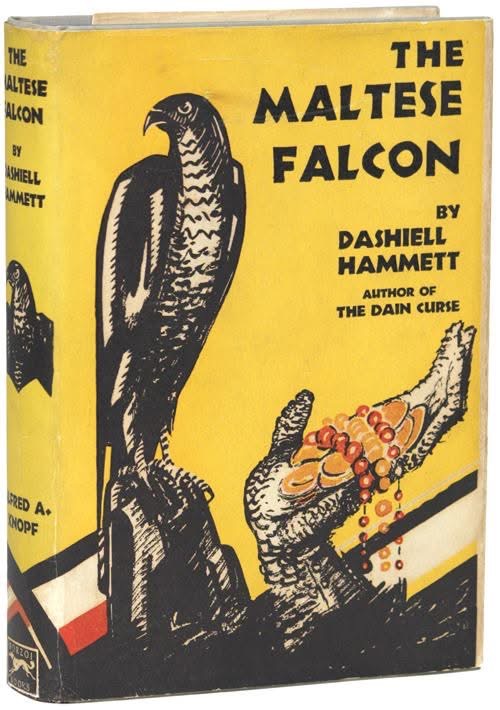
“The Maltese Falcon”

Dashiell Hammett’s THE MALTESE FALCON was first published by Alfred A. Knopf on this day in 1930.

“Samuel Spade’s jaw was long and bony, his chin a jutting v under the more flexible v of his mouth. His nostrils curved back to make another, smaller v. His yellow-grey eyes were horizontal. The v motif was picked up again by thickish brows rising outward from twin creases above a hooked nose, and his pale brown hair grew down-from high flat temples-in a point on his forehead. He looked rather pleasantly like a blonde Satan.”

–from THE MALTESE FALCON

A treasure worth killing for. Sam Spade, a slightly shopworn private eye with his own solitary code of ethics. A perfumed grafter named Joel Cairo, a fat man name Gutman, and Brigid O’Shaughnessy, a beautiful and treacherous woman whose loyalties shift at the drop of a dime. These are the ingredients of Dashiell Hammett’s coolly glittering gem of detective fiction, a novel that has haunted three generations of readers.

The dead partner in this story “comes alive” as the main character of another detective series.

Leave a comment

Filed under fiction, noir, novel, Uncategorized

Dashiell Hammett: a hero for our time – San Francisco Chronicle

Source: Dashiell Hammett: a hero for our time – San Francisco Chronicle

Every Christmas season, my family indulges in the same movie-watching rituals as we trim the tree and string necklaces of twinkling lights around the living room. These movies serve as a comforting backdrop to our yuletide routines. Some of our favorite seasonal films are relative obscurities like “The Family Man” (2000), starring Nicolas Cage, Téa Leoni and Don Cheadle. But we also search out classics, including movies that seemingly have nothing to do with the holiday season. Inevitably, we end up watching at least one of the old “Thin Man” features, that durable Dashiell Hammett detective series starring the most adorable and effervescent married couple in cinematic history, Nick and Nora Charles (William Powell and Myrna Loy).
Why does “The Thin Man” series beckon us this time of year? Maybe it’s the lovely, icy clatter of a holiday martini shaker, that merry clinking sound Nora used to call Nick home to their New York hotel suite when he was relaxing far away in Central Park with their toddler. “Nicky,” the bibulous detective tells Junior, “something tells me that something important is happening somewhere and I think we should be there.”

Or maybe it’s the witty banter and teasing sexuality between Nick and Nora that every sophisticated relationship should aspire to. Nick (trying to divert his wife from an uncomfortably racy subject): “Did I ever tell you that you’re the most fascinating woman on this side of the Rockies?” Nora (signaling she’s no prude): “Wait till you see me on the other side.”
Or it could be the San Francisco aura that drifts through the “Thin Man” films, especially my favorite, “After the Thin Man” (1936), which is set in the city and features locations like the Coit Tower lawn, doubling as the grounds of the Charleses’ Telegraph Hill mansion. Foggy nights in San Francisco are still suffused with a Hammett-like mystery. And there is no better place to conjure the spirit of the founder of the hard-boiled mystery genre than John’s Grill on Ellis Street, where Hammett hero Sam Spade grabbed a quick meal of chops, baked potato and sliced tomato in “The Maltese Falcon.” Hammett himself pounded out his pulp masterpieces on his Underwood typewriter in his apartment nearby, at 891 Post St., after his TB-wracked lungs made it impossible for him to continue his career as a Pinkerton Agency gumshoe.

There is no better way to celebrate the holidays in San Francisco than taking a break from the tyranny of shopping at the legendary downtown grill, presided over by John Konstin, the city’s most charming Greek (besides Art Agnos). A recent lunch hour there was populated by the usual mix of jailhouse lawyers, newshounds, colorful barflies, and SFPD detectives with legendary names – including Lt. Dave Falzon and retired homicide inspector John Cleary Jr. In other words, old San Francisco at its best.

And there is no better lunch companion for such an occasion than fedora-wearing, dapper Eddie Muller — the “Czar of Noir” whose classic cinema festival at the Castro Theatre each January brings together a wildly diverse pageant of filmgoers, from schlumpy and frighteningly obsessive cineastes to elegantly dressed lounge-room lizards and femme fatales who have stepped right out of their own torrid dream. Muller is also a growing presence on the Turner Classic Movies channel, as the film noir host for the brilliantly curated network.

Muller has a familial affinity for the world of Hammett. His late father was the boxing reporter for the San Francisco Examiner for a half-century, a respected fixture in a demimonde filled with the palookas, promoters, and gangsters — the same types Nick and Nora liked to pal around with. And we both share an affection for the prototypical, if opposite, Hammett screen heroines, Loy and Mary Astor.

Astor was the sad-eyed, seductive screen siren who costarred with Bogart in “The Maltese Falcon” (and with my father, Lyle, in such lesser 1930s offerings as “Return of the Terror,” “Red Hot Tires” and “Trapped by Television,” a B-movie thriller that foresaw the scary aspects of the coming medium). Astor was a sexually liberated woman of her day; her erotic self-confidence surges through her performance as the masterfully manipulative Brigid O’Shaughnessy in the Hammett classic.

In 1936, Astor found herself on the pyre in the hottest Hollywood sex scandal of its day, when her estranged husband exposed her “Purple Diary” to the press — a lusty account of her sexual exploits, including the grades she assigned to her lovers’ performances. Playwright George S. Kaufman scored the highest, with Astor extolling his prowess. “Fits me perfectly,” she wrote. “Many exquisite moments … twenty — count them, diary, twenty … I don’t see how he does it … he’s perfect.”

Astor — whose Purple Diary is the subject of two recent books, including a sensually illustrated chronicle by the artist Edward Sorel — got Muller and me talking about Hammett and his view of women. “In some ways, the male-female dynamic is the most interesting thing about Hammett’s work,” said Muller, between sips from his Manhattan. “There’s an emotional complexity and tension that separates it from other detective fiction.” In his own life, Hammett cut himself off from his father and brother at a young age, but remained close to his mother and sister. His own formidable drinking and sparring partner, the writer Lillian Hellman, was the inspiration for Nora Charles.

“He was a tall, slim, well-dressed ladies’ man, who carried with him a sense of damage that women found attractive,” continued Muller. “His drinking, his illness. He made binge drinking heroic because he was so frail. Women would marvel at him — it’s 4 a.m. and he’s still going.”

Hammett had another kind of fortitude as well. A lifelong man of the Left, he was dragged before a federal tribunal during the Cold War and asked to reveal the names of those who had contributed to a bail fund he had overseen for jailed Communist Party leaders. He refused. Ratting on friends was not the kind of thing that the creator of Sam Spade would do. He was sentenced to six months in federal prison for contempt of court, and when he was released in December 1951, his health was more ruined than ever. In 1953, he was summoned again by the witch-hunters, this time by Sen. Joe McCarthy and his sidekick, the reptilian Roy Cohn — one of Donald Trump’s mentors. Again Hammett refused to cooperate. He was blacklisted by Hollywood and went broke. But he was unbroken.

As Trump adviser Newt Gingrich floats the idea of reviving the notorious House Un-American Activities Committee, it’s a good time for us to recall Hammett’s heroism. “People should read his testimony and look at the pictures of him as he underwent the inquisition; it’s so inspiring,” said Muller. “He was just so cool and unshakable. His attitude was like, ‘Do your worst, you can’t even make me angry.’ He was one of his own heroes come to life.”

San Francisco Chronicle columnist David Talbot appears Sundays, Tuesdays and Thursdays. Email: dtalbot@sfchronicle.com

Leave a comment

Filed under 2016, author tribute

‘It’s All One Case’ is a revealing look at detective master Ross Macdonald – The Washington Post

The sprawling book includes previously unpublished interviews and hundreds of photos.

Source: ‘It’s All One Case’ is a revealing look at detective master Ross Macdonald – The Washington Post

“It’s All One Case” is a book that any devotee of American detective fiction would kill for. For fans of Ross Macdonald, the finest American detective novelist of the 1950s and ’60s, it’s an absolute essential.

First off, this huge album contains the transcript of 47 hours of talk between Kenneth Millar — Macdonald’s real name — and Rolling Stone reporter Paul Nelson. The conversations, which took place in 1976, were intended for an article that never got written. Soon after the interviews were over, Millar began to exhibit symptoms of Alzheimer’s disease and would never write another book. He died in 1983. Nelson’s life would gradually just fall apart. He died in 2006.

Largely because of Kevin Avery’s devotion and hard work this major work of mystery scholarship has finally appeared in print.

Yet there’s still another reason to covet this book — its pictures, hundreds of them. Virtually every page shows off Jeff Wong’s awe-inspiring collection of material relating to Millar.

Here one can see every Ross Macdonald novel in every hardcover and paperback edition and seemingly all the periodicals — from Ellery Queen’s Mystery Magazine to Cosmopolitan and Gallery — in which Millar published a story or article; reproductions of the writer’s handwritten letters, spiral notebooks and typed manuscripts; pages from Knopf galleys; and even VHS tapes and DVDs of the movies and TV series based on private eye Lew Archer.

In addition, “It’s All One Case” includes dozens of photographs of Millar, as a boy in Canada, at his longtime home in Santa Barbara, and with his wife, the comparably gifted mystery writer Margaret Millar (whose works Soho Press has recently reissued in several omnibus volumes).

Nearly all Lew Archer’s cases — “The Zebra-Striped Hearse ,” “The Chill ” and a half dozen others — deal, more or less, with the sins of an earlier generation wreaking havoc in the present. In the interviews here, Millar admits that he consciously worked and reworked variations on this theme because of its personal relevance: His father walked out on his mother when he wasn’t quite 4, and little Ken grew up being shunted among various relatives, so much so that he had lived in 50 different houses or apartments by the time he was 16.

At an early age, Millar decided to become a writer. He tells Nelson that important influences included Poe and Twain but that F. Scott Fitzgerald’s “The Great Gatsby” was, for him, “the central novel of the century.” He reveres Dashiell Hammett’s “The Maltese Falcon” and deeply admires the early work of James M. Cain: “Nothing has ever been done in its field better than ‘Double Indemnity.’ ” Among favorite contemporary writers, Millar names Nabokov, “who doesn’t really make mistakes.” He regards Dostoevsky “as probably the greatest of all fiction writers.”

To write his detective novels, Millar says he spends months scribbling plot details in notebooks and that he deliberately uses symbolic imagery as a structural element. His books are, consequently, both complicated and precisely engineered: “I don’t aim at simplicity.” He also stresses that it’s “the stories of the other people” — Archer’s clients rather than the detective himself — “that really interest me more. Archer is just a means of getting to them and showing them as they are.” Indeed, some of his books, he would argue, “are tragedy or at least aim at it.”

Nonetheless, Millar explains, “I don’t start out with a character. I start out with an idea, which is generally a moral situation. . . . The characters are just notations which together form the book. They do represent energies of course, various kinds of imaginative energy going in different directions, and all that has to be orchestrated and unified. That’s what really is so difficult: to get it all in a proper balance so that each of these energies represented by the twenty or so characters in a book gets its proper place, its proper presentation, and its final place in the structure.” He emphasizes that structure is “the one thing I can do better than my competition, so I spend a lot of time on it.”

Clearly Millar, who earned a Ph.D in English from the University of Michigan, isn’t your average pulp mystery hack. Instead his books honor the hard-boiled tradition, even as they complicate and slightly soften it. These days, however, I suspect that Millar’s novels —despite being reprinted in the Library of America — have fallen into literary limbo, remembered but not much read. Yet his mysteries still pack a wallop, as I discovered when, after many years, I again picked up my copy of “The Galton Case.” From the start, Archer’s voice exhibits the laconic factuality and low-keyed wit we associate with Hammett and Raymond Chandler:

“The law offices of Wellesley and Sable were over a savings bank on the main street of Santa Teresa. Their private elevator lifted you from a bare little lobby into an atmosphere of elegant simplicity. It created the impression that after years of struggle you were rising effortlessly to your natural level, one of the chosen.”

As Millar talks about his life and work in “It’s All One Case,” he does repeat some of the same points again and again. Nonetheless, he absolutely refuses to discuss his daughter Linda, who accidentally killed a young boy when driving drunk at the age of 16 and later died at 31. While Millar admits that his fiction is replete with troubled adolescents, he contends that any personal or autobiographical material has been sublimated, shaped and refracted. He is an artist, after all, and that’s what artists do.

Michael Dirda reviews books on Thursdays in Style.

Leave a comment

Filed under 2016, author tribute

Writing tip Wednesday: To name or not to name

“What’s in a name? that which we call a rose
By any other name would smell as sweet;
So Romeo would, were he not Romeo call’d,
Retain that dear perfection which he owes
Without that title. Romeo, doff thy name,
And for that name which is no part of thee
Take all myself.”
–Juliet from the play Romeo and Juliet by William Shakespeare

If Shakespeare received a nickel for every time he was quoted, he’d be able to rebuild The Globe Theatre many times over. He might even make Donald Trump envious. But that is a story for another time.

A few thoughts on naming your characters. I have known writers who called their protagonist “X” or “Mrs. Y” throughout the draft of a story or novel, because they weren’t sure what to call him or her.

Man in space suit

A character’s name can help ground her in your story’s world, no matter where that world is.

Who knows, if really stuck for a name or if your story is Kafkaesque, you might be able to use only a letter for the character’s name. But most of the time that won’t work.

Still, there are no etched-in-stone rules for naming characters, but here are a few suggestions. By no means are these all inclusive suggestions.

    1) The first name you come up with is not unalterable. Until a story or novel is accepted for publication, you can change the name. So, if you have trouble picking out names, maybe the first thing to do is relax. The mystery writer, Robert B. Parker had originally named his private detective David Spenser, but at the last minute decided to pull the first name, because he had two sons, one named David, and he didn’t want to possibly offend his other son by not have a character named after him. So, David Spenser became Spenser, with two “S’s,” like the poet.

    2) If you write in a particular genre, consider if the protagonist’s names have a certain “form” or “rhythm” to them. Turning to the detective fiction genre again, for many years the protagonists always had last names that implied the type of work they did. For example, in The Maltese Falcon, the private eye protagonist’s name was Sam Spade. Spade is a tool for digging. Private eye’s dig up information. Other examples include Mickey Spillane’s Mike Hammer and Ross MacDonald’s Lew Archer. By the way, Lew Archer was also Sam Spade’s partner in The Maltese Falcon. Archer was killed early on, so I guess Ross MacDonald decided to use the name since Dashiell Hammett wasn’t going to use it any more.

    3) Names can reflect part of a characters personality or indicate social strata. For example, a woman named Bunny could be somebody who comes from a well to do family. Or a family that doesn’t but wants to think it does. The other end of the scale would be naming a character Huckleberry as in Huckleberry Finn, the protagonist is the novel about the adventures of this character whose mother is dead and whose father is a drunken illiterate.

Another example might be Mrs. Kitty Warren in George Bernard Shaw’s play Mrs. Warren’s Profession. Warren as a word means a place where rabbits bread or live. It can also mean a building housing many renters in crowded rooms. Mrs. Kitty Warren is a woman who has made her way in the world by being a brothel owner. In this case, both the first name, “Kitty” and the last name “Warren” hint at least part of the nature of the character.

Remember, unlike most of us, who are “stuck” with the names our parents gave us, the names in novels, stories, plays, and other forms of writing can be changed and can be used to help round out your protagonists (and other characters) or hint at aspects of their natures.

Some sources to consider are dictionaries of first names and what those names mean. For example, Eugene means “well born.”There are even some books that talk about the meaning’s of last names. Or, as in the case of Warren above, even a good standard dictionary can help you.

So, while Juliet is correct when she says:
“Thou art thyself, though not a Montague.
What’s Montague? it is nor hand, nor foot,
Nor arm, nor face, nor any other part
Belonging to a man.”

A name – the name you select for your protagonist – can be just as important as a hand or foot, arm or face. It is, after all, a part of that character.

Leave a comment

Filed under character naming, writing tip, Writing Tip Wednesday