
WRITER: Comedy comes from pain.
AGENT: Then this meeting is hilarious.
WRITER: Comedy comes from pain.
AGENT: Then this meeting is hilarious.
Filed under 2020, Monday morning writing joke
How do you write good comedy? Some of Britain’s finest comedians share their knowledge
By Bruce Dessau
Writing comedy is not easy – which is why next weekend, aspiring comedy writers will be gathering in Llandudno in north Wales for the second annual Craft of Comedy Writing conference.
There, commissioning editors, producers, production company bosses and comedians will be divulging their trade secrets in a range of talks, discussions and networking sessions. It’s a great way to learn more about the industry – although it does cost £60. For a cheaper option, we have asked some the biggest names in comedy for their pithiest writing tips.
(For more information on the Craft of Comedy Writing Conference see www.venuecymru.co.uk)
Andy Hamilton
Sitcom writer
His new series ‘Ballot Monkeys’, a satirical sitcom set around the General Election, starts on C4, Tuesday at 10pm.
Reece Shearsmith
Actor/comedy writer
The latest series of Shearsmith’s ‘Inside No 9’, co-written with Steve Pemberton, is on BBC2 on Thursdays.
I think it’s important when writing, and especially sketches, that you very quickly let the audience in on what it is they are supposed to find funny. What is “the thing of it?” Let them in on the joke as quickly as possible. “Oh – I see, it’s a clown that doesn’t like children.” Or “Oh I get it – it’s a squeamish surgeon”. The quicker you get to that penny-dropping moment, the longer your audience have to enjoy the situation and find it funny. Also, try to be as lean as possible. Come in late, and go out early. More often than not, you can lose half of a scene quite easily and still impart the story. And above all else – hide the exposition! No one wants to sound like they are narrating facts. A neat trick is to hide exposition inside a joke. That way it feels valid, and its presence is disguised by a laugh.
Graham Linehan
Sitcom writer
To borrow an image from David Lynch, you’re looking for the big fish. The tiddlers flashing about just below the surface – the trite observations, the easy targets, the established joke-constructions – you need to ignore them and wait for the big one. An image or scene that makes you double over with laughter and could only have come from deep within your subconscious. The good news is that once you have it, the smaller jokes leading up to and away from the scene/sequence/sight gag will also feel fresh. To give you an example from my own work, Mrs Doyle wondering where the “perfectly square bit of black dirt” on the window came from is a set-up so odd the audience doesn’t even think of it as a set-up, and enjoy it for its own sake. So when Ted appears at the window with a Hitler moustache (and that’s the big fish, that’s what Arthur Mathews and I thought of first), one of the reasons it works is that the audience didn’t realise we were setting them up.
Holly Walsh
Stand-up/TV and radio writer
Walsh has previously written BBC3 sitcom ‘Dead Boss’ with Sharon Horgan, and her new radio series ‘Best Behaviour’ starts on Radio 4 on 7 May at 6.30pm.
My tip for writing comedy would be to find someone to collaborate with. OK, so you’ll share the money, but you’ll also share self-doubt and inner loathing, so it kind of balances out. My favourite days are sitting in a room with someone else and trying to make them laugh. You might then have to go off and work stuff up on your own, but at least you know one person has found it funny. Oh, and move around. You’d be surprised how many problems are solved walking to and from the loo. So drink plenty of tea.
The rest of the article: http://www.independent.co.uk/arts-entertainment/comedy/features/how-do-you-write-good-comedy-some-of-britains-finest-comedians-share-their-knowledge-10182878.html
Filed under 2015, writing tip, Writing Tip Wednesday
Book Review: John D. MacDonald Before Travis McGee – WSJ.
There’s a special kind of poignancy—amounting at times to pure excruciation—in seeing a great writer get famous for his worst books. When people bring up John D. MacDonald, they are almost always thinking of the dopey series of adventure stories he wrote about a Florida beach bum named Travis McGee. Ignored and forgotten are his early novels, 40 of them, which he poured out in one decadelong creative rush in the 1950s—thrillers, crime dramas, social melodramas, even science fiction—that taken together make him one of the secret masters of American pop fiction.
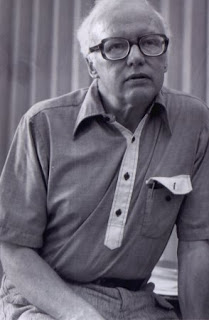
John D. MacDonald
They were meant to be commercial products, and their main appeal today is nostalgia. They’re a kind of mausoleum of postwar American machismo. McGee is the classic wish-fulfillment daydream: an idler on a permanent vacation, who lives on a houseboat on Florida’s Atlantic Coast. He is tanned, ruggedly handsome and muscular; irresistible to women (something about his rueful romantic melancholy and his preference for athletic, commitment-free sex); and intimidating to men (in the late and feeble “Free Fall in Crimson,” where McGee should by rights be filling out membership forms for AARP, his superior masculinity awes and humbles a motorcycle gang).
In novel after novel, nobody ever bests McGee, nobody ever seriously challenges him—though the bad guys do sneak up behind him and knock him unconscious so many times you wonder if he needs a neurologist on speed dial. Meanwhile, the action keeps grinding to a halt so McGee can vent his opinions on contemporary life: the best power tools, the perfect cocktail, the proper way to set up stereo speakers, the menace of air conditioning in grocery stores. These opinions are notable mainly for their unconscious philistinism—as when the perfect dinner menu proves to be this staccato bark: “medium rare, butter on the baked, Italian dressing.” No real man in those days ever ate anything but steak, potato and salad.
But then there’s the rest of MacDonald’s oeuvre. Random House is issuing these in a jumble of paperback reprints and e-book exclusives, but at least they’re there, and no longer need be scrounged out at ruinous prices from the secondhand market. These are the books MacDonald did before he invented McGee, when he was trying out every conceivable pop genre of the postwar market, from soft-core sex comedies to psychological horror.
Article continues at: http://online.wsj.com/news/articles/SB10001424127887323324904579040672688388630
Filed under book review, John D. MacDonald
[Editor’s note: I believe it was the late Rodney Dangerfield who had a comedy routine based on “I don’t get no respect.” The lack of respect could come from anybody, anywhere, including his wife. Below is a playwright Rodney could empathize with. He writes to Dear Abby, and she responds. I have known one or two other writers in the same situation. Maybe you, do, too.]

Sometimes respect is hard to come by for a writer, or a comic. Just ask Rodney Dangerfield.
I have won this prize four times – more than any other writer in the history of the contest. But is my family impressed? Not at all! My wife told me she thinks I write everything the same way and have simply repeated myself four times.
I am up in years. It’s unlikely I will ever again win this prize. So how do I respond to such indifference? What do you do when you feel you have accomplished something important and the response is, “so what else is new?”
–Looking for Validation in Florida
DEAR LOOKING FOR VALIDATION: My hat’s off to you. That you have won this prize more than any other writer in the history of the contest is a notable achievement. Attend the production, take your well-earned bow in the spotlight, and accept that the less you look to your wife for validation, the happier your life will be.


 Booker's Blog