Tag Archives: character

Want a Happier, More Fulfilling Life? 75-Year Harvard Study Says Focus on This 1 Thing

We’ve already uncovered the key to long-term happiness and fulfillment.

Source: Want a Happier, More Fulfilling Life? 75-Year Harvard Study Says Focus on This 1 Thing

[Editor’s note: While not directly related to writing, this information can be used to build and understand characters in your writing. Or to be thankful for those who help you write.]

Positive Alacrity is the art of creating micro-experiences that have an emotionally uplifting impact on others. But I’m getting ahead of myself …

A quick Google search for “secret to happiness” brings up over 7,500,000 results.

That’s a lot of people writing about and searching for something that, according to a groundbreaking Harvard study, has already been found.

That’s right: Thanks to Harvard’s Grant and Glueck studies — which tracked 724 participants from varying walks of life over the course of 75 years — we’ve already uncovered the key to long-term happiness and fulfillment.

The answer? Our relationships.

Here’s Robert Waldinger, director of the Harvard Study of Adult Development:

“The clearest message that we get from this 75-year study is this: Good relationships keep us happier and healthier. Period.”

In other words: The quality of our life — emotionally, physically, and mentally — is directly proportional to the quality of our relationships.

But there’s a catch. If there’s one thing most of us have learned, it’s this: Just knowing a lot of people isn’t enough.

True fulfillment in relationships is about genuine connection, and one of the most efficient ways to form that connection is by practicing what we at Mindmaven call Positive Alacrity; a skill we define as creating micro-experiences that cause an emotional uplifting in others.

The Uncomfortable Truth About Relationships

Did we really need a 75-year study to tell us relationships are important?

Probably not; I bet many of you already knew that. So why do we so often struggle to treat many of the most important relationships in our lives with the reverence and priority we know they deserve?

For example, do any of these situations sound familiar?

  • When under stress, you may have a tendency to be ruder to your spouse than you’d ever dream of being to a complete stranger.
  • When building a business, you’re willing to work 60-hour weeks but somehow never “have time” to check in with lifelong friends.
  • Speaking of business: You may fail to consistently and proactively invest in deepening the professional relationships that might provide the breakthrough opportunities you need.

So why do we do this? Because …

Although many things in life are deadline and urgency driven, relationships almost never are.

As a result, they’re often one of the first parts of our lives that we neglect until we “find the time.”

The good news is, building those deep, meaningful relationships isn’t as daunting or time-consuming as it may sound. In fact, by focusing on one habit, anyone can build more fulfilling relationships every day.

The Secret Factor Controlling the Quality of Your Relationships

But what determines the level of fulfillment we find in our relationships? It isn’t simply “knowing” the other person.

What makes you feel happy or fulfilled isn’t the relationship itself, but the interactions that make that relationship up.

Here’s what it comes down to: The only path to achieving the goal of a fulfilling life is to have fulfilling relationships, and those relationships can only be created by consistently connecting through meaningful interactions.

Let me illustrate with a few examples.

#1: “I just want you to know how much I appreciate you.”

John’s wife Sarah welled up with tears as she read the unexpected thank you note her husband had written her before he left on a 6:00am flight for a business trip.

John — the CEO of an aggressively growing startup — thanked his wife for all the support and grace she’d given him over the last three years as he worked long hours to reach his — and his company’s — fullest potential.

The short note left Sarah feeling appreciated, loved, and truly known by her husband.

#2: “Thank you for sacrificing your time for our vision.”

Hannah, a recent intern-turned-engineer at a public company, felt pleasantly surprised and greatly affirmed after Erin, the CEO, walked over to her cubicle specifically to say thank you.

Without prompting, Hannah had recently pulled an all-nighter in order to ensure a backend patch was completed on time to restore server stability. And even though Erin’s visit was shorter than 30 seconds, the fact that the interaction was focused solely on thanking Hannah left her feeling appreciated for stepping up and excited to work for the company.

#3: “So you never have to lose something again.”

Cole — a die-hard Atlanta Falcons fan — laughed in amusement as he wrote back “Thanks, but I hate you lol ;)” to Rob, a friend who had sent him a Tile following the Falcon’s 2017 Super Bowl loss so he’d, “never have to lose something important again.”

The practical joke made Cole smile and deepened the sense of connection and friendly rivalry the two of them shared.

The Science-Backed Power of Positivity

Here’s the key takeaways from those examples: Each time, someone performed a small, lightweight gesture. For example:

  • John’s handwritten note to his wife,
  • Erin’s 30-second interaction, or
  • Rob’s quick email and gift.

And despite the ease of each interaction, they all delivered an uplifting sense of connection to the other person.

But perhaps the best proof of the power of interactions comes from Dr. Martin Seligman’s famous Gratitude Visits. For those unfamiliar, Dr. Seligman — founder of the positive psychology movement — introduced the concept of Gratitude Visits in a University of Pennsylvania study.

Here’s how it worked: Participants were asked to write a 300+ word letter of gratitude to someone in their life, and to then visit the recipient and read the letter aloud to them.

Simple though that may be, the effects were profound: Although Gratitude Visits were one of many positivity practices recorded in the study, they were the only practice that had participants reporting increased happiness and decreased depression for a full month after completing the action.

And while I fully support the practice of Gratitude Visits, they come with a challenge: Most of us don’t have time to sit down and write a 300-word letter every time we feel positive or grateful.

So I figured if Gratitude Visits are truly one of the most fulfilling things we can do, there must be a way we can simplify it into a habit that can be practiced daily.

Building Happy, Fulfilling Relationships with Ease

The solution? Positive Alacrity.

At the end of the day, this concept’s all about consistently delivering small, simple experiences that leave people feeling genuinely uplifted. So how do we do this? It all comes down to a single habit:

When you think something positive and you genuinely believe it, voice it.

As simple as that habit may be, we believe the impact of Positive Alacrity is as profound as Gratitude Visits, with one distinct advantage: That same simplicity allows you to practice it anytime, anywhere, with practically anyone.

Why? Because most of us already think positive thoughts on a daily basis. For example, I wouldn’t be surprised if you often thought things like …

  • “That’s a really insightful way to look at the situation,”
  • “I really appreciate the way she listens to me,” or
  • “Wow, he handled that ordeal really well.”

Pause a moment and test it for yourself: When was the last time you thought something positive? I’d venture to bet it was within the last 24 hours.

The problem is, we often let these thoughts come and go without ever practicing Positive Alacrity. But when we forgo voicing these thoughts to others, we cheat ourselves out of a valuable opportunity to enrich our relationships in three key ways:

  1. When you voice positive thoughts, you make the recipient feel emotionally uplifted.
  2. This feeling elevates their appreciation of you and the relationship you share.
  3. Because you were the source of that interaction, their emotional response creates an incredibly fulfilling sense of happiness and satisfaction in you.

That last part’s key: By uplifting others, we inadvertently uplift ourselves. Why? Because …

The effects of Positive Alacrity go both ways.

For instance, remember the example above with Hannah the CEO and Erin the engineer?

As a seasoned leader, Erin closely observed Hannah as she thanked her for working so diligently on that patch; so she noticed as Hannah’s expression slowly shifted from shocked confusion to recognition and, finally, to realization.

Seeing Hannah’s cheeks flush, smile spread, and eyes gleam made Erin realize she’d just delivered something truly meaningful, and Hannah’s reaction created a tremendous sense of satisfaction and fulfillment in Erin as the one who delivered that interaction.

If you’ve ever been in a similar situation to Erin’s, you probably understand exactly how she’s feeling, and know just how uplifting those feelings can be.

When you practice Positive Alacrity, you’re not only uplifting others. Above all, you’re uplifting yourself.

Positive Alacrity in Action: Mastering the Habit of Intentional Positivity

The action itself is simple: Think something positive? Voice it.

But until we turn that conscious action into an unconscious habit, we won’t be able to fully leverage it to impact our relationships and enrich our lives. And that all starts with a shift in awareness.

By default, positive thoughts often slip through the cracks before they ever reach conscious acknowledgement, let alone vocal affirmation. So how do you become more aware? By becoming intentional.

Once you’ve become aware of a positive thought, consciously label it “Positive,” then ask yourself: Do I genuinely believe this?

If you believe it, voice it. Positivity works so long as it’s perceived as genuine, and as long as you truly believe what you’re saying you can usually count on a positive outcome.

Habitualizing and Compounding the Secret to Happiness

Keep in mind: As with any new habit, practicing Positive Alacrity is probably going to feel a little clumsy or unnatural at first. But as long as you genuinely believe what you say, it doesn’t matter how awkward it comes out because it’s real.

The most important thing is that you’re voicing it. And if you’re able to push through that initial awkwardness, I can practically guarantee the process will become second nature in no time.

So how do you start? Thankfully, the practice is as simple as the theory. Try following this three-step process to utilize Positive Alacrity today.

  1. Recognition: Think of something positive that happened within the last 24 hours, then ask yourself: “Who was the cause of (or involved in) this experience that I could thank or compliment?”
  2. Specificity: Ask yourself: “What specifically did I like or appreciate about this experience/situation?”
  3. Action: Now, voice it. Pay this person a face-to-face visit. If that doesn’t work, call them. If you can’t call them, then text or email them; immediately, before you finish reading this.

Keep in mind: The steps above are an example of how to leverage Positive Alacrity retroactively, but it’s even easier to perform as you move forward in your day-to-day life.

The only thing you have to do is increase your ability to recognize these thoughts as they occur, then voice them as you become aware of them (rather than once a year when the holidays roll around).

John, Erin, and Rob are prime examples of these principles in action:

  • While getting ready to leave on his business trip, John looked over at his sleeping wife and realized just how appreciative he was for her continued understanding about his hectic travel schedule. So instead of just grabbing his jacket and heading out the door, John went over to the study, picked up some stationery, and wrote Sarah a short note expressing those feelings.
  • After learning of Hannah’s all-nighter, all Erin had to do was have a 30-second conversation genuinely thanking her. The only risk she took? Potentially being a few seconds late to her next meeting.
  • And as the Falcon’s loss made Rob realize how long it’d been since he and Cole talked, the only actions he had to take were writing his friend a tongue-in-cheek note and asking his assistant to mail it off along with a package of Tiles.

John, Erin, and Rob all spent less than a minute acting on their positive thoughts, but the uplifting emotions from those simple interactions have the potential to last for months.

And what about Sarah, Hannah, and Cole, the recipients of those interactions? They’re probably going to walk through the rest of the day feeling uplifted and empowered. In fact, I wouldn’t be surprised if, later that same day, they provided a similar experience for someone else.

That’s the Pay-it-Forward principle in practice:

A single positive interaction can have a multiplicative effect, building and spreading further than you’d ever imagine.

Ultimately, those simple interactions are the heart of Positive Alacrity and the foundation for meaningful relationships. And, as that 75-year Harvard study taught us, those very same relationships are the secret to lifelong happiness and fulfillment.

Want to master the art of Positive Alacrity to revolutionize your relationships and enhance your life? If this was intriguing and valuable to you, and you’d like to learn more …

Click here to learn how to incorporate Positive Alacrity into your day-to-day life!

About the Author:

Patrick Ewers is the founder and CEO of Mindmaven, an executive coaching firm and educational platform focused on helping startup CEOs, executives and their team members achieve their fullest potential by delivering exceptional experiences to the most valuable relationships in their network.

Check out his blog, then follow him on Twitter and LinkedIn for more content like this.

Leave a comment

Filed under 2019, character, character study

cARtOONSDAY: “cHARACTER iSSUES”

And to listen to his critics, even his characters weren't that interesting.

And to listen to his critics, even his characters weren’t that interesting.

Leave a comment

Filed under 2015, cartoon by author, CarToonsday

cARtOONSDAY: “sTUCK”

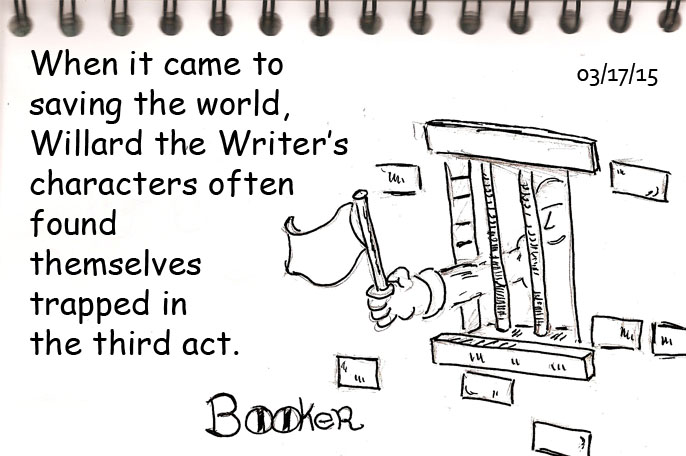
Willard's stories were so full of imprisoned characters, they were starting to complain of overcrowding.

Willard’s stories were so full of imprisoned characters, they were starting to complain of overcrowding.

1 Comment

Filed under 2015, cartoon by author, CarToonsday

Writing tip Wednesday: “Inside, outside, roundabout side”

Three categories to better characters

Sometimes, when creating a character, it is good to break the characteristics of character into three general categories: Inside, outside, and roundabout side. In reality as in your characters, you will probably find that these categories overlap, bump up against each other, maybe even at times clash. Sometimes a good character, like a real person, can be his or her own worst enemy.

Use this below as a starting point. You can add your own questions or prompts. And you can use this for all the major characters, including the protagonist and antagonist. It could even help with some of the minor characters, too.

With the following categories in mind, reread your manuscript with an eye toward making your characters as compelling as possible: both the good guys and the bad ones.

1. Looking in or sometimes called motivation

  • What does your character want?
  • What does your character need?
  • Can you create a situation in which the need and the want come into conflict with each other?
  • Did your character have a happy or unhappy childhood and why?
  • What is your character obsessed with?
  • What is your character’s biggest fear?
  • What is your character’s biggest secret?
  • What is the best thing that has happened to your character? The worst?
  • What are your character’s past and present relationships? With parents? With friends? With enemies? With co-workers?
  • What does your character care about?

2. Looking out or sometimes called appearance, aesthetics, maybe even Mirror, mirror on the wall

  • What sex is your character?
  • How old is your character?
  • How tall is your character?
  • Hair color? Eye color? Skin color?
  • How many eyes, fingers, toes, etc. does your character have, or does your character have only some or none of these?
  • Does your character have an odd-shaped nose or other physical trait? Is this trait lifelong or recently acquired?
  • Does your character dress in the latest fashion with new clothes, in hand-me-downs, second-hand shop clothes, bargain basement buys?
  • Does your character practice regular hygiene? Bath/shower regularly? Smell if he or she doesn’t?
  • What would another character say about this character’s overall appearance?

3. Looking round about or sometimes called quirkiness, idiosyncrasy, or sometimes just plain weird
Please note, that a character’s quirkiness can often arise out of the looking in or looking out categories, and sometimes when one meets the other.

For example, the character could wear a fedora, may even have several for different occasions, and will wear nothing else on his / her head.

A small fear can be an idiosyncrasy. Your character could be afraid of spiders or the number 13.

  • Does your character always were the same color?
  • Does your character have a favorite number?
  • Does your character always count up the change in his / her pocket the same way? Pennies first, then nickels, then dimes, etc.?
  • Does your character have a nickname? If so, what is it and how does it relate to the character?
  • What is the one word that would best describe your character?

–David E. Booker

1 Comment

Filed under writing tip, Writing Tip Wednesday

Writing tip Wednesday: “Introductions”

Write Better: 3 Ways To Introduce Your Main Character

by Les Edgerton

Source: http://www.writersdigest.com/online-editor/write-better-3-ways-to-introduce-your-main-character?et_mid=711152&rid=239626420

1. Keep physical description minimal.

A character’s physical description—unless markedly different than the norm—does relatively little to draw the reader in. The character’s actions, or details such as his occupations and interests, are much more useful. The readers will furnish a perfectly good description on their own if you simply let them know that the Uncle Charley of your story is a butterfly collector, or the elderly toll-gate keeper on the Suwannee River. Doing so will accomplish more than 10 pages of describing hair and eye color, height, weight and all of that kind of mundane detail.

My own writing contains very little description of any of my characters—it’s virtually nonexistent—yet for years I’ve asked readers if they can describe a character I pick at random from my stories, and invariably they come up with a detailed description, no matter which character I choose. When I tell them I haven’t ever described the character mentioned, they’re surprised, and some swear that I did, even going so far as to drag out the story and skim for where I’ve included the description. They never find it.

2. Characterize through action.

Bestselling British writer Nick Hornby starts his novel How to Be Good by taking us through his protagonist’s inciting incident, revealed in an action that is contrary to her normal behavior and personality.

I am in a car park in Leeds when I tell my husband I don’t want to be married to him anymore. David isn’t even in the car park with me. He’s at home, looking after the kids, and I have only called him to remind him that he should write a note for Molly’s class teacher. The other bit just sort of … slips out. This is a mistake, obviously. Even though I am, apparently, and to my immense surprise, the kind of person who tells her husband that she doesn’t want to be married to him anymore, I really didn’t think I was the kind of person to say so in a car park, on a mobile phone. That particular self-assessment will now have to be revised, clearly. I can describe myself as the kind of person who doesn’t forget names, for example, because I have remembered names thousands of times and forgotten them only once or twice. But for the majority of people, marriage-ending conversations happen only once, if at all. If you choose to conduct yours on a mobile phone, in a Leeds car park, then you cannot really claim that it is unrepresentative, in the same way that Lee Harvey Oswald couldn’t really claim that shooting presidents wasn’t like him at all. Sometimes we have to be judged by our one-offs.

Wow! Don’t you wish you’d written that? I sure do!

3. Instill Individuality and Depth.

A very different example of establishing the protagonist’s character from the start is found in crime novelist Michael Connelly’s Lost Light:

There is no end of things in the heart.

Someone once told me that. She said it came from a poem she believed in. She understood it to mean that if you took something to heart, really brought it inside those red velvet folds, then it would always be there for you. No matter what happened, it would be there waiting. She said this could mean a person, a place, a dream. A mission. Anything sacred. She told me that it is all connected in those secret folds. Always. It is all part of the same and will always be there, carrying the same beat as your heart.

I am fifty-two years old and I believe it. At night when I try to sleep but can’t, that is when I know it. It is when all the pathways seem to connect and I see the people I have loved and hated and helped and hurt. I see the hands that reach for me. I hear the beat and see and understand what I must do. I know my mission and I know there is no turning away or turning back. And it is in those moments that I know there is no end of things in the heart.

What makes this opening different? Well, it’s by a brand-name author with a sizable audience already in place. Michael Connelly’s books have made the bestseller lists at least 19 more times than I’ve hit a grand-slam walk-off home run at Yankee Stadium as a member of the Bronx Bombers. This means he can write just about any opening he wants and it’s going to get published. It also means that in the hands of a writer without a ready-made audience such as Connelly enjoys, opening with the protagonist’s bit of philosophy might not work, if not done well. It could easily come across as sentimental or self-indulgent.

More details at: http://www.writersdigest.com/online-editor/write-better-3-ways-to-introduce-your-main-character?et_mid=711152&rid=239626420

Leave a comment

Filed under Writing Tip Wednesday

Writing tip Wednesday: “Character Dimensions and Sketch”

On Saturday, February 1, 2014, I took a workshop sponsored by the Knoxville Writers’ Guild (www.knoxvillewritersguild.org) and led by nationally published author Pamela Schoenewaldt (www.PamelaSchoenewaldt.com and on Facebook at https://www.facebook.com/pages/Pamela-Schoenewaldt/158580547517755?ref=tn_tnmn).

Answering questions beforehand could save you heartburn later.

Answering questions beforehand could save you heartburn later.

The workshop was on character development. What you have below is the third of the three handout exercises from the workshop. The first one, “Who are you?” was posted two Wednesdays ago. The second one, “Conflict Worksheet” was posted last Wednesday.

Each previous worksheet / exercise could be done in ten minutes or less, and oftentimes not pondering too long is best. This worksheet may take a little longer, but like the others can be used for the both the protagonist and antagonist of the story or novel you are working on, or just about any character you want to use it on. It might also be helpful if writing a memoir or biography.

CHARACTER SKETCH EXERCISE

Answer without worrying about grammar or logic.
• NAME your character

• LEARN your character by considering these dimension (writing notes on each or most is ideal)

• REMEMBER that your goal is a rounded character (not all good or bad) with a capacity for moving action.

• SKIP dimensions which repeat information.

• BEWARE of main characters who are very young, psychotics, or whose condition severely restricts their capacity for change.

• KNOW everything about this person.

CHARACTER DIMENSIONS

1. Age, physical appearance and attitude to body.

2. Significant health issues.

3. Distinctive physical signs: scars, handicaps, beauties, tics, tattoos, gestures.

4. Manner of speaking (level of language, accent, peculiarities). Manner of dress.

5. Living situation (where, with whom, how living space reflects character).

6. Socio-economic level and attitude to this level (satisfied, indifferent, ambitious?).

7. Work/ profession/ main activity.

8. Performance in Work/ profession/ main activity.

9. Sexuality and relationship to it (fears, doubts, longings, obsessions).

10. Quality of childhood.

11. Current relationship with family – how does it affect the person?

12. Significant intimate relationships and how they reflect the person.

13. What friends does character have? Attitude to friends, their attitudes to him/her.

14. Significant interests, hobbies, passions, obsessions.

15. Religious/spiritual practice and faith.

16. Fundamental belief about life/self (“The most important thing is . . . “)

17. How does the way the character sees him/her self compare to others’ views of him/her?

18. Major strength (include hidden strengths which could be mobilized).

19. Major success/failure or secret of past. (Any significant patterns?)

20. Typical way of dealing with stress or crisis… (Does it work? Should it change?)

21. Major weakness and fear.

22. Ambitions and blocks to achievement.

23. Shaping force/person/event of past.

24. What is not working for your character now?

25. What would your character sacrifice or fight for?

26. Where does your character experience a major conflict in values?

27. Where does your character draw the line: s/he wouldn’t do this….

28. What might push your character up to the line?

29. What conflict, choice or crisis faces the character now?

Leave a comment

Filed under Photo by author, writing tip, Writing Tip Wednesday, writing tips

Writing tip Wednesday: “Conflict”

On Saturday, February 1, 2014, I took a workshop sponsored by the Knoxville Writers’ Guild (www.knoxvillewritersguild.org) and led by nationally published author Pamela Schoenewaldt (www.PamelaSchoenewaldt.com and on Facebook at https://www.facebook.com/pages/Pamela-Schoenewaldt/158580547517755?ref=tn_tnmn).

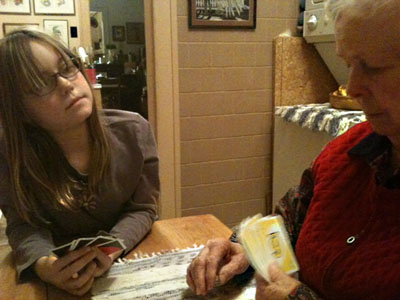
Even a friendly game of cards might harbor some conflict.

Even a friendly game of cards might harbor some conflict.

The workshop was on character development. What you have below is the second of the three handout exercises from the workshop. The first one, “Who are you?” was posted last Wednesday. Each handout can be done in ten minutes or less, and oftentimes not pondering too long is best. The first exercise was called “Who are you?” The you refers to the character. This worksheet can be used for the both the protagonist and antagonist of the story or novel you are working on, or just about any character you want to use it on. It might even be helpful if writing a memoir or biography.

CONFLICT WORKSHEET

Answer without worrying about grammar or logic. Emotions can be messy and illogical. The point is that they MATTER.

1. More than anything, my character wants. . .

2. Getting it matters so much because . . .

3. But the problem/obstacle is . . .

4. My character feels (use 4+ adjectives)

5. Giving up would mean . . .

6. To “win” the character must overcome . . .

7. Who will help and how?

8. Name 3 possible LOCATIONS where this conflict will play out. What OBJECTS will be important?

9. The outcome/ resolution will change the character. Now s/he will . . .

Leave a comment

Filed under writing tip, Writing Tip Wednesday, writing tips

Writing tip Wednesday: “Who are you?”

On Saturday, February 1, 2014, I took a workshop sponsored by the Knoxville Writers’ Guild (www.knoxvillewritersguild.org) and led by nationally published author Pamela Schoenewaldt (www.PamelaSchoenewaldt.com and on Facebook at https://www.facebook.com/pages/Pamela-Schoenewaldt/158580547517755?ref=tn_tnmn).

The workshop was on character development. What you have below is one of the three handout exercises from the workshop. I will be posting the others over time. Each handout can be done in ten minutes or less, and oftentimes not pondering too long is best. The first exercise is called “Who are you?” The you refers to the character. This worksheet can be used for the both the protagonist and antagonist of the story or novel you are working on, or just about any character you want to use it on. It might even be helpful if writing a memoir or biography.

WHO ARE YOU?

Your name is . . .

Your age is . . .

I can see that you are . . . (location)

And you’re looking at . . .

And you’re feeling . . . .

Your great strength is . . . .

Your fear or weakness is . . . .

It’s too bad that . . . .

You’d really laugh if . . . .

Most people don’t know that you . . .

Very soon you must . . . .

The challenge will be . . . .

You will get strength from . . . .

Looking in your eyes, I know that . . .

Leave a comment

Filed under writing tip, Writing Tip Wednesday

Take Two ‘Normal’ People, Add Money To Just One Of Them, And Watch What Happens Next

Take Two 'Normal' People, Add Money To Just One Of Them, And Watch What Happens Next.

View this as a character study. Information to be used when building a story character.

Leave a comment

Filed under character study

cARtOONSDAY: “tALKING sHOP”

Willard Writing Re-Boot.

Willard Writing Re-Boot.

Leave a comment

Filed under cartoon by author, CarToonsday