Tag Archives: books

The return of the printed book

Books are back. Only the technodazzled thought they would go away

The hysterical cheerleaders of the e-book failed to account for human experience, and publishers blindly followed suit. But the novelty has worn off

by Simon Jenkins

Source: http://www.theguardian.com/commentisfree/2016/may/13/books-ebook-publishers-paper?CMP=fb_gu

At last. Peak digital is at hand. The ultimate disruptor of the new information age is … wait for it … the book.

Chair in the last bookshop

Books are back

Shrewd observers noted the early signs. Kindle sales initially outstripped hardbacks but have slid fast since 2011. Sony killed off its e-readers. Waterstones last year stopped selling Kindles and e-books outside the UK, switched shelf space to books and saw a 5% rise in sales.

Amazon has opened its first bookshop.

Now the official Publishers’ Association confirms the trend. Last year digital content sales fell last year from £563m to £554m. After years on a plateau, physical book sales turned up, from £2.74bn to £2.76bn.

They have been boosted by the marketing of colouring and lifestyle titles, but there is always a reason. The truth is that digital readers were never remotely in the same ballpark. The PA regards the evidence as unmistakable, “Readers take a pleasure in a physical book that does not translate well on to digital.” Virtual books, like virtual holidays or virtual relationships, are not real. People want a break from another damned screen.

What went wrong? Clearly publishing, like other industries before (and since), suffered a bad attack of technodazzle: It failed to distinguish between newness and value. It could read digital’s hysterical cheerleaders, but not predict how a market of human beings would respond to a product once the novelty had passed. It ignored human nature. Reading the meaning of words is not consuming a manufacture: it is experience.

As so often, the market leader was the music business. Already, by the turn of the 21st century, its revenues were shifting dramatically from reproduction to live. This was partly because recording and distributing music became so cheap there was no profit margin, but it was largely because the market had changed. Buyers, young and old, wanted to witness music played in the company of like minds, and were prepared to pay for the experience – often to pay lots. Soon the same was true for live sport, live theatre, even live talks. The festival has become king. The money is back at the gate.

Books must be the ultimate test. Admittedly some festivals now give away books for free and charge instead to hear the writers speak.

But just buying, handling, giving and talking about a book seems to have caught the magic dust of “experience”. A book is beauty. A book is a shelf, a wall, a home.

The book was declared dead with the coming of radio. The hardback was dead with the coming of paperbacks. Print-on-paper was buried fathoms deep by the great god, digital. It was rubbish, all rubbish. Like other aids to reading, such as rotary presses, Linotyping and computer-setting, digital had brought innovation to the dissemination of knowledge and delight. But it was a means, not an end.

Since the days of Caxton and Gutenberg, print-on-paper has shown astonishing longevity. The old bruisers have seen off another challenge.

Leave a comment

Filed under 2016, book publishing, books

Bookmobile

Ann Patchett’s Nashville Bookstore Hits the Road, With Dogs in Tow

by Alexandra Alter

Source: http://www.nytimes.com/2016/03/25/business/media/a-bookstore-hits-the-road-with-dogs-in-tow.html?_r=0

Nashville’s newest bookstore is an old van.

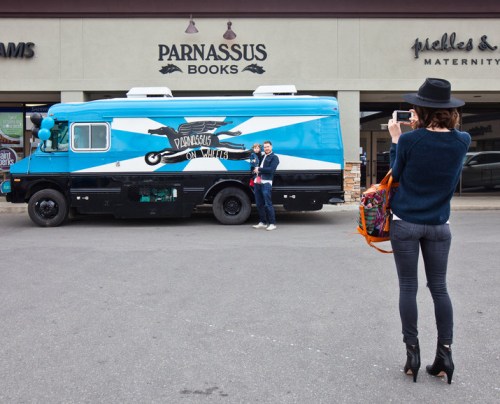
The bright blue bookmobile, which hit the road this week, is a roving offshoot of Parnassus Books, a popular independent bookstore. It will roam around town, stopping at food truck rallies, farmers’ markets and outside restaurants.

The arrival of a bookstore on wheels is a fitting evolution for Parnassus, which is co-owned by Karen Hayes and the novelist Ann Patchett. The store’s name comes from Christopher Morley’s 1917 novel “Parnassus on Wheels,” about a middle-aged woman who travels around selling books out of a horse-drawn van.

Parnassus takes to the streets of Nashville, TN.

Parnassus takes to the streets of Nashville, TN.

Since Parnassus opened in 2011, Ms. Hayes has wanted a traveling bookstore of her own. She looked at taco trucks and ice cream trucks and felt envious of their freedom to take business wherever people gathered, she said.

“A bookmobile made so much sense, because food trucks work so well in this town,” Ms. Hayes said by telephone. “It’s a great way to get our name out there, too. It’s a rolling advertisement.”

Ms. Hayes found the van on eBay last spring, and bought it for $10,000 from a library in Georgia. The van was already outfitted with angled shelves, which keep the books from flying off, but still needed $20,000 worth of work.

It is a logical and efficient way for a small bookstore to expand its footprint, especially as big chains have shuttered locations, leaving a vacuum for enterprising independent stores to fill. A handful of independent stores around the country have taken the trade on the road, in an effort to stir up business and bring books to neighborhoods and suburbs without a bookstore. Little Shop of Stories, an independent store in Decatur, Ga., used a grant from the author James Patterson to turn a used school bus into a mobile bookstore. Fifth Dimension Books, a bookmobile in Austin, Tex., stocks a rotating selection of science fiction and fantasy books from its collection of 100,000 volumes.

Bookmobiles are not about to become as prevalent as food trucks. But their arrival in Nashville and other cities offers another encouraging sign that independent stores are thriving again, after years of decline. Sales at bookstores rose 2.5 percent in 2015 over the previous year, to $11.17 billion, for the first annual increase since 2007, according to the United States Census Bureau.

Dozens of small bookstores across the country are opening multiple locations, expanding into mini chains. Books Inc., a San Francisco Bay Area independent store, now has 11 locations. Third Place Books in Seattle will soon open a new store, its third. Greenlight Bookstore, a prominent independent store in Fort Greene, Brooklyn, is opening a second Brooklyn store in Prospect-Lefferts Gardens.

In 2015, the American Booksellers Association counted 1,712 member stores in 2,227 locations, a big jump from 2009, when the group had 1,401 stores in 1,651 locations.

“The trend is unmistakable, and we see it not only continuing but growing,” said Oren Teicher, the ABA’s chief executive.

Parnassus is expanding too. It will double in size, adding 2,500 square feet of retail space, when it takes over a recently vacated storefront next door. Its owners considered looking for a second location, but decided the book van would be a better way to expand the store’s geographic range and customer base.

The van packs around 1,000 books, mostly new releases and best sellers — a small fraction of Parnassus’s stock of 20,000 books. Its owners have managed to make the cramped space bright and inviting: customers can walk the narrow aisles between the shelves, and can linger and sample books on one of the padded blue benches.

“One of my hopes is that we’ll be able go into some of the outlying suburbs and cities that don’t necessarily have a bookstore,” said Grace Wright, a Parnassus bookseller who will manage the bookmobile. “There’s nothing like a good bookstore.”

Another bonus: the physical bookstore has four resident dogs — Opie, Belle, Mary Todd Lincoln, and Bear — who love riding around town, Ms. Wright said.

“They seem to have fun in the bus,” she said.

Leave a comment

Filed under 2016, bookstore

The aroma of books

What Causes the Smell of New & Old Books?

Source: http://www.compoundchem.com/2014/06/01/newoldbooksmell/

The smell of books.

The smell of books.

Everyone’s familiar with the smell of old books, the weirdly intoxicating scent that haunts libraries and second-hand book stores. Similarly, who doesn’t enjoy riffling through the pages of a newly purchased book and breathing in the crisp aroma of new paper and freshly printed ink? As with all aromas, the origins can be traced back to a number of chemical constituents, so we can examine the processes and compounds that can contribute to both.

As far as the smell of new books goes, it’s actually quite difficult to pinpoint specific compounds, for a number of reasons. Firstly, there seems to be a scarcity of scientific research that’s been carried out on the subject – to be fair, it’s understandable why it might not exactly be high up on the priority list. Secondly, the variation in the chemicals used to manufacture books also means that it’s an aroma that will vary from book to book. Add to this the fact that there are literally hundreds of compounds involved, and it becomes clearer why it evades attribution to a small selection of chemicals.

It’s likely that the bulk of ‘new book smell’ can be put down to three main sources: the paper itself (and the chemicals used in its manufacture), the inks used to print the book, and the adhesives used in the book-binding process.

The manufacture of paper requires the use of chemicals at several stages. Large amounts of paper are made from wood pulp (though it can also be made from cotton and textiles) – chemicals such as sodium hydroxide, often referred to in this context as ‘caustic soda’, can be added to increase pH and cause fibres in the pulp to swell. The fibres are then bleached with a number of other chemicals, including hydrogen peroxide; then, they are mixed with large amounts of water. This water will contain additives to modify the properties of the the paper – for example, AKD (alkyl ketene dimer) is commonly used as a ‘sizing agent’ to improve the water-resistance of the paper.

Many other chemicals are also used – this is just a very rough overview. The upshot of this is that some of these chemicals can contribute, through their reactions or otherwise, to the release of volatile organic compounds (VOCs) into the air, the odours of which we can detect. The same is true of chemicals used in the inks, and the adhesives used in the books. A number of different adhesives are used for book-binding, many of which are based on organic ‘co-polymers’ – large numbers of smaller molecules chemically chained together.

As stated, differences in paper, adhesives, and inks used will influence the ‘new book smell’, so not all new books will smell the same – perhaps the reason why no research has yet attempted to definitively define the aroma.

An aroma that has had much more research carried out around it, however, is that of old books. There’s a reason for this, as it’s been investigated as a potential method for assessing the condition of old books, by monitoring the concentrations of different organic compounds that they give off. As a result, we can be a little more certain on some of the many compounds that contribute to the smell.

Generally, it is the chemical breakdown of compounds within paper that leads to the production of ‘old book smell’. Paper contains, amongst other chemicals, cellulose, and smaller amounts of lignin – much less in more modern books than in books from more than one hundred years ago. Both of these originate from the trees the paper is made from; finer papers will contain much less lignin than, for example, newsprint. In trees, lignin helps bind cellulose fibres together, keeping the wood stiff; it’s also responsible for old paper’s yellowing with age, as oxidation reactions cause it to break down into acids, which then help break down cellulose.

‘Old book smell’ is derived from this chemical degradation. Modern, high quality papers will undergo chemical processing to remove lignin, but breakdown of cellulose in the paper can still occur (albeit at a much slower rate) due to the presence of acids in the surroundings. These reactions, referred to generally as ‘acid hydrolysis’, produce a wide range of volatile organic compounds, many of which are likely to contribute to the smell of old books. A selected number of compounds have had their contributions pinpointed: benzaldehyde adds an almond-like scent; vanillin adds a vanilla-like scent; ethyl benzene and toluene impart sweet odours; and 2-ethyl hexanol has a ‘slightly floral’ contribution. Other aldehydes and alcohols produced by these reactions have low odour thresholds and also contribute.

Other compounds given off have been marked as useful for determining…

Details at: http://www.compoundchem.com/2014/06/01/newoldbooksmell/

1 Comment

Filed under 2016, books

Photo finish Friday: “Christmas tree of Knowledge”

Maybe the tree of Knowledge was actually a tree of books.

Maybe the tree of Knowledge was actually a tree of books.

1 Comment

Filed under 2015, photo by David E. Booker, Photo Finish Friday

Give the gift of reading

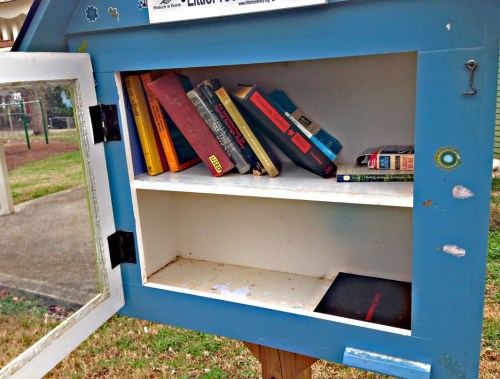
This holiday season, consider donating books you've read to the Little Free Library in your neighborhood.

This holiday season, consider donating books you’ve read to the Little Free Library in your neighborhood.

There are many ways to share the gift of reading with friends you know and even folks you might not ever meet. Giving books is always a good idea. Donating books you’ve read but don’t have room for is another way.

Where to donate? How about a local Little Free Library. It’s based on the idea or bring a book, take a book. Bring something you want to share and if you see something you like, borrow it to read.

This exchange idea is what keeps these free little libraries going. In my neighborhood, there have even been folks from outside the neighborhood who have donated books, people who will probably never make it by to borrow one, but still want to see this Little Free Library remain open and available to those who can use it.

Give the gift of reading this holiday season. Donate a book or two to your local Little Free Library, especially children and young adult books. Start them early on the adventure of reading.

Thank you to all those who have helped to keep the Little Free Library in my neighborhood going.

Thank you to all those who have helped to keep the Little Free Library in my neighborhood going.

1 Comment

Filed under 2015, books

Amazon Killed the Bookstore. So It’s Opening a Bookstore

Store opening in University Village in Seattle, WA. Twenty years after Amazon started selling books online.


by Issie Lapowsky

Source: http://www.wired.com/2015/11/amazon-killed-the-bookstore-so-its-opening-a-bookstore/

amazon logoBookstore owners already loathe Amazon for gutting the cost of books online and driving so many brick and mortar shops out of business. Now, the online retailer is both beating them and joining them, with the opening of its first physical bookstore today in Seattle.

Amazon Books, as the new store is called, will be like any other Main Street bookstore (remember those?), except that Amazon will use the troves of data it collects from its online customers to stock the shelves. That means its book displays will feature real Amazon book reviews, and the store will showcase books that have amassed the most pre-orders online. The books will also come with Amazon’s trademark low price tags.

It can afford those cut-rate prices, of course, because Amazon Books is as much a bookstore as it is a billboard. Amazon’s not suddenly betting big on the bookstore business, and it certainly doesn’t need the store to be a success in order for Amazon to succeed. It’s better to think of Amazon Books as a giant advertisement. If it makes a little extra money for a $294.7 billion company, all the better.

The one silver lining for the book enthusiasts forced to watch their industry turn into a gimmick is that, according to the Seattle Times, Amazon is hiring from other retail stores and libraries that may be struggling. Well, silver lining for those hoping for Seattle-area book store jobs. For Seattle-area book store employers, it’s probably not pleasant watching their employees get poached.

For now, Amazon says the store won’t be serving double duty as a warehouse or pickup center, and the vice president of Amazon Books, Jennifer Cast, tells the Seattle Times the company doesn’t yet have plans to open a second location. “We’re completely focused on this bookstore,” Cast said. “We hope this is not our only one. But we’ll see.”

Additional article: http://www.seattletimes.com/business/amazon/amazon-opens-first-bricks-and-mortar-bookstore-at-u-village/

1 Comment

Filed under 2015, Amazon

Shelf catering: tourists offered chance to run a bookshop on holiday

For £150 a week, AirBnB users are invited to live in – and run – The Open Book store in Wigtown, Scotland

The Open Book in Wigtown, Scotland

The Open Book in Wigtown, Scotland

by Allison Flood

Source: http://www.theguardian.com/books/2015/aug/21/tourists-offered-chance-to-run-a-bookshop-on-holiday-wigtown

For all those who agree with Neil Gaiman’s maxim in American Gods that “a town isn’t a town without a bookstore”, and who yearn to spend their days amongst the pristine spines and glossy covers of a small bookshop, what might be the perfect holiday retreat has just been listed on AirBnB: the opportunity to become a bookseller for a week or two.

For the sum of £150 a week, guests at The Open Book in Wigtown, Scotland’s national book town, will be expected to sell books for 40 hours a week while living in the flat above the shop. Given training in bookselling from Wigtown’s community of booksellers, they will also have the opportunity to put their “own stamp” on the store while they’re there. “The bookshop residency’s aim is to celebrate bookshops, encourage education in running independent bookshops and welcome people around the world to Scotland’s national book town,” says the AirBnB listing.

The Open Book is leased by the Wigtown book festival from a local family. Organisers have been letting paying volunteers run the shop for a week or two at a time since the start of the year, but opened the experience up to the world at large this week when they launched what they are calling “the first ever bookshop holiday experience” on AirBnB.

“I wouldn’t call it a working holiday,” said Adrian Turpin, director of the Wigtown book festival. “It’s a particular kind of holiday [for people] who don’t feel that running a bookshop is work. It’s not about cheap labour – it’s about offering people an experience … It’s one of those great fantasies.”

The money is “just essentially to cover our costs”, said Turpin, admitting that “it can be a hard life, selling books in a small town, so it’s not a holiday for everybody”.

“I suspect [the shop] would have closed, without this,” he said. “Wigtown is Scotland’s national book town, but it’s quite a long way from anywhere. So part of the idea was to get new people in – people who would hopefully end up having a good time and a long-standing relationship with the town. And also to keep the bookshop afloat. It might otherwise have shut down.”

The rest of the article: http://www.theguardian.com/books/2015/aug/21/tourists-offered-chance-to-run-a-bookshop-on-holiday-wigtown

Leave a comment

Filed under 2015, bookshop, bookstore

The Case For Libraries

When it comes to books, libraries and publishers should be in it together, argues a leading marketing expert

Source: http://www.publishersweekly.com/pw/by-topic/industry-news/libraries/article/66106-the-case-for-libraries.html

By David Vinjamuri

Publishers are running out of space. Not in their headquarters, some of which are larger and more imposing than ever, but in retail. The number of booksellers has been dwindling since the demise of Borders, and the largest book retailer today is Amazon, which has no physical space at all.

So the question is, where can publishers showcase new books? If only there were a space dedicated primarily to reading that hundreds of millions of Americans visit annually. If only there existed a trusted space, free of the revenue pressure that necessitates displaying lightly pornographic books of debatable quality. If only there were a space largely inhabited by active readers, where publishers could showcase new authors or shine new light on talented mid-listers.

That space exists in the 16,000 public library branches in America. They’re trusted and willing, and they welcome your attention. But libraries receive surprisingly little coordinated help from publishers beyond lip service—in fact, they’re still in the middle of a very public dispute with publishers about the high prices and restrictive access libraries must contend with to lend e-books to their patrons.

The tension between libraries and publishers seems odd in a market where physical space for displaying books is quickly disappearing. How did we get here? And could libraries actually represent a much better opportunity for publishers than they are given credit for?

A History of Indifference

In the beginning, publishers and libraries were interdependent. When modern publishing houses emerged from printers in the late 19th century, public libraries in the U.S. and U.K. were often the first and only guaranteed customer for a title.

Even as late as 1950, libraries were indispensable customers for publishers. The entire output of the domestic publishing industry in that year was 11,000 titles, and the average branch of a public library purchased 14,000 titles annually. The most reliable market for many books was the 11,135 library branches operating then.

Things are different today. Publishers produced nearly half a million new ISBNs in 2013 (with self-publishers included, that total nearly doubles), though increasingly cash-strapped libraries are purchasing fewer titles. According to industry stats, the library market now represents just over 1.3% of publishers’ trade sales. But just as the crucible of the book superstore transformed publishing in the 1980s, the advent of online sellers—particularly Amazon—is remaking it today. And as the conflict between Hachette and Amazon last year proved, Amazon is both indispensable and despised as a partner to publishers.

But a new challenge has emerged from the transformation of sales channels in the past three decades: discovery. Five years, ago in 2010, just under a third of all frequent readers (who purchase 80% of all books and number 43 million) found the last book they bought at a bookstore. This year, that number is down to 17%, according to Peter Hildick-Smith, of the Codex Group—a change that gives Amazon more power than ever.

“A small group of authors control the bestseller lists,” Hildick-Smith observes. “When we indexed the New York Times hardcover fiction and mass market bestseller lists from June 2008 through June 2014, nearly 16,000 spots in total, we found that all those places were occupied by fewer than 650 authors.”

That concentration has created a problem for publishers, which Amazon has ruthlessly exploited. By promoting both self-published and Amazon-signed authors on the Kindle platform, the online retailer has come to exert tremendous pricing pressure on the entire industry. Amazon can now manipulate the products of hundreds of thousands of other authors through price reduction.

Meanwhile, the dominance of bestsellers has also put the squeeze on the marketing budgets of debut and midlist authors. Since publishers can only afford to make a few big bets per year, the route to building new franchise authors is more uncertain than ever.

Author Brands Matter

A great deal of attention has been paid to the question of so-called platform size for new authors. How large is the social media footprint of the author? How active is she on Facebook, Twitter, and

Continued at: http://www.publishersweekly.com/pw/by-topic/industry-news/libraries/article/66106-the-case-for-libraries.html

Leave a comment

Filed under 2015, library

The Millions: A Year in Reading: Tom Nissley

The Millions : A Year in Reading: Tom Nissley.

I did something in 2014 that would throw a wrench into anyone’s reading: I bought a bookstore. Selling books, as I wasn’t surprised to find, doesn’t leave much time for reading them. Also, it meant I became — not for the first time, but never so publicly, on such a daily basis — a professional reader, as many of us are lucky to end up being in one way or another, as teachers or editors or researchers or some other line of work that corrals your attention from the luxury of polymorphous curiosity into something more traditionally productive, in my case trying to keep up with some of the new releases I might be able to share with my customers.

So, early in the year, my reading shifted back from personal to pro, but there were good books on both sides of the divide. And aside from a few favorites (see below), what I find myself remembering as vivid reading experiences are not consistently excellent books like Marilynne Robinson’s Lila, Ben Lerner’s 10:04, David Markson’s Reader’s Block, Vera Brittain’s Testament of Youth, Lawrence Wright’s Thirteen Days in September, Tove Jansson’s The Summer Book, Jeff VanderMeer’s Annihilation, Edward Hirsch’s Gabriel, Brendan Koerner’s The Skies Belong to Us, and William Gibson’s The Peripheral — all very good books I’d happily put in your hands if you walked into my store — but the more jagged-edged books I might hand you with a caveat.

I remember, with delight, the first half of Anthony Trollope’s The Eustace Diamonds — “Finally reading Trollope,” I told everyone, or, rather, tweeted. “What took me so long to sample this deliciousness?” — before his stamina started to outlast mine. I was delighted too with the first half of Joseph O’Neill’s The Dog and the voice he captured, as companionable as Netherland’s but more chilling (like P.G. Wodehouse telling a J.G. Ballard story), even if for me that voice never grew into a full book. I admired and enjoyed Farther and Wilder, Blake Bailey’s biography of Charles Jackson, but I wondered if his subject was worth his talents until the final third — usually the least interesting in any biography — when Jackson’s accumulated troubles, and his belated reckoning with them, made his life profoundly moving. And though Joel Selvin’s Here Comes the Night had for me a hole at its center == the interior life of its ostensible subject, unsung record man Bert Berns, remained a cipher — I loved Selvin’s hepcat riffs on Berns and his fellow “centurions of pop.”

The rest of the article at: http://www.themillions.com/2014/12/a-year-in-reading-tom-nissley.html

1 Comment

Filed under books

The Ferguson Public Library

In the midst of what is happening in Ferguson, MO, the library has remained open to all.

A Nationwide Outpouring Of Support For Tiny Ferguson Library

Source: http://www.npr.org/blogs/thetwo-way/2014/11/27/366811650/a-nationwide-outpouring-of-support-for-tiny-ferguson-library

The Ferguson Public Library is just a block away from the center of demonstrations at the Ferguson Police Department. As we’ve reported, when violent protests this week led to the burning of more than a dozen businesses and the uncertainty caused schools to close, the library stayed open.

It has become a quiet refuge for adults and children alike in this St. Louis suburb. And the nation has taken notice. The outpouring of support for the library has reached “orders of magnitude” more than any previous amount, says library Director Scott Bonner.

He’s the only full-time librarian there — and he started his job in July, just weeks before the town became an internationally known name. Bonner says the donations may allow him to hire another person to help.

Source: http://www.npr.org/blogs/thetwo-way/2014/11/27/366811650/a-nationwide-outpouring-of-support-for-tiny-ferguson-library

The Ferguson Public Library could use our support

Source: http://www.reddit.com/r/books/comments/2nfocf/the_ferguson_public_library_could_use_our_support/

Hey, all! I’m the director of the Ferguson Municipal Public Library. Thank you, everyone, for the praise and encouragement for us and for libraries in general!

One advantage of a small, independent library like ours is that we have the luxury of being able to be all about the local community. So, when Ferguson needs us, we do our best to be there. And, yup, Ferguson needs us. One thing that doesn’t get out much in the media is that this community will come together when they have a common cause. We saw it at the library. When the kids needed help, everyone from every side came running to do all they could, and built an ad-hoc school in our building. That, right there, gives me hope that Ferguson can – and will – come together in the end.

For those asking how best to donate: 1) Go to your local public library and help them. 2) Use the paypal and bitcoin links in the original post if you want to help us. Thanks, AdamBertocci! 3) If you want to send us books, the Powell’s list is the place to start. http://www.powells.com/cgi-bin/wishlist?email=booksforferguson@gmail.com&list=Books%20for%20Ferguson%20III Thanks, Wonderland01, for the Powell’s link. That book list was put together by Angie Manfredi, a New Mexico librarian who knows her stuff.

We appreciate the hell out of anything you want to do to help us. At least one person was worried about the money going to bad guys. If that was paranoia talking, well, I can’t help that. But I will say that librarians are famous for making the most of every dollar. We’re frugal to a fault, and I am worse than most. I can guarantee that every penny will be spent to help the library help Ferguson. While you’re at it, take a look at Operation Food Search, some of the local churches, and the local public schools for groups that are saving the day, every day.

If you’ve got 8 minutes to waste, here’s a tour of our library (watch on computer so the annotations work – they’re the best part): https://www.youtube.com/watch?v=XtrUgdJZMQQ

Question: would there be interest in me doing an AMA, as a librarian/library director, and someone who works in Ferguson? Or are the questions basically pre-answered, as it were?

Source: http://www.reddit.com/r/books/comments/2nfocf/the_ferguson_public_library_could_use_our_support/

Leave a comment

Filed under library