Tag Archives: book

Book sequel

The 5 best sequels to classic novels

Author Chet Williamson has written an authorised sequel to Robert Bloch’s Psycho. Here, he looks at other sequels that honour the original works while bringing new life to them

Source: http://www.independent.co.uk/arts-entertainment/films/features/my-five-favourite-sequels-to-classic-novels-from-the-further-adventures-of-huckleberry-finn-to-the-a6970976.html

Having just written an authorised sequel to Psycho, Robert Bloch’s original tale of Norman Bates, I was asked by The Independent to come up with what I considered the five best sequels to other classic novels. I’m not so sure about the “best”, but these are certainly my favourites, ones that honour and respect the original works while bringing different perspectives and new life to them:

The Further Adventures of Huckleberry Finn by Greg Matthews (1988)

The author of the western epics, Power in the Blood and Heart of the Country, takes up Sam Clemens’ pen and picks up the story as though channelling Mark Twain. A perfect sequel to a book that’s as close as anyone’s come to the Great American Novel.

Pym by Mat Johnson (2010)

It seems that Edgar Allan Poe’s Arthur Gordon Pym, a story of weird adventure in the Antarctic, is based on fact, and it’s up to a professor of American literature to confirm it with a trip to the South Pole. Johnson deals with race, history, and literature trenchantly and often humorously, while retaining the cosmic mystery of Poe’s original.

Grendel by John Gardner (1971)

Grendel John_GardnerNot so much a sequel as a retelling of the ancient epic, Beowulf, seen from the monster’s point of view. Gardner was an extraordinary writer, and his depiction of Grendel is tender, haunting, empathetic, and terrible.

A Feast Unknown by Philip Jose Farmer (1969)

First published by an “erotica” house, this novel is the great-grandfather of literary mash-ups, and still far superior to most of them. Farmer creates his own versions of Tarzan (Lord Grandith) and pulp hero Doc Savage (Doc Caliban), makes them half-brothers (their father was Jack the Ripper), and sets them against each other in a violent and homoerotic grudge match. A masterpiece of absurdity.

The Hours by Michael Cunningham (1998)

From the ridiculous to the sublime. Cunningham’s tripartite exploration of Virginia Woolf’s Mrs Dalloway is too complex in plot and character to begin to discuss here, but this bold and experimental novel sets the bar for what can be accomplished by treading in the footsteps of an earlier work of literary brilliance.

Psycho: Sanitarium is published on 12th April by Canelo, price £3.99 in eBook

Leave a comment

Filed under 2016, books, novel

The aroma of books

What Causes the Smell of New & Old Books?

Source: http://www.compoundchem.com/2014/06/01/newoldbooksmell/
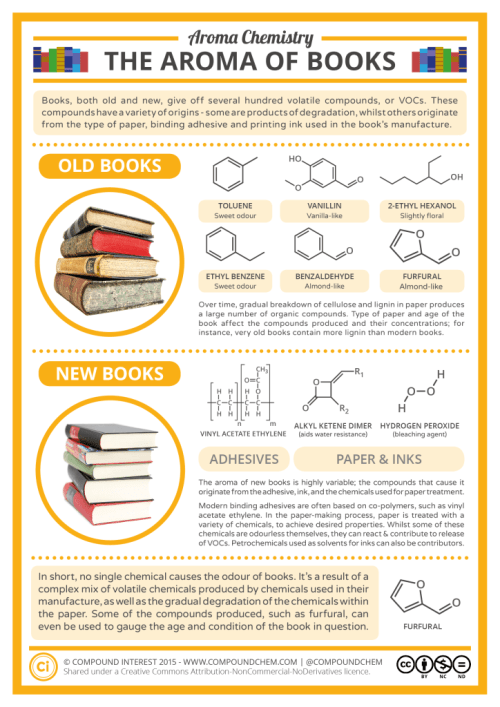
The smell of books.

The smell of books.

Everyone’s familiar with the smell of old books, the weirdly intoxicating scent that haunts libraries and second-hand book stores. Similarly, who doesn’t enjoy riffling through the pages of a newly purchased book and breathing in the crisp aroma of new paper and freshly printed ink? As with all aromas, the origins can be traced back to a number of chemical constituents, so we can examine the processes and compounds that can contribute to both.

As far as the smell of new books goes, it’s actually quite difficult to pinpoint specific compounds, for a number of reasons. Firstly, there seems to be a scarcity of scientific research that’s been carried out on the subject – to be fair, it’s understandable why it might not exactly be high up on the priority list. Secondly, the variation in the chemicals used to manufacture books also means that it’s an aroma that will vary from book to book. Add to this the fact that there are literally hundreds of compounds involved, and it becomes clearer why it evades attribution to a small selection of chemicals.

It’s likely that the bulk of ‘new book smell’ can be put down to three main sources: the paper itself (and the chemicals used in its manufacture), the inks used to print the book, and the adhesives used in the book-binding process.

The manufacture of paper requires the use of chemicals at several stages. Large amounts of paper are made from wood pulp (though it can also be made from cotton and textiles) – chemicals such as sodium hydroxide, often referred to in this context as ‘caustic soda’, can be added to increase pH and cause fibres in the pulp to swell. The fibres are then bleached with a number of other chemicals, including hydrogen peroxide; then, they are mixed with large amounts of water. This water will contain additives to modify the properties of the the paper – for example, AKD (alkyl ketene dimer) is commonly used as a ‘sizing agent’ to improve the water-resistance of the paper.

Many other chemicals are also used – this is just a very rough overview. The upshot of this is that some of these chemicals can contribute, through their reactions or otherwise, to the release of volatile organic compounds (VOCs) into the air, the odours of which we can detect. The same is true of chemicals used in the inks, and the adhesives used in the books. A number of different adhesives are used for book-binding, many of which are based on organic ‘co-polymers’ – large numbers of smaller molecules chemically chained together.

As stated, differences in paper, adhesives, and inks used will influence the ‘new book smell’, so not all new books will smell the same – perhaps the reason why no research has yet attempted to definitively define the aroma.

An aroma that has had much more research carried out around it, however, is that of old books. There’s a reason for this, as it’s been investigated as a potential method for assessing the condition of old books, by monitoring the concentrations of different organic compounds that they give off. As a result, we can be a little more certain on some of the many compounds that contribute to the smell.

Generally, it is the chemical breakdown of compounds within paper that leads to the production of ‘old book smell’. Paper contains, amongst other chemicals, cellulose, and smaller amounts of lignin – much less in more modern books than in books from more than one hundred years ago. Both of these originate from the trees the paper is made from; finer papers will contain much less lignin than, for example, newsprint. In trees, lignin helps bind cellulose fibres together, keeping the wood stiff; it’s also responsible for old paper’s yellowing with age, as oxidation reactions cause it to break down into acids, which then help break down cellulose.

‘Old book smell’ is derived from this chemical degradation. Modern, high quality papers will undergo chemical processing to remove lignin, but breakdown of cellulose in the paper can still occur (albeit at a much slower rate) due to the presence of acids in the surroundings. These reactions, referred to generally as ‘acid hydrolysis’, produce a wide range of volatile organic compounds, many of which are likely to contribute to the smell of old books. A selected number of compounds have had their contributions pinpointed: benzaldehyde adds an almond-like scent; vanillin adds a vanilla-like scent; ethyl benzene and toluene impart sweet odours; and 2-ethyl hexanol has a ‘slightly floral’ contribution. Other aldehydes and alcohols produced by these reactions have low odour thresholds and also contribute.

Other compounds given off have been marked as useful for determining…

Details at: http://www.compoundchem.com/2014/06/01/newoldbooksmell/

1 Comment

Filed under 2016, books

Photo finish Friday: “Flushed with reading”

You need a place to rest your book.

You need a place to rest your book.

Don't try this with an unabridged dictionary.

Don’t try this with an unabridged dictionary.

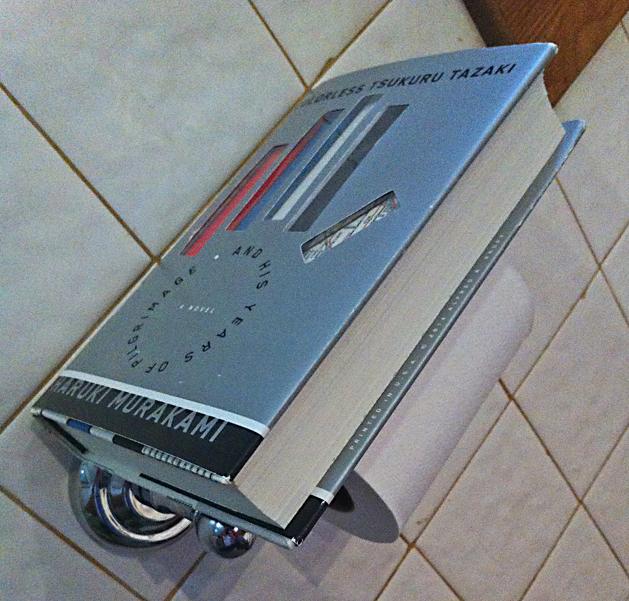
Do you live with your novels as you are reading them? Even in the bathroom?

But maybe you have no bookshelf or place to temporarily rest the book. What do you do? Why, the toilet paper dispenser might be your friend.

Not recommended for heavy books or picture books of odd-sized dimensions. But the right book at the right time with the roll of toilet paper at the right diameter, and you have a temporary bookshelf while you await the flush of success.

Leave a comment

Filed under 2015, photo by David E. Booker, Photo Finish Friday

Retitled

This Guy Created His Own Hilarious Book Sections At A Local Bookstore

Source: http://www.boredpanda.com/funny-accurate-book-section-names/

Tired of having to look at boring and often misleading book sections at his local bookstore, one guy decided to create his own alternative sections that would describe the books more accurately. He carefully placed them all around the bookstore, photographed the results and quickly got away before anyone noticed.

For example, the culinary section is now called “Meals You Intend To Make, But Never Will” – which we have to agree is a much more accurate description. Also, instead of looking for romance novel section, girls can now ask the store manager to show them where the “Dudes who lost their shirts” section is.

Finally there’s some order in the book world!

Section titles include:

Dudes Who Lost Their Shirts

Meals You Intend To Make, But Never Will

Great Places To Poop

And others.

To see photos and read more about it, go to http://www.boredpanda.com/funny-accurate-book-section-names/

1 Comment

Filed under 2015, bookstore

“Book ’em, Dano”

The Danger of Being Neighborly Without a Permit

All over America, people have put small “give one, take one” book exchanges in front of their homes. Then they were told to tear them down.

by Conor Friedersdorf

Source: http://www.theatlantic.com/national/archive/2015/02/little-free-library-crackdown/385531/

Local Little Library box.

Local Little Library box.

Three years ago, The Los Angeles Times published a feel-good story on the Little Free Library movement. The idea is simple: A book lover puts a box or shelf or crate of books in their front yard. Neighbors browse, take one, and return later with a replacement. A 76-year-old in Sherman Oaks, California, felt that his little library, roughly the size of a dollhouse, “turned strangers into friends and a sometimes-impersonal neighborhood into a community,” the reporter observed. The man knew he was onto something “when a 9-year-old boy knocked on his door one morning to say how much he liked the little library.” He went on to explain, “I met more neighbors in the first three weeks than in the previous 30 years.”

Since 2009, when a Wisconsin man built a little, free library to honor his late mother, who loved books, copycats inspired by his example have put thousands of Little Free Libraries all over the U.S. and beyond. Many are displayed on this online map. In Venice, where I live, I know of at least three Little Free Libraries, and have witnessed chance encounters where folks in the neighborhood chat about a book.

I wish that I was writing merely to extol this trend. Alas, a subset of Americans are determined to regulate every last aspect of community life. Due to selection bias, they are overrepresented among local politicians and bureaucrats. And so they have power, despite their small-mindedness, inflexibility, and lack of common sense so extreme that they’ve taken to cracking down on Little Free Libraries, of all things.

Last summer in Kansas, a 9-year-old was loving his Little Free Library until at least two residents proved that some people will complain about anything no matter how harmless and city officials pushed the boundaries of literal-mindedness:

The Leawood City Council said it had received a couple of complaints about Spencer Collins’ Little Free Library. They dubbed it an “illegal detached structure” and told the Collins’ they would face a fine if they did not remove the Little Free Library from their yard by June 19.

Rest of the article: http://www.theatlantic.com/national/archive/2015/02/little-free-library-crackdown/385531/

Leave a comment

Filed under 2015, library

Twenty-four things about publishing…

24 Things No One Tells You About Book Publishing

Ten years ago, my first novel Prep came out. Three novels later, here’s what I’ve learned about the publishing industry and writing since then.

by Curtis Sittenfeld

Writing is only part of the mystery.

Writing is only part of the mystery.

Source: http://www.buzzfeed.com/curtissittenfeld/things-no-one-ever-tells-you-about-the-publishing-industry?bffbbooks

  1. When it comes to fellow writers, don’t buy into the narcissism of small differences. In all their neurotic, competitive, smart, funny glory, other writers are your friends.
  2. Unless you’re Stephen King, or you’re standing inside your own publishing house, assume that nobody you meet has ever heard of you or your books. If they have, you can be pleasantly surprised.
  3. At a reading, 25 audience members and 20 chairs is better than 200 audience members and 600 chairs.
  4. There are very different ways people can ask a published writer for the same favor. Polite, succinct, and preemptively letting you off the hook is most effective.
  5. Blurbs achieve almost nothing, everyone in publishing knows it, and everyone in publishing hates them.
  6. But a really good blurb from the right person can, occasionally, make a book take off.
  7. When your book is on best-seller lists, people find you more amusing and respond to your emails faster.
  8. When your book isn’t on best-seller lists, your life is calmer and you have more time to write.
  9. The older you are when your first book is published, the less gratuitous resentment will be directed at you.
  10. The goal is not to be a media darling; the goal is to have a career.
  11. The farther you live from New York, the less preoccupied you’ll be with literary gossip. Like cayenne pepper, literary gossip is tastiest in small doses.
  12. Contrary to stereotype, most book publicists aren’t fast-talking, vapid manipulators; they’re usually warm, organized youngish women (yes, they are almost all women) who love to read.
  13. Female writers are asked more frequently about all of the following topics than male writers: whether their work is autobiographical; whether their characters are likable; whether their unlikable characters are unlikable on purpose or the writer didn’t realize what she was doing; how they manage to write after having children.

For the other eleven, go to: http://www.buzzfeed.com/curtissittenfeld/things-no-one-ever-tells-you-about-the-publishing-industry?bffbbooks

Leave a comment

Filed under publishing, publishing news

Monday (morning) writing joke: “Enlightenment”

“Outside a dog, a book is man’s best friend. Inside a dog, it’s too dark to read.” –Groucho Marx

Groucho Marx

Groucho Marx

1 Comment

Filed under Monday morning writing joke

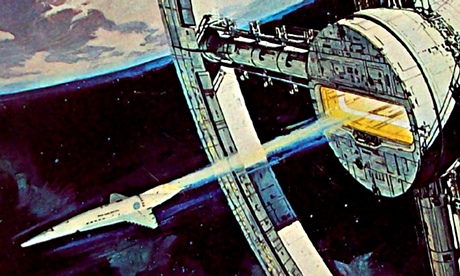
Quiz: Can you identify these classic sci-fi books by their covers? | Books | theguardian.com

Quiz: Can you identify these classic sci-fi books by their covers? | Books | theguardian.com.

Leave a comment

Filed under book covers

Writers on Writing: “Times are….”

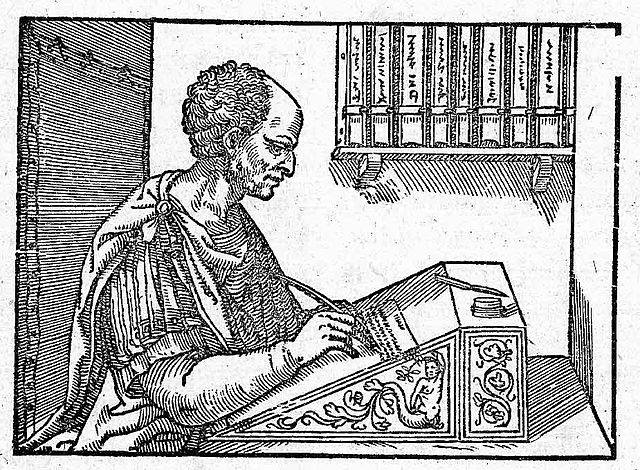
“Times are bad. Children no longer obey their parents and everyone is writing a book.” — Cicero, 43 BCE

“Times are bad. Children no longer obey their parents and everyone is writing a book.”
— Cicero, 43 BCE

Since I am working on a book or two, I guess I am adding to the bad times. And you?

Leave a comment

Filed under Writers on writing

Haiku to you Thursday: “Love in the folds”

Love is an art form /
tucked deep into a book’s fold: /
read, forgotten, dreamed.

Leave a comment

Filed under Haiku to You Thursday, poetry by author