Tag Archives: Bob McKey

Building a better story: Tension

In the last installment, I said there was a difference between conflict and tension. Conflict, as Bob McKey pointed out, is the gap between expectation and result. The gap can be small, such as being overcharged a dime or great, such as losing a loved one when you thought he would survive.

The best way to explain tension is to refer to a small book on writing by the writer and editor Algis Budrys, Lithuanian for “Gordon John Sentry, more or less.” His book, Writing to The Point: A complete guide to selling fiction is only 64 pages long, and may be hard to get. But this Strunk and White-sized guide to writing is worth your time (and it even covers manuscript formatting).

For Gordon John Sentry, more or less, a story consists of seven parts: 1) a character 2) in a context with a 3) problem, who 4) makes an intelligent attempt to solve the problem and 5) fails, tries a second time and fails, tries a third time and finally 6) succeeds or completely fails, and whose actions are then 7) validated by another character in the story.

Sounds simple, doesn’t it? That is the allure of telling a good story. But the execution is often more difficult, for writer as well as story character. Step 4 – 6 above is where in a story you find tension. The key is that the character makes an intelligent attempt and fails. With increased knowledge, he or she tries again, and fails. The increased knowledge increases the stakes in the attempt and thus increases the tension. After all, it should succeed, right? Then there is a third and final attempt. This is, in essence, all or nothing, so the tension should be at its highest here.

Grimm reaper and man

Tension, while often confused with conflict, is not the same thing.
Tension, then, is something that builds over the life of the story, fueled by and feeding into the conflict. A well known love story may provide the clearest example. Romeo and Juliet loved each other. Their families, however, were adversaries. Romeo and Juliet attempted to find a way to manifest their love in the midst of this conflict, each time failing until each makes one last effort that leads to both their deaths. In this example, the tension builds in opposition to the conflict, which is fairly clever if you think about, and because of that opposition, the conflict works to heighten the tension.

Leave a comment

Filed under advice, Algis Budrys, building a better story, tension, words, writer, writing, writing tip

Writing Tip: Conflict

In the last installment of this feature, I put forth a little paradigm about writing that started off with “Drama is conflict….” But what is conflict? Is it open hostilities between two armies? It can be. It is the harsh words a husband has for a wife? It can be that, too. It is dealing with opposing desires or wants, such as deciding between love and honor? Yes, it can be that as well.

But all three examples listed above and in a host of others there is a common thread, something unspoken, and as important as words are, it is often the unspoken or unwritten element that defines a scene in a story and sometimes the story itself.

As I said in the previous article, I learned the paradigm that begins “Drama is conflict …” in 1993. Some twelve years later, and even though I wasn’t looking, I learned from author, screen writer, and teacher Steven Womack a definition of conflict that adds depth and, dare I say, meaning to the word conflict and the entire paradigm. He credits learning it from Bob McKey, a script doctor. McKey has made a living and a small fortune fixing other people’s scripts though he often doesn’t get screen credit for it. All scripts need conflict; conflict drives the story forward. How will the protagonist react? What will she do? But conflict is not car chases, gun battles, or galaxies spiraling out of control. Conflict, McKey said, is the gap between expectation and result. That’s it.

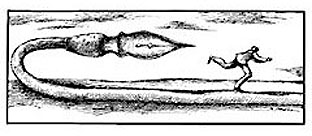
Pen chasing man

Conflict can be a small thing, or a large one, real or imagined.

Conflict can be as small as being overcharged a dime and how your protagonist reacts or as great as losing a battle when the protagonist fought hard to win. In both examples, there is a gap between expectations and results. How your protagonist deals with that gap and what steps he takes to close it are what drives a story forward, whether the story is a script, a short story, or a novel. The obstacles in the way preventing the protagonist from easily closing that gap are what are called tension, but that is a discussion for another time.

Leave a comment

Filed under advice, Bob McKey, building a better story, novel, Steven Womack, tension, words, writer, writing, writing tip