This year we celebrate the
two-hundredth birthday of Walt Whitman; and by “we” I mean all of us who
take conscious pleasure in speaking American English. Whitman invented a poetry
specific to this language and open to the kinds of experience, peculiar to
democracy in a polyethnic society on a vast continent, that might otherwise be
mute. Public events commemorating the bicentennial include three summer shows
in New York—at the Morgan Library, the New York Public Library, and the Grolier
Club—that touch on the story of his life. There are books, manuscripts, prints,
photographs, audio and video elements, and relics—at the Public Library, a lock
of his hair, and, at the Grolier, snips that may be from his beard. The shows
are excellent of their kind: informational and evocative, about remembering.
But I don’t much care for them. They have unavoidably cultish auras, akin to
celebrity worship; not that Whitman would have minded, he having been a
shame-free self-promoter who ghosted rave reviews of “Leaves of Grass” and
played to his sappy popular image as “the Good Gray Poet” (less good if brunet,
less gray if bad?). Such exhibits are to poetry as museum wall texts are to art
works—supposedly enhancing but often displacing aesthetic adventure.
I recommend observing the occasion at home, or on vacation. Sit down with a loved one and read aloud two poems: the miraculous “The Sleepers” (1855), in which Whitman eavesdrops on the slumber of multitudes, alive and dead, and interweaves dreams of his own—at one point joining a merry company of spirits, of whom he says, “I reckon I am their boss, and they make me a pet besides”—and “When Lilacs Last in the Dooryard Bloom’d” (1865), his epic elegy for Abraham Lincoln, in which the President isn’t named, even as his loss interpenetrates nature, symbolized by the unearthly song of “the gray-brown bird,” a hermit thrush. (I’ve gone online to hear its call: a melancholy arpeggio, repeated at different pitches.) In either case, see how far you get before you’re in tears, then pull yourself together and continue to the end. Reading Whitman silently enriches, but hearing your own or a partner’s voice luxuriate in the verse’s unhurried, insinuating cadences, drawn along on waves of alternately rough and delicate feeling, can quite overwhelm. That’s because your voice, if you are fluent in American, is anticipated, pre-wired into the declarative but intimate, easy-flowing lines. It’s as if you were a phonograph needle dropped into a vinyl groove.
Whitman was born the second of nine
children on a farm in West Hills, on Long Island, where his father struggled in
various lines of work. When Whitman was three, the family moved to Brooklyn,
and, in 1830, he left school, at age eleven, to help support the household. He took
jobs as a printer, meanwhile roaming the city and, an insatiable reader,
haunting libraries. After the printing district burned down, in 1835, he
returned to Long Island, working unhappily as a schoolteacher and pursuing a
knockabout career in journalism. By 1846, he was the editor of the prestigious
Brooklyn Daily Eagle, from which he was fired, two years later, for his
radical free-soil and anti-slavery politics. Among subsequent ventures, he
founded a weekly newspaper; another fire destroyed the office after its initial
issue.
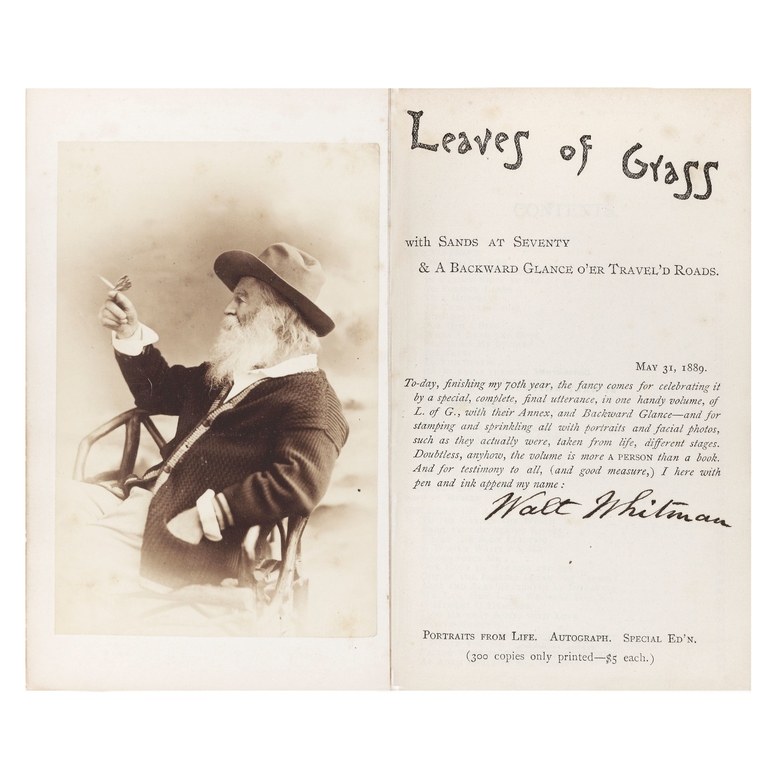
In 1855, Whitman self-published the
first of an eventual nine editions of “Leaves of Grass.” He advertised it by printing,
without permission, a private letter of praise that he had received from Ralph Waldo Emerson, whose essay “The Poet,” from
1844, reads in parts like a directive—“America is a poem in our eyes; its ample
geography dazzles the imagination, and it will not wait long for metres”—that
young Walt more than carried out. The book gradually gained wide notice, while
often coming under attack for alleged obscenity. Whitman’s homosexuality became
unmistakable in his impassioned “Calamus” poems of “adhesiveness,” named for a
plant with phallus-shaped “pink-tinged roots,” but, even before then, his
sensuality, regarding women as well as men, was earthy enough to rattle the
genteel. He expressed fervent Union patriotism at the start of the Civil War
and, in 1862, travelled south of Washington, D.C., to find his brother George,
who had been wounded in the Battle of Fredericksburg. For the next three years,
he served indefatigably as a volunteer nurse and comforter of wounded, sick,
and, too often, dying soldiers in Washington hospitals. “The real war will
never get in the books,” he wrote, but certain of its awful aspects are etched
in his own writing.
Those harrowing years amplified
Whitman’s already Romantic conceptions of death. If Keats was “half in love
with easeful death,” Whitman was head over heels for it, as a subject fit for
his titanic drive to coax positive value from absolutely anything. (“What
indeed is beautiful, except Death and Love,” he wrote. Note that death has
pride of place.) Meanwhile, he piloted his soul in genial company with all
other souls, afoot like him on ideal democracy’s Open Road, exulting in human
variety. If he failed any definitive American experience, it was aloneness.
That lack was made good by his younger contemporary Emily Dickinson: the soul
in whispered communication with itself. Both poets dealt with the historical
novelty of a nation of splintered individuals who must speak—not only for
themselves but to be reassured of having selves at all. There have been no
fundamental advances in the spiritual character—such as it is, touch and go—of
our common tongue since Whitman and Dickinson. It’s a matter of the oneness of
what they say with how they sound saying it. Admittedly, Whitman can be gassy
and Dickinson obscure, but they mined truth, and mining entails quantities of
slag. They derived messages from and for the mess of us.
Whitman’s flaws were at once
eccentric and typical of his day. He was a sucker for modish philosophies and
supposed sciences, from positivism to phrenology. In “Salut au Monde!” (called
“Poem of Salutation” on its first publication, in 1856), he exalted the
“divine-souled African, large, fine-headed, nobly-formed, superbly destined, on
equal terms with me!” But he was less universalist in his journalism and made
pointedly racist remarks in later years, calling blacks “baboons” and “wild
brutes”—a serious matter in any era but especially today, at a moment of newly
concerted will to face down the pestilential afterlife of slavery. Whitman had
imbibed a version of social Darwinism that predicted the decline of nonwhite
peoples, Asians sometimes excepted. It’s not for me to say that this, much less
his slurs, should be forgiven. Even so, in liberalism he was miles ahead of his
most penetrating modern critic, D. H. Lawrence, whose apposite essay in
his alternately profound and infuriating “Studies in Classic American Literature” leaps to
my mind whenever I think of Whitman.
Lawrence is sardonic about Whitman’s
hyperbolism. Quoting the line “I am he that aches with amorous love,” Lawrence
comments, “Better a bellyache.” He taxes Whitman with a disintegration of
personhood, “leaking out in a sort of dribble, oozing into the universe.” But
then he writes, “Whitman, the great poet, has meant so much to me”—as “a
strange, modern, American Moses” and “a great changer of the blood in the veins
of men.” Lawrence quails at democracy, from which he wants to rescue Whitman.
“The only riches, the great souls,” he concludes, with bullying confidence in
having one himself. But for Whitman the soul is fungible, shared by all. It’s a
terrific contrast: Lawrence bitterly struggling to be free of Old World
constrictions, Whitman born free to “loaf at my ease, observing a spear of
summer grass.” Lawrence craved the American’s freedom without surrendering his
own alpha-male prerogative, recoiling from a charity of spirit that was a
common sense of citizenship to Whitman. Having no use for prerogatives, Whitman
took in all the world that was and returned himself to it, giving himself
continuously away. ♦







 Booker's Blog