
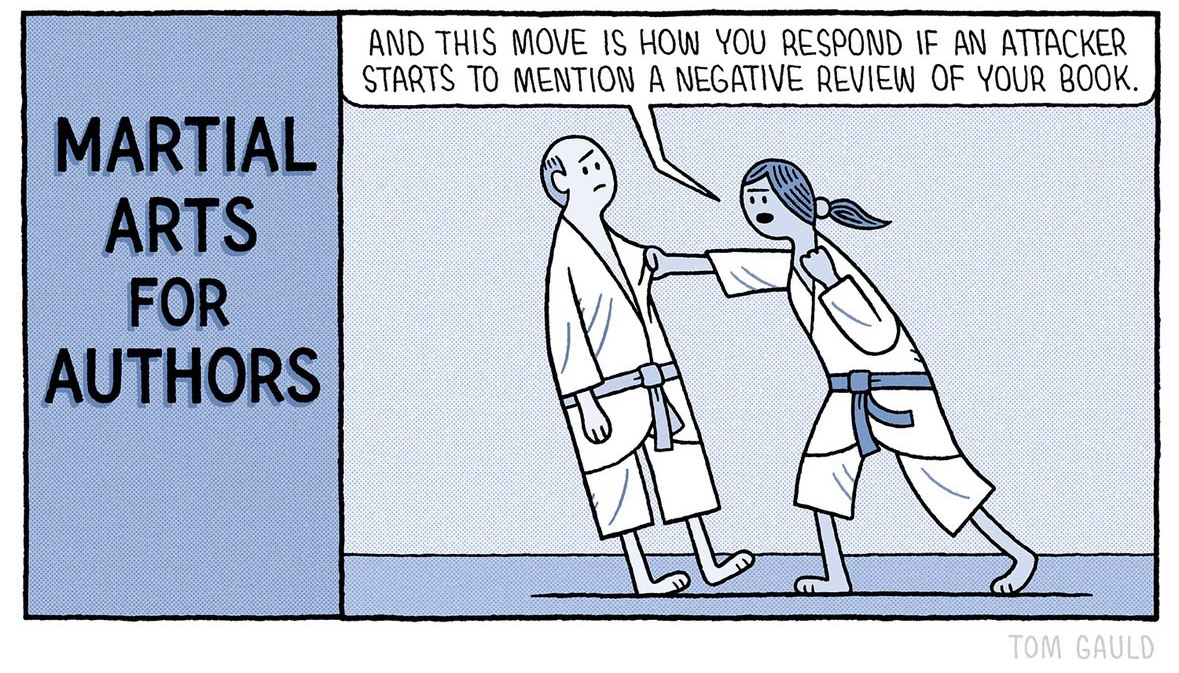
Author
Author, dear author, /
I relent, I repent, I plead: /
“Give me one more chance!”
.
.
#051125 #2025 #author #relent #repent #plead #chance #haiku #poem #poetry #haiga #tomgould #cartoonnotmine #may #sunday
Author
Author, dear author, /
I relent, I repent, I plead: /
“Give me one more chance!”
.
.
#051125 #2025 #author #relent #repent #plead #chance #haiku #poem #poetry #haiga #tomgould #cartoonnotmine #may #sunday
Filed under 2025, author, Cartoon, haiku, poem, poet, poetry, poetry by author, Poetry by David E. Booker, writer
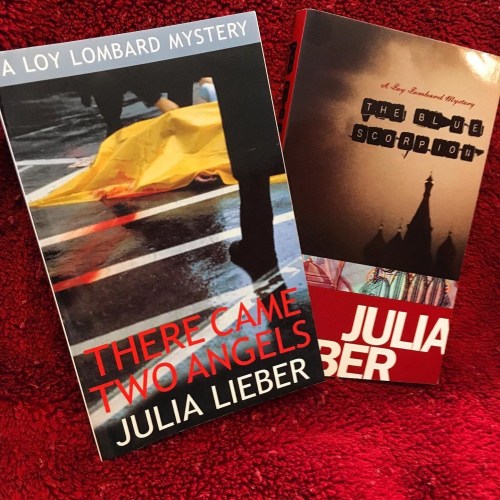
If I should meet
If this author I should meet
In a bookstore or on the street
Will she autograph my books
Or give me ugly, sullen looks?
Will she shoo her hand and say,
“Old man just go away.”
Or will she take her pen in hand
And send me to the Promised Land?
Driving pen down into my heart
And ending life with a sudden start?
Or will she stop and graciously offer
To personalize the books I proffer?
Thanking me for supporting her
Though these works may be obscure?
If this author I should meet
On a bench or restaurant seat
Sadly, I’ll not have her books with me.
What a disappointment that will be.
.
.
#poem #davidebooker #tuesday #2019 #may #rhyming #poetry #writing #writer #books #novels #author #signing #booksigning #pen #penname #051419
Filed under 2019, photo, photo by David E. Booker, poetry, Poetry by David E. Booker
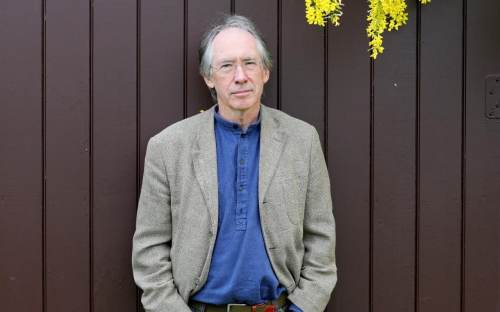
Ian McEwan, the award-winning author, has admitted feeling “a little dubious” about people being compelled to study his books, after helping his son with an essay about his own novel and receiving a C.
Source: Ian McEwan ‘dubious’ about schools studying his books, after he helped son with essay and got a C+
by Hannah Furness, Arts Correspondent, 8 May 2018
McEwan, author of works including Atonement, Amsterdam, and On Chesil Beach, said he remained unconvinced about the purpose of asking students to analyse his work.
“I always feel a little dubious about people being made to read my books,’ he told Event magazine, saying his son Greg was required to write an A-Level essay on Enduring Love several years ago.
“Compelled to read his dad’s book – imagine. Poor guy,” McEwan added.
“I confess I did give him a tutorial and told him what he should consider. I didn’t read his essay but it turned out his teacher disagreed fundamentally with what he said.
“I think he ended up with a C+.”
Asked for his thoughts on the literary landscape of 2018, McEwan suggested he was sceptical.
“Literary fiction is in a curious nosedive saleswise, down about 35 per cent over the past five years,” he said.
“Everyone’s got a theory: TV box sets, some sort of fatigue, who knows. Maybe it’s not just good enough.
“When people ask me who are the amazing writers under 30, I’m not in a position to judge. I start a lot of modern novels and don’t find myself compelled to continue.”
McEwan’s latest work has seen him adapt his novel, On Chesil Beach, for the screen after other books were turned into films by outside scriptwriters.
“I’ve learnt from experience that if you want to have influence, you have to get your hands dirty,” he said, admitting: “I tinker – I can’t stop.
“There’s one scene in the movie I know that if it had occurred to me when I was writing the novel, I’d have put it in.
“What’s also not in the book is the ending, because cinematically it’s irresistible.”
Filed under 2018, author interview
Why did the author cross the road?
I don’t know. Why?
To catch the agent on the other side. Why did the agent cross the road?
I don’t know.
To catch the editor on the other side. Why did the editor cross the road?
Why?
To catch the publisher on the other side. Why did the publisher cross the road?
Okay, why did the publisher cross the road?
He was following the chicken.
Filed under 2017, joke by author, Monday morning writing joke
Brynn Kelly, author of DECEPTION ISLAND (June 2016, HQN Books), shares 5 tips for moving past Author Anxiety and to keep writing.
Source: 5 Ways to Combat Author Anxiety | WritersDigest.com

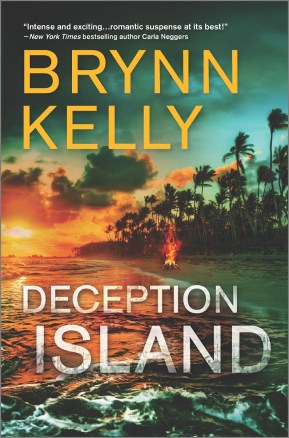
It turns out Author Anxiety is a Thing. It’s not just me.
I discovered this on the eve of publication of my debut novel, DECEPTION ISLAND, when I was silly enough to Google my shiny new title. Up popped a Netgalley reviewer live-tweeting as she read it. Only she was hating it—pulling it apart chapter by chapter.
I’d had loads of great reviews—in Publishers Weekly, Booklist, Library Journal, RT Book Reviews, on dozens of blogs—but this one hobby reviewer withered my fragile confidence. It was the intimacy of it. I could see what she looked like, I could see what page she was reading, I could certainly see exactly what she thought of the story. And I couldn’t stop refreshing. Because I’m an idiot.
I’ve been a journalist for two decades and I’ve published a bunch of nonfiction books, so public criticism is nothing new. Why, then, did this rattle me?
I did what any 21st century dweller does when faced with a 21st century dilemma. I Googled. And I discovered I wasn’t alone. Not only is Author Anxiety a Thing, but it’s such a Thing that, yes, it deserves initial caps. I set out to find a remedy before this vile feeling paralyzed me from writing another fictional word. In the interests of author solidarity, I’m sharing five of my best cures.
1. Find perspective
Many years ago, to finance my journalism degree, I worked as a TV publicist. A fun job but intensely shallow. (Ask me anything about “Beverly Hills 90210” and “Melrose Place.”) Even so, like all jobs, sometimes it got stressful. The most important lesson I learned from that two years was from a boss who was fond of saying, “It’s entertainment. It’s not f***ing brain surgery.” Same goes for my novel. It’s a romantic thriller. It’s not important. My bad day at work is when a reader isn’t entertained or moved and I lose that reader. I’m not a doctor who has lost a patient or an air-traffic controller who’s lost a plane. The worst-case scenario? This novel tanks, everyone forgets about it, and I write another one.
2. Embrace imperfection
Don’t tell my publisher this, but DECEPTION ISLAND isn’t perfect. There, I’ve said it. What a relief. I could have spent three decades rewriting it and it still wouldn’t be perfect. There’s no such thing as perfection in creative endeavor. At some point—usually when a deadline hits—you must step away from your manuscript and say, “There, it’s done. It’s the best I can do right now.” That book has become your past, not your future. It’s not even your present, anymore. The only thing that remains wholly in your control is your next book.
3. Get productive
If I read a bad review, suddenly I don’t feel like writing. But you know what? A good writing day blows away my doubt and fear. And studies into motivation have found that the muse kicks in after you begin a task, not before. Don’t feel like writing because someone just told the (virtual) world that you suck? Open your WIP and start somewhere, anywhere. Tinker with a paragraph you wrote a year ago, write a random exchange of dialogue, change the font. Just. Start. Your brain will light up, the motivation will come and the angst will evaporate.
4. Log out
Only one thing will make you a successful novelist: writing novels. Let the virtual world live without you—especially if it drags you down. Forget the rules that you must regularly post on social media and engage online. If bad reviews on Goodreads or Amazon discourage you, don’t read them. If you can’t help flicking onto them—because validation is addictive— but you hate yourself for it, get a productivity app and block those sites, and any others that routinely make your heart soar and sink. (If a review falls in a forest…) Ray Bradbury once said: “You have to know how to accept rejection and reject acceptance.” And if you just want the boost without the pain? Ask a friend to email you only the great reviews, in a monthly digest. It’s not a cop-out. It’s sensible.
5. Escape
If that sniping little head of yours is not a pleasant place to hang out, get out of it. Do something immersive: play a card game with your kid, see a movie, whack a tennis ball around a court. When you return, you should find your mind is a more agreeable—and productive—environment. Keep it that way by throwing a little love into the world to offset the negativity. Tweet an author about how much you enjoyed her book—because she may be feeling Author Anxiety today, too.
Filed under 2017, writing tip, Writing Tip Wednesday
The Surprising Punctuation Habits Of Famous Authors, Visualized
Hemingway actually used denser punctuation than Jane Austen, William Faulkner, or Charles Dickens.
by John Brownlee
As writers, we’re endlessly fascinated by the idiosyncrasies of authors and the way they use punctuation. Yet how much can the way authors use punctuation really reveal about their style? Plenty, it turns out.
Over on Medium, Adam Calhoun decided to strip eight of his favorite novels down to just the punctuation. The novels he chose were James Joyce’s Ulysses, Jane Austen’s Pride and Prejudice, Mark Twain’s Huckleberry Finn, Charles Dickens’s Great Expectations, Mary Shelley’s Frankenstein, Cormac McCarthy’s Blood Meridian, Lewis Carroll’s Alice in Wonderland, Ernest Hemingway’s A Farewell to Arms, and William Faulkner’s Absalom! Absalom!.
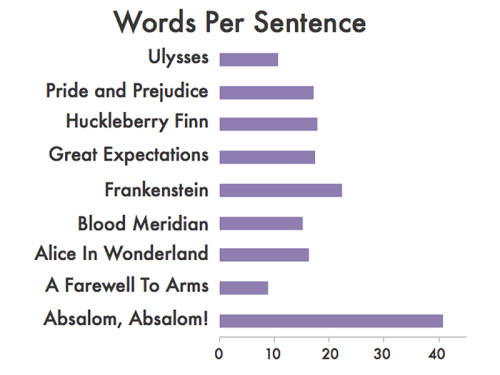
Like previous efforts to cut away everything but punctuation from famous novels, this left just a stream-of-consciousness staccato of commas, periods, question marks, quotation marks, and the occasional semi-colon to represent each book. But instead of merely turning his efforts into pretty posters, Calhoun actually analyzed them, visualizing the punctuation of these novels in a way that put their punctuation use in perspective.
His resulting charts aren’t visually sophisticated, but they are informative. For example, in one chart, Calhoun visualizes punctuation density, or how many words (on average) an author puts in a row before he throws in a punctuation mark. Surprisingly, Hemingway actually uses punctuation more densely than Jane Austen, William Faulkner, or Charles Dickens, a finding that might have more to do with Hemingway’s short, crisp sentences than anything else.
Calhoun also breaks down each novel by most-used punctuation mark, highlighting each author’s favorite. Commas and periods tend universally to be the most used marks, but some authors have a fondness for apostrophes (Mark Twain), exclamation points (Lewis Carroll), and semi-colons (William Faulkner).
Filed under 2016, authors, punctuation
Up the Amazon with the BS Machine,
or
Why I keep Asking You Not to Buy Books from Amazon
by Ursula K. Le Guin
Source: http://bookviewcafe.com/blog/2015/06/01/up-the-amazon/
Amazon and I are not at war. There are vast areas in which my peaceful indifference to what Amazon is and does can only be surpassed by Amazon’s presumably equally placid indifference to what I say and do. If you like to buy household goods or whatever through Amazon, that’s totally fine with me. If you think Amazon is a great place to self-publish your book, I may have a question or two in mind, but still, it’s fine with me, and none of my business anyhow. My only quarrel with Amazon is when it comes to how they market books and how they use their success in marketing to control not only bookselling, but book publication: what we write and what we read.
Best Seller lists have been around for quite a while. Best Seller lists are generated by obscure processes, which I consider (perhaps wrongly) to consist largely of smoke, mirrors, hokum, and the profit motive. How truly the lists of Best Sellers reflect popularity is questionable. Their questionability and their manipulability was well demonstrated during the presidential campaign of 2012, when a Republican candidate bought all the available copies of his own book in order to put it onto the New York Times Top Ten Best Seller List, where, of course, it duly appeared.
If you want to sell cheap and fast, as Amazon does, you have to sell big. Books written to be best sellers can be written fast, sold cheap, dumped fast: the perfect commodity for growth capitalism.
The readability of many best sellers is much like the edibility of junk food. Agribusiness and the food packagers sell us sweetened fat to live on, so we come to think that’s what food is. Amazon uses the BS Machine to sell us sweetened fat to live on, so we begin to think that’s what literature is.
I believe that reading only packaged microwavable fiction ruins the taste, destabilizes the moral blood pressure, and makes the mind obese. Fortunately, I also know that many human beings have an innate resistance to baloney and a taste for quality rooted deeper than even marketing can reach.
If it can find its audience by luck, good reviews, or word of mouth, a very good book may become a genuine Best Seller. Witness Rebecca Skloot’s Immortal Life of Henrietta Lacks, which for quite a while seemed to have immortal life among the Times Top Ten. And a few books work their way more slowly onto BS lists by genuine, lasting excellence — witness The Lord of the Rings, or Patrick O’Brian’s sea stories. Not products of the BS Machine, such books sell because people actually like them. Once they get into the BS Machine, they are of course treated as products of the BS Machine, that is, as commodities to exploit.
Making a movie of a novel is a both a powerful means of getting it into the BS Machine and a side-effect of being there.
Read the rest: http://bookviewcafe.com/blog/2015/06/01/up-the-amazon/
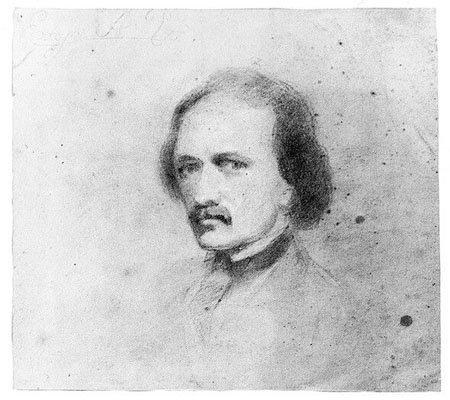
Edgar Allan Poe — self-portrait
Was the famous author killed from a beating? From carbon monoxide poisoning? From alcohol withdrawal? Here are the top nine theories
By Natasha Geiling
Source: http://www.smithsonianmag.com/history/still-mysterious-death-edgar-allan-poe-180952936/#vV6aWAfTgq8vGGWu.99
Give the gift of Smithsonian magazine for only $12! http://bit.ly/1cGUiGv
Follow us: @SmithsonianMag on Twitter
t was raining in Baltimore on October 3, 1849, but that didn’t stop Joseph W. Walker, a compositor for the Baltimore Sun, from heading out to Gunner’s Hall, a public house bustling with activity. It was Election Day, and Gunner’s Hall served as a pop-up polling location for the 4th Ward polls. When Walker arrived at Gunner’s Hall, he found a man, delirious and dressed in shabby second-hand clothes, lying in the gutter. The man was semi-conscious, and unable to move, but as Walker approached the him, he discovered something unexpected: the man was Edgar Allan Poe. Worried about the health of the addled poet, Walker stopped and asked Poe if he had any acquaintances in Baltimore that might be able to help him. Poe gave Walker the name of Joseph E. Snodgrass, a magazine editor with some medical training. Immediately, Walker penned Snodgrass a letter asking for help.
Baltimore City, Oct. 3, 1849
Dear Sir,There is a gentleman, rather the worse for wear, at Ryan’s 4th ward polls, who goes under the cognomen of Edgar A. Poe, and who appears in great distress, & he says he is acquainted with you, he is in need of immediate assistance.
Yours, in haste,
JOS. W. WALKER
To Dr. J.E. Snodgrass.
On September 27—almost a week earlier—Poe had left Richmond, Virginia bound for Philadelphia to edit a collection of poems for Mrs. St. Leon Loud, a minor figure in American poetry at the time. When Walker found Poe in delirious disarray outside of the polling place, it was the first anyone had heard or seen of the poet since his departure from Richmond. Poe never made it to Philadelphia to attend to his editing business. Nor did he ever make it back to New York, where he had been living, to escort his aunt back to Richmond for his impending wedding. Poe was never to leave Baltimore, where he launched his career in the early 19th- century, again—and in the four days between Walker finding Poe outside the public house and Poe’s death on October 7, he never regained enough consciousness to explain how he had come to be found, in soiled clothes not his own, incoherent on the streets. Instead, Poe spent his final days wavering between fits of delirium, gripped by visual hallucinations. The night before his death, according to his attending physician Dr. John J. Moran, Poe repeatedly called out for “Reynolds”—a figure who, to this day, remains a mystery.
Poe’s death—shrouded in mystery—seems ripped directly from the pages of one of his own works. He had spent years crafting a careful image of a man inspired by adventure and fascinated with enigmas—a poet, a detective, an author, a world traveler who fought in the Greek War of Independence and was held prisoner in Russia. But though his death certificate listed the cause of death as phrenitis, or swelling of the brain, the mysterious circumstances surrounding his death have led many to speculate about the true cause of Poe’s demise. “Maybe it’s fitting that since he invented the detective story,” says Chris Semtner, curator of the Poe Museum in Richmond, Virginia, “he left us with a real-life mystery.”
The nine theories include: beating, cooping (voter fraud), alcohol (related to cooping), poisoning (carbon monoxide or heavy metal), murder, and flu.
24 Things No One Tells You About Book Publishing
Ten years ago, my first novel Prep came out. Three novels later, here’s what I’ve learned about the publishing industry and writing since then.
by Curtis Sittenfeld

Writing is only part of the mystery.
For the other eleven, go to: http://www.buzzfeed.com/curtissittenfeld/things-no-one-ever-tells-you-about-the-publishing-industry?bffbbooks
Filed under publishing, publishing news


 Booker's Blog
Author regrets writing story
“Brokeback Mountain” author Annie Proulx says she regrets writing the story
by Daisy Wyatt
Source: http://www.independent.co.uk/arts-entertainment/books/news/brokeback-mountain-author-annie-proulx-says-she-regrets-writing-the-story-9949636.html
Annie Proulx has said she regrets writing “Brokeback Mountain” due to the number of men who have written to her complaining about the story’s ending.
The US author said she wishes she had not written the short story after the “hassle and problems and irritation” she received after the film came out in 2005.
“So many people have completely misunderstood the story. I think it’s important to leave spaces in a story for readers to fill in from their own experience, but unfortunately the audience that ‘Brokeback’ reached most strongly have powerful fantasy lives,” Proulx said in an interview with the Paris Review.
“And one of the reasons we keep the gates locked here is that a lot of men have decided that the story should have had a happy ending. They can’t bear the way it ends – they just can’t stand it.
“So they rewrite the story, including all kinds of boyfriends and new lovers and so forth after Jack is killed. And it just drives me wild.”
The author said the majority of letters she received complaining about the film’s ending began “I’m not gay, but…” and added that she was frustrated the men did not seem to understand that the story was not about the lead characters Jack and Ennis.
“It’s about homophobia; it’s about a social situation; it’s about a place and a particular mindset and morality. They just don’t get it,” she said.
Rest of the article at: http://www.independent.co.uk/arts-entertainment/books/news/brokeback-mountain-author-annie-proulx-says-she-regrets-writing-the-story-9949636.html
Share this:
Leave a comment
Filed under author commentary, author interview
Tagged as Annie Proulx, author, Brokeback Mountain, commentary, Daisy Wyatt, regrets, Sunday, The Independent