
 How Amazon’s crackdown on scammers is impacting indie authors
Source: How Amazon’s crackdown on scammers is impacting indie authors
How Amazon’s crackdown on scammers is impacting indie authors
Source: How Amazon’s crackdown on scammers is impacting indie authors
May 2015 Author Earnings Report
Source: http://authorearnings.com/report/may-2015-author-earnings-report/
Welcome to the May 2015 Author Earnings Report. This is our sixth quarterly look at Amazon’s ebook sales, with data taken on over 200,000 bestselling ebooks. With each report over the past year and a half, we have come to see great consistency in our results, but there is always something new that surprises us. Often, it’s something we weren’t expecting, like the massive shadow industry of ISBN-less ebooks being sold, or the effect Kindle Unlimited has on title visibility. This time, we went into our report curious about one thing in particular. But we were still not prepared for what we found.
If you’ve been shopping for ebooks on Amazon lately, you may have seen this new addition to many ebook product pages:
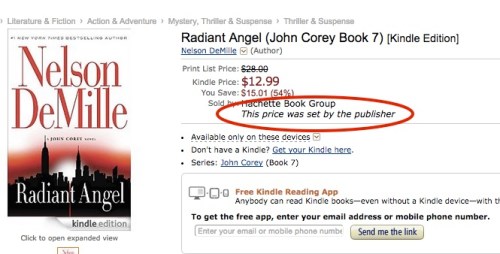
This announcement can be found on ebooks from several of the largest publishers, and it appears to serve as both an apology from Amazon and also a shifting of the blame for high ebook prices. Amazon has stated in the past that they believe ebooks should not cost more than $9.99. Self-published authors are no doubt familiar with this price constraint, as their royalties are cut in half if they price higher than this amount. But after a contentious and drawn-out negotiation with Hachette Book Group last year, Amazon relinquished the ability to discount ebooks with several publishers. Prices with these publishers are now set firmly by them.
Soon after these agreements went into place, industry observers noted an upward move in average ebook prices. Freed from Amazon’s discounting, and with complete control over pricing, the publishers made a decision to push the price of many of their books above $9.99.
With six quarterly snapshots, each snapshot consisting of 50,000+ of the top-selling ebook titles, we plotted the average price by publisher type to see just how much prices have gone up. The blue bars show the price of self-published ebooks for each of our reports. The purple bars show the average price of Big 5 published ebooks.

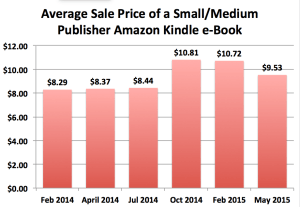
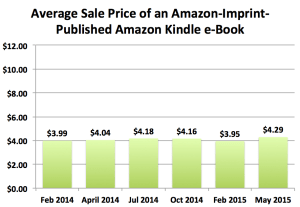

Since we started pulling this data, the average price of an ebook from a Big 5 publisher has gone up 17%. Compare this to a difference of 5% for self-published titles, or the increase of 7.5% across Amazon imprints. The prices for Big 5 published ebooks have risen quite steadily, rather than a sudden surge since the return to agency.
What will the effect of these pricing decisions have on unit sales, revenues, and author earnings? We were eager to find out.
The May 2015 Author Earnings Report
We start with a simple counting of the number of titles on Amazon’s ebook bestseller lists. No math involved, just a detailed look at whose works are showing up as top-selling titles. For comparison, we included the same graph from our January 2015 report.
Number of Titles in Amazon’s Ebook Best Seller Lists

In the last three months, the Big 5 publishers have seen a 26% reduction in the number of titles on Amazon’s Best Seller lists. This means fewer titles are selling well enough to make these lists, and it also means fewer titles are receiving that added visibility.
Ebook Unit Sales
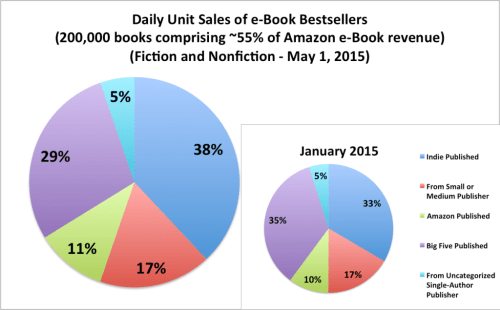
Over the same period, daily unit sales from the Big 5 have fallen 17%. This is a measure of the average rank of each ebook. Just as publishers study the New York Times bestseller lists to gauge the strength of their competition, we are looking at the same thing. But with a sample size of 200,000, rather than 20.
Rest of the article: http://authorearnings.com/report/may-2015-author-earnings-report/
Filed under 2016, ebook publishing
Store opening in University Village in Seattle, WA. Twenty years after Amazon started selling books online.
by Issie Lapowsky
Source: http://www.wired.com/2015/11/amazon-killed-the-bookstore-so-its-opening-a-bookstore/
 Bookstore owners already loathe Amazon for gutting the cost of books online and driving so many brick and mortar shops out of business. Now, the online retailer is both beating them and joining them, with the opening of its first physical bookstore today in Seattle.
Amazon Books, as the new store is called, will be like any other Main Street bookstore (remember those?), except that Amazon will use the troves of data it collects from its online customers to stock the shelves. That means its book displays will feature real Amazon book reviews, and the store will showcase books that have amassed the most pre-orders online. The books will also come with Amazon’s trademark low price tags.
It can afford those cut-rate prices, of course, because Amazon Books is as much a bookstore as it is a billboard. Amazon’s not suddenly betting big on the bookstore business, and it certainly doesn’t need the store to be a success in order for Amazon to succeed. It’s better to think of Amazon Books as a giant advertisement. If it makes a little extra money for a $294.7 billion company, all the better.
The one silver lining for the book enthusiasts forced to watch their industry turn into a gimmick is that, according to the Seattle Times, Amazon is hiring from other retail stores and libraries that may be struggling. Well, silver lining for those hoping for Seattle-area book store jobs. For Seattle-area book store employers, it’s probably not pleasant watching their employees get poached.
For now, Amazon says the store won’t be serving double duty as a warehouse or pickup center, and the vice president of Amazon Books, Jennifer Cast, tells the Seattle Times the company doesn’t yet have plans to open a second location. “We’re completely focused on this bookstore,” Cast said. “We hope this is not our only one. But we’ll see.”
Additional article: http://www.seattletimes.com/business/amazon/amazon-opens-first-bricks-and-mortar-bookstore-at-u-village/
Not exactly a household name, she attracted fans and detractors.
http://motherboard.vice.com/read/woman-who-reviewed-31000-books-on-amazon-dies
Harriet Klausner is not exactly a household name. But in the weird subculture of Amazon reviewers, she was either a legend or a legendarily bad shill. Klausner amassed more than 31,000 reviews of books under one username, seeming to sell just as many on Half.com after she finished them. Now Klausner, a former librarian and self-proclaimed speedreader, is reportedly dead at age 63.

The Age of the Internet review.
The three paragraph reviews often introduced a plot summary (often inaccurately) for the first two paragraphs before a brief summary of praise, and a four or five star review. Many of the reviews were of mass market romance books and other pulp genres. Many reviews cropped up on the day the book was released, with many of the books showing up on her son’s Half.com account before the actual release date, according to a blog post of the cheekily named Harriet Klausner Appreciation Society (which was anything but.) This led to allegations that the reviews were planted and paid for.
Read the rest: http://motherboard.vice.com/read/woman-who-reviewed-31000-books-on-amazon-dies
A posting in Time magazine from 2006.
http://content.time.com/time/magazine/article/0,9171,1570726,00.html
Without the web, Harriet Klausner would be just an ordinary human being with an extraordinary talent. Instead she is one of the world’s most prolific and influential book reviewers. At 54, Klausner, a former librarian from Georgia, has posted more book reviews on Amazon.com than any other user—12,896, as of this writing, almost twice as many as her nearest competitor. That’s a book a day for 35 years.
Klausner isn’t paid to do this. She’s just, as she puts it, “a freaky kind of speed-reader.” In elementary school, her teacher was shocked when Klausner handed in a 31⁄2-hour reading-comprehension test in less than an hour. Now she goes through four to six books a day. “It’s incomprehensible to me that most people read only one book a week,” she says. “I don’t understand how anyone can read that slow.” All TIME 100 Best Novels
Klausner is part of a quiet revolution in the way American taste gets made. The influence of newspaper and magazine critics is on the wane. People don’t care to be lectured by professionals on what they should read or listen to or see. They’re increasingly likely to pay attention to amateur online reviewers, bloggers and Amazon critics like Klausner. Online critics have a kind of just-plain-folks authenticity that the professionals just can’t match. They’re not fancy. They don’t have an agenda. They just read for fun, the way you do. Publishers treat Klausner as a pro, sending her free books—50 a week—in hopes of getting her attention. Like any other good critic, Klausner has her share of enemies. “Harriet, please get a life,” someone begged her on a message board, “and leave us poor Amazon customers alone.”
Klausner is a bookworm, but she’s no snob. She likes genre fiction: romance, mystery, science fiction, fantasy, horror. One of Klausner’s lifetime goals—as yet unfulfilled—is to read every vampire book ever published. “I love vampires and werewolves and demons,” she says. “Maybe I like being spooked.” Maybe she’s a little bit superhuman herself.
Read the rest: http://content.time.com/time/magazine/article/0,9171,1570726,00.html
Up the Amazon with the BS Machine,
or
Why I keep Asking You Not to Buy Books from Amazon
by Ursula K. Le Guin
Source: http://bookviewcafe.com/blog/2015/06/01/up-the-amazon/
Amazon and I are not at war. There are vast areas in which my peaceful indifference to what Amazon is and does can only be surpassed by Amazon’s presumably equally placid indifference to what I say and do. If you like to buy household goods or whatever through Amazon, that’s totally fine with me. If you think Amazon is a great place to self-publish your book, I may have a question or two in mind, but still, it’s fine with me, and none of my business anyhow. My only quarrel with Amazon is when it comes to how they market books and how they use their success in marketing to control not only bookselling, but book publication: what we write and what we read.
Best Seller lists have been around for quite a while. Best Seller lists are generated by obscure processes, which I consider (perhaps wrongly) to consist largely of smoke, mirrors, hokum, and the profit motive. How truly the lists of Best Sellers reflect popularity is questionable. Their questionability and their manipulability was well demonstrated during the presidential campaign of 2012, when a Republican candidate bought all the available copies of his own book in order to put it onto the New York Times Top Ten Best Seller List, where, of course, it duly appeared.
If you want to sell cheap and fast, as Amazon does, you have to sell big. Books written to be best sellers can be written fast, sold cheap, dumped fast: the perfect commodity for growth capitalism.
The readability of many best sellers is much like the edibility of junk food. Agribusiness and the food packagers sell us sweetened fat to live on, so we come to think that’s what food is. Amazon uses the BS Machine to sell us sweetened fat to live on, so we begin to think that’s what literature is.
I believe that reading only packaged microwavable fiction ruins the taste, destabilizes the moral blood pressure, and makes the mind obese. Fortunately, I also know that many human beings have an innate resistance to baloney and a taste for quality rooted deeper than even marketing can reach.
If it can find its audience by luck, good reviews, or word of mouth, a very good book may become a genuine Best Seller. Witness Rebecca Skloot’s Immortal Life of Henrietta Lacks, which for quite a while seemed to have immortal life among the Times Top Ten. And a few books work their way more slowly onto BS lists by genuine, lasting excellence — witness The Lord of the Rings, or Patrick O’Brian’s sea stories. Not products of the BS Machine, such books sell because people actually like them. Once they get into the BS Machine, they are of course treated as products of the BS Machine, that is, as commodities to exploit.
Making a movie of a novel is a both a powerful means of getting it into the BS Machine and a side-effect of being there.
Read the rest: http://bookviewcafe.com/blog/2015/06/01/up-the-amazon/
When it comes to books, libraries and publishers should be in it together, argues a leading marketing expert
By David Vinjamuri
Publishers are running out of space. Not in their headquarters, some of which are larger and more imposing than ever, but in retail. The number of booksellers has been dwindling since the demise of Borders, and the largest book retailer today is Amazon, which has no physical space at all.
So the question is, where can publishers showcase new books? If only there were a space dedicated primarily to reading that hundreds of millions of Americans visit annually. If only there existed a trusted space, free of the revenue pressure that necessitates displaying lightly pornographic books of debatable quality. If only there were a space largely inhabited by active readers, where publishers could showcase new authors or shine new light on talented mid-listers.
That space exists in the 16,000 public library branches in America. They’re trusted and willing, and they welcome your attention. But libraries receive surprisingly little coordinated help from publishers beyond lip service—in fact, they’re still in the middle of a very public dispute with publishers about the high prices and restrictive access libraries must contend with to lend e-books to their patrons.
The tension between libraries and publishers seems odd in a market where physical space for displaying books is quickly disappearing. How did we get here? And could libraries actually represent a much better opportunity for publishers than they are given credit for?
A History of Indifference
In the beginning, publishers and libraries were interdependent. When modern publishing houses emerged from printers in the late 19th century, public libraries in the U.S. and U.K. were often the first and only guaranteed customer for a title.
Even as late as 1950, libraries were indispensable customers for publishers. The entire output of the domestic publishing industry in that year was 11,000 titles, and the average branch of a public library purchased 14,000 titles annually. The most reliable market for many books was the 11,135 library branches operating then.
Things are different today. Publishers produced nearly half a million new ISBNs in 2013 (with self-publishers included, that total nearly doubles), though increasingly cash-strapped libraries are purchasing fewer titles. According to industry stats, the library market now represents just over 1.3% of publishers’ trade sales. But just as the crucible of the book superstore transformed publishing in the 1980s, the advent of online sellers—particularly Amazon—is remaking it today. And as the conflict between Hachette and Amazon last year proved, Amazon is both indispensable and despised as a partner to publishers.
But a new challenge has emerged from the transformation of sales channels in the past three decades: discovery. Five years, ago in 2010, just under a third of all frequent readers (who purchase 80% of all books and number 43 million) found the last book they bought at a bookstore. This year, that number is down to 17%, according to Peter Hildick-Smith, of the Codex Group—a change that gives Amazon more power than ever.
“A small group of authors control the bestseller lists,” Hildick-Smith observes. “When we indexed the New York Times hardcover fiction and mass market bestseller lists from June 2008 through June 2014, nearly 16,000 spots in total, we found that all those places were occupied by fewer than 650 authors.”
That concentration has created a problem for publishers, which Amazon has ruthlessly exploited. By promoting both self-published and Amazon-signed authors on the Kindle platform, the online retailer has come to exert tremendous pricing pressure on the entire industry. Amazon can now manipulate the products of hundreds of thousands of other authors through price reduction.
Meanwhile, the dominance of bestsellers has also put the squeeze on the marketing budgets of debut and midlist authors. Since publishers can only afford to make a few big bets per year, the route to building new franchise authors is more uncertain than ever.
Author Brands Matter
A great deal of attention has been paid to the question of so-called platform size for new authors. How large is the social media footprint of the author? How active is she on Facebook, Twitter, and
Continued at: http://www.publishersweekly.com/pw/by-topic/industry-news/libraries/article/66106-the-case-for-libraries.html
Big Publishing is the Problem | Hugh Howey.
A few weeks ago, I speculated that Hachette might be fighting Amazon for the power to price e-books where they saw fit, or what is known as Agency pricing. That speculation was confirmed this week in a slide from Hachette’s presentation to investors:

So, no more need to speculate over what this kerfuffle is about. Hachette is strong-arming Amazon and harming its authors because they want to dictate price to a retailer, something not done practically anywhere else in the goods market. It’s something US publishers don’t even do to brick and mortar booksellers. It’s just something they want to be able to do to Amazon.
The biggest problem with Hachette’s strategy is that Hachette knows absolutely nothing about retail pricing. That’s not their job. It’s not their area of expertise. They don’t sell enough product direct to consumers to understand what price will maximize their earnings. Amazon, B&N, Kobo, and Apple have that data, not Hachette.
Beyond their ignorance of pricing strategy, Hachette also has a strong bias toward print books. Their existing relationships with major brick and mortar retailers gets in the way of their e-book pricing. This has been confirmed by my own publishers, who have admitted privately that they would like to experiment with digital pricing but don’t want to upset print book retailers. This puts their pricing strategy at odds with their investors’ needs, their authors’ needs, even their own profitability. In sum, they are making irrational decisions with their pricing philosophy. Hachette is making the same mistake that many publishers make, which is to think that harming Amazon somehow helps themselves.
The same presentation by Hachette to investors stressed the importance of DRM and
The rest of the article at: http://www.hughhowey.com/big-publishing-is-the-problem/
Filed under publishers, publishing, publishing news

2014-07-13 11:48 AM
Open letter from Richard Russo on Amazon vs. Hachette
Richard Russo is President of the Author’s Guild. This is long but, if you’re wondering what’s going on, worth reading. I’d like to say he took the words right out of my mouth, but he uses better words.
“The primary mission of the Authors Guild has always been the defense of the writing life. While it may be true that there are new opportunities and platforms for writers in the digital age, only the willfully blind refuse to acknowledge that authorship is imperiled on many fronts. True, not all writers are equally impacted. Some authors still make fortunes through traditional publishing, and genre writers (both traditionally published and independently published) appear to be doing better than writers of nonfiction and “literary” mid-list fiction. (The Guild has members in all of these categories.) But there’s evidence, both statistical and anecdotal, that as a species we are significantly endangered. In the UK, for instance, the Authors’ Licensing and Collecting Society reports that authors’ incomes have fallen 29 percent since 2005, a decline they deem “shocking.” If a similar study were done in the U.S., the results would be, we believe, all too similar.
“On Tuesday, Amazon made an offer to Hachette Book Group that would “take authors out of the middle” of their ongoing dispute by offering Hachette authors windfall royalties on e-books until the dispute between the companies is resolved. While Amazon claims to be concerned about the fate of mid-list and debut authors, we believe their offer – the majority of which Hachette would essentially fund – is highly disingenuous. For one thing, it’s impossible to remove authors from the middle of the dispute. We write the books they’re fighting over. And because it is the writing life itself we seek to defend, we’re not interested in a short-term windfall to some of the writers we represent. What we care about is a healthy ecosystem where all writers, both traditionally and independently published, can thrive. We believe that ecosystem should be as diverse as possible, containing traditional big publishers, smaller publishers, Amazon, Apple, Barnes & Noble and independent bookstores, as well as both e-books and print books. We believe that such an ecosystem cannot exist while entities within it are committed to the eradication of other entities.
To read the rest, go to: http://journalscape.com/sjrozan/2014-07-13-11:48/
Filed under Amazon, publishing
Another view of the Amazon vs. Publishers battle
Publishing Vs. Amazon: A Play in Five Acts – Insatiable Booksluts.
Act I:
Amazon: Hey Publishing, we just invented a new thing that we think you’ll like. You know how after you make a book you have to pay a buttload of money to get it all printed and shipped and stuff? We figured out a way that you could not have to pay all that money and still sell lots of books.
Publishing: OMG NO WHAT IS THIS WHY ARE YOU TRYING TO DESTROY PUBLISHING
Customers: Hey! These ebooks are pretty cool! I can carry a bunch with me all the time and it sucks less when I have to move!
Publishing: NO THEY ARE NOT COOL, PAPER BOOKS FOREVER, WE KNOW YOU JUST WANT TO STEAL OUR CONTENT OFF OF THE INTERNETS. CAN WE TRIPLE THE DRMs PLEASE
Customers: ……
Act II:
Amazon: Hey Publishing, we want to buy a buttload of books from you and we aren’t even going to return a bunch of unsold books like other bookstores do, and in return do you think you could give us a good deal since you’re going to make a lot of money? And also because like, every other industry that we work with works with us at a wholesale discount since we spend so much money with them and all.
Publishing: OMG NO WE DO NOT WANT TO SELL YOU A BUTTLOAD OF BOOKS WE HATE YOU. WHY ARE YOU TRYING TO DESTROY PUBLISHING
Amazon: Hey just FYI we are also going to publish some books by people because we think it looks like a neat business to get into. Competition is awesome right? I mean, it’s mostly celebrities and authors that are doing all the work themselves anyway.
Publishing: YOU ARE MURDERING US TO DEATH STAHP. NOBODY SHOULD BUY BOOKS PUBLISHED BY AMAZON BECAUSE ONLY WE ARE ALLOWED TO PUBLISH.
Bookstores: We hate Amazon too because nobody else should be allowed to sell books, especially if customers like going to them better. We will not sell Amazon’s books even if customers want to read them.
Publishing: YEAH WE HATE YOU AMAZON
Bookstores: Do you still love us, Publishing? We promise that we will only sell paper books and not any from Amazon.
Publishing: YEAH YOU ARE MY BOO.
Act III:
Amazon: Hey Publishing, since it only costs you like a fraction of a percent actually to
For the rest of the play go to: http://insatiablebooksluts.com/2014/06/27/publishing-vs-amazon-play/
Filed under Amazon, publishing


 Booker's Blog