Tag Archives: advice

Writing tip Wednesday: knock-off anyone?

[Editor’s commentary: “It was a dark and stormy night.” How many times have you as a writer been told not to copy. Don’t copy somebody’s homework. Don’t copy the way somebody looks. Seems somewhere along the line may have changed. Or, at least, knock-offs of something may be okay. Or at least what publishers are looking for. That’s what this article suggests. So, maybe what you need to do is find some best selling novel and “spice” it up in some way, and see if an agent or publisher will buy it. I say it with a bit of tongue-in-cheek. Therefore, I don’t know that I so much say this is a writing tip and maybe a way to get started writing if you feel stuck. Take something out there, a classic maybe, and bend it some, change it in some way. Many of the stories of King Arthur’s knights of the round table were retold in just such a fashion. Each new writer taking what had been written before about a certain knight and adding his own inflections to it. In some ways, we may not be quite as far beyond the Middle Ages as we would like to think.]

“Fifty shades” of knock-offs?

Source: http://www.hlntv.com/article/2012/05/14/fifty-shades-grey-knock-offs?hpt=hp_c2

By Matthew Carey

updated 11:31 AM EDT, Mon May 14, 2012

An erotic bestseller has publishers fantasizing… about how to repeat its runaway success.

The “Fifty Shades of Grey” trilogy by author E. L. James has sold an amazing three million copies in just a few weeks, seducing readers with its sadomasochistic tale of virginal college student Anastasia Steele and her troubled billionaire lover Christian Grey. Universal snapped up the film rights for a reported $5 million.

The “Fifty Shades” boom “is a very big deal,” says Jim Milliot of Publishers Weekly. “I think it’s safe to say it’s a mini-phenomenon.” Milliot says publishing houses are pouring over ideas hoping to duplicate “Shades’” achievement.

“This is a notoriously copycat industry… This industry jumps on whatever big thing comes along,” Millot explains.

But it’s tricky to imitate what you don’t quite understand — and many industry pros are baffled by the trilogy’s success.

“A lot of people are kind of scratching their heads about what has made this thing pop,” Milliot says. “It’s not just the sex thing that’s selling. There’s way more explicit stuff out there if you want it. It’s more than that.”

Milliot credits word of mouth, plus “Shades’” distinctive cover art (a silver necktie) and what he calls a “secret sauce” — that mystery ingredient that can turn something ordinary into a big hit.

Already, some rival publishers are promoting titles with their own recipe for “secret sauce”:

• “Bared to You” by Sylvia Day is described as a compelling combo of “love, lust and secrets.” Heroine: Young Eva Tramell. Troubled, rich boyfriend: Gideon Cross.

• “Big Game”, the latest in the “Vampire Vacation Inn” series by C. J. Ellisson, which could be called a cross between “Twilight” and “Fifty Shades of Grey.” Heroine: 580-year-old vampire Vivian. Sexy soulmate: Rafe.

Like “Fifty Shades,” Ellisson’s books contain a “heavy erotic element,” the author told HLN (though she notes the hot action involves a married couple). Ellisson began publishing her series before the “Shades” explosion, but all the media attention on James’ trilogy may benefit her sales too.

“I love that [“Fifty Shades of Grey”] has brought erotic literature into the mainstream. I think that’s terrific,” says Ellisson.

There’s an irony in publishers trying to imitate “Fifty Shades of Grey,” because it basically began as an imitation itself of Stephanie Meyer’s “Twilight” series. E.L. James’ story originated on a Twilight “fan fiction” website, and her main characters were first called Bella and Edward (not Anastasia and Christian).

Milliot says — imitation or not — “Shades” is not in “Twilight”‘s league, despite those impressive sales figures and a movie in the early stages of development.

“I think you see how books two and three (in the series) do and you have to see how the movie gets made and if the books have legs. It’s not there (yet) to be compared to ‘Twilight’ and ‘Harry Potter.’”

But Milliot adds, “It has the foundation to do that.”

Leave a comment

Filed under knock-off, writing, writing tip

Writing tip: a writer can’t just be a writer

Should You Focus on Your Writing or Your Platform?

by Jane Friedman

April 27, 2012

Source: http://writerunboxed.com/2012/04/27/should-you-focus-on-your-writing-or-your-platform/#more-14057

Craft!

Platform!

Craft!!

Platform!!

It’s a debate that might span eternity: how much time should you devote to writing versus platform building?

I don’t know if there was ever a real beginning to this debate, but if so, it was when editors and agents started telling nonfiction authors that their book was only viable if a platform was in place. Which made sense for technological and cultural reasons. Take the ease of word processing and affordable personal computers, add Baby Boomers with free time to pursue their dreams, and presto! Suddenly there were more people than ever trying to write a book and get it published, with limited skills and experience, and often no credentials.

So what does a well-meaning agent or editor say to one of these people? The easiest thing to say is: You need a platform.

Fast forward a decade or two, and we now live inside an unending media conversation wheel, where anyone can find a niche readership, do solid work on building a platform, and even put writing on the backburner—and still reasonably claim to be a writer.

I think there’s a backlash against some of these people, which I understand. It’s applying the entrepreneurial, get-rich-quick Tim Ferriss mindset to the world of literature, where we tend to believe that blood, sweat, and tears (and rejection) are demanded before you gain recognition.

Plus: Real writers write. (Right?) They don’t tweet, they don’t blog, they don’t connect with readers, at least not joyfully.

I exaggerate, but you know the people I’m talking about.

The horrible catch is—at least for beginning writers without fame and fortune, who are starting their careers in a transitioning industry—focusing on your writing work to the exclusion of all else can hamper you later down the road. If you shut yourself away and don’t learn to navigate the online world (the personalities, the flow of conversations, the tools), you’re terribly disadvantaged when it comes time to get a publisher, market your work, and find readers.

Excellent arguments reside on each side of this debate, which often boil down to: “Writing is all that matters,” and “audience is all that matters.”

But the truth is a little different for each of us, and that’s why it’s next to impossible to give general advice on platform. It necessarily varies based on the author and the work in question.

But it does rip me apart to hear very new writers feel anxious that they can’t figure out their platform, especially when they have not a single book or credit to their name.

Well, it’s not a mystery why platform is so confusing when you don’t know who you are yet as a writer!

This has been a very long preface to what I’d like to offer: a set of general guidelines to help any writer understand how to balance writing with platform building.

Balance is the key word here.

Focusing on your writing probably means spending 10%-25% of your available writing time on platform activities. I never recommend abandoning platform activities entirely, because you want to be open to new possibilities. Being active online—while still focused on your writing—could mean finding a new mentor or the perfect critique partner, connecting with an important influencer, or pursuing a new writing retreat or fellowship opportunity.

Without further ado, the list.

When to focus more on your writing:

If you are within the first five years of seriously attempting to write with the goal of publication
For novelists: If you have not yet completed and revised one or two full-length manuscripts
If you can tell that what you’re writing is falling short of where you want and need to be
If you see a direct correlation between the amount of writing you put out and the amount of money that comes into your bank account (the JA Konrath model)
If you are working on deadline.

When to focus more on your platform:

If you start to realize you’re on the verge of publication
If you have a firm book release date of any kind
If you want to sell a nonfiction book concept (non-narrative)
If you intend to profit from online/digital writing that you are creating, distributing, and selling on your own
If you need to prove to a publisher or agent that your work has an audience.

Brief Bio.: Jane Friedman is a professor of media and writing at the University of Cincinnati, and the former publisher of Writer’s Digest. Visit her at JaneFriedman.com, for regular insights into the future of publishing.

4 Comments

Filed under writer, writing, writing tip

I’m a writer and I don’t get no respect

[Editor’s note: I believe it was the late Rodney Dangerfield who had a comedy routine based on “I don’t get no respect.” The lack of respect could come from anybody, anywhere, including his wife. Below is a playwright Rodney could empathize with. He writes to Dear Abby, and she responds. I have known one or two other writers in the same situation. Maybe you, do, too.]

Rodney Dangerfield

Sometimes respect is hard to come by for a writer, or a comic. Just ask Rodney Dangerfield.

DEAR ABBY: I am an amateur playwright. Our local theater sponsors an annual playwriting contest. The prize isn’t monetary, but something far more important to an author – full scale production of the play.

I have won this prize four times – more than any other writer in the history of the contest. But is my family impressed? Not at all! My wife told me she thinks I write everything the same way and have simply repeated myself four times.

I am up in years. It’s unlikely I will ever again win this prize. So how do I respond to such indifference? What do you do when you feel you have accomplished something important and the response is, “so what else is new?”

–Looking for Validation in Florida

DEAR LOOKING FOR VALIDATION: My hat’s off to you. That you have won this prize more than any other writer in the history of the contest is a notable achievement. Attend the production, take your well-earned bow in the spotlight, and accept that the less you look to your wife for validation, the happier your life will be.

Leave a comment

Filed under advice, Dear Abby, humor, respect, Rodney Dangerfield, writer, writing

Best writing advice you’ve received?

Below is some writing advice gathered by Chip MacGregor of MacGregor Literary. The listing below is from his blog. Website for the agency is http://macgregorliterary.com/.

http://chipmacgregor.typepad.com/main/2011/12/whats-the-best-writing-advice-you-ever-got-.html

December 30, 2011

What’s the best writing advice you ever got?

I’ve had several people write to share the best writing advice they’ve ever received.

Vince Zandri, who has done numerous novels and sold more than a quarter million books, wrote to me and said, “The best writing advice I ever got came from Ernest Hemingway in the form of his memoir, A Moveable Feast. If writers are worried about one thing, it’s the ability to keep a story moving from day to day. To avoid the ‘block,’ as some people call it. Papa wrote slowly and methodically in the early morning hours, and trained himself to stop at a point where he knew what was going to happen next. That way he could be sure of getting started the next day — and it left him the afternoons to play, exercise, fish, drink, or do whatever he wanted.”

Successful nonfiction writer Mel Lawrenz wrote to say, “The best advice? Take the long view. See the long process of publishing as an advantage — the stages of writing, editing, rewriting, and revising make for a more refined end product. Don’t miss the opportunity to rethink what you originally wrote.”

Harlequin author Dana Mentink sent this: “The best writing advice I got as a pre-pubbed author was that I should act like a professional. My mentor encouraged me to treat my writing like a business, not a hobby. Put in the hours, describe yourself to others as a writer, and really put yourself into the mindset of a professional. She explained to me that there’s a big difference between ‘I want to write a book’ and ‘I want to be an author.’ The latter requires professional dedication.”

Children’s author Kayleen Reusser noted, “Believe in yourself, even if no one else does. At my beginning I was the only one who believed I could write and get published. Even my mother told me I could not write — no money, no time, three small children to care for. But I swore I would die trying. (Thank goodness it has not come to that.)”

And novelist Dianne Price wrote to say, “Know your characters. LIve with them. Talk to them. Listen to their words and the cadence of their speech. Make them your constant companions. Argue with them. Commiserate with them. Ask them questions. You must know them to make them believable.”

What about you? What’s the best writing advice you’ve ever heard?

4 Comments

Filed under advice, agents, writing, writing tip

“Wings” to heaven.

DEAR ABBY: I am a middle-aged woman who is Baptist by faith. I believe that when I die I will go to heaven, My problem is, if going to heavean means being reunited with my parents and other family members, then I don’t want to go! The idea of spending eternity with them is more than I can stand, but I don’t want to go to hell, either. Any thoughts? –Eternally Confused in Mississippi

DEAR ETERNALLY CONFUSED: Yes. When you reach the pearly gates, talk this over with St. Peter. Perhaps he would be willing to place you in a different wing than the one your parents and other family members are staying in. And in the meantime, discuss this with your minister.

&&&

Sometimes, you just can’t make things up. The entry above appeared in the Dear Abby column of my local paper in November of this year. In one sense, it needs no commentary, though it does remind me of the quote from mark Twain: “Heaven for climate and hell for society.” This also seems like a question the writer should have been asking of her minister before asking Dear Abby or even instead of Dear Abby, whose response is interesting and yet odd in its own way. “Wings” to heaven?  Is this an attempt at a pun?

Leave a comment

Filed under advice, Dear Abby, heaven, humor, Mark Twain, puns

Starting with the obvious

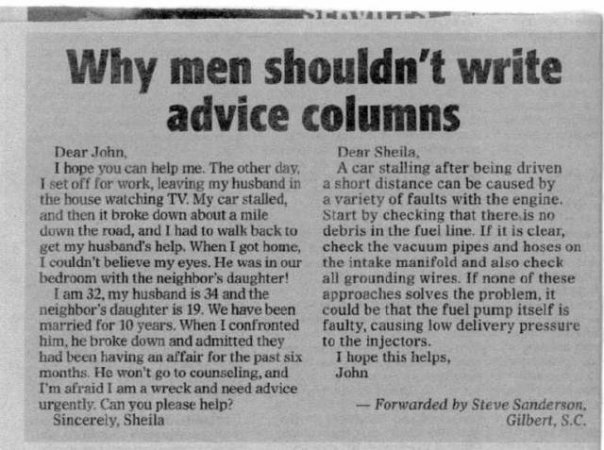
Why men shouldn't write advice columns

Some things need no commentary, but I have one below anyway.

Editor’s comment: Some say this is an example of why men should not write advice columns. I say it’s an example of missing the obvious. First, the advice guy should have told the writer to check to make sure there was enough gas in the car’s tank. An empty gas tank and a car will stall easily. Geez, some people never want to start with obvious.

Leave a comment

Filed under absurdity, advice, advice column, age, car, fun, humor, men, obvious, wit, words, writing

Building a better story: Tension

In the last installment, I said there was a difference between conflict and tension. Conflict, as Bob McKey pointed out, is the gap between expectation and result. The gap can be small, such as being overcharged a dime or great, such as losing a loved one when you thought he would survive.

The best way to explain tension is to refer to a small book on writing by the writer and editor Algis Budrys, Lithuanian for “Gordon John Sentry, more or less.” His book, Writing to The Point: A complete guide to selling fiction is only 64 pages long, and may be hard to get. But this Strunk and White-sized guide to writing is worth your time (and it even covers manuscript formatting).

For Gordon John Sentry, more or less, a story consists of seven parts: 1) a character 2) in a context with a 3) problem, who 4) makes an intelligent attempt to solve the problem and 5) fails, tries a second time and fails, tries a third time and finally 6) succeeds or completely fails, and whose actions are then 7) validated by another character in the story.

Sounds simple, doesn’t it? That is the allure of telling a good story. But the execution is often more difficult, for writer as well as story character. Step 4 – 6 above is where in a story you find tension. The key is that the character makes an intelligent attempt and fails. With increased knowledge, he or she tries again, and fails. The increased knowledge increases the stakes in the attempt and thus increases the tension. After all, it should succeed, right? Then there is a third and final attempt. This is, in essence, all or nothing, so the tension should be at its highest here.

Grimm reaper and man

Tension, while often confused with conflict, is not the same thing.

Tension, then, is something that builds over the life of the story, fueled by and feeding into the conflict. A well known love story may provide the clearest example. Romeo and Juliet loved each other. Their families, however, were adversaries. Romeo and Juliet attempted to find a way to manifest their love in the midst of this conflict, each time failing until each makes one last effort that leads to both their deaths. In this example, the tension builds in opposition to the conflict, which is fairly clever if you think about, and because of that opposition, the conflict works to heighten the tension.

Leave a comment

Filed under advice, Algis Budrys, building a better story, tension, words, writer, writing, writing tip

When to talk about IT

Note to self: Should I ever reach this stage in my career, do not talk about it being time for me to retire in front of a group, no matter how small, of overworked, under stress employees who are working overtime just to stay behind.

Leave a comment

Filed under absurdity, humor, idea, redo, retirement, when to talk

Some writing advice to consider

Here are three writing places you can go to get some advice. I sure there are others, but these three stops could be helpful:

http://janeyolen.com/the-alphabetics-of-story/
From A to Z, literally in alphabetical order prolific author Jane Yolen discusses almost every aspect of story writing, from architecture to endings. None of the entries are long, so it is not as if you have to spend hours with your eyeballs glued to the screen. But hey, if you write, you’re probably already doing that anyway.

http://blogs.plos.org/neurotribes/2011/06/02/practical-tips-on-writing-a-book-from-22-brilliant-authors/
If you are more into writing non-fiction, then this list of practical tips from twenty-two authors could be of help for you. But there are nuggets of information for any writer, such as being willing to delete entire chapters and favorite passages. Not all the recommendations are so painful, but it takes more than fast fingers and a fluid imagination to make your writing work.

http://blog.nathanbransford.com/
A former agent turned author, Nathan Bransford covers a wide variety of topics dealing with writing, including poles where he asks his readers to offer their opinions. He has entries for subjects such as How to find an agent and How to write a synopsis or query letter, all under a heading called Publishing Essentials.

1 Comment

Filed under advice, blog, fiction, Jane Yolen, Nathan Brandsford, non-fiction, publishing, Steve Silberman, words, writer, writing, writing blog, writing tip

Writing Tip: Drama is conflict

My writing is distinctly middle brow. Just ask anybody who has suffered through it. Still, I like to think that even in my middling way, I can offer some helpful advice when I stumble across it. Therefore, from time to time, I will post some writing advice, but not from me. The advice will come from established sources. I will endeavor not to make it overlong or overreaching, and sometimes it will simply be reminders of what we all probably already know, but it will be some tips I have picked up from reading, from attending writing conferences, or it may even come from you.

Writing with paperclips in ears and nose

Darma is conflict, sometimes even self-inflicted

The first bit of advice comes from a writing course the Knoxville Writers’ Guild sponsored way back in 1993. The teacher was Joseph Gunnels and the cost was $75. It was two-day event, May 15 and 16, and we spent part of a pleasant afternoon sitting on the grass outside the Candy Factory, on The 1982 World’s Fair site. I took over 30 pages of notes, but rather than bore you with details, here is the essence of what I took away from the seminar:

Drama is conflict;
Without conflict no action;
Without action no character;
Without character no story;
Without story, who cares?

In a future entry, I’ll give you a short, crisp definition for conflict that I learned at a more recent one-day writing seminar. It comes from a very highly regarded script doctor in Hollywood, but applies just as well to other forms of fiction writing. Stay turned.

Leave a comment

Filed under advice, building a better story, character, conflict, drama, story, tension, words, writing, writing conference, writing tip