
Madness leads my life.
Thunder and snow break my heart.
Tears ring with new ice.
Thunder and snow
Madness leads my life.
Thunder and snow break my heart.
Tears ring with new ice.
Super Tuesday Wrap Up

The Summation of Super Tuesday
Filed under Cartoon, humor, political humor, satire, Super Tuesday
Weird in an endearing sort of way
I have a friend who is tentatively planning to get married in March or April of 2013. Her boyfriend is an outdoorsman sort of fellow. They are considering New Orleans as a possible honeymoon destination, and I suggested that she and her intended take a raft down the Tennessee River near where we live to the Ohio River, the Ohio to the Mississippi River at Cairo, IL, and the Mississippi River to New Orleans. I suggested she could even mount her telescope to the raft and chart the stars as they go floating down the rivers.
She said she was not going rafting, not now, not ever, and not for her tentative honeymoon.
I said I was only trying to help them save on gas or air fare to The Big Easy and give them a chance to bond as they lived off the fish they caught in the rivers or the animals he shot on the land.
She said I was weird, but in an endearing way.
What I haven’t figured out is a river plan to get them to their other choice for a honeymoon: The Big Apple. Seems appropriate to send a newlywed couple to a city nicknamed after the fruit that tripped up Adam and Eve.
Some ideas are simply ahead of their time.
Found story: Frank and Ike
“Frank, what are we?”
“We’re pumpkins, Ike.”
“But if we’re pumpkins, how come we’re white?”

Frank (left) and Ike (right) discuss life as a pumpkin.
“Halloween came and went, and when Christmas came along, they decorated us up as snowmen. Or at least the heads of them.”
“Oh, nice, Frank.”
“If you say so.”
“What do you mean?”
“Ike, just wait and see.”
#

Ike tells Frank they're changing.
“Frank, are you still there?”
“Yes, Ike.”
“We’re changing. I feel it on the inside.”
“If you say so.”
#
“Frank, look at you.”
“I can’t see myself, Ike. I can’t even see you now.”
“Frank, I’m scared.”
“I know.”
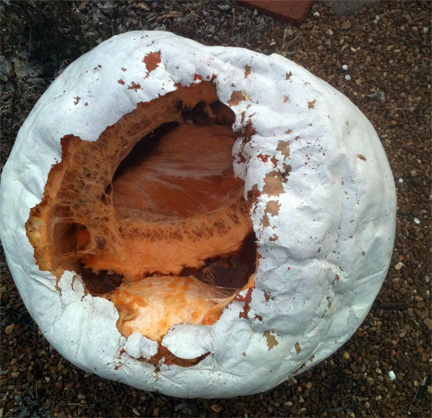
Ike becoming undone.
“Frank, what are we?”
“We’re friends.”
“I mean, what are we? What are we becoming?”
“We’re pumpkins, Ike. We’ve been pumpkins. We are pumpkins. We will always be pumpkins.”
“Are you sure?”
“I’m sure.”
“That’s good to know, Frank. Good to know.”
“Good bye, Ike.”
“Frank, don’t leave me.”
“Frank … Frank ….”
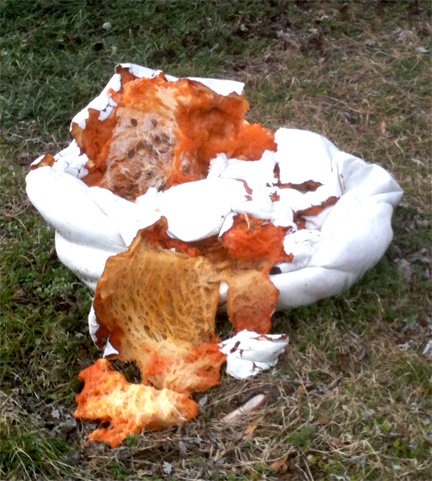
Frank undone.
Filed under Found story, pumpkins, story, storytelling, words, writing
The Good Doctor S.
Dr. Seuss, can you come and play?
Dr. Seuss, it’s your birthday.
Dr. Seuss, can you stay?
Dr. Seuss has gone away.
Oh, Dr. Seuss, you cause dismay
and all the children want to say,
“Slay the monster or feed it hay,
that mean ol’ one that took you away.
Leave it toys or snacks on a tray,
however odd, bizarre, outre.
Oh, Dr. Seuss, what a display
Of love we have for you this day.
Writing Tip: Successful Revision
[Editor’s note: the essay below is taken from an e-mail newsletter sent out by the writer Bruce Hale. you can find his web site at: http://www.brucehalewritingtips.com/. You can also sign up for his e-newsletter at that site. Each electronic newsletter comes with other information, including a writing joke.]
5 ELEMENTS OF A SUCCESSFUL REVISION
By Bruce Hale
So you’ve finished that first draft and let your story marinate in its own juices for a while, and now it’s time for revision. Only question is: where to start?
With a picture book, that’s not too terribly daunting. But with a longer novel, you’d be well served to devise a strategy before plunging into those narrative hickets that can swallow the unwary writer. I suspect everyone has his or her own favored approach to revision. Here’s the one I’ve found most useful…
1. FIRST READ
First time through, the hardest thing is to *just* read your story and take notes. No line edits, no grammar corrections, no paragraph revisions — just reading. But if you want to be able to see the whole forest, instead of the individual trees, this approach is vital.
By all means, take copious notes. “Tighten the opening on page 43;” “wonky sentence on page 12, first paragraph;” “fix the plot logic in Chapter 18.” These are all helpful. And they prepare the way for…
2. FIRST REVISION
Once you’ve waded through your story and taken copious notes, congratulate yourself. It’s not as bad as you thought, right? (We hope.) With this optimistic thought, it’s time to roll up the sleeves and plunge into wholehearted revision.
The first time through, work on larger issues: plot holes, character inconsistencies, gaps in story logic, slow scenes that need to be trimmed, and so forth. You can always do the fine polishing later.
Revise sequentially if you can, rather than skipping around. For any sections that require you to write new material, use the same method you would in a first draft: write it fast and sloppy. After all, you can always fix it in the NEXT revision.
3. READ-ALOUD REVISION
Taking the time to read your work aloud may seem redundant at this point, but it’s necessary. You won’t believe how many errors you’ll catch. Homonyms, awkward phrasing, missing words, echoes (unintentionally repeated words) — all these will pop out at you like Halloween skeletons at a haunted house.
This is the revision where you can really focus on the sound and rhythm of your writing. Listen for those areas that sound clunky and don’t really roll off the tongue — that’s your cue to break out the belt sander and make things smooooth.
4. DIALOG REVISION
Once the story is as good as you can make it, and you’ve read aloud to catch hidden glitches, it’s time to turn the microscope on your dialog. First, make sure each character speaks differently. Have them use different idioms, word choice and catch phrases — otherwise, they’ll all sound like each other (or like you).
Top-notch authors like Elmore Leonard vary their character dialog so deftly, they don’t even need attributions (he said/she said). It’s that clear who’s speaking. In real life, we all have our own ways of putting things. So just make sure your fictional characters possess that same distinction.
5. FINAL CHECK
Before I send my story off to agent or editor, I usually try to let it sit for a week or so, then do one last read-through, to make sure all my changes fit, and to smooth out any remaining rough edges. This is an ideal time to search for words you overuse. (And we *all* overuse certain pet words.)
For example, I know that I tend to drop in “just” and “only” too often, and I tend to have too many characters shrugging and nodding. A quick search for these words shows me where I’ve overdone it, and a quick fix guards against too much sameness in the manuscript.
And that’s about all I can bear to write on the subject of revision right now. I think you know why. Yes — time to get back to revising my latest story.
Filed under advice column, Bruce Hale, revising, words, writer, writing, writing tip
The blathering idiot has more questions
Just the other day, the blathering idiot had some time to kill, though he wasn’t sure it was alive to begin with, and while pondering the philosophical depths of life, came across questions for which he could not find answers. Below are a few more of those questions.
How come you can beat the odds, but never the evens?
How come formatting something means to put it in some sort of structure, but to reformat something means to wipe away all the structure?
How come falling in love leads only to a broken heart?
How come you can take a turn, but never give one?
How come you can fancy something, but are always told to speak plainly?
How come you can give a damn, but never take one?
After you put on airs, how do you take them off?
How come you can go for broke, but have to stop on a dime?

This may be too hard to think about
Filed under blathering idiot, Cartoon, humor, question of the day, questions, word play
The Devil’s Dictionary: miscreant
Every now and then, it is good to revisit a classic, or even a curiosity from the past. The Devil’s Dictionary by Ambrose Bierce was originally published in newspaper installments from 1881 until 1906. You might be surprised how current many of the entries are.
For example, here is a definition for the word miscreant The Old definition is Bierce’s. The New definition or comment are mine. From time to time, just as it was originally published, we will come back to The Devil’s Dictionary, for a look at it then and how it applies today. Click on Devil’s Dictionary in the tags below to bring up the other entries.
Old definition
Miscreant, n. A person of the highest degree of unworth. Etymologically, the word means unbeliever, and its present significance may be regard as theology’s noblest contribution to the development of our language.
New definition
Miscreant, n. A person of the highest degree of unworth, such as a politician or political pundit who wraps herself in the flag like swaddling clothes; proclaims “family values” as if they were a manger under siege, yet does nothing for families in dealing with the ravages of capitalism as the top 1 percent of the wealthiest people in the country control more wealth than the bottom 40 percent, and “wants to take my country back” as if somehow retreating into the past will deal with the future.
Etymologically, the word means unbeliever, holding an unorthodox or false religious belief. Again, see politician political pundit as described above. There is nothing more heterodoxical than living in a past that never was.
May want to see previous Devil’s Dictionary entries on politicians, politics, and orthodoxy.
Filed under Ambrose Bierce, Devil's Dictionary, humor, miscreant, satire
Cartoon: Giving Your All

Giving Your All is easier to give your all when somebody or some corporate entity has already taken it.


 Booker's Blog
Wealthy, motivated by greed, are more likely to cheat, study finds
People of higher status are more prone to cheating, taking candy from children and failing to wait their turn at four-way stops, a UC Berkeley experiment finds.
http://www.latimes.com/news/science/la-sci-0228-greed-20120228,0,5965885.story?track=icymi
By Eryn Brown, Los Angeles Times
7:07 PM PST, February 27, 2012
The rich really are different from the rest of us, scientists have found — they are more apt to commit unethical acts because they are more motivated by greed.
People driving expensive cars were more likely than other motorists to cut off drivers and pedestrians at a four-way-stop intersection in the San Francisco Bay Area, UC Berkeley researchers observed. Those findings led to a series of experiments that revealed that people of higher socioeconomic status were also more likely to cheat to win a prize, take candy from children and say they would pocket extra change handed to them in error rather than give it back.
Because rich people have more financial resources, they’re less dependent on social bonds for survival, the Berkeley researchers reported Monday in Proceedings of the National Academy of Sciences. As a result, their self-interest reigns and they have fewer qualms about breaking the rules.
“If you occupy a more insular world, you’re less likely to be sensitive to the needs of others,” said study lead author Paul Piff, who is studying for a doctorate in psychology.
But before those in the so-called 99% start feeling ethically superior, consider this: Piff and his colleagues also discovered that anyone’s ethical standards could be prone to slip if they suddenly won the lottery and joined the top 1%.
“There is a strong notion that when people don’t have much, they’re really looking out for themselves and they might act unethically,” said Scott Wiltermuth, who researches social status at USC’s Marshall School of Business and wasn’t involved in the study. “But actually, it’s the upper-class people that are less likely to see that people around them need help — and therefore act unethically.”
In earlier studies, Piff documented that wealthy people were less likely to act generously than relatively impoverished people. With this research, he hoped to find out whether wealthy people would also prioritize self-interest if it meant breaking the rules.
The driving experiments offered a way to test the hypothesis “naturalistically,” he said. Trained observers hid near a downtown Berkeley intersection and noted the makes, model years and conditions of bypassing cars. Then they recorded whether drivers waited their turn.
It turned out that people behind the wheels of the priciest cars were four times as likely as drivers of the least expensive cars to enter the intersection when they didn’t have the right of way. The discrepancy was even greater when it came to a pedestrian trying to exercise a right of way.
There is a significant correlation between the price of a car and the social class of its driver, Piff said. Still, how fancy a car looks isn’t a perfect indicator of wealth.
So back in the laboratory, Piff and his colleagues conducted five more tests to measure unethical behavior — and to connect that behavior to underlying attitudes toward greed.
For instance, the team used a standard questionnaire to get college students to assess their own socioeconomic status and asked how likely subjects were to behave unethically in eight different scenarios.
In one of the quandaries, students were asked to imagine that they bought coffee and a muffin with a $10 bill but were handed change for a $20. Would they keep the money?
In another hypothetical scenario, students realized their professor made a mistake in grading an exam and gave them an A instead of the B they deserved. Would they ask for a grade change?
The patterns from the road held true in the lab — those most willing to engage in unethical behavior were the ones with the highest social status.
One possible explanation was that wealthy people are simply more willing to acknowledge their selfish side. But that wasn’t the issue here. When test subjects of any status were asked to imagine themselves at a high social rank, they helped themselves to more candies from a jar they were told was meant for children in another lab.
Another experiment recruited people from Craigslist to play a “game of chance” that the researchers had rigged. People who reported higher social class were more likely to have favorable attitudes toward greed — and were more likely to cheat at the game.
“The patterns were just so consistent,” Piff said. “It was very, very compelling.”
Piff, who is writing a paper about attitudes toward the Occupy movement, said that his team had been accused of waging class warfare from time to time.
“Berkeley has a certain reputation, so yeah, we get that,” he said.
But rather than vilify the wealthy, Piff said, he hopes his work leads to policies that help bridge the gap between the haves and have-nots.
Acts as simple as watching a movie about childhood poverty seem to encourage people of all classes to help others in need, he said.
eryn.brown@latimes.com
Copyright © 2012, Los Angeles Times
==========================================
Conclusions:
And these are my own.
1) I particularly like the comment about the wealthy being more likely to take candy meant for a kid. The cartoons and comedies I saw as a kid showing just this sort of act weren’t that far off target.
2) With enough wealth, as the article states, we could be just like most of the wealthy in the study: more unethical than we are.
3) Seems to me the beginnings of a good case for some sort of — dare I say it — wealth redistribution. Seems it might just be good for a democratic republic like ours. Do it until we at least get the candy back, and maybe a little while longer.
4) Maybe the Occupy Wall Street people are on to something.
5) Cartoon commentary:
The emptiness you feel may be real.
Share this:
2 Comments
Filed under Cartoon, Commentary, L.A. Times, Random thought, redistribution, wealth
Tagged as cartoon, cheating, commentary, L.A. Times, marshall school, Occupy Wall Street, redistribution, social bonds, uc berkeley researchers, unethical acts, wealth