
One must live in love’s
embrace in order to feel
its sublime madness.
E-book pricing: lawsuit filed
Source: http://www.latimes.com/entertainment/news/la-et-apple-authors-20120413,0,6062761.story
Lawsuit against Apple: Writers wary of action by Dept. of Justice
Michael Connelly and Sherman Alexie are among authors who view the Justice Department’s suit against Apple and five publishers as acting against writers’ interests.
By Carolyn Kellogg, Los Angeles Times
April 13, 2012
When the Department of Justice and state officials announced their lawsuits against Apple and five major publishers Wednesday, it sent a ripple of anxiety through the talent at the industry’s heart.
“I’m in a bit of an awkward position because this has pitted my publisher against the retailer that far and away sells more of my books than any other,” says Michael Connelly, the bestselling mystery novelist. “I don’t want to bite the hand that feeds me, and both of these hands feed me.”
Connelly is published by Little, Brown, which is owned by Hachette, one of the publishers named in the suits that has since agreed to settle.
The scrutiny given to Apple’s alleged arrangement with the publishers — they are accused of colluding to raise the price of e-books, which they have denied — is largely perceived in publishing as shifting the balance of power in bookselling to Amazon. Publishers rely on Amazon as a major source of print book sales and have generally cooperated with its policies. When it launched the Kindle, Amazon deeply discounted e-book prices and offset the loss with profits from other parts of its business. Apple has been the first significant alternative to Amazon as an e-book retailer.
“I think the DOJ’s suit is misguided,” explains Andrew Wylie, the most powerful agent in publishing, who counts a number of Nobel Prize-winners among his 800 clients. “I think it is acting against the interests of culture and diversity in publishing. I think it is acting against the interests of authors.”
In part, that’s because the pricing of e-books directly affects the way authors can earn a living — and the publishing ecosystem that sustains them. “I know for a fact that my publishers and my editors publish books that they know are going to lose money but they think should be of the world,” says National Book Award-winning writer Sherman Alexie. “The John Grishams of the world support the experimental nature of publishing.” The DOJ’s suit, he says, “gave Amazon explicit permission to go for a total monopoly.”
Connelly observes that the DOJ suit seems to be unbalanced. “I believe in fair play. So I feel that if the government is going to step in and put controls on how publishers act to ensure a competitive marketplace, then I hope the government will be just as vigilant in guarding this amazing, creative and important industry from being monopolized by one entity,” he says. ” Amazon spreads my work far and wide. You can’t beat that. I’m very grateful. But I don’t want a world where there are no bookstores or other venues for discovering my work or the work of any other writers.”
For a writer just starting out, the suit served as a reminder that publishing is in flux. “I love writing and am going to continue writing, but having all my eggs in one basket is kind of scary,” says Elliott Holt, whose debut novel will be published by Penguin in 2013.
Copyright © 2012, Los Angeles Times
[Editor’s note: while I read and enjoy the works of Michael Connelly and Sherman Alexie, I don’t think the lawsuit is “misguided.” I think colluding to fix prices is misguided and as history shows, only furthers to protect the profits of those on the inside (Those fixing the prices.) at the expensive of those on the outside (Those having to pay them). Apple should not be allowed to set prices and neither should Amazon, but in this case it appears that Apple with the aid of publishers was doing just that, which profited them at the expense of book buyers. To read earlier articles on this, click on one of the Category listings below: e-book, publishers, or publishing.]
Filed under authors, e-book, publishers, publishing
The 13th noir
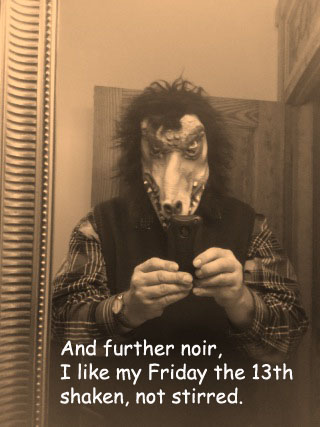
Some days, you get the noir, and some days the noir gets you.
Filed under Friday the Thirteenth, noir, Photo by author
Thirteen is a lonely number
I hardly know ya, /
Triskaidekaphobia. /
Afraid to hold ya. /

It's Friday, Friday the Thirteenth. Just the facts, ma,am.
I have just told ya, /
Triskaidekaphobia. /
I hardly know ya. /
Just the facts, you say, /
Triskaidekaphobia./
Will make you go away. /
But you’re here to stay. /
triskaidekaphobia. /
For the entire day. /
So I might just play, /
Triskaidekaphobia. /
On this fine Friday: /
Triskaidekaphobia
Filed under Friday the Thirteenth, haiku, poem, poetry
E-book pricing: possible lawsuit
[Editor’s note: This is a follow up to an article posted on this blog on 12/18/2011. Click on Category listing “e-book” below to bring up that article by Tom Dupree.]
Apple Lawsuit: DOJ May Sue Tech Company Over eBooks As Early As Wednesday
By Diane Bartz and Poornima Gupta
4/10/2012 8:17 PM (Eastern Time)
WASHINGTON/SAN FRANCISCO, April 10 (Reuters) – The Justice Department could sue Apple Inc as early as Wednesday over alleged electronic book price-fixing, while settling with several publishers as early as this week, two people familiar with the matter said.
The Justice Department is investigating alleged price-fixing by Apple and five major publishers: CBS Corp’s Simon & Schuster Inc; HarperCollins Publishers Inc; Lagardere SCA’s Hachette Book Group; Pearson and Macmillan, a unit of Verlagsgruppe Georg von Holtzbrinck GmbH.
A lawsuit against Apple, one of the parties not in negotiations over a potential settlement, could come as early as Wednesday but no final decision had been made, the people said.
Apple declined to comment. The Justice Department and the five publishers could not be reached for comment.
The Justice Department is investigating whether deals Apple cut two years ago with the quintet of major publishers – when the consumer electronics maker launched its iPad tablet computer – were done with the intent of propping up prices for digital books, sources have said.
As part of those agreements, publishers shifted to a model that allowed them to set the price of e-books and give Apple a 30 percent cut of sales, the sources have said.
Talks between the Justice Department and some publishers had been proceeding, with settlements expected as soon as this week, one of the two sources familiar with the matter said on condition of anonymity, because the discussions were not public.
A negotiated settlement is expected to eliminate Apple’s so-called “most favored nation” status, which had prevented the publishers from selling lower-priced e-books through rival retailers such as Amazon.com Inc or Barnes & Noble Inc , sources had told Reuters last month.
But the situation was fluid, those sources said at the time.
Filed under e-book, publishers, publishing
I’m a writer and I don’t get no respect

She threw the book at me!
I’m a writer and I don’t get no respect. Just the other day I hired an editor to help me with my manuscript, and the first thing she did was throw the book at me! The unabridged book at me. The one that defines words. You know it. D-i-k something something something.
Filed under Cartoon, cartoon by author, no respect, writing
Building a better story: three elements to character building
You can’t always get what you want
You can’t always get what you want
You can’t always get what you want
But if you try sometimes you just might find
You just might find
You get what you need
So goes the chorus from The Rolling Stones song, “You Can’t Always Get What You Want.”
Those are perfect lyrics in which to briefly discuss the three elements that can help a writer build a character.
When creating a main character, ask yourself three questions:
1) What does your main character (protagonist) want?
2) What does your character need?
3) How can these two things be brought into conflict?
Despite what advertising might try to convince about having hunger pangs that only a certain hamburger can cure, there is a difference. Hunger is a need. The body needs food to live. The hamburger (Or whatever other food you wish to insert) is a want. Hunger can be alleviated by a wide range of foods, not just the one being advertised at the moment you feel hunger.

What a character needs is often more important than what she wants.
You can also think of this way: want is often an external thing; need an internal thing. The hamburger is an external manifestation of something that is an internal need: hunger. They come into conflict when you find out you don’t have enough money for that hamburger, or if having that hamburger will cause you to break out in hives, due to an allergic reaction you may have recently developed to ground beef.
The same is also often true of your story’s main character. There is something he wants. There is something he needs. The want and the need to come into conflict.
Take for example, Huckleberry Finn in Mark Twain’s The Adventures of Huckleberry Finn.
What is it wants: to escape his alcoholic father who has kidnapped him and locked him in an old cabin in the woods, because the father wants the money that Huck is entitled to. He escapes from his dad and hides out on an island as part of his plan to keep from being kidnapped again. What he needs, though he is not willing to even admit it to himself, is an adult who will accept him for how he is (and won’t try to civilize him), but still be willing to take care of him, even guide if not raise him, and love him. Huck finds that in the runaway slave Jim, and at the point of the novel where Huck should turn Jim in as runaway slave, Huck decides not to do what society wants him to do, he sides with Jim because Jim is somebody whom Huck needs, and who also needs Huck. Much of the rest of the novel from that point on is about handling the consequences of that decision and the temptations to still turn Jim in.
There are many other examples in fiction and in film, on the stage and even sometimes in long story poems.
You can have your protagonist side with what he wants over what he needs. This often leads to more trouble or even tragedy. You can have you protagonist win by losing. He loses what he wants, but wins what he needs and is the better for it. He can find a way to make the two work together, with the want being a true outward manifestation of the inward need.
So, decide what it is your character wants (that job promotion, the girl next door, the pot of gold) and what he needs (validation of his self-worth, love, money to buy the thing he always wanted), and then bring those two into conflict.
[Editor’s update/note: click on “building a better story” in the Category listings to find several other blog pieces of information I have put together from classes, books, and other sources (including my own experiences).]
Filed under building a better story, cartoon by author, character, writing tip
The Kibitzer and The Kidd, part 7
[Editor’s note: Parts 1 – 6 of The Kibitzer and the Kidd are available by clicking on “Kidd” or “Kibitzer” in the tag section. This is science fiction western with more than dollop of humor and satire.]
888888
Al Wayne handed the Cough Drop Kidd a hot toddy. They were in Wayne’s private office off the mezzanine in the saloon.
Given the scuffed look of the saloon, this office was opulent with upholstered seats and an intricately carved fireplace mantel. There was no fire in the fireplace, and the Kidd wondered if it worked. Wayne assured him that it did, but that he rarely used it because it was an inefficient way to heat and added to the carbon footprint.
Wayne handed the Kidd a copy of his book, Global Warning. The Kidd wasn’t quite sure what to do, a warm drink in one hand and a cold tome in the other.
He laid the book on a side table by the chair, He was almost certain he heard the table sigh and mutter, “Oh, no, not another one.”
“Drink up,” Wayne said, raising his own drink to his lips and taking a sip. “It’s not often we get a toddy drinker in this town. It’s good to have a little sophistication every now and then.”
The Kidd didn’t think of himself as a sophisticate, only somebody with a sore throat from coughing too much.
“What about what the Kibitzer said. Is it true?”
Wayne smiled.
“That Bonnie can whip up some mighty powerful cough drops. Sometimes a whiff of those apothecary fumes can make you say things you normally wouldn’t.”
“So, it’s not true?”
Wayne shrugged. “Many folk around here have claimed they’ve been struck by lightning and then resurrected some time later. I don’t put much stock in it myself.”
The smile on Wayne’s face didn’t ease the feeling of disquiet the Kidd felt rippling just under his skin. Particularly since it was at Wayne’s insistence that the Kibitzer had to sleep I the stable on the edge of town. Not that it was a large town, and a few of the buildings only had facades and nothing behind them. One or two had signs that read: “Coming soon,” but nothing else. At one point in their travels together, the Kidd had heard the Kibitzer use the term Potemkin Village and he wondered if this might be that. The name of this place was Potomac. But there was no river nearby.
“You haven’t touched your toddy.”
The Kidd quickly took a sip. It was tepid now, but still tasted amazingly good. He took a second, long sip.
“Now, I have a question for you, Mr. Kidd.”
Kidd smiled. He rarely heard anybody call him Mr. Kidd. Kidd or hey you was more likely. For the moment, he couldn’t remember what the Kibitzer called him. Probably nothing he wanted to repeat.
Kidd wasn’t his real name, at least not the real name his parents gave him. But he abandoned that name shortly after he abandoned them.
“My question is in your travels have you heard anyone mention or met anyone by the name of John Gore?”
At that moment, the floor-faced man barged into the room. He spotted The Kidd and curled his lip.
“Fire. There’s fire down at the livery.” He said it breathlessly, but not in a good breathless way.
The Kibitzer, the Kidd thought.
“Save my horses. My prize Walkers,” Wayne said.
Wayne was at the door, shoving the floor-faced man out in front of him.
The Kidd put down his toddy on the book and headed for the door.
“Don’t forget your book,” the table said.
The Kidd hesitated.
“Take it, fool,” the table said.
The Kidd snatched it from under the toddy. The cup tipped over and smashed against the floor. Breaking china and escaping toddy skittered and splashed about.
“Oh, Mr. Wayne’s going to be mad. That’s not eco-friendly.”
The Kidd didn’t hear the table. He was down the stairs and almost to the saloon’s swinging front doors when two dark figures stepped in front of him, blocking his way. The Kidd tried going around them, but they would have none of it.
(To be continued…)
The Philosoper and growing up

No April Fool this philosopher.
Filed under aging, Cartoon, eight year old philosopher, growing older, humor, word play


 Booker's Blog