Writing tip Wednesday: “Pre-writing”

Pre-writing might help you write faster and clearer.

Pre-writing might help you write faster and clearer.

Do you pre-write?

Pre-writing? Is that like rinsing your dishes before putting them in the dishwasher to make sure they get clean? you ask.

Sort of. The goal is at least equivalent. You pre-write with the idea in mind that it will help guide you to a better conclusion to that day’s writing.

It doesn’t take long. The amount of time pre-writing could depend on the number words or amount of time you are going to spend writing, but should probably be no more than ten minutes.

When you pre-write, you decide what scene it is you are working on and what should happen or that you want to happen in that scene.

For example, say Nick is in a hurry to get to the local BBQ restaurant to meet Kelly for their first date. You decide: Nick is nervous. He hasn’t had a date in almost a year and he always wanted to date Kelly. He is so nervous he mistakes his cologne for his shampoo and accidentally dumps most of his cologne on his head and now has to scramble to clean himself up and NOT reek of his favorite cologne, the one guaranteed to drive women mad. Kelly will certainly be mad if he arrives late.

Now, with that brief sketch of the scene, you write it out in more detail, but you know what he has done and what he is trying to do and what has happened to prevent him from accomplishing his goal of meeting Kelly on time, or even arriving a little ahead of time.

Give it a try and see if it works for you. See if it helps you write more in the same amount of time or write clearer. Some authors, such as Rachel Aaron in her e-book 2,000 to 10,000, How to write faster, write better, and write more of what you love.

I wonder how long it took her to write that title.

Leave a comment

Filed under article by author, Writing Tip Wednesday

cARtOONSDAY: “tHE rIGHT cURVE”

Idea in the corner pocket.

Idea in the corner pocket.

Some ideas just won't stay put.

Some ideas just won’t stay put.

Leave a comment

Filed under cartoon by author, CarToonsday

Monday morning writing joke: “Take two”

Q.: How many screenwriters does it take to change a light bulb?

A.: Ten.

1st draft: Hero changes light bulb.
2nd draft: Villain changes light bulb.
3rd draft: Hero stops villain from changing light bulb. Villain falls to death.
4th draft: Lose the light bulb.
5th draft: Light bulb back in. Fluorescent instead of tungsten.
6th draft: Villain breaks bulb, uses it to kill hero’s mentor.
7th draft: Fluorescent not working. Back to tungsten.
8th draft: Hero forces villain to eat light bulb.
9th draft: Hero laments loss of light bulb. Doesn’t change it.
10th draft: Hero changes light bulb.

Leave a comment

Filed under Monday morning writing joke

The Devil’s Dictionary: “Alien, Alliance, Ambidextrous, Ambition, Amnesty”

A young Ambrose Bierce

A young Ambrose Bierce


In our continuing quest to revisit a classic, or even a curiosity from the past and see how relevant it is, we continue with The Devil’s Dictionary by Ambrose Bierce. Originally published in newspaper installments from 1881 until 1906. You might be surprised how current many of the entries are.

For example, here are definitions for Alien, Alliance, Ambidextrous, Ambition, and Amnesty. The Old definitions are Bierce’s. The New definitions are mine or somebody else contemporary. The new definitions can also be simply examples of The Devil’s Dictionary definitions. From time to time, just as it was originally published, we will come back to The Devil’s Dictionary, for a look at it then and how it applies today. Click on Devil’s Dictionary in the tags below to bring up the other entries.

OLD DEFINITION:

ALIEN, n. An American sovereign in his probationary state.

ALLIANCE, n. In international politics, the union of two thieves who have their hands so deeply inserted in each other’s pockets that they cannot separately plunder a third.

AMBIDEXTROUS, adj. Able to pick with equal skill a right-hand pocket or a left.

AMBITION, n. An overmastering desire to be vilified by enemies while living and made ridiculous by friends when dead.

AMNESTY, n. The state’s magnanimity to those offenders whom it would be too expensive to punish.

NEW DEFINITIONS:

(ILLEGAL) ALIEN, n. An un-American scofflaw unable to achieve a probationary state of any sort, at least as seen by some radical conservative elements. For them ALIEN is always preceded by ILLEGAL. This distinguishes him from the American scofflaw, who with enough money and AMBITION can form at least one ALLIANCE in which he can pick the pockets of friends and foes alike.

ALLIANCE, n. In National and International politics, the union of two thieves who have their hands so deeply inserted in each other’s pockets that they cannot separately plunder a third. However, as a grouped entity they often find a way to plunder others. The NRA plus the GOP being one fine example of how two groups manage to plunder a third, even to the point of death.

AMBITION, n. An overmastering desire to be vilified by enemies while living and made ridiculous by friends when dead. (Nothing much new need be added to this.)

AMNESTY, n. The state’s magnanimity to those offenders whom it would be too expensive to punish or who have enough money to acquire amnesty as one acquires a Get-Out-Of-Jail-Free card in Monopoly. In other words, it would be too “expensive” to ignore the offer.

Leave a comment

Filed under Devil's Dictionary

Photo Finish Friday: “Portal”

In the hedge lay adventure.

In the hedge lay adventure.

Robbie said, “Ain’t so.”

“Is too,” Ray said back.

Robbie and Ray were each six years old. Robbie was a few months older, and on occasions like this, he like to remind Ray of that. They just weren’t sure what this occasion was. Still, Robbie was asserting his role as elder statesman to tell Ray he was wrong.

“It’s like Nose legend.,” Ray said “You know, that great fight called Rag in a rock.”

“This got nothin’ to do with that,” Robbie said. “Ain’t nothin’ more than a strange cut in the hedge for that box.”

“It’s a portal, I tell you. And those Nose gods will come pourin’ through it to do battle with them frost giants and there will be an army of Gideon.”

“Who’s that?” Robbie asked.

Ray shrugged. “Some guy who can pour armies.”

“Ain’t no army goin’ to come pourin’ out of that hole in the hedge. It don’t even go all the way through.”

“It’s still a portal,” Ray said, “and if you go and sit in it for six hours, you will see it: happening. I dare ya’. I double dog dare ya!”

Not one to turn down a double dog dare, Robbie snuck up on the rectangular. And to show he wasn’t scared at all, he climbed into the hole in the fence. He tried several different poses and a few words he wasn’t supposed to.

After thirty minutes, Robbie fell asleep in the portal. After another ten minutes had passed, Ray left and walked back to the family picnic where he immediately ate his ice cream allotment and Robbie’s, too.

Leave a comment

Filed under humor, Photo by author, Story by author

Haiku to you Thursday: “First fright”

He reached the road’s end. /

He stepped into the unknown. /

The first fright was love.

Leave a comment

Filed under Haiku to You Thursday, poetry by author

Adventures In Editing, Part V

Step up, sit down, and read about one editor’s adventures in editing. If you are a writer, it is worth your time, and if you are a reader, it is also worth you time. And if you don’t do either, well, then, shame on you.

Tom Dupree's avatarYou and Me, Dupree

editing

One day, Bantam publisher Irwyn Applebaum summoned me into his office and asked, “How do you respond when I say, ‘Tom Robbins’?” Without even thinking, I said, “one of the great prose stylists of his generation.” He said, “That’s what I thought. I want you to go out to Seattle and meet him. You might become his editor.” (Spoiler Alert: I did, and I did. But I’m getting ahead of myself.)

In past pieces in this series, I’ve tried to give you some idea of what life is really like from the editor’s point of view. I began writing “Adventures In Editing” because I rarely read about that aspect of the publishing business, and the little I did read described only a cookie-cutter, stereotypical, author-v.-editor relationship that tended to come from the author’s side of the negotiating desk: much of it seemed to emanate from Writer’s Digest

View original post 1,755 more words

Leave a comment

Filed under editor

Writing tip Wednesday: “Frankly, my plot doesn’t give a….”

WHY DOESN’T MY PLOT WORK?

by BRUCE HALE and MICHAEL STEARNS

http://www.brucehalewritingtips.com/

Getting perspective on your own writing is tougher than two-year-old Halloween caramels. You squint at the story, mull it over, and suspect something isn’t working, but it’s hard to say what, exactly.

At a recent conference, my friend and former editor, Michael Stearns, offered up one of the best cures I’ve seen for this problem. His series of diagnostic questions can help you turn your plot from wimpy to wicked-strong.

Reprinted with his permission, here’s an excerpt from Michael’s list of questions, together with my explanations.

1. Do you have something pulling the character forward?
Every character needs a powerful goal or desire. Make sure it’s compelling enough to believably motivate them.


2. Do you have something pushing the character from behind?

Add a meddlesome mom, a pursuing villain, an obnoxious rival — someone who applies pressure.

3. Have you remembered clocks?
This refers to a deadline that must be met, or else. Think of Marty McFly in Back to the Future, who must drive his time machine
past the clock tower at the right moment, or remain stuck in the past.

4. Have you made the character lie — to others and to us?
Everybody lies. And whether it’s a big lie or a little one, the truth wants to come out. This energy helps invigorate your plot.

5. Do you know your character’s motives inside and out?
Often, plots bog down when you lose sight of why your hero wants to do something. Unmotivated action rings false.

6. Does all the above apply to even minor characters?
The villain, the best friend, even the bit players have a reason for doing what they do. And when you get clear on that reason, their actions will be make more sense.

7. Have you buried the ends of chapters?
Don’t immediately resolve the issue or question that gets raised near the chapter’s end. Resolve it in the next chapter — or better yet, the chapter after that. Your readers will curse you while they keep on reading.

8. Have you been as mean as possible to your characters?
We’re talking about Job mean, Sophie’s Choice mean, evil-punk-the-reader-will-hate-you-forever mean. Don’t just give your hero grief, give her the worst day imaginable.

9. Do you always go for the extreme?
What keeps readers reading is high-stakes action. In the words of Spinal Tap, dial it up to 11. The higher the stakes, the better the book.

Michael Stearns is an agent and partner of Upstart Crow Literary Agency. You can visit his website at: http://clicks.aweber.com/y/ct/?l=O8uEK&m=IsxyiV6D9FLsQz&b=7cPIzxf9UuUk28zsEYoWSw

___________

Bruce Hale

Bruce Hale

About Bruce…
Bruce Hale began his career as a writer while living in Tokyo, and continued it when he moved to Hawaii in 1983. Before entering the world of children’s books, he worked as a magazine editor, surveyor, corporate lackey, gardener, actor, and deejay.

Bruce has written and illustrated over 25 books for kids. His Underwhere series includes Prince of Underwhere and Pirates of Underwhere. His Chet Gecko Mysteries series includes: The Chameleon Wore Chartreuse, The Big Nap, The Malted Falcon, Hiss Me Deadly, and others. More at http://www.brucehale.com/

Leave a comment

Filed under writing tip, Writing Tip Wednesday

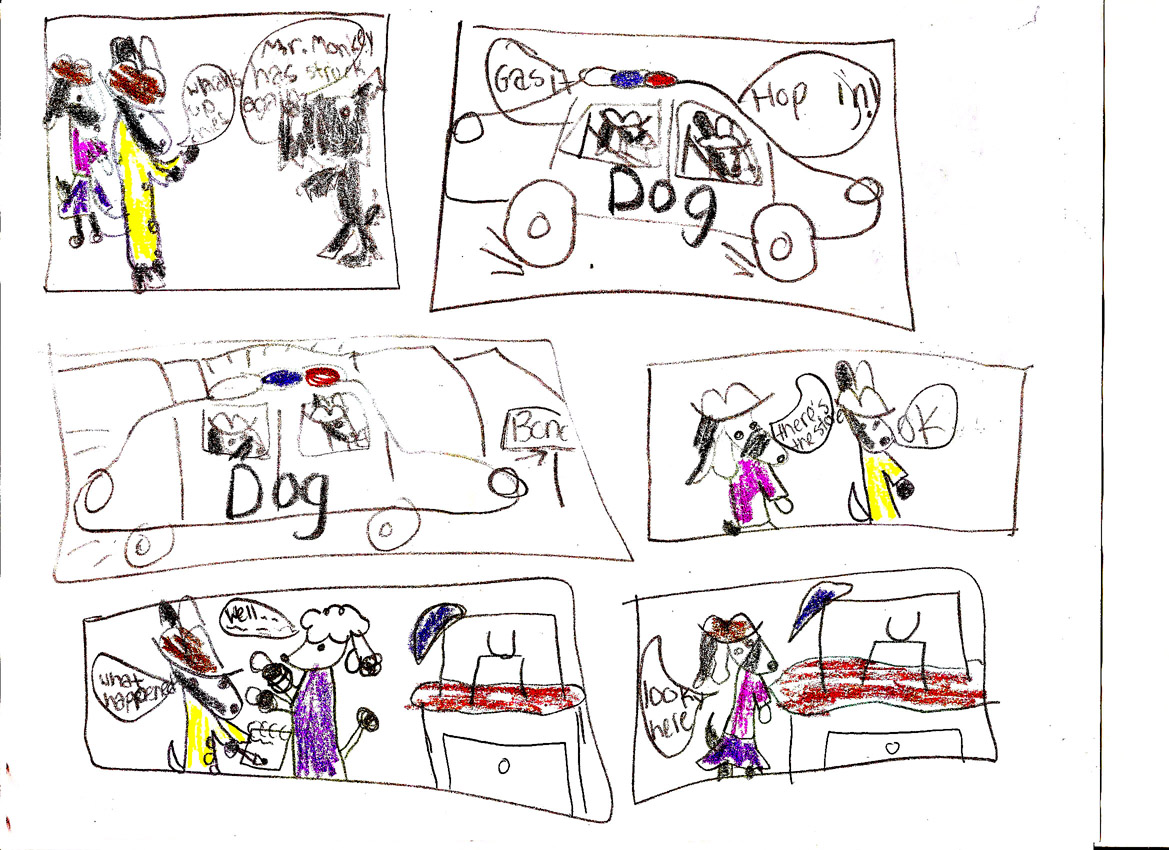
Eleanor and Rose, and “The Case of the Fleaing Colors,” Credits

Cartoonist: Lauren Booker

Cartoonist: Lauren Booker

This has been a Talltalestogo presentation of The Case of the Fleaing Colors.

Starring: Eleanor and Rose
Special appearance: Kali

Drawings by Lauren Booker

Coloring by Lauren Booker

Non-coloring by Lauren Booker

Story adapted for the blog screen by David E. Booker from a story told to him by Lauren Booker.

Editing by David E. Booker

Layout by David E. Booker

Concept by Lauren Booker

Any resemblance to dogs or monkeys real or imagined may not be completely coincidental.

Copyright 2013 by Lauren Booker and David E. Booker

Thank you for reading The Case of the Fleaing Colors

A Talltalestogo presentation.

To re-view any or all of the mystery strong>The Case of the Fleaing Colors, click on the links below, especially the one that reads: “The case of the fleaing colors”.

Story by: Lauren Booker and David E. Booker

Story by: Lauren Booker and David E. Booker

Leave a comment

Filed under cartoon by author, Eleanor and Rose, Story by author

Monday morning writing joke: “the screen and the bulb”

Q.: How many screenwriters does it take to screw in a light bulb?

A.: Why does it have to be changed?

Leave a comment

Filed under Monday morning writing joke