Writing tip Wednesday: “…try, try again.”

If at first you don’t succeed…

PenPal asks, Which is correct?
A. “I will try and schedule a dentist appointment for Tuesday.”
B. “I will try to schedule a dentist appointment for Tuesday.”

My excellent high school and college English instructors taught this well, along with the reasoning behind it, and I’ve never forgotten this grammar point. In fact, it has become a pet peeve of my editorial life!

Here is a somewhat simplified but completely adequate explanation:
In Example A, we have a compound predicate, which means we have two or more distinct actions (verbs or verb phrases). The sense of this is the following: the subject will both try [something] and schedule [a dentist appointment]. If we read it correctly, we are left wondering what the subject is going to try—it could be anything! In my case, it would be to avoid the dentist.

In Example B, we have a simple predicate, which means there is one distinct action (verb or verb phrase). The sense of this is as follows: the subject will try to schedule [a dentist appointment]. Example B contains correct verb usage and syntax; Example A is not correct.

More and more often, I see this phrasing [try and . . .] misused in publications. If you take a moment to think it through logically, it’s an easy and important error to correct in the quest for excellent, rather than mediocre, substandard, writing. Try the brief quiz below to see if you understand the distinction. There is one “trick” question; try to spot it and choose correctly.

Select the correct wording in each sample set below:
A.
1. My mother will try to attend my baby shower even though she lives in Tucson.
2. My mother will try and attend my baby shower even though she lives in Tucson.

B.
1. Mark’s dragon would try and fit into seven pairs of boots that morning before he’d find the perfect pair.
2. Mark’s dragon would try to fit into seven pairs of boots that morning before he’d find the perfect pair.

C.
1. If you don’t mind, Zelda, try and schedule our meeting before 2 p.m. Friday afternoon.
2. If you don’t mind, Zelda, try to schedule our meeting before 2 p.m. Friday afternoon.

D.
1. Try and fail; it’s better than never trying at all.
2. Try to fail; it’s better than never trying at all.

E.
1. Try to pay attention the first time I explain this proof, will you, Zachary?
2. Try and pay attention the first time I explain this proof, will you Zachary?

Answers:
A:1; B:2; C:2; D:1; E:1

[Explanation for D: This is clearly a different usage for “try.” In this sentence, two abstractions are presented. Rather than a subject trying something or failing at something, the author is discussing the broader concepts of effort and failure. We presumably don’t try to fail at anything. Always consider the context when applying grammar rules.]

________

Cathy Kodra a/k/a PenPal

Cathy Kodra a/k/a PenPal

About PenPal…
Cathy Kodra works as an independent editor in Knoxville, TN. Her poetry and short stories have appeared in numerous journals and anthologies including Roanoke Review, New Millennium Writings, Common Ground Review, Now & Then, Cavalier Literary Couture, Slow Trains, Still Crazy, The Medulla Review, Prime Mincer, Yemassee, and others. She is a contributing editor for New Millennium Writings and past guest poetry editor for The Medulla Review. She was first runner up in Prime Mincer’s 2011 Poetry Contest, judged by Rodney Jones, and took first place in the 2012 Old Gray Cemetery Poetry Contest. Cathy’s first poetry chapbook, Thin Ice, was published in 2011 by Medulla Publishing.

Cathy is a member of the Knoxville Writers’ Guild and of two local writing groups. An avid reader and writer, she is currently working on two poetry collections and a collection of short stories. Her hobbies include gardening and vegan cooking, and she lives happily with her husband Ron, two dogs, and a cat. She can be reached at www.cathykodra.com.

Leave a comment

Filed under Writing Tip Wednesday

Monday (morning) writing joke: “Dead again,” part 2

In honor of all the zombie movies over the past year, and books about zombies and other dead creatures, here is the second of two or three “dead” jokes, puns, bits of humor. Groan as you see fit.

Q.: What do you call…

…a race between zombies?

A.: A dead run.

…a warm day for zombies?

A.: A dead heat.

…a zombie who ate his girlfriend?

A.: A dead ‘n’ ate her.

…a zombie in an explosion?

A.: Dead bone air.

…somebody killed by a medieval zombie?

A.: Dead of knight.

…a zombie politician too long in office?

A.: A deadencated public servant.

.…a lobbyist?

A.: Dead weight.

…500 zombie lawyers at the bottom of the ocean?

A.: Habeas corpses.

Leave a comment

Filed under Monday morning writing humor, Monday morning writing joke

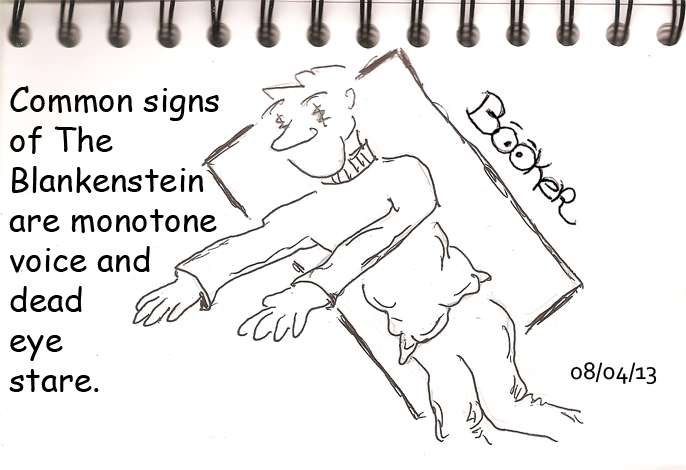
New Word to Live By: “Blankenstein”

First Saturday (or Sunday) of the month. Time for new words to live by. Once a month on the first Saturday (or Sunday) of each month, I will list a new word. This is NOT a word you are likely to find in the dictionary. It is a new word, often a portmanteau word, sometimes just a new word not made from merging two other words. Some of the previous words have included: obsurd, a combination of obscure and absurd, obscure absurdity means something obsurd. These new words might even be considered an exercise in obsurdity.

Here now is the new word.

Blankenstein, n., 1) The blank look on your computer monitor when the hard drive has crashed and all your files are gone, the program has crashed and your important work is gone, or your computer won’t start up for some reason, such as the motherboard gone band, and you can’t access your folders and files. In some cases, also known as “The Blue Screen of Death.”

Beware the Blankenstein!

Beware the Blankenstein!

2) The blank look on a low level business or government functionary who, while claiming to help you, is actually doing nothing to aid your situation. The blank or dead eye look and the monotone voice are often signs of the Blankenstein in non-action. While this can sometimes be confused with being lost in thought, it is more the thought, on the part of the functionary, that you will get lost.

Leave a comment

Filed under new word, New words to live by

Photo Finish Friday: “One for the Ages”

She looked at the invitation and thought about joining. Even if the name was wrong, it was okay. She could be “Laura,” like Laura in the Little House on Prairie books she read. Yes, she could be Laura. And if she was going to be Laura, the free travel bag would be a help. Maybe then she could travel more, though she didn’t like to travel much. She thought about it some more. It cost $16 to join. Money was tight. She didn’t have a regular job and was on a fixed budget, but sometimes she could get help. All she had to do was ask. But there was only one really big problem she saw with accepting AARP’s offer to join — she was only ten years old. And even she waited and waited and replied at the last minute, just before the September 11th deadline, she still would only be ten years old. Maybe next year, when she was a little older, she could join the American Association of Retired Persons. After all, she was already retired — at least for the summer.

Maybe next year she could join.

Maybe next year she could join.

Leave a comment

Filed under Photo by author, Photo Finish Friday

Haiku to you Thursday: “Bones”

Bones along the road /

speak of Passion’s empty end. /

Still, I long for you.

Leave a comment

Filed under Haiku to You Thursday, poetry by author

Writing tip Wednesday: “Plotting, part 2”

MAKE PLOTTING EASIER WITH THE PLOTCLOCK – PART 2

By JOYCE SWENEY

FROM LOW POINT TO DENOUEMENT

Plotting time

Plotting takes time.


Last time we covered the first half of the Plotclock template, up through Act 1; this month, we’re taking it home with the rest of the story structure.

Act 2 is usually a series of failures, losses and attempts to navigate the new world using the old skills. Events will punish the main character for refusing to change until they are at a breaking point and all seems lost. Fun to observe that at this point in stories, main character is often actually shown making a physical descent of some kind, like a symbolic falling to their knees. The story “breaks” them here and opens them to:

THE CHANGE

Right after The Low Point in the beginning of Act 3, the main character makes a major tactical change, the one the reader has been hoping for: the shy person starts to speak up, for instance. In Act 3, the main character is rewarded for the change by gaining strength and power. But at the same time, the forces against her react and also become stronger.

Stakes and hopes for the reader begin to climb in Act 3, but reader is encouraged to think no one can stop our Main Character now until:

THE TURNING POINT

More like a curveball, this is a surprise that comes from left field and changes the game, raising the stakes and making the eventual climax look much more difficult for the main character than we ever could have guessed. This is the most often overlooked plot point and probably the one that separates a good plotter form a great plotter. The classic example would be Luke Skywalker doing very well in his battle with Darth Vadar until….”Luke, I am your father.”

THE CLIMAX

Another moveable plot point, this is the mother-of-all battles in the novel, when the main character gets his final exam, as it were… when all the marbles are at stake and tension is at the highest. The climax will change everything one way or another. In action/adventure, it’s literally a battle, but there should be a high stakes climax even in the quietest, most literary work.

A main character who stands up to a bully might just do it with words, but it should still be big and powerful as a moment. In a very commercial story, the climax comes almost at the end (because who cares about denouement when the monster is dead?) In a literary story you can take almost a quarter of the book to clean up the emotional havoc wreaked at the climax.

THE DENOUNEMENT

Whatever you need to clean up the mess and let the reader know what they need to know about how things turned out after the battle was won. No more, no less.

The joy of The Plot Clock is this: that it guides you when you’re lost, helps you realize which plot points you might be missing, clears up the terror on where to begin, and just in general, is a good friend to hold your hand as you plot your novel. If you’re a plotter, you probably will consult it before you even start to write. If you like to plunge and discover as you go, it’s a great revision tool.

—-

Joyce Sweeney is the author of 14 novels for young adults and one book of poetry. A writing teacher and mentor to aspiring authors, she runs writer’s workshops, critiques manuscripts, and conducts classes and seminars throughout the state of Florida. This article is just one of the ten lessons included in her Fiction Writing Essentials which starts in July and is taking registrations now at: www.sweeneywritingcoach.com.

[Editor’s note: This entry comes courtesy of Bruce Hale. Bruce has written and illustrated over 25 books for kids. His Underwhere series includes Prince of Underwhere and Pirates of Underwhere. His Chet Gecko Mysteries series includes: The Chameleon Wore Chartreuse, The Big Nap, The Malted Falcon, Hiss Me Deadly, and others. More at http://www.brucehale.com/]

Leave a comment

Filed under Writers on writing, Writing Tip Wednesday

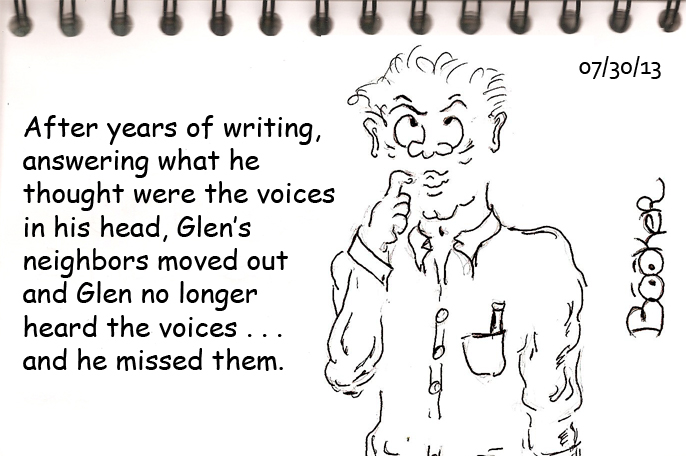
cARtOONSDAY: “a-mUSING vOICES”

You may never know  when the muse will come or when the muse will go.

You may never know
when the muse will come
or when the muse will go.

Leave a comment

Filed under cartoon by author, CarToonsday

Monday (morning) writing joke: “Dead again, ” part 1

In honor of all the zombie movies over the past year, and books about zombies and other dead creatures, here is the first of two or three “dead” jokes, puns, bits of humor. Groan as you see fit.

Q.: What do you call…

…a dead psychiatrist?

A.: A dead head.

…a dead musician?

A.: A dead beat.

…a dead twin bell musician?

A.: A dead ringer.

…a dead sailor?

A.: Dead lee

…a dead radio personality?

A.: Dead air

…a dead royal radio personality?

A.: Dead air apparent.

…a dead conservative?

A. Dead to rights

…a dead writer’s last sentence?

A. A deadline.

2 Comments

Filed under Monday morning writing joke

The Devil’s Dictionary: “Law,” part 1

A young Ambrose Bierce

A young Ambrose Bierce

In our continuing quest to revisit a classic, or even a curiosity from the past and see how relevant it is, we continue with The Devil’s Dictionary by Ambrose Bierce. Originally published in newspaper installments from 1881 until 1906. You might be surprised how current many of the entries are.

For example, here are definitions related to the law. The Old definitions are Bierce’s. The New definitions are mine or somebody else contemporary. The new definitions can also be simply examples of The Devil’s Dictionary definitions. From time to time, just as it was originally published, we will come back to The Devil’s Dictionary, for a look at it then and how it applies today. Click on Devil’s Dictionary in the tags below to bring up the other entries.

OLD DEFINITION:

APPEAL, v.t. In law, to put the dice into the box for another throw.

ARREST, v.t. Formally to detain one accused of unusualness.
God made the world in six days and was arrested on the seventh. –The Unauthorized Version

FORMA PAUPERIS. [Latin] In the character of a poor person–a method by which a litigant without money for lawyers is considerately
permitted to lose his case.

When Adam long ago in Cupid’s awful court
(For Cupid ruled ere Adam was invented)
Sued for Eve’s favor, says an ancient law report,
He stood and pleaded unhabilimented.
“You sue in forma pauperis, I see,” Eve cried;
“Actions can’t here be that way prosecuted.”
So all poor Adam’s motions coldly were denied:
He went away — as he had come — nonsuited.
G.J.

HABEAS CORPUS. A writ by which a man may be taken out of jail when confined for the wrong crime.

HANGMAN, n. An officer of the law charged with duties of the highest dignity and utmost gravity, and held in hereditary disesteem by a populace having a criminal ancestry. In some of the American States his functions are now performed by an electrician, as in New Jersey, where executions by electricity have recently been ordered—the first instance known to this lexicographer of anybody questioning the expediency of hanging Jerseymen.

HOMICIDE, n. The slaying of one human being by another. There are four kinds of homicide: felonious, excusable, justifiable, and praiseworthy, but it makes no great difference to the person slain whether he fell by one kind or another–the classification is for advantage of the lawyers.

NEW DEFINITION

APPEAL, v.t. In law, to put the dice into the box for another throw. If you have enough money, you can keep throwing until you get the role you want.

ARREST, v.t. Formally to detain one accused of unusualness or even being a little different.
God made the world in six days and was arrested on the seventh. –The Unauthorized Version

FORMA PAUPERIS. [Latin] In the character of a poor person–a method by which a litigant without money for lawyers is considerately
permitted to lose his case.

When Adam long ago in Cupid’s awful court
(For Cupid ruled ere Adam was invented)
Sued for Eve’s favor, says an ancient law report,
He stood and pleaded unhabilimented.
“You sue in forma pauperis, I see,” Eve cried;
“Actions can’t here be that way prosecuted.”
So all poor Adam’s motions coldly were denied:
He went away — as he had come — nonsuited.
G.J.

If you cannot afford an attorney in a crime case, one can be appointed for you. Of course, he or she might not be making much more money than you.

HABEAS CORPUS. A writ by which a man may be taken out of jail when confined for the wrong crime. How he was confined to begin with, one may never know given how long it might before the writ is written.

HANGMAN, n. An officer of the law charged with duties of the highest dignity and utmost gravity, and held in hereditary disesteem by a populace having a criminal ancestry. In some of the American States his functions are now performed by an electrician, as in New Jersey, where executions by electricity have recently been ordered—the first instance known to this lexicographer of anybody questioning the expediency of hanging Jerseymen.

A way of making a habeas corpus into a plain corpus.

Today this has been replaced in most states by injection. Contributes less to climate change (global warming) this way.

HOMICIDE, n. The slaying of one human being by another. There are four kinds of homicide: felonious, excusable, justifiable, and praiseworthy, but it makes no great difference to the person slain whether he fell by one kind or another — the classification is for advantage of the lawyers and certain segments of the media who present opinion reportedly under the guise of news.

Leave a comment

Filed under Devil's Dictionary

Photo Finish Friday: “Ditty”

Sometimes a little unincorporated Ditty is all you need.

Sometimes a little unincorporated Ditty is all you need.

Leave a comment

Filed under Photo by author, Photo Finish Friday