

“And this was a good idea, why?”
Sunlight crusts the sky /
crimping red and orange hues /
to the mountains’ edges.
Filed under Haiku to You Thursday, poetry by author
Follow top tips on writing from Scotland’s Makar Liz Lochhead

Makar Liz Lochhead
Here, Scotland’s Makar Liz Lochhead, our national poet, gives would-be writers some tips to tell us their story of home.
All the good advice about writing is very simple. So straightforward it’s all been said before but it’s probably worth reminding ourselves of it.
I know I have to tell myself all this and I have to do this every time I get going on something new.
1 Write what really interests you, not what you think you ought to be interested in.
2 The old five senses. See it, touch it, taste it, smell it, hear it. Turn yourself into it, said Ted Hughes, and then the words will look after themselves. Well, certainly I have to turn all my censors, inhibitors and ego, and false sense of myself as a writer, and certainly any attempts at cleverness, off – in the first draft at least.
See, it’s only when you read back what you have written down, tasting and testing the words as words and sounds, you can see where you have captured a bit of life in the language, an image, a wee detail – and that won’t be necessarily in the bit that felt like it flowed or had the fancy words, but often in the bit that you struggled over and in the end, och, just put down what would have to do for now.
3 Throw away all the bits that don’t have that bit of life in them, keep the surprisingly real or surprisingly honest and vivid bits, the bits that, to tell the truth, surprised you – maybe by their simplicity – and start again with them.
4 Don’t explain. You don’t have to give the reasons for going there or the co-ordinates on a map. Consider cutting off the beginning and the end paragraph or stanza of what you have written – and do this once you think it’s finished and cut down to the bone already.
Source and rest of the article at: http://www.dailyrecord.co.uk/news/scottish-news/follow-top-tips-writing-scotlands-3274256
[Editor’s note: In case you’re wondering, makar is Scottish for poet or writer.]
Filed under writing tip, Writing Tip Wednesday, writing tips
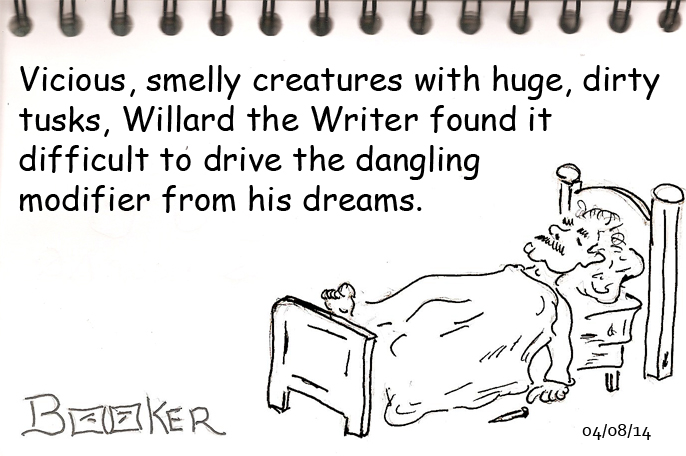
Dangling toes may or may not have anything to do with dangling modifiers.
Filed under cartoon by author, CarToonsday
C, E Flat, and G walk into a bar.
The bartender says, “Sorry, no minors.”
Filed under Monday morning writing joke
Myth About Harvard Book Made of Human Skin Debunked.

Sample:
Science: 1, Internet: 0.
For one reason or another—perhaps it was the flashy headline, or the gruesome mysterious details—a nearly decade-old story published by the Harvard Crimsonabout a collection of books at the university’s library, that are allegedly bound in human skin, crawled to the surface of the Internet this week. But unfortunately for the Internet, as the story started to regain traction officials from the school fleshed out the details of what really wraps at least some of the literature in their collection, and discovered it’s not human skin after all—it’s actually sheepskin. “Baaaaaad news for fans of anthropodermic bibliopegy (binding books in human skin): Recent analyses of a book owned by the [Harvard Law School] Library, long believed but never proven to have been bound in human skin, have conclusively established that the book was bound in sheepskin,” according to a post on the Harvard Library Law School’s blog, dated April 3.
http://www.bostonmagazine.com/news/blog/2014/04/03/harvard-book-made-of-human-skin/
Suggested by: Ashlie
Filed under book covers
20 Embarrassingly Bad Book Covers for Classic Novels – Flavorwire.

Source: http://flavorwire.com/378513/20-embarrassingly-bad-book-covers-for-classic-novels/view-all/
Filed under book covers

It takes a village to mulch a park.
Pick up a pitch fork and come pitch in.
Bring a rake — we’ll show where to begin.
Bring a wheelbarrow to move stuff around;
there are weeds to pull and mulch to lay down.
From 2 to 4 come down to ONK park.
We’ll work some, but not up to dark.
Stop by on Sunday with your pair of gloves
and show this little park a lot of love.
Filed under Photo by author, Photo Finish Friday, poetry by author
Rain plucks at the soil /
Thunder cackles through the clouds /
Earth’s face awakens.
Filed under Haiku to You Thursday, poetry by author
On Saturday, February 1, 2014, I took a workshop sponsored by the Knoxville Writers’ Guild (www.knoxvillewritersguild.org) and led by nationally published author Pamela Schoenewaldt (www.PamelaSchoenewaldt.com and on Facebook at https://www.facebook.com/pages/Pamela-Schoenewaldt/158580547517755?ref=tn_tnmn).

Answering questions beforehand could save you heartburn later.
The workshop was on character development. What you have below is the third of the three handout exercises from the workshop. The first one, “Who are you?” was posted two Wednesdays ago. The second one, “Conflict Worksheet” was posted last Wednesday.
Each previous worksheet / exercise could be done in ten minutes or less, and oftentimes not pondering too long is best. This worksheet may take a little longer, but like the others can be used for the both the protagonist and antagonist of the story or novel you are working on, or just about any character you want to use it on. It might also be helpful if writing a memoir or biography.
CHARACTER SKETCH EXERCISE
Answer without worrying about grammar or logic.
• NAME your character
• LEARN your character by considering these dimension (writing notes on each or most is ideal)
• REMEMBER that your goal is a rounded character (not all good or bad) with a capacity for moving action.
• SKIP dimensions which repeat information.
• BEWARE of main characters who are very young, psychotics, or whose condition severely restricts their capacity for change.
• KNOW everything about this person.
CHARACTER DIMENSIONS
1. Age, physical appearance and attitude to body.
2. Significant health issues.
3. Distinctive physical signs: scars, handicaps, beauties, tics, tattoos, gestures.
4. Manner of speaking (level of language, accent, peculiarities). Manner of dress.
5. Living situation (where, with whom, how living space reflects character).
6. Socio-economic level and attitude to this level (satisfied, indifferent, ambitious?).
7. Work/ profession/ main activity.
8. Performance in Work/ profession/ main activity.
9. Sexuality and relationship to it (fears, doubts, longings, obsessions).
10. Quality of childhood.
11. Current relationship with family – how does it affect the person?
12. Significant intimate relationships and how they reflect the person.
13. What friends does character have? Attitude to friends, their attitudes to him/her.
14. Significant interests, hobbies, passions, obsessions.
15. Religious/spiritual practice and faith.
16. Fundamental belief about life/self (“The most important thing is . . . “)
17. How does the way the character sees him/her self compare to others’ views of him/her?
18. Major strength (include hidden strengths which could be mobilized).
19. Major success/failure or secret of past. (Any significant patterns?)
20. Typical way of dealing with stress or crisis… (Does it work? Should it change?)
21. Major weakness and fear.
22. Ambitions and blocks to achievement.
23. Shaping force/person/event of past.
24. What is not working for your character now?
25. What would your character sacrifice or fight for?
26. Where does your character experience a major conflict in values?
27. Where does your character draw the line: s/he wouldn’t do this….
28. What might push your character up to the line?
29. What conflict, choice or crisis faces the character now?
Filed under Photo by author, writing tip, Writing Tip Wednesday, writing tips


