

Unable to go to sleep before a big anatomy test, the veterinary student got up and mapped out the horse bones … on the side of a horse.
Unable to go to sleep before a big anatomy test, the veterinary student got up and mapped out the horse bones … on the side of a horse.
Filed under Photo by author, Photo Finish Friday
Do not think too much! /
Hobgoblins of reason feast /
on broken headstones.
Filed under Haiku to You Thursday, poetry by author
The 5 C’s of Writing a Great Thriller Novel
By James Scott Bell
Remember when Tommy Lee Jones holds up the empty shackles in The Fugitive and says, “You know, we’re always fascinated when we find leg irons with no legs in ’em”? It makes me think of readers who pick up thrillers and find no thrills in them. Or at least not as many as there could be.
I’m not just talking about plot here. It’s possible to have guns and bombs and hit men and terrorists and black helicopters and still not have a novel that grips the reader in the gut.
For a healthy, fully functioning thriller, try some literary vitamin C. Dose your book with these five Cs and it will stand strong, chest out, ready to give your reader a run for the money.
1. Complex Characterizations
The first place to fortify a thriller is its cast of characters. A critical mistake made here can undermine even the best story concept.
Is your protagonist all good? That’s boring. Instead, the thriller hero needs to struggle with issues inside as well as outside. She’s got to be a carrier of flaws as well as virtues. These roiling conflicts make her survival an open question.
When we first meet Detective Carol Starkey in Robert Crais’ Demolition Angel, she’s flicking her cigarette ash on the floor of a therapist’s office, “pissed off” because it’s been three years and her demons are still alive and well. Quite an introduction, especially for someone on the LAPD bomb detail. We know she has a short fuse. And we want to watch to see if it goes off.
Brainstorm a list of at least 10 inner demons your hero has to fight. Ten. Get creative. Then choose the best one. Work that demon into your hero’s backstory, and show how it is affecting him in the present—and could hinder him even further in the future. Give him actions that demonstrate the flaw.
…
2. Confrontation
I call the main action of a novel the confrontation. This is where the hero and antagonist battle over the high stakes a thriller demands.
When it comes to the antagonist, writers can easily make the opposite of the “all-good protagonist” mistake: They make their bad guy all bad. Worse, they make him all bad because he’s crazy.
More interesting confrontations come from a villain who is justified in what he does.
You mean, in doing evil things?
Yes, that’s exactly what I mean—in his own mind, that is. How much more chilling is the bad guy who has a strong argument for his actions, or who even engenders a bit of sympathy? The crosscurrents of emotion this will create in your readers will deepen your thriller in ways that virtually no other technique can accomplish. The trick is not to overdo it—if you stack the deck against your villain, readers will feel manipulated.
Start by giving your antagonist just as rich a backstory as your hero. What hopes and dreams did he have? How were they dashed? What life-altering hurt did he suffer? Who betrayed him? How did all of this affect him over the course of his life?
…
Learn more about these two and the other three Careening, Coronary, and Communication at: http://www.writersdigest.com/online-editor/the-5-cs-of-writing-a-great-thriller-novel?et_mid=672637&rid=239626420
Filed under writing tip, Writing Tip Wednesday, writing tips
It is the first weekend of the month and time again for a new word to live. This is a word or phrase not currently in use in the U.S. English lexicon, but might need to be considered. Other words, such as obsurd, crumpify, subsus, flib, congressed, and others, can be found by clicking on the tags below. Today’s New Word is a merging of two words: quagmire and muffin. Without further chattering trumpmuffin is the new word for this month:
Trump, v. to surpass, outdo, excel.
Muffin, n. small, cup-shaped quick breads made with cornmeal, wheat flour, or something similar and baked in a muffin pan creating a series of cuplike breads. Slang., an “attractive” person. Example:, a stud muffin = attractive male.
Trumpmuffin, n. 1) a person who feels the need to outdo the previous person. Example: tell the biggest fish story. 2) a person who has to get the last word in. 3) a person who has to get the last word in regardless of being right or wrong, and is often wrong. Example: Donald Trump is a trumpmuffin (particularly when you consider his hair) regardless of whether he is right or wrong when he speaks.
Use in a sentence: “Don is such a trumpmuffin,” Gail said, getting in the last word in her group of friends.
Filed under new word, New words to live by
Drift in uncertain /
waters engulf all I am /
here tentatively.
Filed under Haiku to You Thursday, poetry by author

“Dear Willard, we the undersigned characters of your novel Ground Out have decided to move in another direction and no longer require your services….”
Filed under cartoon by author, CarToonsday
First writer: All my characters have a certain look.
Second writer: And what look is that?
First writer: The one they give me every time I try to get them to do something.
Filed under Monday morning writing joke
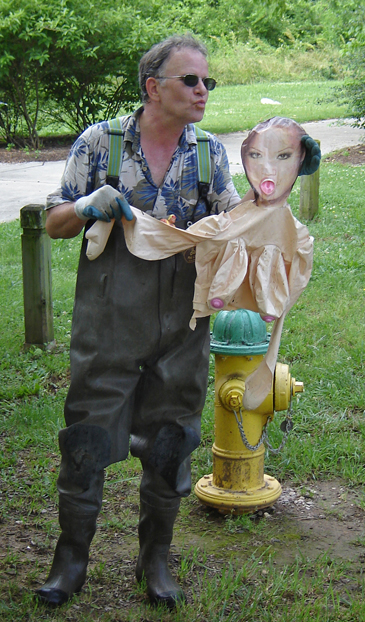
Sometimes, a relationship just doesn’t hold together.
The man in the waders
by David E. Booker
The man in waders
met the woman in half.
When others saw them,
they thought they were daft.
They met at the creek,
down by the water’s edge.
It was a salvage operation
of the heart it is said.
She could not say
where her lower half went.
Like a little mermaid
she was half woman, half rent.
The relationship didn’t last.
Alas it is said,
the fact she had no bottom
went straight to his head.
Filed under Photo by author, Photo Finish Friday, poetry by author
The weeds are at home /
nestled in the greening grass. /
Motley blooms my yard.
Filed under Haiku to You Thursday, poetry by author
5 Tips for Finding Your Content Writing Niche
By Ellen Miller
Source: http://www.skyword.com/contentstandard/for-writers/5-tips-for-finding-your-content-writing-niche/
Pretend you just contracted a strange illness that caused your hands to turn purple. You go see your doctor, and he refers you to another doctor that specializes in curing weird hand pigment diseases. You breathe a huge sigh of relief, knowing that you’ve found the perfect person to solve this very unsightly issue.
In that way, brands are a lot like patients. They have specific content writing needs and want to find writers who can do the best job meeting them.
What we’re talking about here is a content writing niche. In a recent piece on personal branding, I addressed the importance of identifying your niche with a quote from John Gordon: “Experts are not called upon because they are the smartest person in every room; they are called upon because they are the smartest person in a specific room.”
Finding your niche, or your areas of expertise, will do wonders for your personal brand and your wallet. That’s because brands aren’t just looking for good writers; they’re looking for good writers with very particular areas of expertise. By carving out a content writing niche and becoming a subject matter expert, you’ll see more freelance job opportunities and higher paychecks.
So, how does one go about figuring out their niche? Here are five ways to get started:
Leverage Your Experience
If you have a day job, or used to work in a particular industry, you can leverage that experience to your advantage. And be creative! Let’s say you worked at a Verizon store, where you sold customers mobile devices and accessories. That kind of experience can give you authority on a range of topics: consumer mobile technology, technology retail, contract sales, retail management, window displays, and more. List out topics you know about from jobs, hobbies, and school, and then identify the ones that get you most excited. If you’re not passionate about the topic, it’s probably not the niche for you.
Be Specific
Let’s say you want your content writing niche to be “finance.” That’s a good place to start, but there are millions of other writers out there doing the same thing. So force yourself to be more specific. “Living on a budget” is a step in the right direction. Even better: “Living on a budget in college.” The more specific you get (within reason), the more likely you are to be a top choice for brands and recruiters. This list gives you a sense of the type of specificity to shoot for, and might even inspire you to find your niche.
Other recommendations include: Align with an Industry, Think About Your Audience, and Listen.
Details at: http://www.skyword.com/contentstandard/for-writers/5-tips-for-finding-your-content-writing-niche/
Filed under writing tip, Writing Tip Wednesday, writing tips


